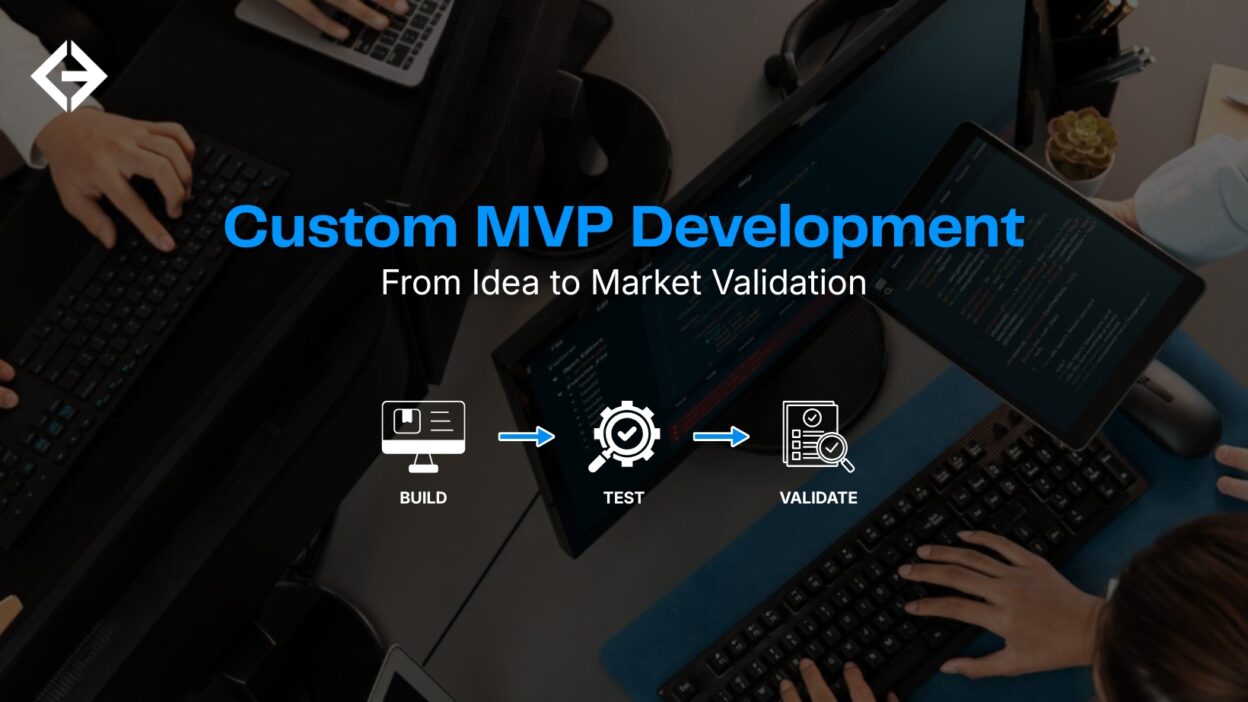
Custom MVP development services take a raw product idea and turn it into a working, testable product through structured PoC and MVP builds, covering discovery, UI/UX prototyping, development, QA, and launch. Most MVPs cost $15,000-$80,000 and ship in 8-14 weeks, letting founders validate with real users before committing a full build budget.
Key Takeaways:
- An MVP is the smallest version of your product real users can actually use, built to prove demand, not perfection.
- Realistic budgets run $15,000-$80,000 for most startups; regulated industries add a 20-40% compliance premium.
- Typical timelines are 8-14 weeks; AI-assisted development now compresses builds by 40-60%.
- Teams that invest 20% of budget in pre-development discovery are 3x more likely to build a successful product.
- The right consulting partner talks about validation and learning, not just features and billable hours.
📊 Contact Our Experts for a Free Tech Review
The most expensive mistake in product development is not a bug. It is spending six months and six figures building something in isolation, then discovering the market never wanted it. Roughly a third of startups fail on exactly that pattern, and every one of them could have learned the same lesson in ten weeks at a fraction of the cost.

What Custom MVP Development Services Actually Include
A real MVP engagement is a launch system, not a coding contract. The service spans four phases: discovery and scoping (validating the problem, defining the core feature set, planning architecture), design and prototyping (wireframes and interactive mockups tested before code), development and QA (the build itself, with testing throughout), and launch with post-release iteration.
“Custom” matters here. Template builds are cheap until your differentiating feature does not fit the template. A custom MVP development services are architected around your specific value proposition, so the codebase can scale into Version 2 instead of being thrown away after validation.
The consulting layer is what separates strong partners from code shops. Good MVP consultants push back on scope, ask “can we launch without this?” for every feature, and design the build around the assumption you are actually testing.
What an MVP Costs and How Long It Takes
| MVP Type | Typical Cost | Timeline | Main Cost Driver |
| Landing page / validation MVP | $2,000-$10,000 | 1-3 weeks | Design and messaging |
| Simple web app | $15,000-$40,000 | 6-10 weeks | Core feature loop, auth, database |
| SaaS dashboard MVP | $30,000-$80,000 | 8-14 weeks | Multi-tenancy, billing, roles |
| Marketplace platform | $30,000-$80,000+ | 12-20 weeks | Two-sided logic, payments, matching |
| AI-powered MVP | $40,000-$100,000+ | 10-24 weeks | Model integration, data pipelines |
Two variables move these numbers most: feature scope and team location. A senior developer in the US bills $150-$250 per hour; the same seniority offshore runs $25-$75. That gap alone often halves the total budget without touching quality.
Budget beyond launch too. Annual maintenance runs 15-20% of the build cost, and the post-MVP iteration phase (building what user feedback actually demands) typically adds 30-50% of the original budget.
5 Practices That Keep MVP Budgets Under Control
Run a discovery sprint first: A $5,000 scoped specification prevents the most expensive mistake in software: building the wrong thing. Vague requirements at week one become rework invoices at week ten.
Cut features against the core assumption: If a feature does not directly test whether users want your product, it belongs in Version 2. Scope creep is the top reason MVPs blow their budgets.
Use existing components: Auth0 for login, Stripe for payments, SendGrid for email. Off-the-shelf services save $20,000-$55,000 per build and cut weeks off the timeline.
Go cross-platform, not native: Flutter or React Native delivers near-native performance for 30-40% less than building iOS and Android separately.
Do not compress the timeline artificially: Crushing a four-month build into two months raises the budget 20-40% and the defect rate with it. The bottleneck is decision-making, not typing speed.
Where PoC Fits Before the MVP
For technically risky ideas, especially AI products, there is a step before the MVP: the proof of concept. A PoC answers “can this actually be built?” before the MVP answers “will anyone use it?” Skipping it means betting your full build budget on an unverified technical assumption. To see how the two stages connect and when each one applies, read our complete guide on PoC development services bridging the gap between idea and MVP before scoping your build.
AB Ark’s Vocaliv engagement shows the full arc from validated concept to shipped product. The client needed to prove that AI could genuinely reduce trainer workload for training institutes; the team built and launched a platform with AI-powered lesson planning, voice-based content creation, automated quizzes, and 24/7 student support, now serving training providers in production (full case study). That idea-to-launch pattern, repeated across hundreds of clients over 15K+ working hours by an 80+ person team at a 99-100% job success rate, is the consulting depth the “custom” in custom MVP development services are supposed to mean.
How to Choose an MVP Development Partner
Ask for MVP-specific case studies, not an enterprise portfolio; teams optimized for Fortune 500 platforms operate nothing like teams optimized for lean startup builds. Demand milestone-based pricing with a line-by-line statement of work, and confirm what post-launch support costs before development starts.
Then listen to how they talk. A partner focused on validation, iteration, and what you will learn from launch is building your business. A partner focused only on features and hours is billing it.

Frequently Asked Questions
What is MVP development Services?
MVP (Minimum Viable Product) development services help businesses design, build, and launch a basic version of a product with core features to validate ideas, gather user feedback, and reduce development risk.
What is MVP in service design?
In service design, an MVP (Minimum Viable Product) is the simplest version of a product or service with essential features, created to test ideas, validate customer needs, and gather feedback before full-scale development.
How much does MVP development cost?
Most startup MVPs cost $15,000-$80,000, with simple web apps at the low end and AI-powered or marketplace products at the high end. Regulated industries like healthcare and fintech add a 20-40% compliance premium.
How long does it take to build an MVP?
Simple MVPs ship in 5-8 weeks, standard SaaS products in 8-14 weeks, and complex AI-powered builds in 3-6 months. AI-assisted development has compressed these timelines by 40-60% versus traditional cycles.
What is the difference between an MVP and a prototype?
A prototype is a visual mockup that shows how the product would look but does not function; an MVP is a real, working product customers can use and pay for. Prototypes validate design and pitch investors; MVPs validate the business.
The founders who win are not the ones who build the most. They are the ones who learn the fastest, and a disciplined MVP is the fastest learning tool that exists.
👉 Book Your 1-on-1 Engineering Strategy Session

Syed Ahmad Ali is a tech writer at AB Ark with a knack for turning complex ideas into easy reads. He writes across a range of topics, but AI, software development, and the business of tech sit right at the top of his list.