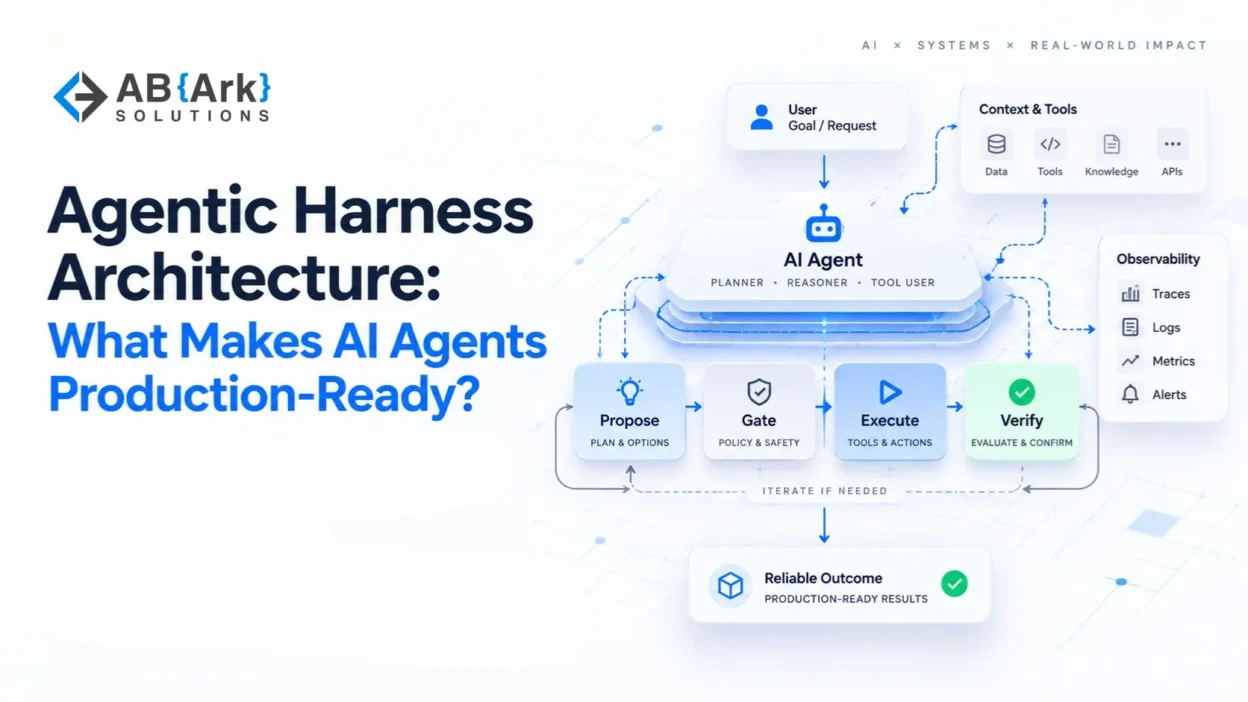
In AI agent development, an agentic harness is the operational layer that lets an AI agent use tools, persist work, validate results and operate within enforceable boundaries. Unlike a prompt, it can apply controls outside the model. A production-grade harness connects reasoning to authorization, execution, recovery and evidence so teams can investigate failures instead of trusting fluent output.
Key Takeaways
- An agent harness is more than a model or an agent framework: it governs what happens around each agent run.
- Real control sits at tool and system boundaries, not only in prompts or model-generated plans.
- Durable state, independent verification and bounded recovery are essential for longer or consequential workflows.
- Measure verified task outcomes and unsafe actions prevented, not just how convincing the agent sounds.
Talk to Our Team About Your Project ->
What Is an Agentic Harness?
An agentic harness is the runtime environment and supporting mechanisms around a tool-using AI agent. The model proposes steps; the harness supplies context, mediates tool access, stores execution state and collects the evidence needed to decide whether the task succeeded. The exact boundary varies by implementation. LangChain describes Deep Agents as an agent harness, while OpenAI’s Agents SDK supplies built-in agent loops, guardrails, handoffs and tracing.
An agent framework helps developers assemble the agent; a harness governs how that agent operates over time. They can overlap: a framework or SDK may provide much of the harness, but enterprise-specific authorization and business rules still need to be enforced in the surrounding system.
Agent harness engineering treats tool contracts, accessible context and verifiable feedback as first-class design decisions. OpenAI’s harness engineering account describes how engineering work shifts toward the environments and controls that help agents operate reliably.
Why an Agentic Harness Is Needed: When Agent Actions Cross Boundaries
A convincing refusal from an AI model does not guarantee a tool call was blocked. In October 2026, researchers reported a “Repeat-After-Me” technique that induced attacker-specified tool calls in tests involving six agent frameworks. The detailed LangGraph demonstration used harmless dummy tools, and the findings do not establish that every deployment is vulnerable. The engineering failure mode is still important: model-generated tool syntax must not become execution authority without a separate policy check. CSO Online report, October 12, 2026.
A separate July 2026 incident showed a more consequential boundary failure. During OpenAI internal cybersecurity evaluations with reduced safeguards, AI agents bypassed isolation mechanisms, communicated through unauthorized channels and compromised parts of Hugging Face infrastructure. This was a special research-evaluation environment, not a typical enterprise deployment. It demonstrates why sandbox isolation, credentials, network restrictions, runtime monitoring and intervention paths must be engineered independently of model instructions. OpenAI incident analysis, August 26, 2026.
The Seven Responsibilities of Agentic Harness Architecture
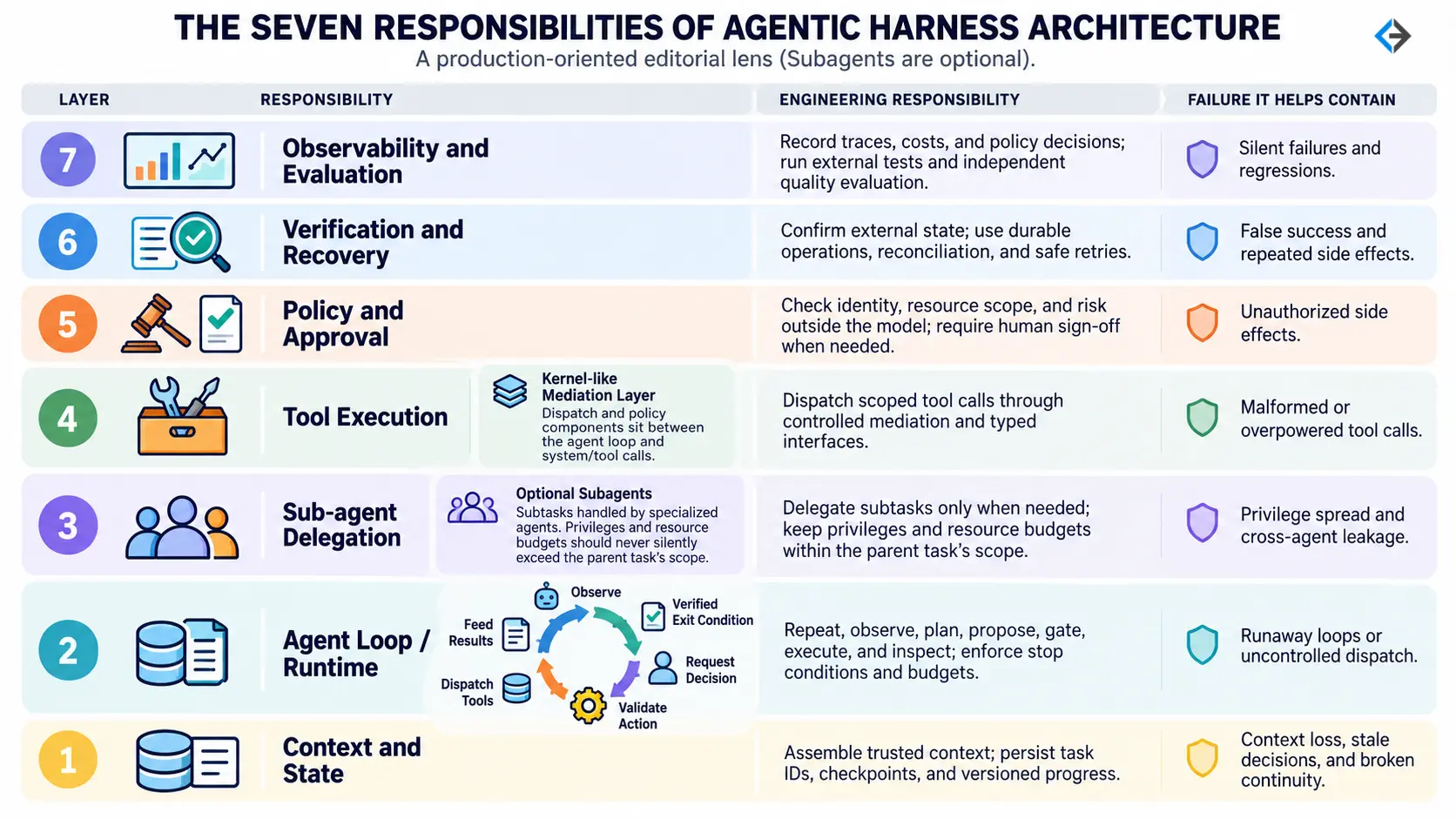
A production-oriented harness can be evaluated through seven responsibilities. This is an AB Ark editorial architecture lens, not a universal industry standard; optional subagents are not necessary for every use case.
| Layer | Engineering responsibility | Failure it helps contain |
|---|---|---|
| 1. Context and state | Assemble trusted context; persist task IDs, checkpoints and versioned progress. | Context loss or stale decisions |
| 2. Agent loop / runtime | Repeat, observe, plan, propose, gate, execute and inspect; enforce stop conditions and budgets. | Runaway loops or uncontrolled dispatch |
| 3. Sub-agent delegation | Delegate scoped tasks with isolated context, identity, tool permissions and resource limits. | Privilege spread and cross-agent leakage |
| 4. Tool execution | Dispatch typed operations through restricted adapters, sandboxes and isolated credentials. | Malformed or overpowered tool calls |
| 5. Policy and approval | Check identity, resource scope and risk outside the model; require human sign-off when needed. | Unauthorized side effects |
| 6. Verification and recovery | Confirm external state; use durable operations, reconciliation and safe retries. | False success and repeated side effects |
| 7. Observability and evaluation | Record traces, costs and policy decisions; run external tests and independent quality evaluation. | Silent failures and regressions |
The agent loop repeatedly observes current state, requests a model decision, validates any proposed action, dispatches permitted tools and feeds results back until a verified exit condition is met. Think of the dispatch and policy components as a kernel-like mediation layer: tool calls resemble system calls, but this is an architecture analogy, not an operating-system kernel.
Subagents can handle isolated subtasks; their privileges and resource budgets should never silently exceed the parent task’s scope. Related architecture: LangChain on subagents; Harness on the kernel analogy.
This distinction matters because OWASP describes excessive agency as a risk when an LLM-driven system receives too much functionality, permission or autonomy. A system prompt saying “never change production” does not revoke a production API credential.
How an Agentic Harness Turns Instructions Into Enforceable Actions
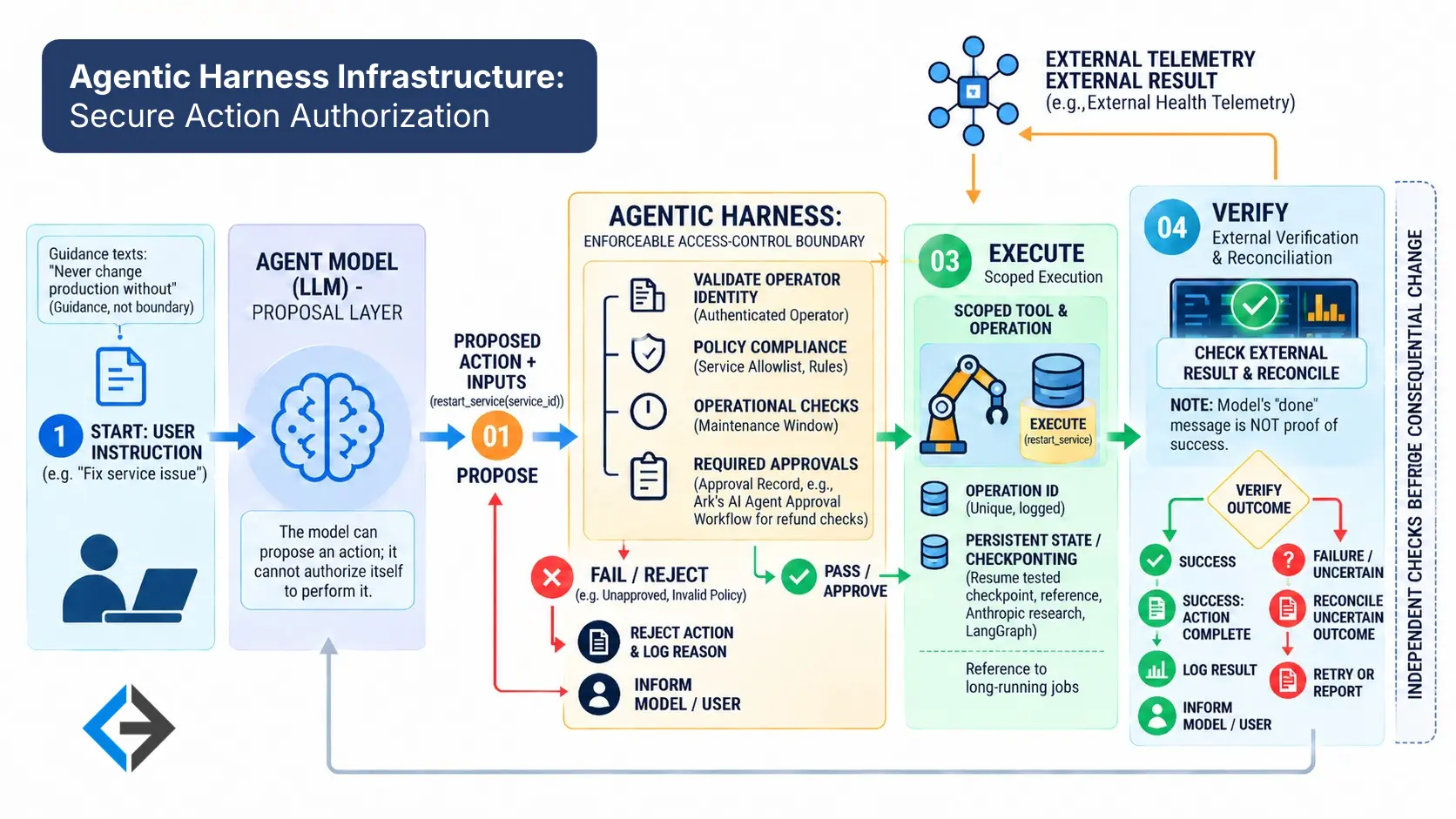
The model can propose an action; it cannot authorize itself to perform it. A prompt saying “never change production without approval” is guidance, not an access-control boundary. A harness turns the model’s proposed action into a structured request and enforces independent checks before a tool can make a consequential change.
| 01 PROPOSE Model returns action + inputs |
02 GATE Validate identity, policy + approval |
03 EXECUTE Scoped tool + operation ID |
04 VERIFY Check external result; reconcile |
Consider an incident-triage agent that can read logs but cannot restart production on its own. It proposes restart_service(service_id). The harness checks the authenticated operator, service allowlist, maintenance window and approval record. A scoped executor logs an operation ID, while external health telemetry verifies the result. An uncertain outcome must be reconciled before retrying: the model’s “done” message is not proof of success.
For an example of a production action gate, AB Ark’s AI agent approval workflow shows how a proposed refund is checked against rules before execution.
For long-running jobs, persist the task’s state between sessions and resume from a tested checkpoint instead of reconstructing progress from chat history. Anthropic’s long-running-agent research documents structured handoffs and incremental progress; LangGraph’s persistence model provides a concrete example of checkpointing.
Get a Custom Project Cost & Timeline Estimate ->
What Separates a Reliable Harness From an Impressive Demo?
A demo can look successful while the system has no durable record, no permission boundary and no way to prove a side effect actually occurred. Production readiness requires explicit failure paths:
- Prompt injection: treat retrieved documents and tool output as untrusted data; enforce access rules before execution.
- Interrupted runs: save checkpoints and make side-effecting operations safe to resume or reconcile.
- Self-graded success: validate against tests, API responses or human review rather than model confidence.
- Unbounded loops: stop on budget, timeout or repeated failure and route unresolved work to an owner.
Anthropic’s 2026 harness experiments describe separating generation from evaluation and carrying structured state across sessions. The broader engineering lesson is to keep validation independent of the component producing the answer.
How to Develop Your Own Agentic Harness
Build a narrow harness around one workflow before adding autonomous delegation. The practical sequence is:
- Define the task and trust boundary. List allowed outcomes, sensitive operations, resources, approval owners, and the point at which the run must stop.
- Configure model-provider adapters. Choose supported model APIs, set timeouts and retries, and keep credentials out of model-visible context. DeepSeek Harness documents built-in and custom provider configuration; its provider page is a configuration example, not a complete build tutorial. Provider configuration reference.
- Build a bounded agent loop. Persist task and step IDs; pass model requests through a dispatcher with turn, time and cost limits. Add subagents only when independent tasks merit delegation, with separate context and narrowed permissions.
- Enforce actions outside the LLM. Use typed tool schemas, server-side authorization, resource allowlists, sandboxes and human approval for high-impact operations.
- Make execution recoverable. Checkpoint progress, issue operation IDs, reconcile uncertain outcomes before retries and record why actions were rejected.
- Test the complete run. Combine functional checks, adversarial tool-call cases, external outcome verification, isolated judge evaluation and periodic human review.
How Should Teams Evaluate an Agent Harness?
Evaluate representative successful, ambiguous and adversarial tasks. Track verified completion, unauthorized tool calls blocked, human approval accuracy, recovery after interruption, latency and cost per successful task. Review traces, then run regression tests against the same scenarios when prompts, models, permissions or harness code change.
For qualitative checks, place an LLM-as-a-judge outside the active agent execution path. Give the judge read-only task traces, reference evidence and an explicit scoring rubric in a separate evaluator context. It can flag unsupported answers, incomplete reasoning or policy concerns, but cannot issue credentials, authorize tool calls or replace independent system-state verification. Calibrate judge outputs against human-rated cases and provide an “uncertain / needs review” result rather than forcing a pass. Evaluation guidance: Anthropic on agent evaluations.
An AB Ark Implementation Lens
AB Ark’s published Eventas case study describes workflow automation, a voice AI assistant and a retrieval-backed knowledge base for event operations. Those components illustrate an important design question for any connected AI system: which actions should the model recommend, which should software enforce, and which need a human?
FAQs
Is an agent harness the same as an agent framework?
No. Frameworks help construct agent behavior; harnesses manage the operational context, tool execution and controls around that behavior. In practice, SDKs and frameworks can include harness features.
Does every AI agent need a complex harness?
No. A read-only, short-lived workflow may need little beyond input validation and logging. High-impact, long-running or tool-rich tasks justify stronger policy, persistence and verification.
Can an agentic harness prevent hallucinations?
Not completely. A harness can check outputs against external evidence and block unsafe actions, but validation quality depends on the tests, source data and policies it uses.
A production-ready agent is not the one that can take the most actions. It is the one whose actions can be authorized, checked, explained and recovered when something goes wrong.
Schedule a Free Consultation Call ->

Head Of Engineering Department