

Your first AI budget should go to the AI use case with a measurable business outcome, data you already have and can use, a named owner who will change the process, and a small enough scope to show results within one or two quarters. Rank candidates on value, feasibility, data readiness and risk, remove any that fail a readiness check, and fund the highest-scoring one as a time-boxed pilot with a pre-agreed success metric.
Key takeaways
- The most exciting AI use case is rarely the right first one. The first project’s job is to prove value and build delivery capability, so feasibility should weigh as much as ambition.
- Score every candidate on the same weighted criteria, so a finance idea and a customer-service idea compete fairly.
- Apply hard disqualifiers before scoring: no accessible data, no business owner, no measurable outcome or unacceptable risk means not yet, whatever the score.
- Agree the success metric, baseline and stop criteria before spending, not after the pilot.
- Treat high-value use cases that fail readiness as investments in preconditions, such as data clean-up, rather than as rejected ideas.
Why the first AI use case matters so much
The first AI use case a company funds sets expectations for every AI project after it. If it stalls, budget holders conclude that AI does not work for the business; if it delivers a visible, measured result, it earns the funding and trust for harder projects. Choosing it is therefore a portfolio decision, not just a technology decision.
The evidence shows how often the choice goes wrong. Gartner predicted that at least 30% of generative AI projects would be abandoned after proof of concept by the end of 2025, citing poor data quality, inadequate risk controls, escalating costs or unclear business value (press release, July 2024). For agentic AI, Gartner has since predicted that over 40% of agentic AI projects will be canceled by the end of 2027 for similar reasons: escalating costs, unclear business value or inadequate risk controls (press release, June 2025).
Those failure causes map directly onto prioritisation criteria:
| Reason AI projects are abandoned (Gartner) | What it means at selection time | Criterion that catches it |
|---|---|---|
| Unclear business value | No agreed metric, baseline or owner for the outcome | Business value, scored only against a named, measurable metric |
| Poor data quality | The data needed is missing, scattered, unlabelled or inaccessible | Data readiness, checked before scoring |
| Escalating costs | Scope grows, or running costs at full volume were never estimated | Cost to value, including run costs after the pilot |
| Inadequate risk controls | Errors would harm customers, money or compliance, with no human checkpoint | Risk, with a hard disqualifier for unacceptable risk |
Each of these causes can be checked before any code is written, which makes structured prioritisation one of the cheapest controls a company has.
The AI use case prioritisation matrix
The simplest way to see a shortlist is a 2×2 matrix: business value on one axis, ease of delivery (feasibility, data readiness and time to value) on the other. Each quadrant implies a different funding decision, and only one quadrant is the right home for a first budget.
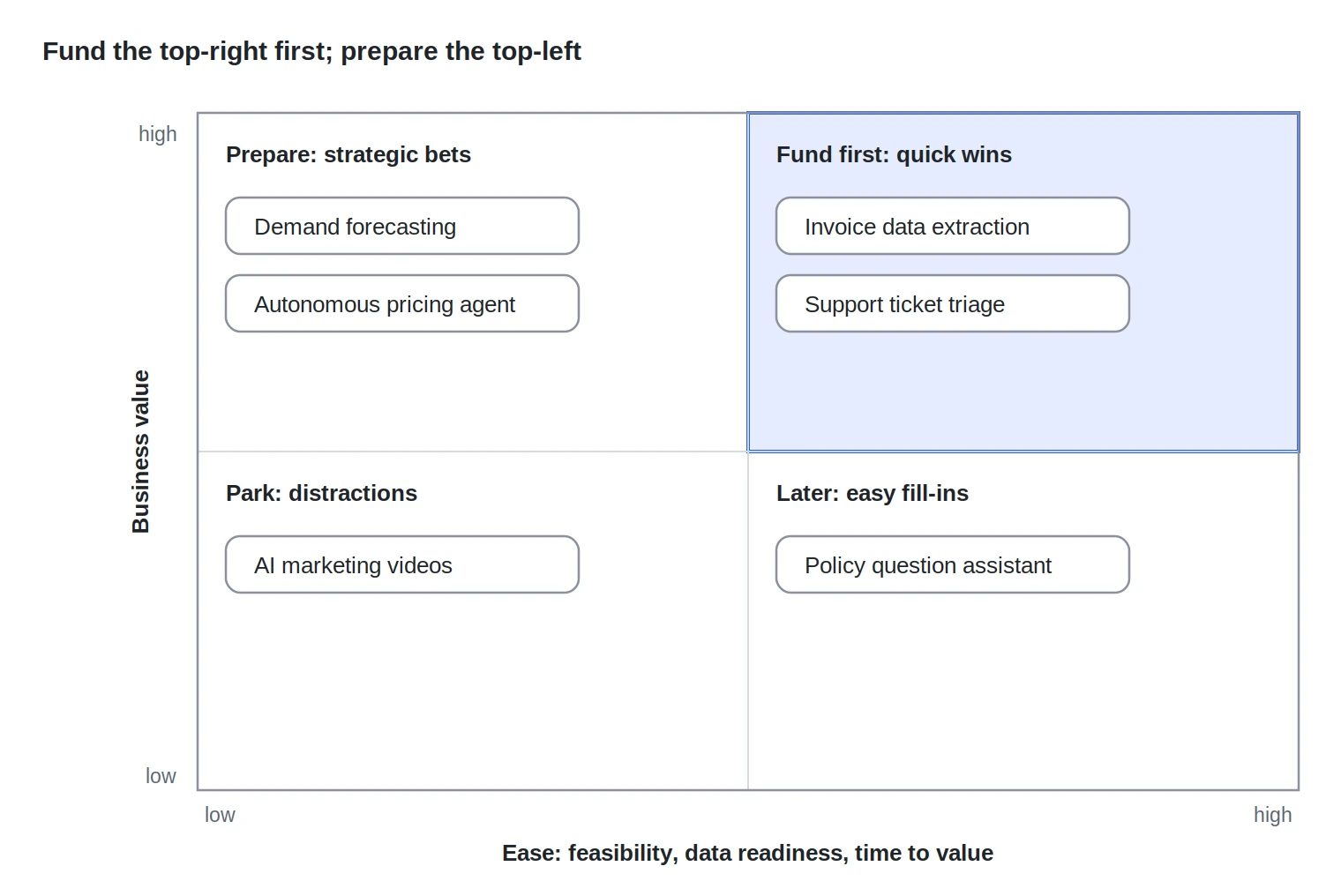
AI use case prioritisation matrix · value against ease, six example use cases
The six use cases plotted are the illustrative examples scored in the next section. A matrix drawn by hand drifts toward the loudest sponsor’s favourite, so use it to show the result of the weighted scores, not to replace them.
How to score AI use cases: the AB Ark first-budget scorecard
The AB Ark first-budget scorecard rates each candidate AI use case from 1 to 5 on five criteria, multiplies by a weight and adds the results. Weights favour feasibility and data readiness more than most enterprise frameworks, because a first project has to succeed to unlock the second. These weights are AB Ark’s editorial defaults, not a validated benchmark; adjust them, then keep them fixed across all candidates.
| Criterion | Weight | Score 1 | Score 5 |
|---|---|---|---|
| Business value | 30% | No measurable outcome, or a nice-to-have | A named metric with a baseline, owned by a budget holder (cost, revenue, cycle time, error rate) |
| Technical feasibility | 20% | Unproven approach, many integrations, real-time constraints | Proven AI pattern (extraction, classification, drafting, search) with few integrations |
| Data readiness | 20% | Data missing, scattered or not permitted for this use | Clean, accessible, permissioned data already in use |
| Time to value | 15% | More than 12 months to a measurable result | A measurable result within one quarter |
| Risk (5 = lowest) | 15% | Errors cause financial, legal or customer harm with no human check | Errors are low-impact or always reviewed by a person |
Worked example: six candidate AI use cases
The example below is illustrative, for a mid-sized company; it is not a client case. Scores are in the order value, feasibility, data, time, risk.
| Candidate AI use case | Scores | Weighted score | Reading |
|---|---|---|---|
| Invoice data extraction for accounts payable | 4, 5, 4, 5, 4 | 4.35 | Fund first: proven pattern, data exists, result within a quarter |
| Support ticket triage and draft replies | 4, 4, 4, 4, 4 | 4.00 | Strong second; can run in parallel if the team has capacity |
| Demand forecasting for inventory | 5, 3, 2, 2, 4 | 3.40 | High value, low data readiness: fund data clean-up first |
| Internal policy question-answering assistant | 2, 4, 3, 4, 4 | 3.20 | Easy but low value; good for a later quick deployment |
| Autonomous pricing agent | 5, 2, 2, 1, 1 | 2.60 | Strategic bet; fails the risk check until controls exist |
| AI-generated marketing videos | 2, 2, 3, 2, 3 | 2.35 | Low value, high effort: park it |
Two lessons stand out in this example. The highest-value ideas, here demand forecasting and autonomous pricing, rarely score highest overall, because value without readiness does not deliver in the first year. And near-ties, like the top two here, should be broken by the strength of the business owner and how visible the result will be to budget holders.
For real-world examples of where AI and automation projects typically start, see AB Ark’s guide to top use cases for an AI and automation service.
Disqualifiers: five checks before any AI use case is scored
A high score should never override a missing precondition. Run these five checks first; a use case that fails any of them is not rejected, but it is not ready for budget yet.
| Check | Passes when | If it fails |
|---|---|---|
| Named business owner | One person with budget authority will own the outcome and change the process | Find a sponsor, or drop the idea |
| Measurable outcome | The success metric, its current baseline and the target are written down | Measure the baseline before going further |
| Accessible data | The data exists, the team can reach it, and you are permitted to use it for this purpose | Fund a data access or clean-up project first |
| Acceptable risk | The worst plausible error is tolerable, or a human checkpoint can catch it | Redesign with human review, or narrow the scope |
| Process to act on output | Someone will use the AI’s output in a real workflow, not just view a dashboard | Design the workflow change before the model |
The last check is easy to overlook. An AI model that produces accurate predictions delivers nothing if no process changes because of them; adoption is part of the use case, not a phase after it.
Use cases that fail on data or risk but score highly on value deserve a different kind of budget: a smaller investment in the preconditions, such as data pipelines, access governance or approval workflows, that will make them viable later.
How to fund and run the first AI use case
Fund the first AI use case in stages, releasing money only when the previous stage meets its agreed criteria. Staged funding keeps the downside small and gives budget holders a clear decision point, which addresses the “escalating costs” and “unclear value” causes of abandonment directly.
| Stage | What it proves | Exit criteria agreed up front |
|---|---|---|
| 1. Discovery (short, fixed scope) | The data is accessible and the process can change | Baseline measured; data sample reviewed; owner signed off on the target metric |
| 2. Proof of concept | The AI approach works on real data | Accuracy or quality threshold met on a held-out sample; error types understood |
| 3. Pilot in the live workflow | People use it and the metric moves | Target metric improved against baseline for a defined group and period; running cost per transaction known |
| 4. Scale | It holds up at full volume | Monitoring, support and ownership in place; cost at full volume within the business case |
Three rules keep the first project on track:
- Write stop criteria as well as success criteria. Decide in advance what result would end the project, so a weak pilot is closed rather than extended indefinitely.
- Budget for running costs, not only build costs. Model inference, monitoring, human review and retraining continue after launch; estimate them at full volume before approving stage 4.
- Report the result in the owner’s metric. Hours saved, errors avoided or revenue protected land with budget holders; model accuracy alone does not.
When the first use case succeeds, re-run the scorecard. The data, integrations and team skills it built can raise the feasibility and data scores of related use cases, which is how a portfolio grows from one project rather than from many parallel experiments.
If you want an outside view on your shortlist, AB Ark’s custom software development team can run a short discovery on your top-scoring use case and estimate the pilot.
Frequently asked questions
What is an AI use case?
An AI use case is a specific business task where AI performs or supports the work, defined by who uses it, what task it handles, what data it relies on and what outcome it should improve. “Extract invoice fields for accounts payable to cut processing time” is a use case; “use generative AI” is not, because it cannot be scored or measured.
How do you prioritise AI use cases?
List candidate AI use cases in a consistent format, remove those that fail basic readiness checks (owner, measurable outcome, data, risk, workflow), then score the rest on weighted criteria such as business value, feasibility, data readiness, time to value and risk. Fund the top scorer as a staged pilot with agreed success and stop criteria.
Should the first AI project be a quick win or a strategic bet?
For most organisations, the first AI project should be a quick win with clear value: high feasibility, ready data and a measurable result within a quarter. Strategic bets are better funded once the organisation has shown it can deliver one AI project into a live workflow, and once the data and controls they need are in place.
How many AI use cases should we fund at once?
Start with one, or two if they share data or a team and you have the capacity. Running many pilots in parallel spreads skills and attention thinly, and makes it harder to attribute results. Add use cases as earlier ones reach the pilot stage.
Who should be involved in AI use case prioritisation?
Involve the business owners who would run each use case, someone who understands the data, a technical lead who can judge feasibility, and a person responsible for risk, security or compliance. Finance should agree how value will be measured before scoring, so the final ranking is accepted by budget holders.
The decision in brief
The AI use case that deserves your first budget is the one that passes every readiness check and scores highest on a weighted scorecard that values feasibility as much as ambition. In practice that is usually a proven AI pattern, such as extraction, classification or drafting, applied to data you already have, owned by someone who will change the process and measured against a baseline. Fund it in stages, prove it in the live workflow, then let what it builds raise the scores of the next candidates.

CEO At AB Ark Solutions