
Gamified educational platform development is the design and engineering of learning or training software that uses game mechanics, such as points, levels, challenges, feedback loops and progress visuals, to drive learning behaviour. Research shows gamification can improve learning outcomes, but effects vary widely with design quality. A successful platform maps each mechanic to a learning objective, integrates with existing LMS standards, and measures learning, not just engagement.
Key takeaways
- Gamification adds game elements to non-game learning; game-based learning uses a full game. They need different budgets, skills and evidence.
- Meta-analyses find positive average effects of gamification on learning, but with large variation. The design, not the badge count, determines results.
- Start from the learning objective and the behaviour you want, then choose the mechanic. Leaderboards motivate some learners and discourage others.
- Build the gamification layer as an event-driven rules engine fed by learning events (xAPI or your own event stream), so mechanics can change without rebuilding courses.
- Measure knowledge and on-the-job outcomes alongside streaks and logins, or the platform will optimize for activity rather than learning.
What is a gamified educational and training platform?
A gamified educational and training platform is learning software that applies game design elements to an existing learning process: progress bars, levels, points, badges, quests, streaks, team challenges, story and immediate feedback. The research literature uses the definition from Deterding and colleagues (2011), “the use of game design elements in non-game contexts”, which the Sailer and Homner meta-analysis adopts. The same paper stresses that gamification is a design process applied to existing learning, not a product in the way a serious game is.
The distinction matters for budgets and teams:
| Approach | What you build | Typical team | Best fit |
|---|---|---|---|
| Gamified learning platform | A learning platform or LMS layer with game mechanics wrapped around courses, quizzes and practice | Product, full-stack and learning-design specialists | Compliance and onboarding training, school and university courses, upskilling, language and test prep |
| Game-based learning (serious games) | A complete game in which learning happens through play | Game designers, artists, game engine developers | Simulations, safety and procedural skills, high-stakes practice where realism matters |
| Hybrid | A gamified platform that also launches short simulations or mini-games | Both of the above | Programmes that need both broad reach and a few deep, practice-heavy modules |
Gamified platforms serve two markets that need different designs. Educational platforms (schools, universities, edtech products, tutoring) usually optimize for knowledge acquisition and course completion. Corporate training platforms usually optimize for applied skills, compliance completion and time to competence, and must report into HR or LMS systems. The rest of this guide notes where the two diverge.
If you are planning a learning platform without a gamification focus, AB Ark’s e-learning software development guide covers LMS build-versus-buy and general platform costs.
Does gamification improve learning? What the research says
Gamification has a positive but modest average effect on learning, and the effect depends heavily on design. The most widely cited synthesis, Sailer and Homner’s meta-analysis in Educational Psychology Review (2020, studies published 2013 to 2017), found significant small effects on three kinds of outcome compared with conventional instruction:
| Outcome type | What it measures | Effect size (Hedges’ g) | Studies, participants | Holds up in the most rigorous studies? |
|---|---|---|---|---|
| Cognitive | Conceptual and applied knowledge | 0.49 | 19 studies, 1,686 people | Yes (g = 0.42 in the high-rigour subset) |
| Motivational | Motivation, engagement, self-efficacy | 0.36 | 16 studies, 2,246 people | No significant effect in the high-rigour subset |
| Behavioural | Skills and task performance | 0.25 | 9 studies, 951 people | No significant effect in the high-rigour subset |
Four findings from the same paper translate directly into platform design decisions:
- Knowledge gains are the most reliable result: The cognitive effect was the only one that remained significant when the analysis was restricted to experimental or pre/post-tested studies. Design and measure for learning, not only engagement.
- Competition alone is weaker than competition with collaboration: In the rigorous subset, combining team collaboration with competition outperformed pure competition for motivational and behavioural outcomes. Team challenges beat a single global leaderboard.
- Story helps skills practice: Including game fiction (a narrative or game world) was a significant moderator for behavioural outcomes, though the authors caution that those outcomes were mostly measured during the intervention itself.
- Effects vary widely: Heterogeneity was substantial in all three outcome groups (I² of roughly 64 to 75 percent). The average effect is not a promise; a poorly designed system can deliver none of it.
Two caveats for buyers. First, the paper notes that most education-focused gamification studies come from higher education, and in its sample no work-related training study tested competitive or collaborative designs. Second, few studies used delayed post-tests, so long-term retention effects are largely untested. Build measurement into your platform so you can generate your own evidence.
Core features: mapping game mechanics to learning goals
Every mechanic in a gamified platform should exist because it changes a learning behaviour you can name. The AB Ark mechanic-to-objective map below is an editorial design aid, built from the research findings above and common learning-design practice; it is a starting point for your learning designers, not a validated model.
| Learning or training goal | Behaviour to encourage | Mechanics that fit | Use with care |
|---|---|---|---|
| Retain knowledge over time | Short, repeated practice | Streaks, daily goals, spaced-review quests, mastery levels per topic | Streak penalties that punish missed days can drive drop-off |
| Build confidence in a new skill | Practice without fear of failure | Levels, unlockable difficulty, retries, immediate feedback | Points for completion only, which reward speed over accuracy |
| Complete mandatory or compliance training | Finish on time | Progress bars, milestones, team completion targets, manager dashboards | Badges for compliance alone add little; pair with knowledge checks |
| Apply skills to real scenarios | Decision-making in context | Branching scenarios, story missions, simulations, role-play | Narrative that delays the practice it is meant to frame |
| Learn from peers | Discussion and help-giving | Team quests, peer recognition badges, collaborative challenges | Public individual leaderboards that discourage lower performers |
| Sustain a long programme | Return over weeks or months | Seasons or cohorts, evolving avatars or narratives, reset leaderboards | Reward inflation as points lose meaning |
Platform features beyond the mechanics
A gamified platform still needs the foundations of any learning system. Learners need personalized learning paths, mobile access and offline-tolerant progress. Instructors and admins need content authoring, cohort and team management, assessment and question banks, and a rules console to configure points, badges and challenges without developers. Organizations need analytics that link mechanic use to assessment results, single sign-on, accessibility to WCAG standards, and integrations with HR systems or an existing LMS.
For children’s education, add parental controls, age-appropriate data handling and avoidance of manipulative reward loops; regulations on children’s data vary by country, so confirm requirements in each market you serve.
Architecture: how a gamified learning platform is built
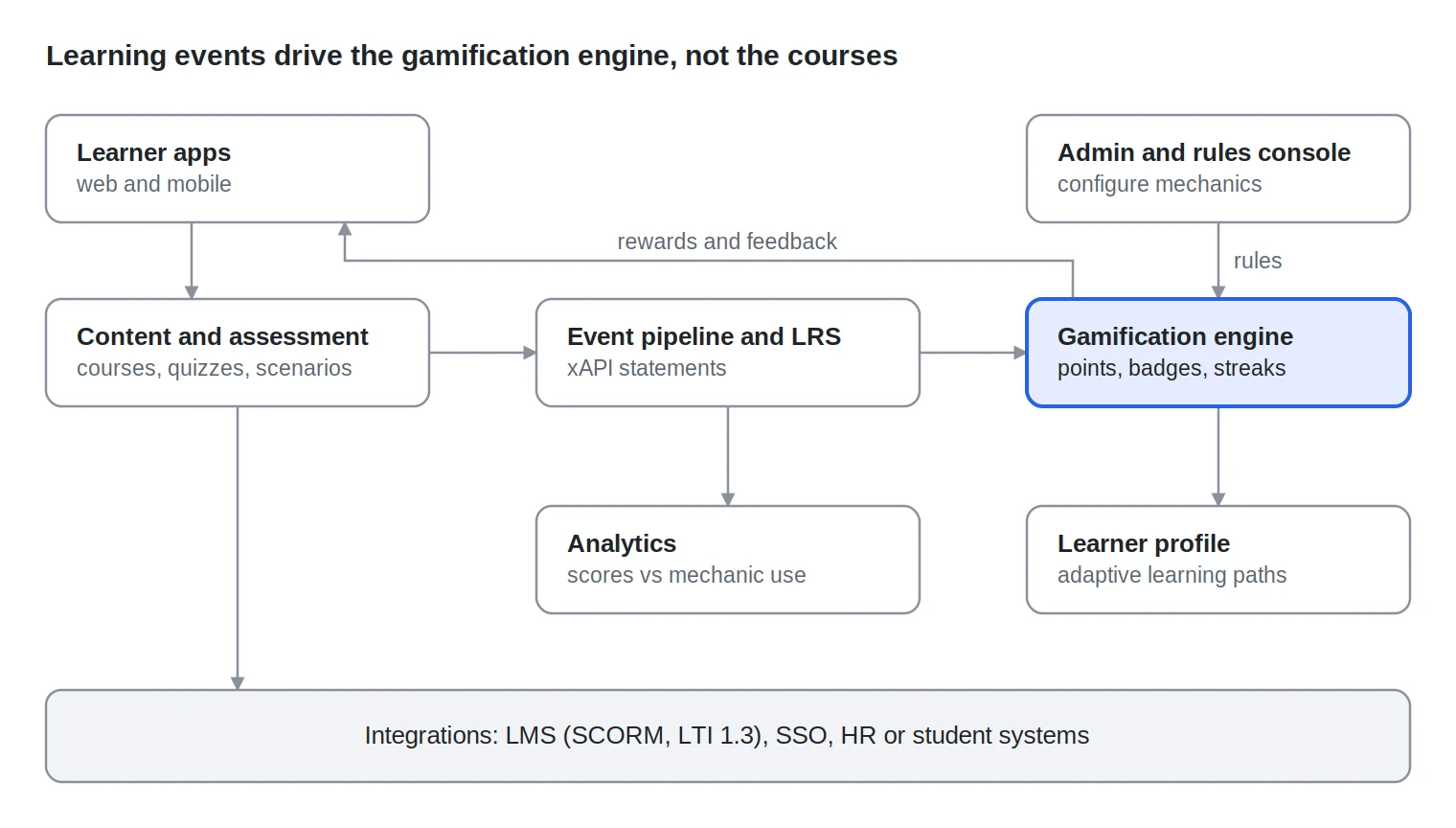
A maintainable gamified platform separates learning content from game logic. Learning activities emit events; a gamification rules engine turns those events into points, badges, levels and challenge progress; and analytics read both streams to show whether mechanics are improving learning. Keeping the rules engine separate lets learning designers change a reward without redeploying courses.
gamified learning platform architecture · event flow from learner activity to rewards
Learner activity becomes xAPI events; the gamification engine turns those events into rewards shown back to the learner, while analytics compares mechanic use with assessment results.
The main components are: learner apps (web and mobile); a content and assessment service for courses, quizzes and scenarios; an event pipeline that records learning events; the gamification rules engine with its own store for points, badges, streaks and leaderboards; a learner profile and adaptive-path service; an admin and rules console; and an analytics layer. Integrations connect to an existing LMS, single sign-on and HR or student information systems.
Standards that keep the platform interoperable
| Standard | What it does | When you need it |
|---|---|---|
| xAPI (Experience API) | Records learning experiences as structured statements in a Learning Record Store (LRS), from courses, simulations, mobile apps or on-the-job activity | Tracking gamified activities, simulations and mobile learning outside a traditional course; feeding analytics |
| SCORM | Packages e-learning courses so an LMS can launch them and track completion and scores | Delivering gamified courses into a client’s existing LMS |
| LTI 1.3 and LTI Advantage (1EdTech) | Lets an LMS launch an external tool securely and exchange data such as rosters and grades | Selling a gamified tool to schools and universities that run Canvas, Moodle, Blackboard or similar |
| SSO (SAML or OpenID Connect) | Single sign-on with the organization’s identity provider | Corporate training and institutional deployments |
xAPI is particularly useful for gamification because its statements can describe any experience, not just course completion. The official xAPI specification, stewarded by the ADL Initiative, defines a service that delivers statements of experience to a Learning Record Store; these are typically learning experiences, but the format can record any kind of activity. That gives the rules engine one consistent event format to reward.
Technology choices
Most gamified platforms are standard web and mobile applications, so mainstream stacks work: a React or similar web front end, React Native or Flutter for mobile, a Node.js, Python or .NET back end, PostgreSQL for core data, and Redis or a similar in-memory store for real-time leaderboards and streak counters. A game engine such as Unity is only needed for 3D simulations or full games; use it for those modules rather than for the whole platform. AI features, such as adaptive question selection, generated practice items or conversational tutors, sit beside the rules engine and should be evaluated against assessment results like any other mechanic.
Cost and build vs buy
The cost of gamified educational platform development depends mostly on scope: how many learner roles, how much custom content and simulation work, whether you need mobile apps, and how many systems you integrate. AB Ark’s e-learning software development guide publishes its own 2026 estimates, ranging from about $15,000 for a basic MVP to $300,000+ for an enterprise LMS, with an advanced tier that includes AI personalization, live classes and gamification at $120,000 to $250,000 over 6 to 9 months. These are AB Ark’s estimates for its delivery context, not an industry benchmark.
The biggest cost drivers specific to gamification are custom content production (scenarios, story and art), simulations or 3D modules built in a game engine, real-time multiplayer or team features, and the analytics needed to prove learning impact.
| Option | What it is | Best fit | Trade-off |
|---|---|---|---|
| Buy a gamified LMS | A licensed platform with built-in points, badges and leaderboards | Standard corporate or compliance training on a short timeline | Mechanics are generic; per-seat fees grow with learners; limited control over data and design |
| Add a gamification layer | Build or buy a rules engine and connect it to your existing LMS through xAPI or LTI | You already have an LMS and content, and want engagement mechanics on top | Integration depth limited by what your LMS exposes |
| Build a custom platform | A platform designed around your learners, content and business model | Edtech products you sell, distinctive learning methods, or large learner volumes where licence fees dominate | Highest upfront cost; you own maintenance |
| Hybrid | Buy the LMS backbone, build custom gamified modules or apps that plug into it | Most mid-sized organizations | Two systems to maintain and keep in sync |
AB Ark field evidence
AB Ark has not published a case study of a gamified learning platform specifically, so this guide does not claim gamification results. Two published projects are relevant to the engineering involved. The Vocaliv case study describes an AI-powered platform for training institutes with lesson planning, voice-based content creation, automated quizzes and 24/7 student support, which covers the content, assessment and learner-data layers a gamified platform builds on. Separately, a client review on AB Ark’s DesignRush profile describes a habit-tracking mobile app AB Ark built with streak tracking, journaling and AI-driven insights, the same retention mechanics used in gamified learning. Neither project reports learning-outcome data.
How to develop a gamified learning platform: a seven-step process
The order of work matters more than the feature list: define what learners must be able to do, prove the mechanics on a small group, then scale. The steps below apply to both educational and corporate training platforms.
- Define learning outcomes and the baseline: Write the knowledge or skills learners should gain and how you will assess them. Record current completion, assessment scores and time to competence before building anything.
- Profile learners: Age, motivation, device access, time available and attitudes to competition. Corporate learners and school students respond differently to leaderboards and public rankings.
- Map mechanics to objectives: Use a mechanic-to-objective map like the one above. Remove any mechanic that cannot be tied to a learning behaviour.
- Prototype and playtest: Build a clickable prototype or a paper version of the core loop and test it with five to ten real learners before writing production code.
- Build the MVP around one course or programme: Ship the content service, event tracking, rules engine and a basic analytics view for a single programme. Integrate with the LMS or SSO you must use from day one.
- Pilot with a comparison group: Run the gamified version alongside the existing format where possible, and compare assessment results, not just activity.
- Tune and scale: Adjust point values, difficulty and social features based on pilot data, then add programmes, cohorts and advanced features.
Metrics that show whether it is working
| Category | Metric | Why it matters |
|---|---|---|
| Learning | Pre/post assessment gain; delayed retention check after 30 to 90 days | The outcome the research says is most reliable, and the one most often unmeasured |
| Application | Time to competence; on-the-job performance or error rates (training) | Shows whether skills transfer outside the game |
| Completion | Course and programme completion rate; time to complete | Common business goal, especially for compliance |
| Engagement | Weekly active learners; return rate; streak distribution | Leading indicators, but not proof of learning |
| Equity | Engagement and scores by learner segment | Detects mechanics that motivate top performers but discourage others |
Common failure modes
- Pointsification: Adding points and badges to unchanged content. Mechanics cannot fix weak instruction.
- Rewarding the wrong behaviour: Points for clicks or speed teach learners to click quickly, not to learn.
- Leaderboard discouragement: A single global ranking where most learners can never reach the top. Use team, cohort or personal-best leaderboards instead.
- Novelty decay: Engagement peaks at launch and fades. Plan seasons, new challenges and evolving narratives.
- No baseline, no proof: Without pre-launch metrics, the platform’s value cannot be shown to budget holders.
- Over-engineering the game: Building 3D worlds before validating that the core learning loop works.
Frequently asked questions
What is the difference between gamification and game-based learning?
Gamification adds game design elements, such as points, levels, challenges and feedback, to an existing learning process. Game-based learning uses a complete game, often called a serious game, in which the learning happens through play. Gamification is usually cheaper and faster to build and easier to apply across many courses; game-based learning suits simulations and practice-heavy skills where realism matters.
How long does it take to build a gamified learning platform?
Timelines depend on scope and integrations. AB Ark’s own estimates put an advanced e-learning platform with AI personalization and gamification at 6 to 9 months, and a basic MVP can be much faster. Plan a short discovery and prototyping phase first, and pilot with one programme before scaling.
Can I add gamification to my existing LMS instead of building a new platform?
Often, yes. Many teams build a separate gamification service that receives learning events from the LMS through xAPI, SCORM data or the LMS’s own API, then displays points, badges and challenges in a companion app or embedded widget. How far you can go depends on what data and extension points your LMS exposes.
Do leaderboards work for learning?
Leaderboards can motivate some learners and discourage others. Sailer and Homner’s meta-analysis found that combining competition with collaboration produced better motivational and behavioural outcomes than competition alone in the most rigorous studies. Team leaderboards, cohort leaderboards that reset regularly, or personal-best tracking are safer choices than a single permanent global ranking.
Is gamification suitable for corporate compliance training?
Gamification can raise completion and engagement in compliance training, but completion alone does not show understanding. Pair mechanics such as progress bars and team targets with scenario-based knowledge checks, and report assessment results alongside completion to managers and auditors.
The decision in brief
A gamified educational or training platform is worth building when you can name the learning behaviours it should change and measure the result. Start from learning outcomes, choose mechanics that serve them (favouring team challenges and feedback over global leaderboards), build the gamification layer as a separate event-driven engine on interoperable standards, and pilot against a baseline before scaling.
If you are scoping a gamified platform or adding gamification to an existing LMS, you can request a project estimate from AB Ark with your learner profile, programmes and the systems you need to integrate.
Sources
- Sailer, M. and Homner, L. (2020). The Gamification of Learning: a Meta-analysis. Educational Psychology Review, 32, 77 to 112. Open access.
- ADL Initiative, Experience API (xAPI) specification, official repository on GitHub.
- 1EdTech, Learning Tools Interoperability Advantage Implementation Guide.
- AB Ark, E-Learning Software Development Services (first-party cost estimates).
- AB Ark, Vocaliv case study; client review on DesignRush.

Engineering Manager At AB Ark Solutions