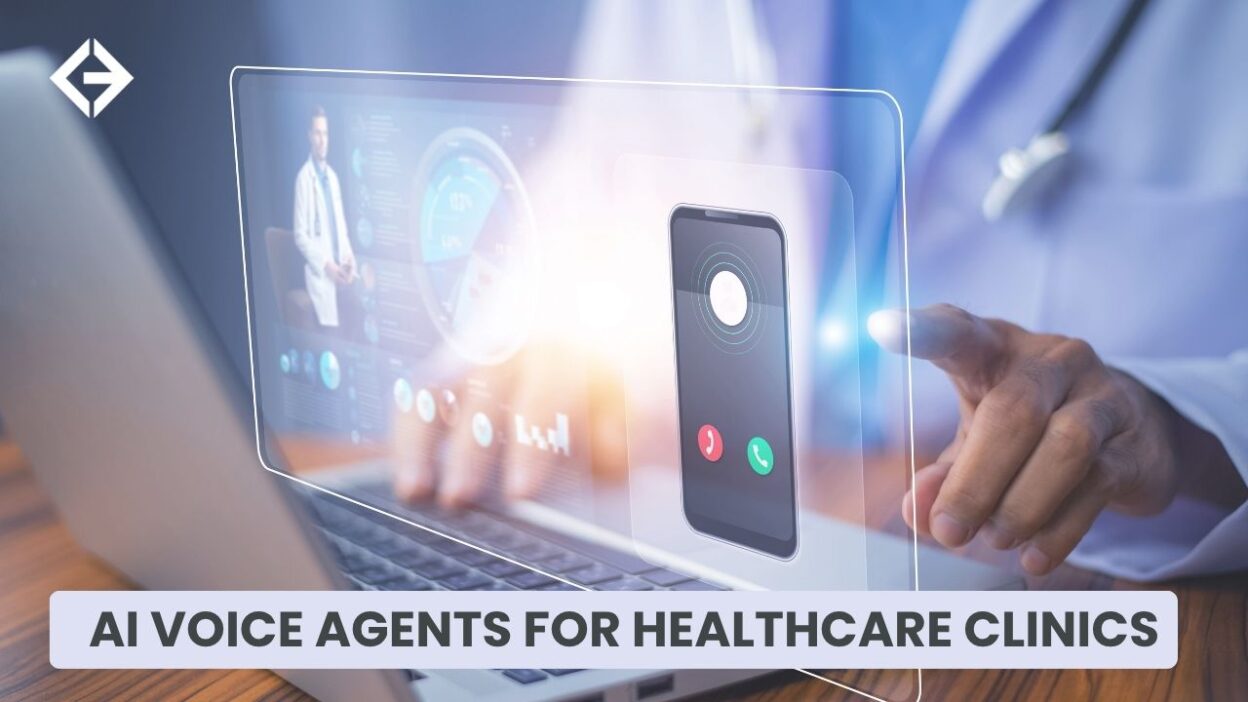
An AI voice agent for healthcare clinic answers patient calls 24/7, books and reschedules appointments, answers routine questions, and hands urgent or complex calls to staff. Used properly, it frees front-desk teams from repetitive calls without replacing clinical judgment. AB Ark’s AI voice agent development builds these systems around each clinic’s scheduling tools, call flows and compliance requirements.
Key Takeaways
- AI voice agents handle the routine share of clinic calls, such as booking, rescheduling, directions, hours and insurance questions, around the clock.
- They can book appointments directly when connected to your scheduling or practice management system.
- HIPAA compliance depends on how the system is built, not on the AI itself. Every vendor handling patient data must sign a Business Associate Agreement (BAA).
- Emergency and clinical calls must always escalate to humans, and emergencies must be directed to emergency services.
- After-hours calls are captured instead of lost to voicemail, and urgent cases are routed to the on-call provider.
What Can an AI Voice Agent Do for a Clinic?

An AI voice agent handles the high-volume, predictable calls that take up most of a front desk’s day. Here are the most common tasks, and where each should hand off to staff:
| Task | AI handles | Hands off to staff when |
|---|---|---|
| Appointment booking | New bookings, rescheduling, cancellations | The patient needs a specific clinical triage decision |
| Reminders and confirmations | Outbound reminder calls, confirmation requests | The patient raises a medical concern |
| General questions | Hours, location, parking, services, accepted insurance | Questions need a clinician’s judgment |
| Prescription refill requests | Collecting the request details for staff review | Always, since refill approval stays with clinicians |
| Intake | Collecting name, date of birth and reason for visit | Information is unclear or sensitive |
| After-hours calls | Capturing messages, booking next-day visits | Urgent symptoms, which go to the on-call provider |
The key design principle is that the agent handles logistics and staff handle medicine. A voice agent should never diagnose, give medical advice or decide whether a symptom is serious.
Is an AI Voice Agent HIPAA Compliant?
An AI voice agent can be HIPAA compliant, but only if it’s built and contracted correctly. No AI tool is automatically compliant.
Under HHS guidance on HIPAA and cloud computing, any vendor that creates, receives, stores or transmits electronic protected health information on a clinic’s behalf is a business associate. That means the clinic and each vendor in the chain must sign a Business Associate Agreement. For a voice agent, that chain usually includes:
- The telephony provider that carries the call
- The speech-to-text and text-to-speech services
- The LLM provider that powers the conversation
- The hosting and database provider where call recordings and transcripts are stored
- The development partner, if they have access to patient data
Beyond BAAs, a compliant build should include:
- Encryption of call recordings and transcripts in transit and at rest
- Access controls and audit logs showing who viewed patient information
- Data minimization, meaning the agent collects only what’s needed for the task
- A contract term that prevents patient data being used to train AI models
- A documented risk analysis, which HIPAA requires of both clinics and their business associates
Ask any vendor for a list of every sub-processor that touches patient data and confirm that each one has signed a BAA. If a vendor can’t provide that list, that’s a red flag. This article is general information, not legal advice, so confirm your setup with your compliance officer or a healthcare attorney.
💡 Have a question about your clinic’s setup or scheduling system? Send us a message and our team will get back to you.
Can AI Book Patient Appointments?
Yes. An AI voice agent can book, reschedule and cancel appointments in real time when it’s integrated with your scheduling or practice management system. During the call, it checks live availability, offers open slots, confirms the patient’s choice, and writes the booking directly into your calendar.
For booking to work reliably:
- Integrate with your system of record so the agent never works from an outdated copy of your schedule.
- Encode your booking rules, such as appointment lengths by visit type, provider preferences, and new patient versus follow-up slots.
- Verify patient identity with details like name and date of birth before changing an existing booking.
- Send a confirmation by text or email after every booking.
AB Ark built this kind of system in our AI Call Agent project. It’s an AI receptionist platform that answers calls instantly, manages bookings, and lets owners oversee multiple branches from one dashboard, with 24/7 call handling and no missed calls.
How Do AI Voice Agents Handle After-Hours Calls?
AI voice agents answer every after-hours call instead of sending patients to voicemail. The agent sorts each call into one of three paths:
- Routine requests, such as booking a visit or asking about hours, are completed immediately, and the booking is ready when staff arrive in the morning.
- Non-urgent clinical questions are logged as a message with the caller’s details and reason, then queued for staff follow-up the next business day.
- Urgent situations are routed straight to the on-call provider. Callers describing an emergency are told to hang up and call emergency services right away.
This matters because patients who reach voicemail often call the next clinic on their list instead. Capturing after-hours bookings is one of the fastest ways a voice agent pays for itself.
What Happens When the AI Can’t Answer?
When a voice agent can’t answer, it should hand the call to a human smoothly instead of guessing. A well-designed escalation follows these rules:
- Clear triggers: the agent escalates when it detects emergency keywords, clinical questions, frustration, repeated misunderstanding, or a direct request for a person.
- Warm transfer during business hours: the call goes to staff along with a summary, so the patient doesn’t have to repeat themselves.
- Callback outside business hours: the agent records the details and promises a callback within a set time.
- No invented answers: if the agent doesn’t know, it says so. Answers should come only from the clinic’s approved information, which is where retrieval-augmented generation keeps responses grounded in your actual policies.
Escalation design is where most voice agent projects succeed or fail. We cover the difference between assistants that answer and agents that act in agentic AI vs chatbots.
How to Roll Out an AI Voice Agent in Your Clinic
A phased rollout keeps risk low and builds staff confidence:
- Start with overflow and after-hours calls only, so the agent handles calls your team would otherwise miss.
- Review transcripts weekly for the first month to fix wrong answers and adjust escalation rules.
- Expand to daytime booking once accuracy is proven.
- Add outbound reminders to reduce no-shows.
AB Ark has built healthcare AI products including Grey Mind, an AI mental health platform, and QURI.AI.
See How an AI Voice Agent Would Work for Your Clinic
Every clinic has different call patterns, scheduling systems and compliance needs. In a free 30-minute call, we’ll map your current call flow and show you which calls can be automated safely.

Frequently Asked Questions
Can an AI voice agent replace my receptionist?
It’s better used to support your receptionist than to replace them. The agent handles repetitive calls and after-hours coverage, so front-desk staff can focus on patients in the clinic and on complex calls.
Do patients know they’re speaking with AI?
They should. Tell callers at the start of the call that they’re speaking with an AI assistant, and give them an easy way to reach a person. This builds trust and may be required by law in some places.
Is ChatGPT HIPAA compliant for a clinic phone line?
Consumer AI tools are not suitable for patient data. A compliant setup uses enterprise services from providers willing to sign a BAA, configured with encryption, access controls and audit logging.
What if a patient describes an emergency to the AI?
The agent should immediately tell the caller to contact emergency services and, where appropriate, alert the on-call provider. Emergency detection should be one of the first things tested before launch.
How long does it take to set up an AI voice agent for a clinic?
A focused after-hours or overflow agent can typically go live in a few weeks. A full deployment with scheduling integration and custom workflows takes longer, depending on your systems.
Which clinics benefit most from AI voice agents?
Clinics with high call volumes, a small front-desk team, frequent missed calls, or strong after-hours demand see the fastest return. This includes dental, dermatology, physiotherapy, primary care and multi-location practices.

Engineering Manager At AB Ark Solutions