
AI agent governance is the set of rules, roles, limits and evidence that decide what an AI agent may do, who is accountable for it, and how it is proven safe before it touches real systems. Testing without touching production means climbing a ladder: offline evaluations, a sandbox with mocked tools and synthetic data, replay of past cases, shadow mode with no side effects, and finally a limited release with approval gates and a kill switch.
Key Takeaways
- Governance answers four questions: what the agent may do, who is accountable, how it was tested, and how it is monitored. Singapore’s January 2026 framework for agentic AI organizes guidance around four similar dimensions.
- Test in five stages that add reality one step at a time. Real side effects should appear only in the last stage, and only under approval, caps and a kill switch.
- A safe sandbox controls tools, data, network access, spend and step counts, and routes every tool call through a gateway that can refuse it.
- Measure reliability, not luck. An agent with an 80% per-run success rate succeeds on all of five runs only about 33% of the time.
- Write the promotion gates down and keep the evidence. Regulators and standards bodies are moving toward asking for it.
Talk to Our Team About Your Project ->
What Is AI Agent Governance?
AI agent governance is the management system around an AI agent: the limits on its autonomy, the people accountable for it, the testing that proves it is ready, and the monitoring that catches problems afterwards. It differs from general AI governance because an agent does not just produce text. It plans, calls tools and takes actions that change real systems.
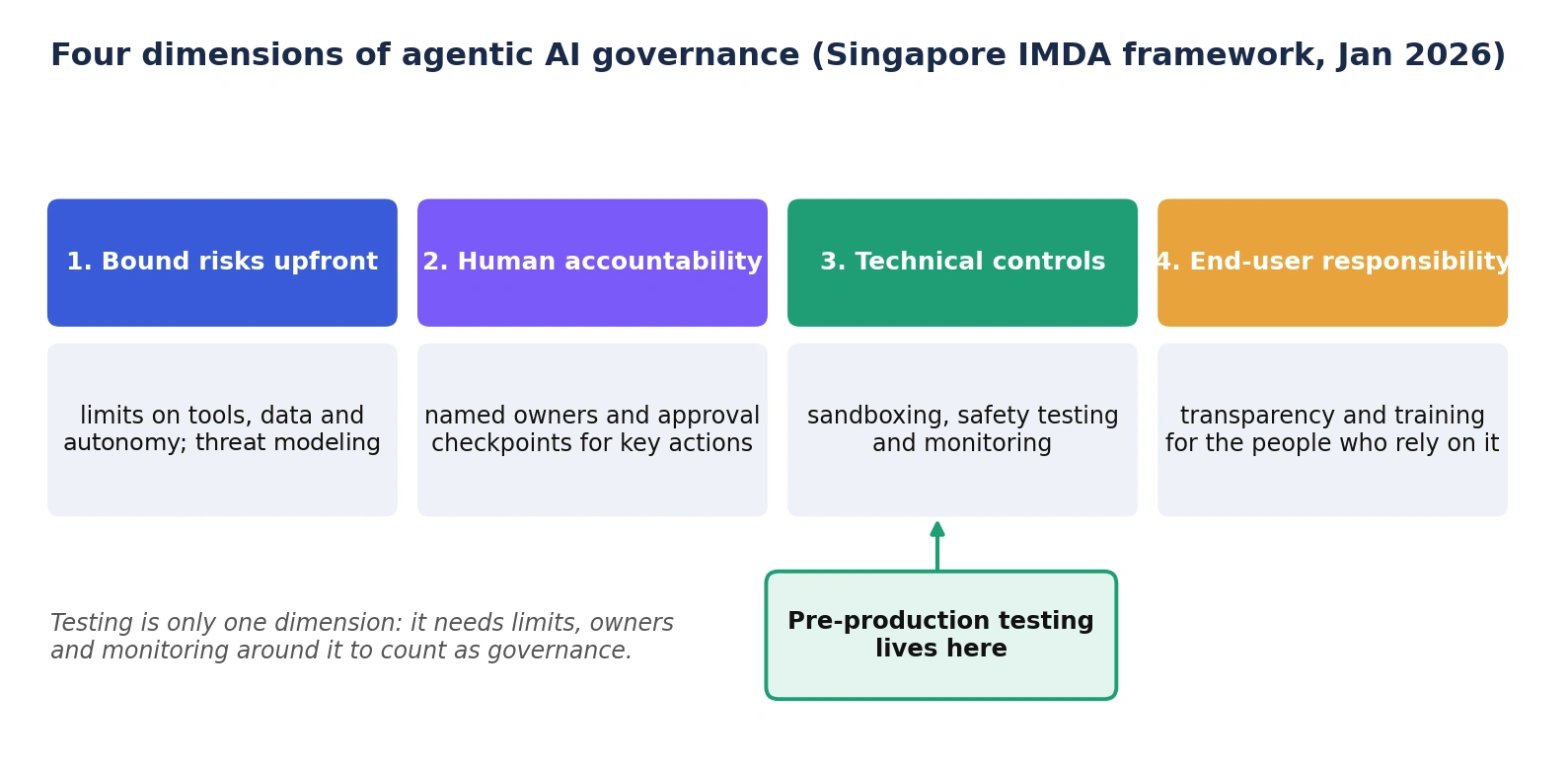
Singapore’s Infocomm Media Development Authority launched its Model AI Governance Framework for Agentic AI on January 22, 2026, describing it as the first governance framework designed specifically for agents that plan, reason and act autonomously. Its four dimensions are assessing and bounding risks upfront, making humans meaningfully accountable, implementing technical controls and processes, and enabling end-user responsibility. A K&L Gates summary lists sandboxing, safety testing and monitoring among the technical controls, and notes the framework is non-binding.
Why Test Agents Before They Touch Production?
Agents fail in ways that conventional software tests do not catch, and the cost of discovering that in production is high. Three independent signals point the same way.
Officials expect surprises. CISA, the NSA and partner agencies advise treating security as a core priority and proceeding incrementally, starting with clearly defined, low-risk tasks. According to a legal summary, the guidance concludes that organizations should assume agentic systems may behave unexpectedly and plan deployments accordingly.
Multi-agent failures are mostly design failures. Berkeley researchers analyzing more than 1,600 execution traces found 14 failure modes across seven frameworks, many stemming from system design rather than model weakness.
Projects are being canceled. Gartner predicts that over 40% of agentic AI projects will be canceled by the end of 2027 due to escalating costs, unclear business value or inadequate risk controls.
Pre-production testing is the cheapest place to find an agent that loops, misuses a tool, leaks data or overspends. It is also where governance gets its evidence.
What Do Regulators and Standards Bodies Expect?
| Source | Date | Relevance to testing before production |
| Singapore IMDA Model AI Governance Framework for Agentic AI | January 22, 2026 | Four dimensions; technical controls include sandboxing, safety testing and monitoring; non-binding |
| NIST AI Agent Standards Initiative (CAISI) | February 17, 2026 | Research on agent security, identity and evaluation; guidance still being developed, not a finished standard |
| CISA, NSA and partners: Careful Adoption of Agentic AI Services | May 1, 2026 | Assume unexpected behavior; adopt incrementally, starting with low-risk tasks |
| OWASP Top 10 for LLM Applications 2026 | August 3, 2026 | Excessive agency rose from sixth to third place, with a companion list for agentic applications |
| EU AI Act, as amended by the Digital Omnibus | In force July 27, 2026 | Transparency duties have applied since August 2, 2026; high-risk duties from December 2, 2027 (Annex III) and August 2, 2028 (Annex I) |
Sources: Baker McKenzie on the Singapore framework, NIST announcement and a guide to its current status, Mayer Brown on the CISA guidance, Cloud Security Alliance on OWASP 2026, and CMS and Hunton on the EU timeline. Whether the EU high-risk rules apply to a given agent depends on its use case, so confirm with counsel.
The Five-Stage Testing Ladder
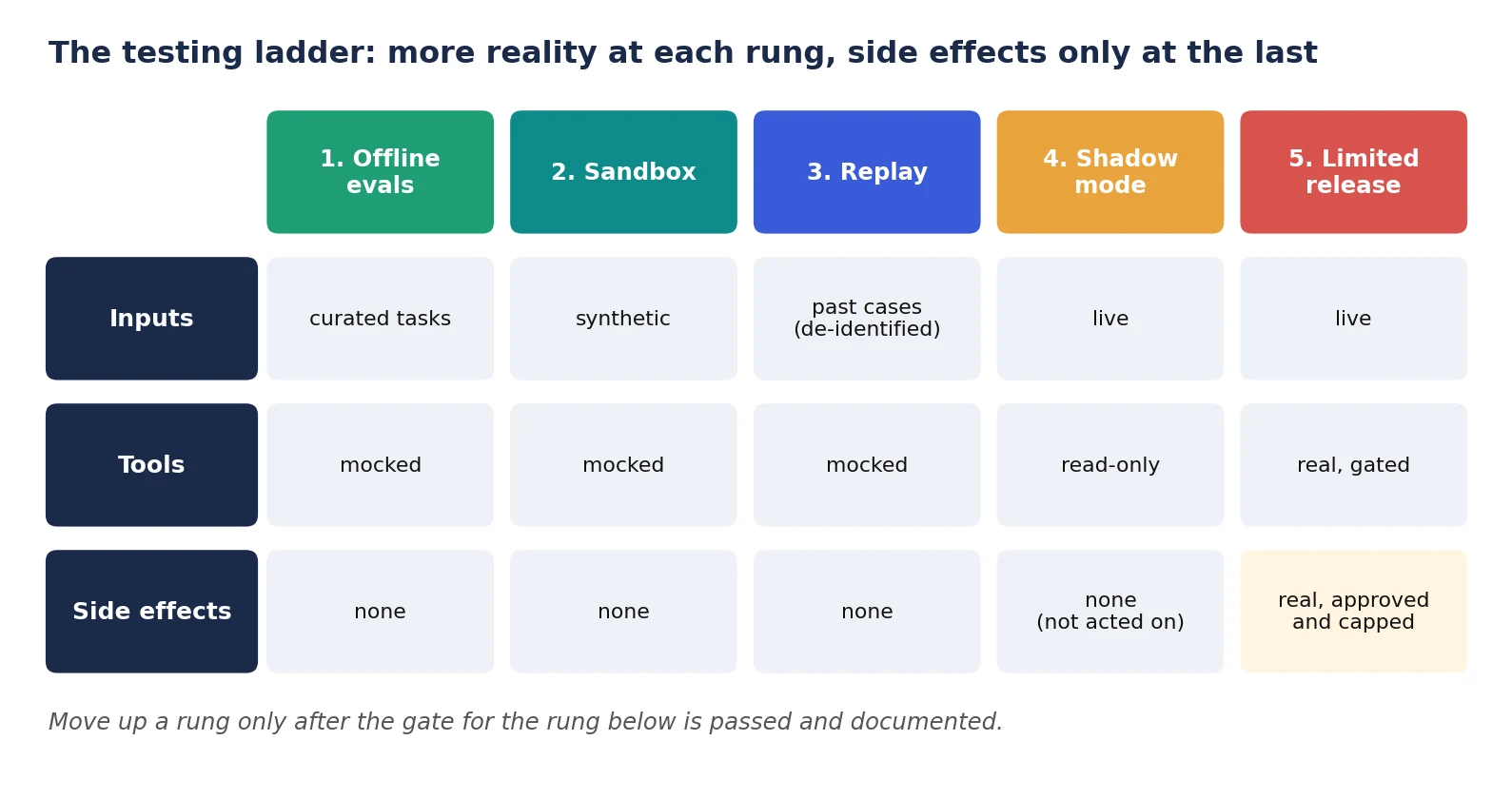
The safest way to test an agent is to expose it to reality in small steps. Each rung adds something real, such as live inputs or live tools, while keeping real side effects out until the last stage.
Stage 1: Offline evaluations
Run the agent against a fixed set of realistic tasks with known good outcomes, several times each. Anthropic’s guidance on agent evals distinguishes the transcript, which records what the agent said and did, from the outcome, the final state of the environment. Grade the outcome, and read transcripts to confirm the graders are fair. Build the task set from real failures first.
Stage 2: Sandbox with mocked tools and synthetic data
Let the agent act, but against fake tools and fake data, so nothing real can change. This is where to test unhappy paths, prompt-injection attempts, permission boundaries, loops and cost, because you can push the agent hard without consequences.
Stage 3: Replay of past cases
Run the agent over de-identified historical cases and compare its decisions with what actually happened. Replay shows how the agent handles the messy distribution of real work without exposing any live customer.
Stage 4: Shadow mode
In shadow mode, the agent receives live inputs alongside the existing process, but its proposals are logged, never executed.
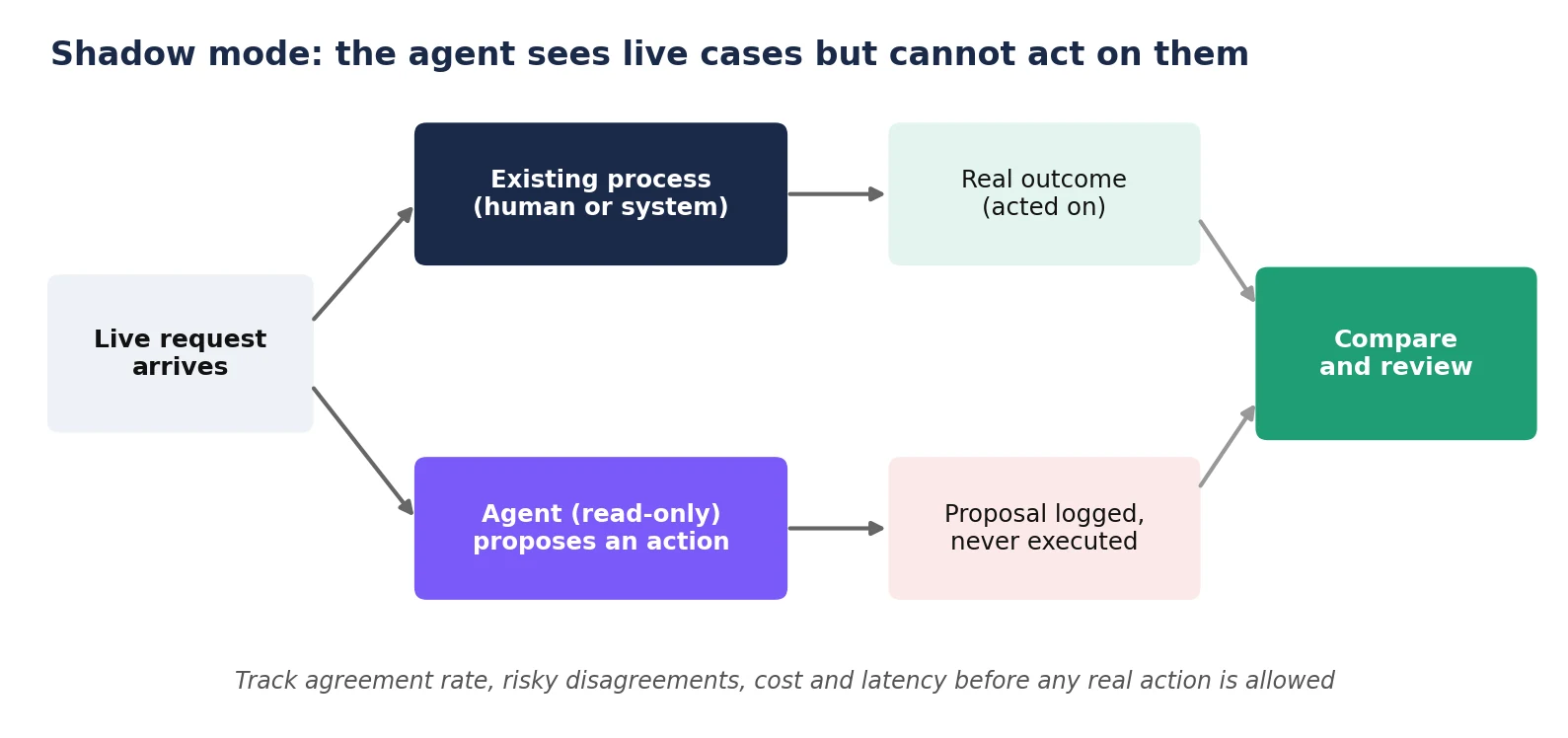 Track the agreement rate with the real outcome, any risky disagreements, cost and latency. Access should be read-only, and live data raises privacy obligations, so agree data handling with your data protection lead first.
Stage 5: Limited release
Only now do real actions begin, for a small share of low-risk tasks, with approval on gated actions, spend caps, monitoring and a tested kill switch. Expand gradually as evidence accumulates, and only after the expansion gate in the promotion gates table below is passed. Agree rollback criteria before launch: a critical action, a cost breach, a drop in pass rate or a failed approval audit should trigger the kill switch first, then a return to the previous stage and an investigation. This mirrors the incremental approach in CISA’s guidance.
How Do You Build a Safe Agent Sandbox?
A safe sandbox makes it technically impossible for the agent under test to cause real harm, whatever it tries. Do not rely on instructions in the prompt.
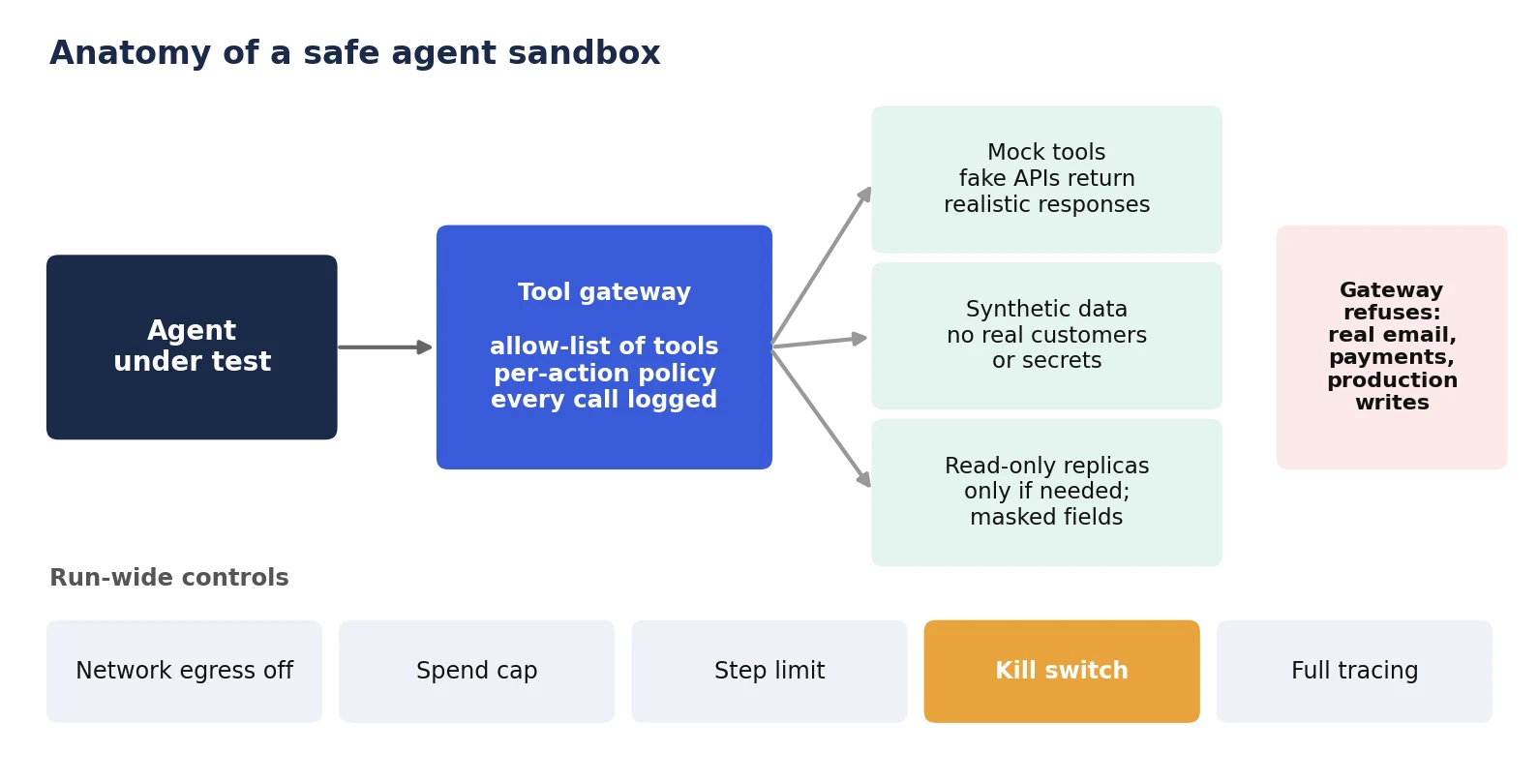
Route every tool call through a gateway that checks an allow-list and per-action policy, and logs each call.
Use mock tools that return realistic responses, including errors, timeouts and malformed data.
Use synthetic data, with no real customer records or secrets. If read-only replicas are unavoidable, mask sensitive fields.
Block outbound network access except to approved test endpoints, so the agent cannot email, post or pay anyone.
Cap spend and steps per run, so loops and runaway costs stop themselves.
Provide a kill switch that halts the agent immediately, and test it before every promotion.
Trace everything, for example with OpenTelemetry’s GenAI agent conventions, so failures can be reproduced and audited.
How Do You Measure Whether an Agent Is Ready?
Readiness depends on reliability across repeated runs, not on one good demonstration. Agent output varies, so a single success hides how often the agent fails. Anthropic’s guidance defines two metrics: pass@k, the probability of at least one success in k attempts, and pass^k, the probability of succeeding on all k attempts. With a per-run success rate p and independent runs, pass@k = 1 – (1 – p)^k and pass^k = p^k.
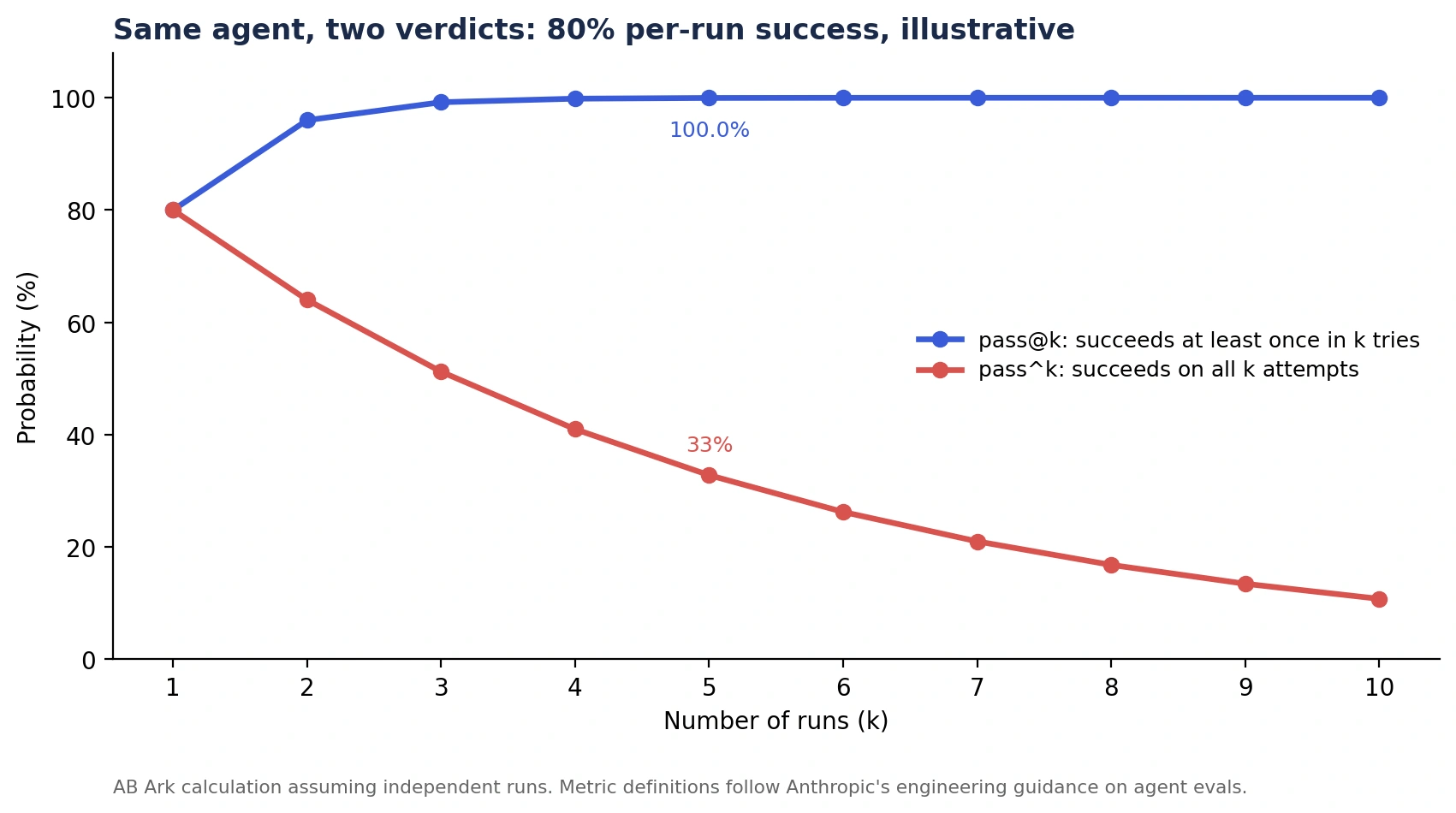
The gap is large. At 80% per-run success, pass@5 is about 99.97% while pass^5 is about 33%. A worked explanation of the same arithmetic reaches the same conclusion: whether you need pass@k or pass^k depends on whether a retry is acceptable. If a human can pick the best of several attempts, pass@k may be enough. If the agent acts alone, as in customer support, reliability across runs matters more.
Keep two eval sets: a capability set that stretches the agent, and a regression set that must stay near 100% before every release.
Use code-based graders wherever the outcome can be checked deterministically, and calibrate any model-based grader against human review.
Re-run the full set whenever the model, prompt, tools or data change.
What Should Each Promotion Gate Require?
A gate is a written, testable condition for moving up a rung. The thresholds below are illustrations, not benchmarks: set real numbers from your task, risk and baseline.
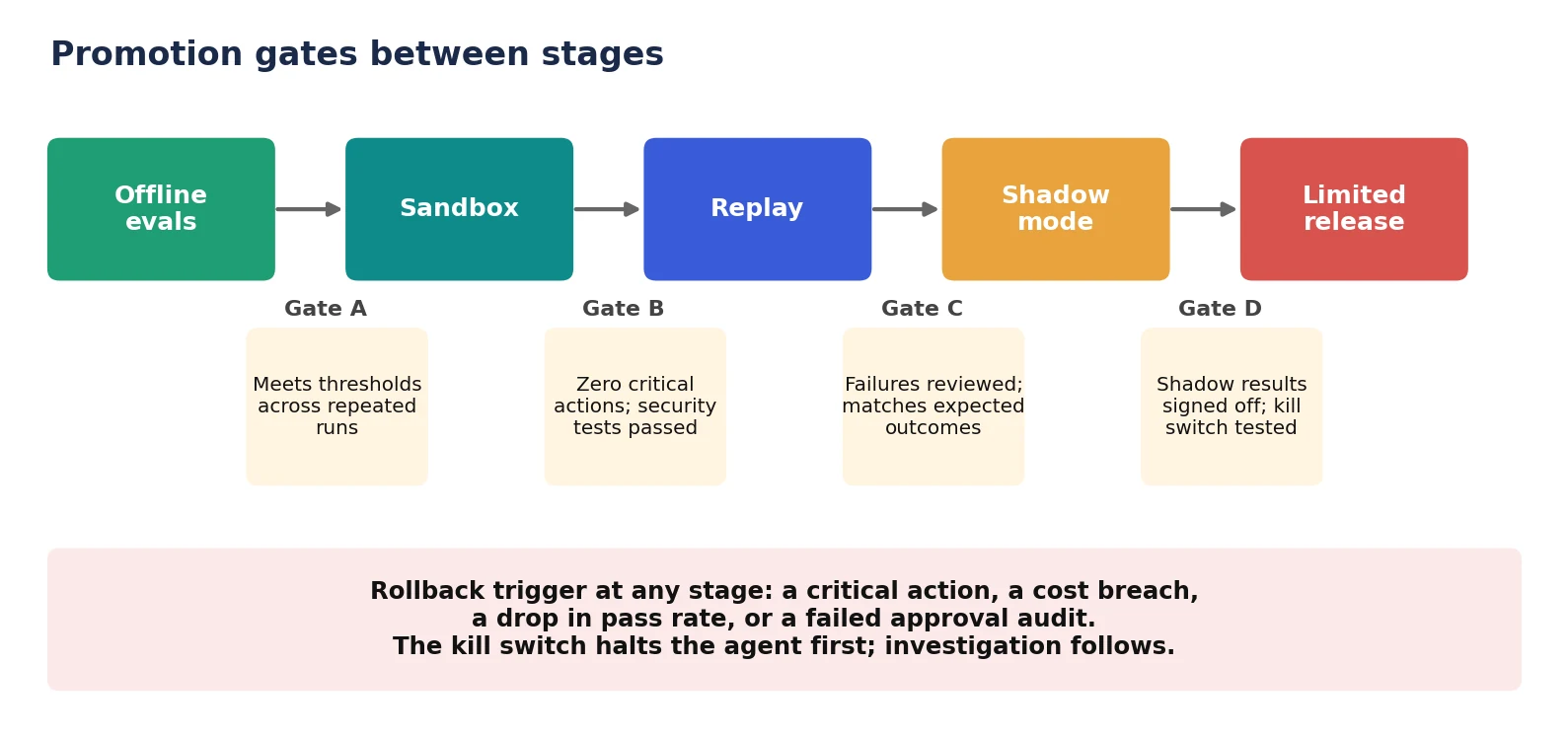
| Gate | Move from | Move to | Example requirement (illustrative) |
| A | Offline evals | Sandbox | Pass rate above an agreed threshold across repeated runs on the eval set; regression set clean |
| B | Sandbox | Replay | Zero critical actions in adversarial tests; prompt-injection and permission tests passed; cost and step caps respected |
| C | Replay | Shadow mode | Failures reviewed and classified; outcomes match history within the agreed tolerance |
| D | Shadow mode | Limited release | Agreement and risky-disagreement results signed off by the owner; kill switch tested; approvers named and trained |
| E | Limited release | Wider release | Pass rate, cost and approval audits stay within agreed limits for an agreed period; no critical actions; rollback criteria and kill switch tested; owner signs off |
Who Is Accountable for an AI Agent?
Accountability must be assigned to named people before testing starts. A summary of the Singapore framework describes accountability spread across leadership, who define goals and permitted use cases, and product teams, who handle design, testing and user education, and reinforced externally through contracts with model and tool vendors.
| Role | Accountable for |
| Agent owner (business) | Purpose, permitted use cases, success measures and risk acceptance |
| Technical lead | Design, sandbox, evaluation sets and test results |
| Security reviewer | Threat model, adversarial testing and access scope |
| Privacy and compliance lead | Data handling in replay and shadow stages; legal obligations |
| Promotion approver | Signing each gate; independent of the build team where possible |
| Production approvers | Reviewing gated actions, with training against over-trusting the agent |
What Evidence Should Governance Keep?
If a regulator, customer or auditor asks how an agent was proven safe, the answer should be a folder, not a recollection.
Agent record: purpose, owner, model and version, tools, permissions and autonomy limits.
Eval sets and results, with run counts, graders used and transcripts of failures.
Sandbox reports, including adversarial and security tests.
Replay and shadow-mode comparisons, with reviewed disagreements.
Gate sign-offs with dates and names.
Change log of prompts, models, tools and data, with re-test results.
Kill-switch tests, incident log and monitoring dashboards after release.
Common Mistakes in Pre-Production Testing
Testing the happy path only: real inputs are messy; include errors, abuse and ambiguity.
Giving the test agent real credentials: a sandbox with production keys is not a sandbox.
Trusting one run: repeat every task and report reliability across runs.
Skipping shadow mode: replay misses today’s inputs; shadow mode shows how the agent handles them.
Letting the build team approve its own work: keep an independent promotion approver.
Not re-testing after changes: a new model, prompt or tool can change behavior.
Relying on the prompt for safety: enforce limits in tools and gateways.
How AB Ark Approaches AI Agent Governance
AB Ark builds agents that act for businesses and treats limits, approvals and testing as part of the design, not an afterthought. Its published case studies include a 24/7 AI call agent that answers calls and manages bookings across multiple branches, the kind of system where clear autonomy limits and staged rollout matter. Teams planning an agent can start with AB Ark’s AI agent development service.
Get a Custom Project Cost & Timeline Estimate ->
FAQs
What is AI agent governance?
The rules, roles, limits and evidence that control what an AI agent may do, who is accountable, how it is tested before release and how it is monitored afterwards.
How do you test an AI agent without risking production?
Use a staged ladder: offline evaluations, a sandbox with mocked tools and synthetic data, replay of past cases, shadow mode with no side effects, and only then a limited release with approvals, caps and a kill switch.
What is shadow mode for AI agents?
The agent receives live inputs alongside the existing process, but its proposed actions are logged and never executed. Teams compare them with real outcomes to judge readiness.
What are pass@k and pass^k?
pass@k is the probability an agent succeeds at least once in k attempts. pass^k is the probability it succeeds on all k attempts. For autonomous agents, pass^k is the stricter and more relevant measure.
Is AI agent governance legally required?
It depends on where and how the agent is used. Singapore’s framework and NIST’s initiative are voluntary, while the EU AI Act already imposes binding duties, phased in from 2025, with more applying to high-risk uses from 2027. Check your use case with legal counsel.
Prove the agent in places where nothing real can break, write down who decided it was ready, and expand its powers only as fast as the evidence allows.
Schedule a Free Consultation Call ->

Head Of Product