In software development outsourcing, the biggest trends in 2026 are about how work is delivered and priced, not where it is done. AI-assisted engineering is changing team sizes and pushing vendors away from pure hourly billing, buyers are choosing partners for specialist skills more than low rates, and governance, security and AI regulation now shape vendor selection. Location still matters, but mainly for time-zone overlap and compliance.
Key Takeaways
- Services spending is still growing, but Gartner’s July 2026 forecast puts it at 5.3% growth against 15.5% for software, so outsourcing budgets compete harder with AI and cloud.
- AI coding agents became routine: Stack Overflow’s surveys show agent use nearly doubling between 2025 and April 2026.
- Verified quality is now the differentiator. Review, testing and a written AI-use policy matter more than claimed AI speed.
- The US H-1B fee put onsite delivery models under pressure, though the fee is currently blocked in court and its future is unsettled.
- EU AI Act transparency duties began on 2 August 2026, while high-risk obligations moved to 2 December 2027.
Talk to Our Team About Your Project ->
The 2026 Market: More Money for Technology, Slower Growth for Services
Software development outsourcing sits inside a technology budget that is growing fast but unevenly. Gartner’s latest forecast puts worldwide IT spending at $6.37 trillion in 2026, up 14.2% on 2025 (forecast published 27 July 2026). Most of that growth is going to AI infrastructure, cloud and software, not to services.
| Segment (Gartner, July 2026) | 2026 spending | 2026 growth |
|---|---|---|
| Data center systems | $822 billion | 62.5% |
| Infrastructure as a service (IaaS) | $287 billion | 29.3% |
| Software | $1,468 billion | 15.5% |
| Services | $1,570 billion | 5.3% |
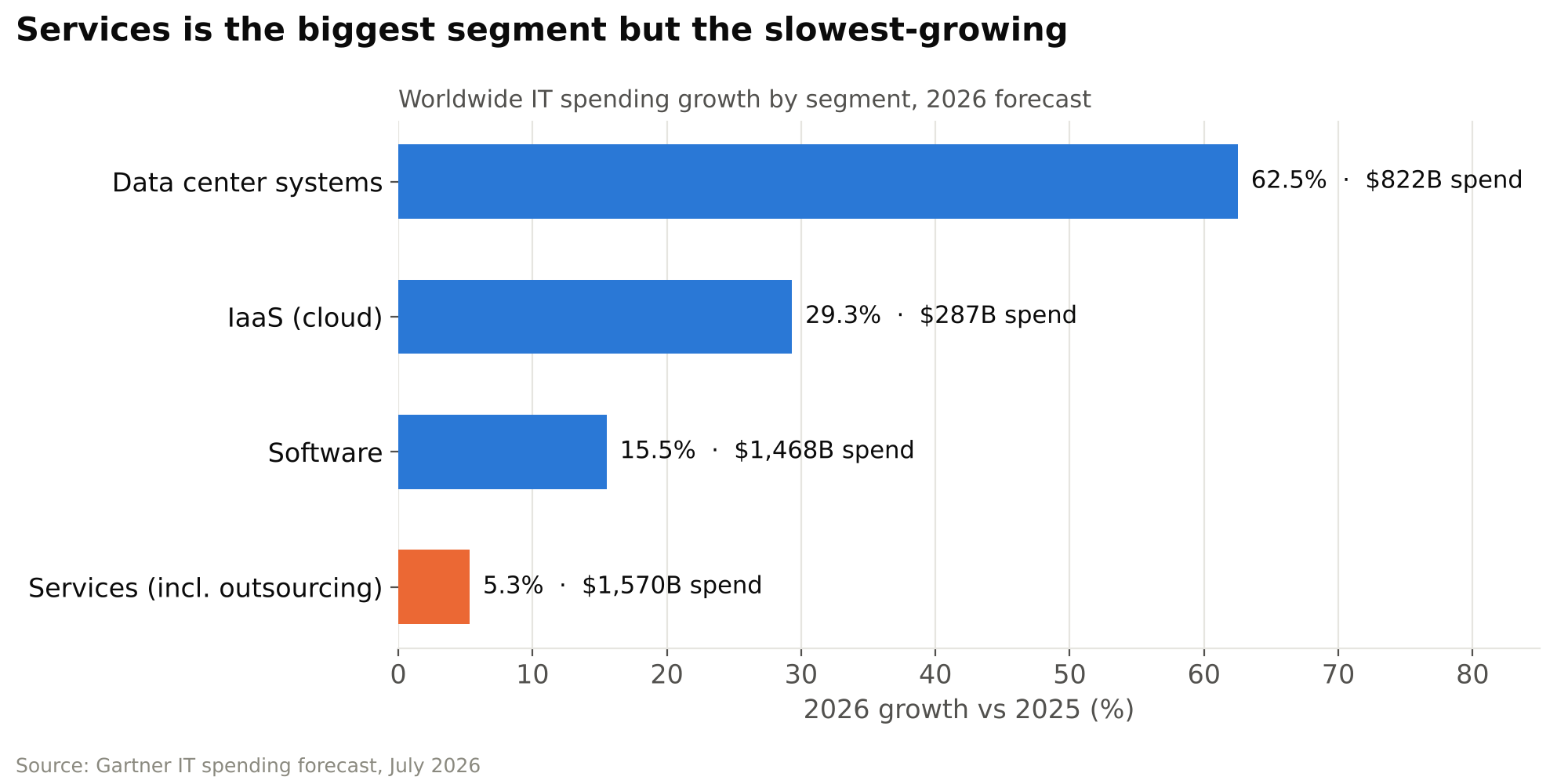
Services, the category that includes outsourced development and managed services, remains the largest single segment but is growing at around a third of the rate of software. A Gartner analyst summarized it as a market where rising spending does not lift every segment, with technology budgets strained by inflation, hardware and memory costs and AI funding priorities.
One caution when comparing numbers: Gartner’s July 2026 table reports IaaS separately from services, while its earlier 2026 forecasts grouped IaaS inside IT services. Growth rates from different releases are therefore not directly comparable.
For outsourcing buyers and vendors, the implication is that budgets for external development are not shrinking, but they are competing harder with AI tooling and cloud costs. Vendors have to justify each engagement in outcomes, and buyers have more reason to ask what AI-assisted delivery should do to price and team size.
What caused these changes
Three forces drove the shifts described in this article. First, AI investment: buyers are pouring money into data center systems, cloud infrastructure and software to run AI, which is why those segments grew several times faster than services. Second, cost pressure: Gartner points to inflation, hardware and memory costs and AI funding priorities as strains on technology budgets, so spending outside AI is being examined more closely. Third, policy and regulation: the US H-1B payment requirement raised the cost and risk of onsite staffing, and the EU AI Act began imposing transparency duties on AI features. Together, these explain why outsourcing is still growing but on different terms.
Five Software Development Outsourcing Trends That Changed in 2026
1. AI coding agents became normal in delivery teams
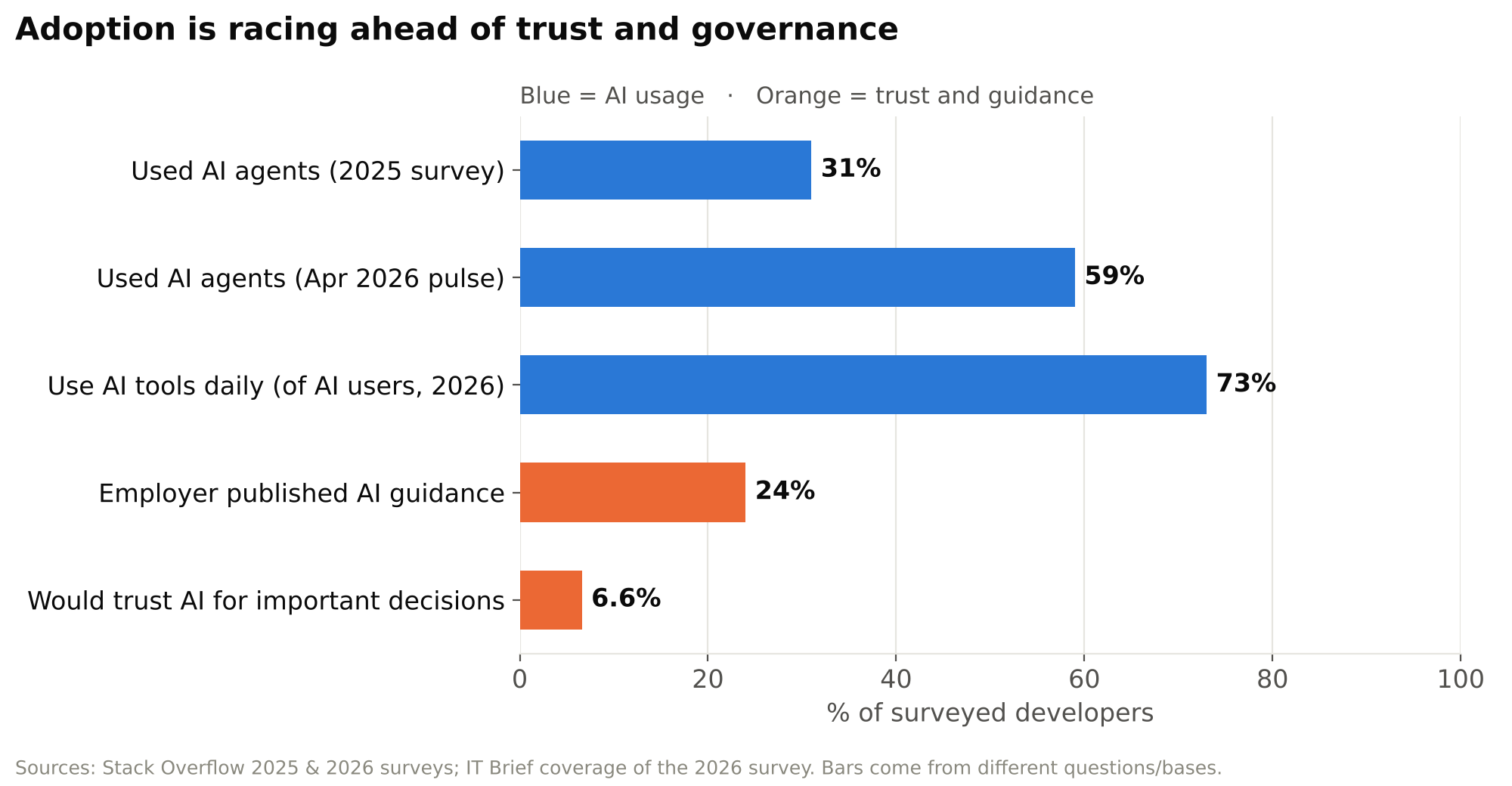
In 2026, AI coding agents moved from experiment to everyday tool for most developers, which means the outsourced team you hire is likely to use them whether or not the contract mentions it. Stack Overflow reported that agent use among developers it surveyed nearly doubled, from 31% in its 2025 survey to 59% in an April 2026 pulse survey. Its full 2026 Developer Survey results, published on 6 October, found that 73% of respondents using AI coding assistants or agents use them daily, and that the most-used agents among respondents were Claude Code (66%) and GitHub Copilot (59%).
What it means for buyers: ask every vendor which AI tools their engineers use, on what data, under which licenses, and how AI-generated code is reviewed. Put the answers in the contract, alongside IP ownership and confidentiality terms.
2. Verification became the scarce skill
As AI writes more code, the value of an outsourced team shifts toward reviewing, testing and owning that code. Trust remains conditional: coverage of the 2026 survey reported that nearly half of respondents trust AI output when they can verify it, while only 6.6% would trust it with an important decision. The same coverage reported that only 24% of respondents said their employer had published approved AI tools or official guidance.
What it means for buyers: judge vendors on code review, automated testing, security scanning and senior oversight, not on how fast they claim AI makes them. A vendor without a written AI-use policy for its own engineers is a governance risk.
3. The onsite H-1B delivery model came under sustained pressure
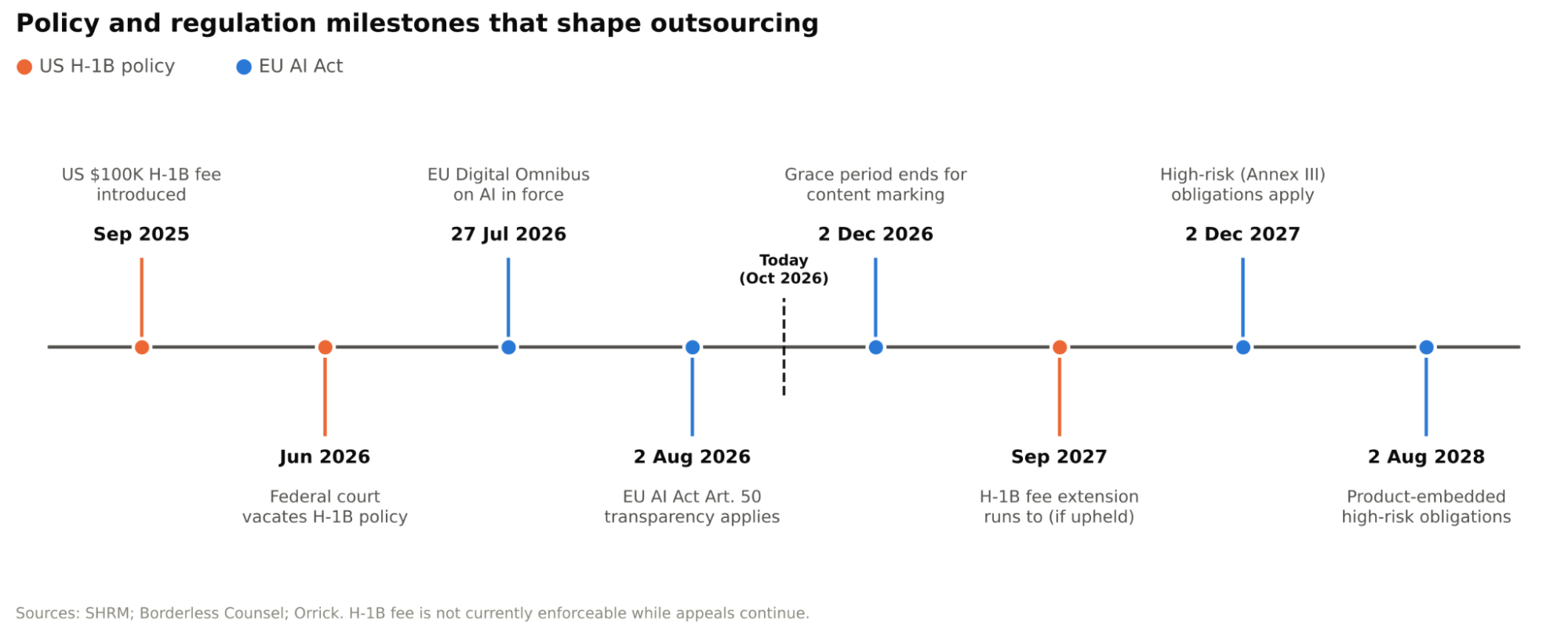
The US $100,000 payment requirement for certain new H-1B petitions, introduced in September 2025, reshaped onsite staffing during 2026, though its legal status is unsettled. SHRM reported that when the administration extended the requirement through September 2027, the White House said registrations from the largest IT staffing and outsourcing firms had fallen 92%. However, a federal court vacated the policy in June 2026 and, as of late September, the fee is not currently enforceable while appeals continue; DHS has separately proposed a $103,265 fee for cap-subject petitions.
What it means for buyers: delivery models that depend on bringing offshore engineers onsite in the US carry policy risk. Remote offshore and nearshore delivery, with clear time-zone overlap, avoids most of it. Check visa dependency when a vendor proposes onsite staff.
4. EU AI Act duties started, and high-risk rules moved
For teams building AI features used in the EU, 2026 brought both new obligations and a delay. The Digital Omnibus on AI entered into force on 27 July 2026 and, according to Orrick’s summary, moved high-risk AI obligations under Annex III from 2 August 2026 to 2 December 2027, with product-embedded high-risk systems moving to 2 August 2028. Article 50 transparency obligations for AI-generated content still apply from 2 August 2026, with a grace period to 2 December 2026 for content marking by systems already on the market.
What it means for buyers: if an outsourced team builds chatbots or generative features for EU users, transparency requirements apply now. If the product could fall into a high-risk category, such as hiring, credit or education, use the extra time to build documentation and controls into the roadmap rather than pausing.
5. Budgets favored AI and software, and services had to justify themselves
With services spending forecast to grow 5.3% against 15.5% for software in Gartner’s July 2026 forecast, outsourcing budgets are under closer scrutiny. This is AB Ark’s editorial reading of the data rather than a measured trend: when services grow far more slowly than software, each outsourcing engagement has to compete for budget on the outcomes it delivers, and buyers have good reason to ask how AI-assisted delivery affects estimates.
What it means for buyers: expect and request pricing that reflects AI-assisted productivity, such as fixed-scope milestones or outcome-linked fees, rather than headcount alone. Compare estimates on scope delivered, not hourly rate.
Get a Custom Project Cost & Timeline Estimate ->
What Changed and What Stayed the Same
Not everything moved in 2026. The fundamentals of a good outsourcing relationship – clear scope, strong communication and code ownership – matter as much as ever; what changed is how delivery happens, what it costs to staff, and which rules apply.
| Area | What changed in 2026 | What stayed the same |
|---|---|---|
| Delivery | AI coding agents became routine for many developers | Senior engineers still own architecture, review and production quality |
| Vendor evaluation | AI-use policy, review practice and security became selection criteria | References, relevant case studies and team continuity remain the core evidence for shortlisting |
| Location | The onsite H-1B model faced policy and legal uncertainty | Time-zone overlap and communication remain the main reasons to choose nearshore or offshore |
| Regulation | EU AI Act transparency duties began; high-risk duties moved to December 2027 | GDPR and data-processing agreements still govern most outsourced work with personal data |
| Budgets | Spending growth concentrated in AI, cloud and software; services grew more slowly | Outsourcing remains a large, growing category, not a shrinking one |
| Pricing | Pressure to reflect AI-assisted productivity in estimates (editorial view) | Fixed price, time and materials and dedicated teams remain the core models |
What Buyers Should Do Differently This Year
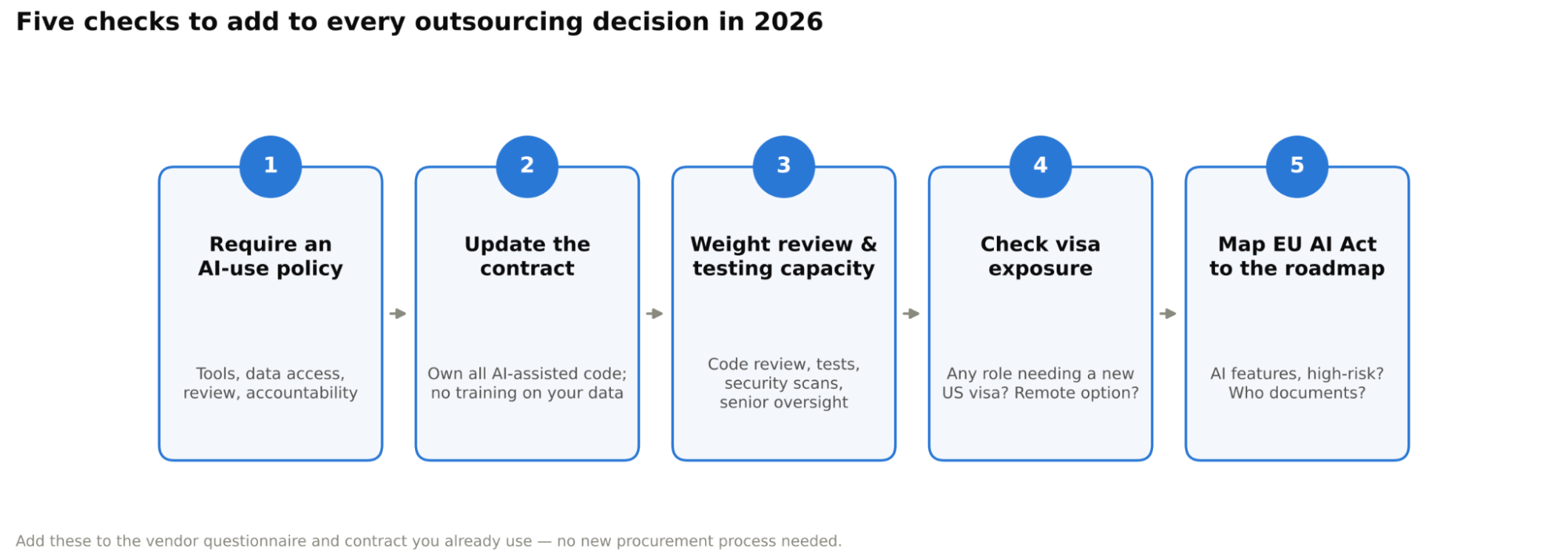
The 2026 changes add five questions to every outsourcing decision. None requires a new procurement process; they belong in the vendor questionnaire and the contract you already use.
| Action | Why it matters in 2026 | What to ask or add |
|---|---|---|
| Require an AI-use policy from the vendor | Engineers are likely using coding agents on your code | Which tools, which data they see, how output is reviewed, who is accountable |
| Update the contract for AI-generated code | IP, licensing and confidentiality terms predate AI tools | Clause confirming you own all deliverables, including AI-assisted code, and that your data is not used to train third-party models |
| Weight review and testing capacity | Speed is cheap; verified quality is not | Code review process, automated test coverage, security scanning, senior oversight ratio |
| Check delivery-model exposure to policy | Onsite models depend on visas that are legally contested | Whether any proposed role depends on a new US work visa, and the remote alternative |
| Map EU AI Act duties to the roadmap | Transparency duties apply now; high-risk duties from December 2027 | Which features are AI-driven, whether any could be high-risk, who prepares documentation |
If you are comparing outsourcing models or regions, AB Ark’s software outsourcing services buyer’s guide covers pricing models, rates by region and hidden costs in more detail.
What Developers Should Do Differently This Year
The same changes affect the engineers doing the work, whether they sit in an outsourcing vendor or an in-house team. Developers who adapt fastest will be the ones clients and employers trust with AI-assisted delivery.
- Treat AI output as a draft. Review, test and understand every AI-generated change before it is merged, and be able to explain it in code review.
- Invest in verification skills. Automated testing, security scanning and code review are now the scarce skills, not raw coding speed.
- Follow a written AI-use policy. Use only approved tools, keep client code and data out of tools that are not covered by the contract, and record where AI was used.
- Respect licensing and IP. Check that AI-suggested code does not introduce licensing conflicts, so clients can own their deliverables cleanly.
- Learn the regulatory basics. Understand when EU AI Act transparency duties apply to features you build, and help prepare the documentation clients will need.
- Strengthen remote collaboration. As onsite models face policy pressure, clear written communication and reliable time-zone overlap matter more.
An AB Ark Implementation Lens
AB Ark delivers custom software development through dedicated teams, staff augmentation and fixed-price projects, with offices in the UAE, the USA and Pakistan. That model is remote-first, so the onsite visa pressure described above does not apply to it in the same way. AB Ark’s All-in-One Business Platform case study shows the dedicated-team model in practice: the client was running operations across disconnected tools for tasks, communication, data and workflows, and an AB Ark team consolidated them into one platform covering accounting, task management and team collaboration. The trends in this article are AB Ark’s editorial analysis of public data, not a summary of that project’s results.
FAQs
Is software development outsourcing growing in 2026?
Yes, but more slowly than other technology spending. Gartner’s July 2026 forecast puts services spending at about $1.57 trillion in 2026, up 5.3%, compared with 15.5% growth for software and much faster growth for data center systems and IaaS. Outsourcing budgets are growing, but competing harder with AI and cloud costs.
Will AI replace software development outsourcing?
There is no evidence of that in 2026. AI coding tools are changing how outsourced teams work and how much they can deliver, but developers in Stack Overflow’s surveys report limited trust in AI output for important decisions. The demand is shifting toward teams that combine AI tools with strong review, testing and architecture skills.
Is offshore outsourcing still cheaper after the H-1B fee?
The US H-1B payment requirement affects onsite staffing models, where offshore engineers are brought to the US, rather than fully remote offshore teams. Remote offshore and nearshore delivery are not directly affected by the fee. The fee’s legal status remains contested, so check the latest position before relying on onsite staff.
Does the EU AI Act affect outsourced software development?
It can. If an outsourced team builds AI features used in the EU, the Act’s Article 50 transparency obligations have applied since 2 August 2026, and high-risk obligations for systems in areas such as hiring, credit and education apply from 2 December 2027. Responsibility usually sits with the company placing the system on the market, so define the vendor’s documentation duties in the contract.
What should I ask an outsourcing vendor about AI?
Ask which AI tools their engineers use, what data those tools can access, how AI-generated code is reviewed and tested, who owns the resulting code, and whether your data could be used to train third-party models. Ask for their written AI-use policy and make the key commitments contractual.
The Bottom Line for 2026
Software development outsourcing in 2026 is still growing, but it is being reshaped by AI-assisted delivery, policy pressure on onsite staffing, new AI regulation and budgets that favor software and AI infrastructure. The vendors worth hiring this year can show how they use AI responsibly, prove quality through review and testing, deliver remotely across time zones, and price against outcomes rather than headcount alone.
The outsourcing partner worth hiring in 2026 is not the one that promises the most AI speed. It is the one that can show how AI-assisted work is reviewed, owned and delivered.
Schedule a Free Consultation Call ->

Head Of Product