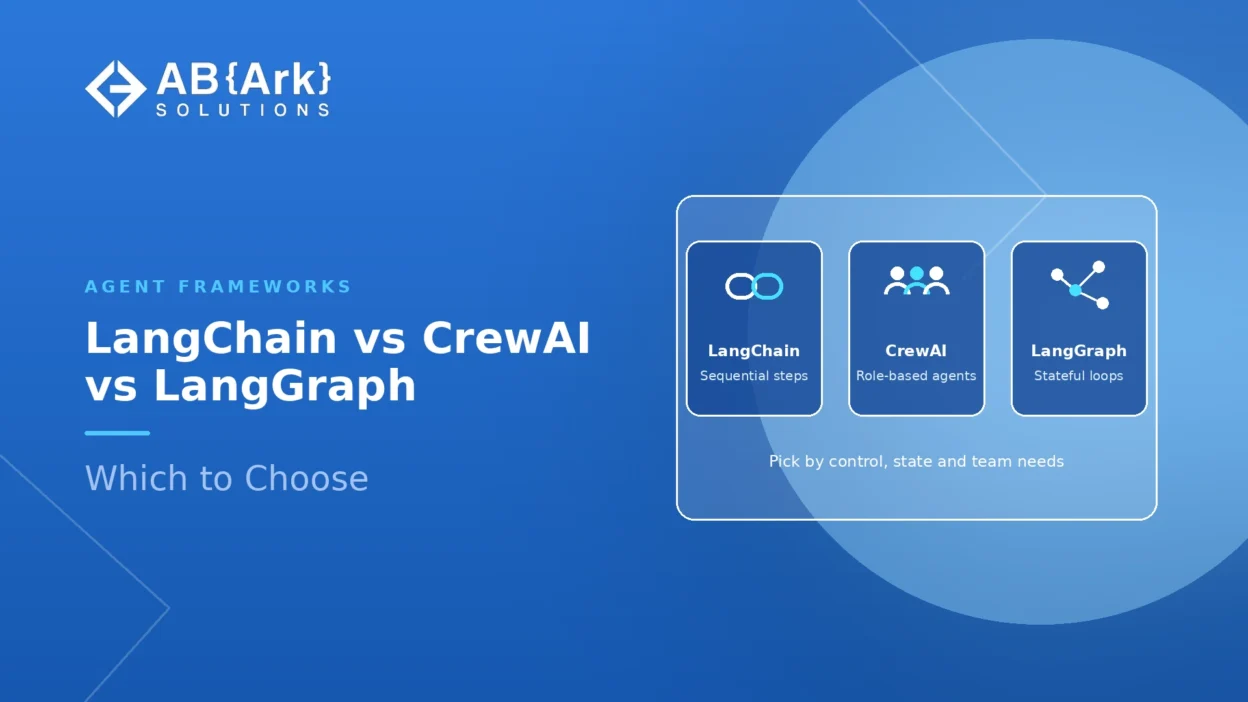

Choose LangChain to get a single tool-using agent working quickly with almost any model, CrewAI to organize several role-based agents that collaborate on a task, and LangGraph when you need precise control over branching, loops, state and human approvals. LangChain and LangGraph are not really rivals: LangChain’s agents run on LangGraph’s runtime. Among agentic AI frameworks, the real choice is between a fast, opinionated starting point and an explicit, controllable workflow.
Key Takeaways
- LangChain offers a pre-built agent (create_agent) and over 1,000 integrations; it runs on LangGraph’s durable runtime.
- LangGraph is a low-level orchestration framework for stateful, branching and long-running agents with memory and human-in-the-loop control.
- CrewAI is an independent framework built around crews of role-based agents, plus Flows for more structured orchestration.
- All three have open-source cores and separate commercial platforms (LangSmith and CrewAI’s enterprise platform) for observability and deployment.
- Simple, fixed workflows may not need an agentic AI framework at all.
Talk to Our Team About Your Project →
What Are Agentic AI Frameworks?
Agentic AI frameworks are libraries that handle the repetitive plumbing of building AI agents: connecting to a model, defining tools, parsing tool calls, managing memory, retrying failures and orchestrating multi-step or multi-agent work. Hugging Face’s agents course lists the core needs as an LLM engine, a list of tools, a parser for tool calls, a system prompt synced with that parser, a memory system, and error logging and retry mechanisms.
The same course makes a point many comparisons skip: an agentic framework is not always needed. If the workflow is a predefined chain of prompts, plain code gives full control without abstractions. Frameworks start to pay off when an LLM must call functions or several agents must work together.
How Do LangChain, LangGraph and CrewAI Relate?
LangChain and LangGraph come from the same company and form two layers of one stack, while CrewAI is a separate framework with its own ecosystem.
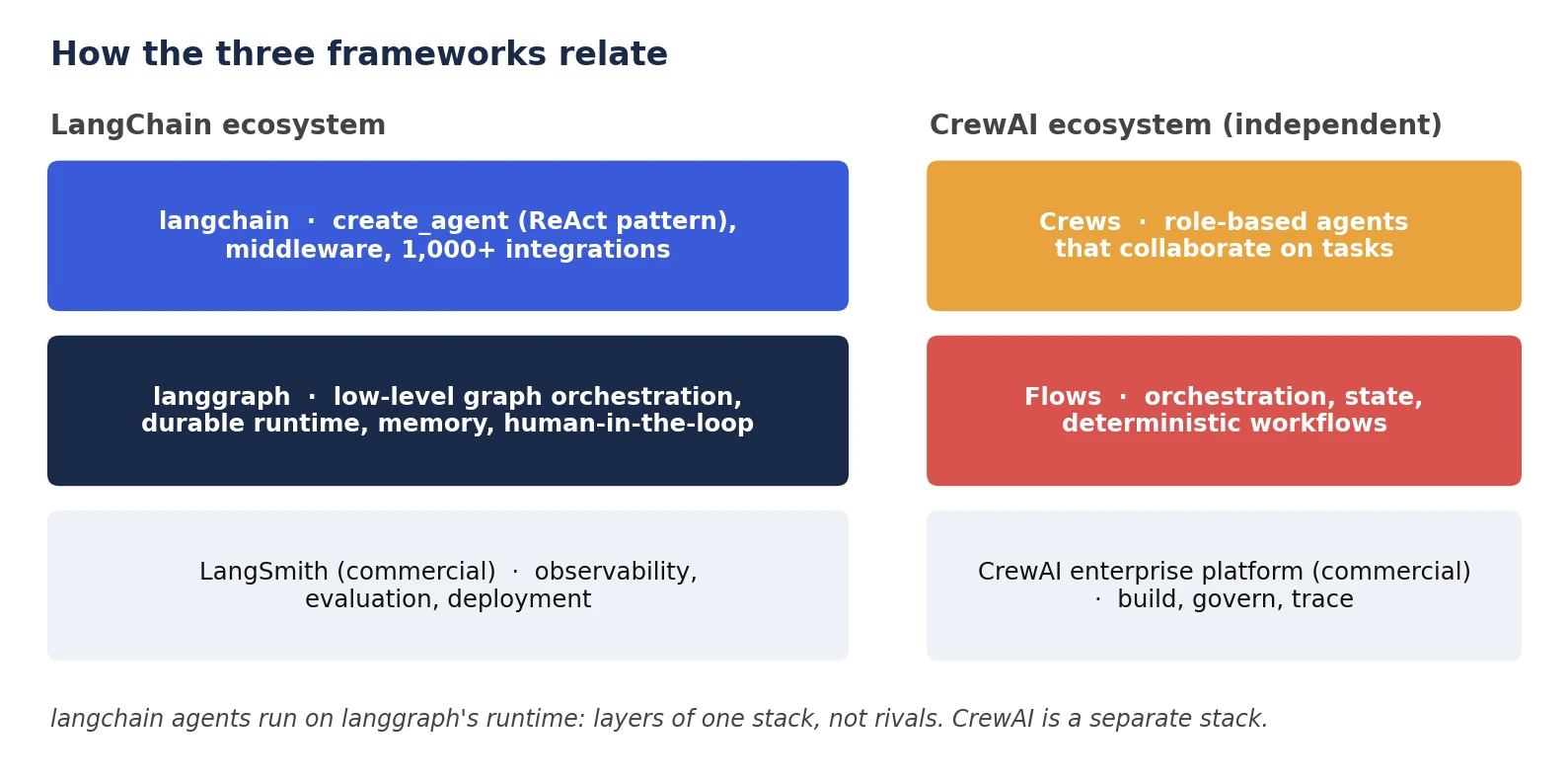
LangChain’s product page states that its create_agent function provides a proven ReAct (Reason + Act) pattern on LangGraph’s durable runtime, giving agents persistence, rewind, checkpointing and human-in-the-loop support. As of October 2026, LangChain’s site positions three open-source frameworks: langchain for quick-start agents with any model provider, langgraph for agents with low-level control, and Deep Agents (deepagents) for long-running, complex tasks.
CrewAI, by contrast, describes itself as an open-source multi-agent platform with high-level abstractions and low-level APIs, plus a commercial enterprise platform for building and running agents.
LangChain: Fastest Path to a Working Agent
LangChain is best when you want one capable agent working quickly and the freedom to swap models and tools. LangChain describes itself as an open-source framework with a pre-built agent architecture and integrations for any model or tool, citing more than 1,000 integrations.
Strengths: fast setup with create_agent, broad model and tool integrations, and middleware hooks for human-in-the-loop approval, summarization and PII redaction.
Trade-offs: the default agent loop is opinionated; complex branching and multi-agent control are better expressed directly in LangGraph.
License: MIT, per LangChain’s FAQ.
LangGraph: Control for Complex, Stateful Agents
LangGraph is best when the workflow itself matters as much as the model. LangChain describes LangGraph as an agent runtime and low-level orchestration framework with durable execution, memory, streaming and human-in-the-loop controls.
Strengths: explicit nodes and edges, shared state, loops and retries you can see and test, checkpointing, built-in memory across sessions, and support for single-agent, multi-agent and hierarchical designs.
Trade-offs: more code and design upfront; you are building the control flow rather than accepting a default one.
License: MIT, per LangGraph’s FAQ.
CrewAI: Role-Based Multi-Agent Teams
CrewAI is best when a task naturally divides into roles, such as researcher, analyst and writer, that collaborate. CrewAI’s open-source page explains that you describe each agent’s role, goal and backstory, optionally setting its model, reasoning, memory, tools and skills, and define agents in YAML, code or both.
Strengths: readable role-based setup, hundreds of built-in tools, support for the Model Context Protocol (MCP) and the Agent2Agent (A2A) protocol, memory, planning and checkpointing for replaying or forking runs.
Structure when needed: Flows add orchestration and state around crews, and CrewAI’s enterprise platform advertises deterministic workflows, tracing, approval gates and policy hooks.
Trade-offs: the role metaphor can hide control flow; debugging depends on good tracing, and highly custom branching may be easier in an explicit graph.
LangChain vs CrewAI vs LangGraph: Side-by-Side Comparison
| Factor | LangChain | LangGraph | CrewAI |
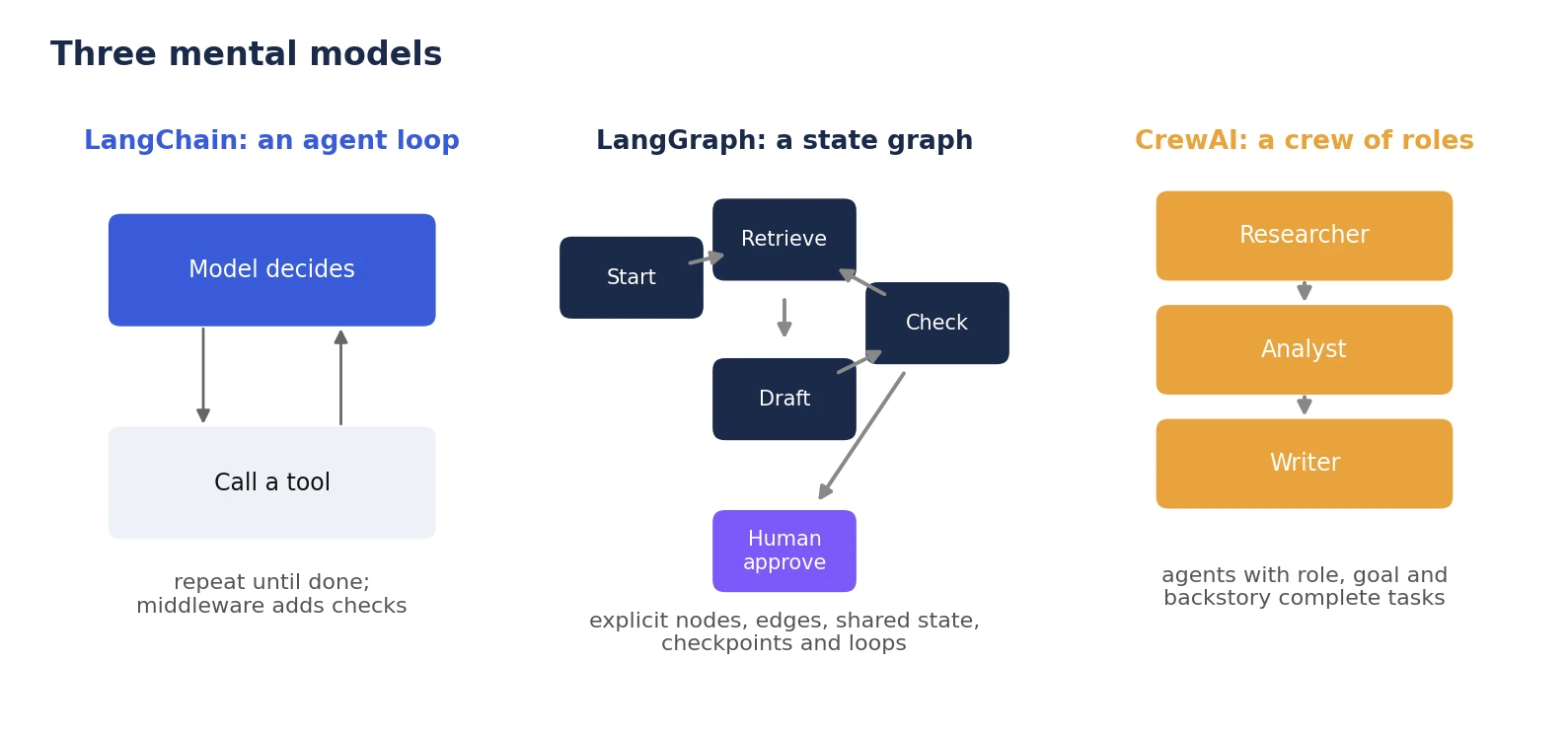
| Core idea | Pre-built agent loop with integrations | Explicit graph of steps with shared state | Crew of role-based agents completing tasks |
| Best for | Single agents, fast prototypes, model flexibility | Complex, branching, long-running workflows | Multi-agent collaboration with clear roles |
| Control over flow | Medium (middleware hooks) | High (you define every edge) | Medium; higher with Flows |
| Learning curve | Low | High | Low-Medium |
| Human-in-the-loop | Via middleware | Built in (interrupts) | Approval gates in enterprise platform; supported in Flows |
| State and memory | Via LangGraph runtime | Built-in persistence and memory | Built-in memory and checkpointing |
| Commercial platform | LangSmith | LangSmith | CrewAI enterprise platform |
| Open-source license | MIT | MIT | MIT |
Sources: LangChain, LangGraph and CrewAI open-source product pages and CrewAI’s GitHub repository, checked October 2026. The comparison judgments are AB Ark’s editorial assessment.
Which Framework Should You Choose?
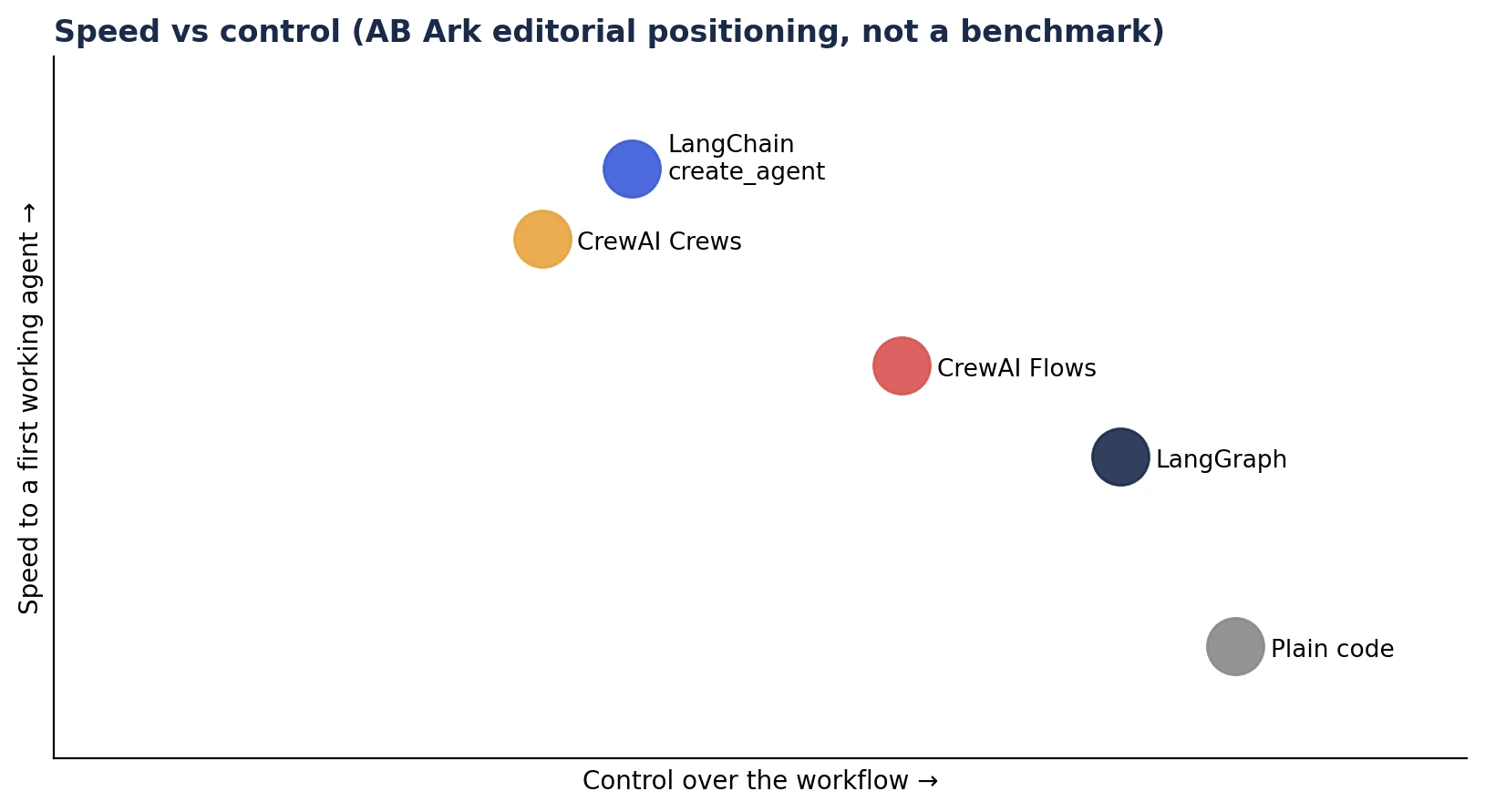
Choose by the shape of the work, not by popularity. This AB Ark decision guide is an editorial framework, not an industry standard.
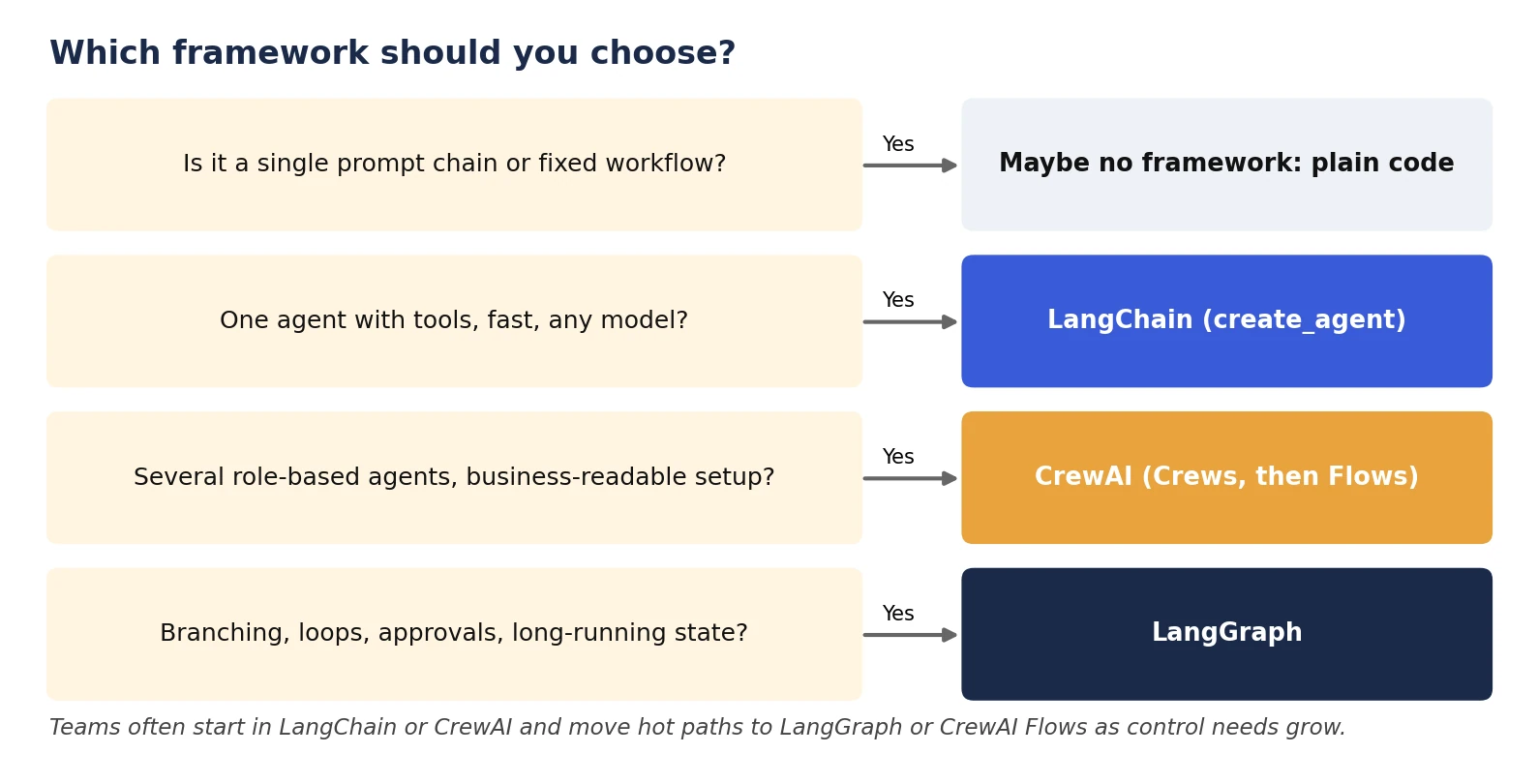 Plain code for a fixed sequence of prompts or a single tool call. You keep full control and avoid framework upgrades.
LangChain for one agent that uses tools, especially when you expect to switch models or need many integrations.
CrewAI for work that maps to roles and handoffs, such as research-to-report pipelines, lead enrichment or content workflows, and when business stakeholders need to read the setup.
LangGraph for production workflows with branching, retries, approvals, long-running state or strict audit needs, such as agentic Retrieval-Augmented Generation (RAG) pipelines and regulated processes.
Many teams prototype in LangChain or CrewAI and move critical paths into LangGraph or CrewAI Flows once requirements stabilize. For retrieval-heavy agents, data quality matters more than the framework; see AB Ark’s guide to why RAG systems fail in production.
What Matters More Than the Framework?
Framework choice is rarely what makes an agent succeed in production. The deciding factors are usually:
Evaluation: a test set of real tasks you re-run before every change.
Observability: traces of every model call, tool call and decision. LangChain’s ecosystem uses LangSmith; CrewAI’s enterprise platform advertises tracing with cost accounting; both can integrate with third-party tools.
Tool design: clear tool descriptions, validated arguments and least-privilege permissions.
Exit costs: keep business logic, prompts and tools in your own modules so you can change framework if needed.
AB Ark’s agentic AI development team applies the same criteria whichever framework a project uses.
FAQs
Is LangGraph replacing LangChain?
No. LangChain’s agents run on LangGraph’s runtime, so they are layers of the same stack. LangChain is the faster, higher-level option; LangGraph is the lower-level option for custom control flow.
Is CrewAI built on LangChain?
No. CrewAI is an independent framework with its own open-source project and enterprise platform, and it does not require LangChain to build crews. Early versions of CrewAI used LangChain; later releases removed that dependency, which is why the question still comes up.
Which agentic AI framework is best for beginners?
LangChain’s create_agent or a simple CrewAI crew are the quickest starting points.
Which framework is best for production?
LangGraph offers the most explicit control for complex production workflows, while CrewAI and LangChain both offer production platforms. The best choice depends on how much control flow you need to define and test.
Do I need an agentic AI framework at all?
Not always. Hugging Face notes that predefined workflows and simple prompt chains can be built in plain code with full control. Frameworks help once agents call tools, use memory or coordinate with other agents.
Pick the framework that matches how your workflow actually behaves: a loop, a team or a graph. Then invest in evaluation and tracing, because those decide whether it survives production.

Head Of Product