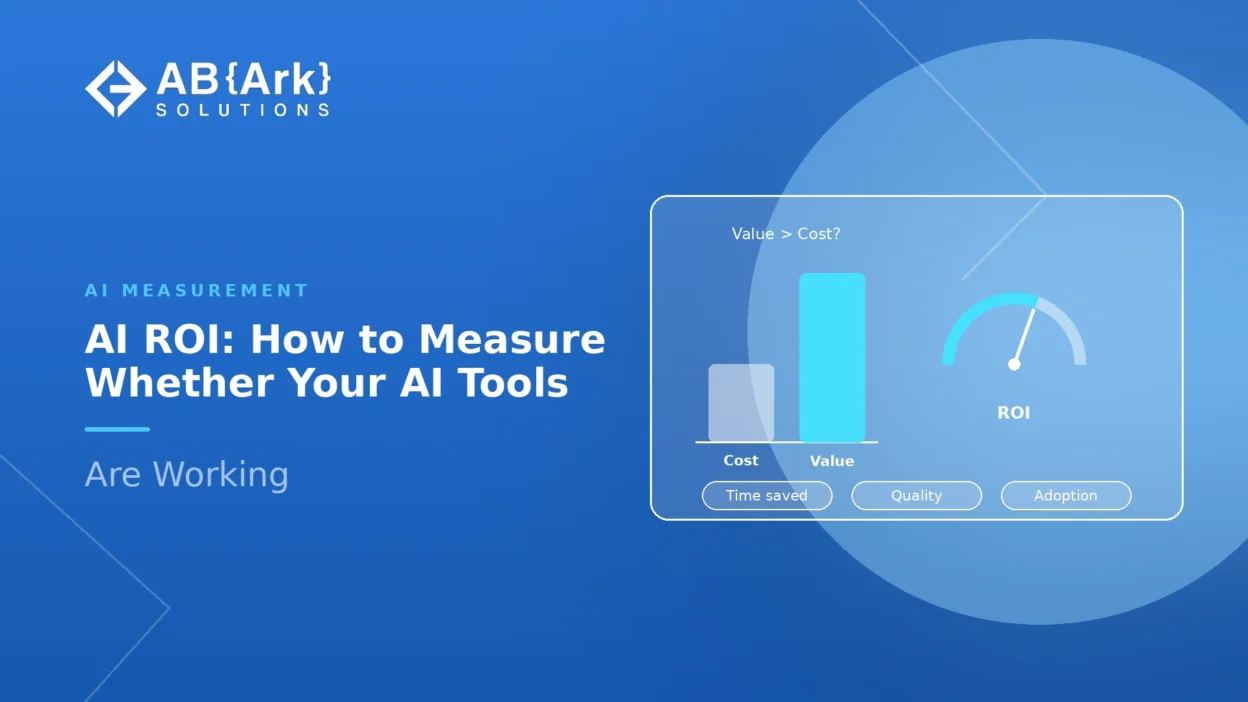

AI ROI is the measured benefit of an AI tool minus its full cost, divided by that cost. To know whether your AI tools are working, compare performance against a baseline from before the tool, using real output and quality data rather than how productive people feel. Count every cost, including integration, training, oversight and rework. Then decide per tool whether to scale, optimize, rethink or stop. Results vary widely: rigorous studies have found both large gains and measurable slowdowns.
Key Takeaways
- Measure AI ROI against a pre-AI baseline and, where possible, a comparison group. Self-reported productivity is unreliable.
- In a randomized trial, experienced developers expected AI to make them 24% faster, felt 20% faster afterwards, and actually took 19% longer.
- In a large customer support study, an AI assistant raised issues resolved per hour by 14% on average, with much larger gains for less experienced agents.
- Time saved only becomes financial ROI if it is redeployed to valuable work or reduces cost.
- Track a ladder of metrics, from adoption to business outcomes, and calculate ROI only on outcomes.
Talk to Our Team About Your Project →
What Is AI ROI?
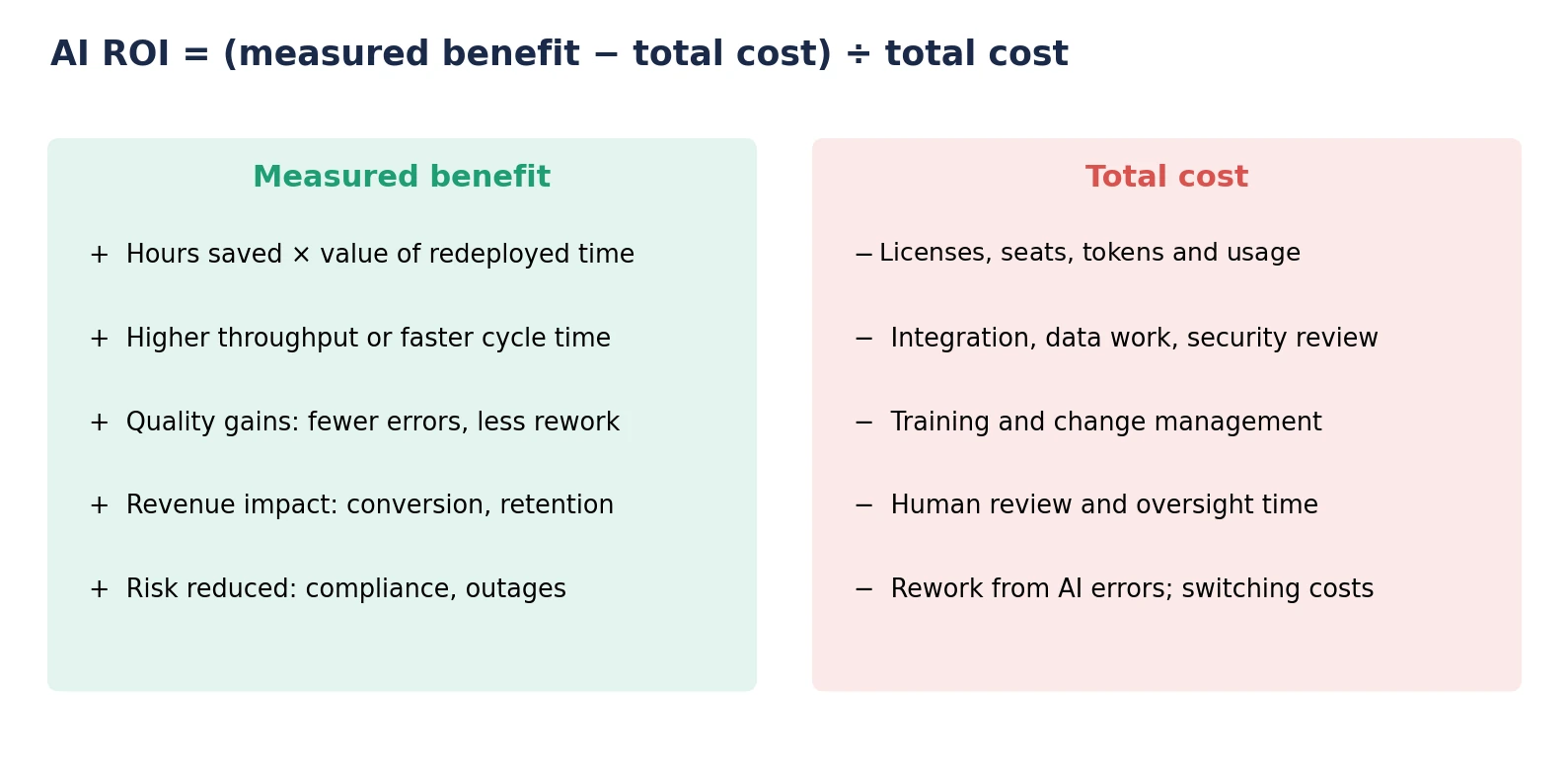
AI ROI is the return an organization gets from an AI tool or project relative to what it spends on it. The basic formula is the same as any investment: (measured benefit minus total cost) divided by total cost. What makes AI different is that both sides of the equation are easy to get wrong. Benefits are often estimated from enthusiasm rather than measured, and costs are often limited to license fees.
Why Is AI ROI So Hard to Measure?
AI ROI is hard to measure because the benefits are spread across many small tasks, people misjudge their own productivity, and the costs are partly hidden in other teams’ time.
People feel faster than they are
The clearest evidence comes from a 2025 randomized controlled trial by METR. Sixteen experienced open-source developers completed 246 real tasks in large, mature codebases they knew well, with each task randomly allowed or disallowed AI tools. Developers forecast a 24% speed-up beforehand and still estimated a 20% speed-up afterwards, but tasks with AI took 19% longer.
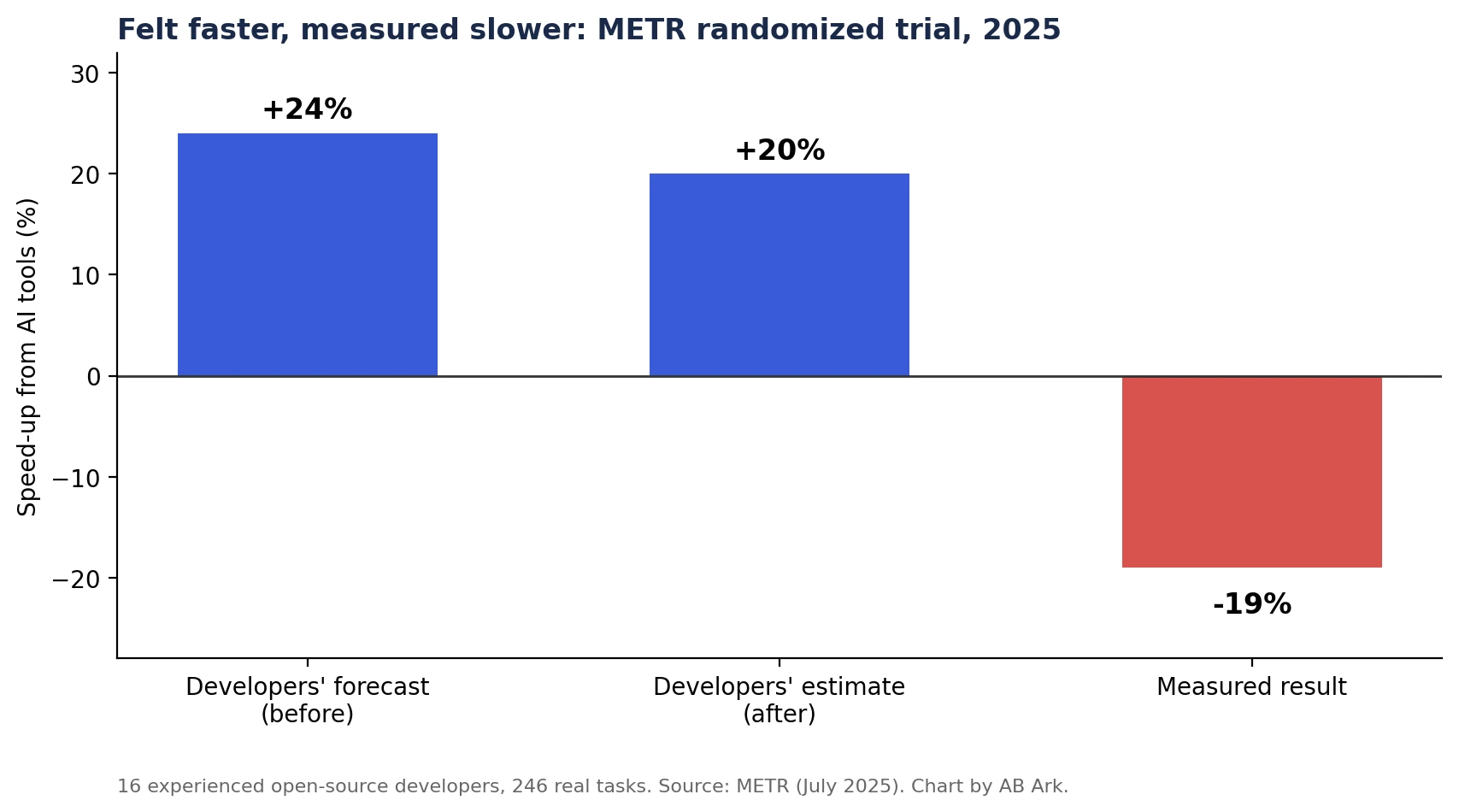
METR is careful about scope: the researchers note that the slowdown does not mean AI tools rarely help, and that high familiarity with the code and the size of the repositories both contributed. The lesson for ROI is narrower and more useful: if you measure AI impact with surveys, you may be measuring sentiment, not productivity.
Gains are real but uneven
The same rigour can also show strong returns. A study of 5,179 customer support agents by Erik Brynjolfsson, Danielle Li and Lindsey Raymond found that access to a generative AI assistant increased issues resolved per hour by 14% on average, including a 34% improvement for novice and low-skilled workers, with minimal impact on the most experienced. The authors also reported better customer sentiment and higher employee retention.
Together, these studies make the central point of this article: the same category of tool can create value in one workflow and destroy it in another. ROI has to be measured per use case, not assumed per product.
Projects get canceled when value is unclear
Unclear value has consequences. Gartner predicted in June 2025 that over 40% of agentic AI projects would be canceled by the end of 2027 due to escalating costs, unclear business value or inadequate risk controls.
What Should You Measure?
Measure AI tools on a ladder of metrics, from activity at the bottom to business value at the top. Most dashboards stop at the bottom two rungs.
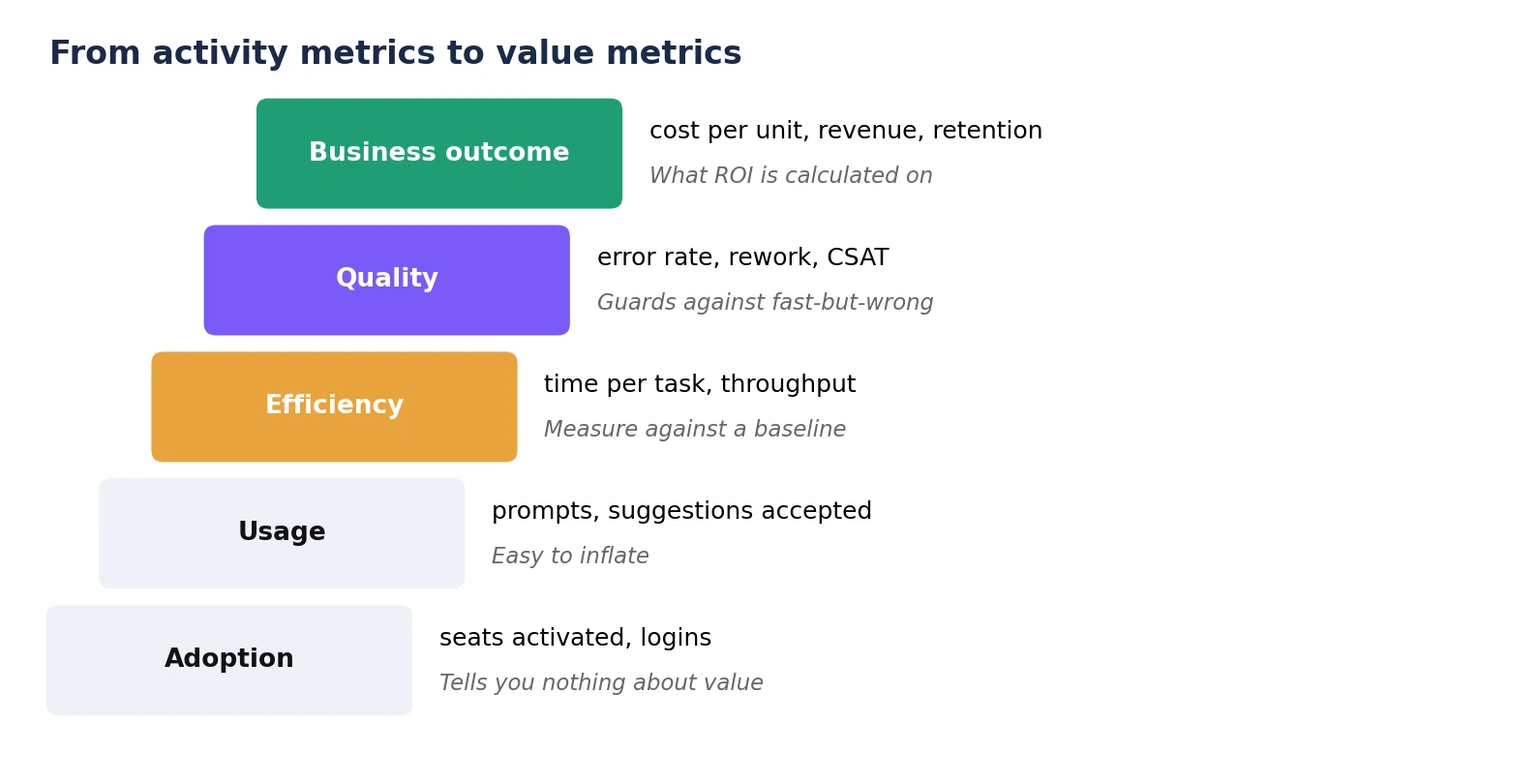
| Metric level | Examples | How to use it |
| Adoption | Seats activated, weekly active users | Diagnose rollout problems; never report as ROI |
| Usage | Prompts, suggestions accepted, agent runs | Spot under-use or over-reliance |
| Efficiency | Time per task, tickets per hour, cycle time | Compare against a pre-AI baseline |
| Quality | Error rate, rework, escalations, customer satisfaction | Confirm speed did not come at the cost of accuracy |
| Business outcome | Cost per ticket, revenue per rep, churn, time to market | The basis for the ROI calculation |
How Do You Measure AI ROI Properly?
Measure AI ROI with a simple experiment rather than a survey. Five steps cover most tools:
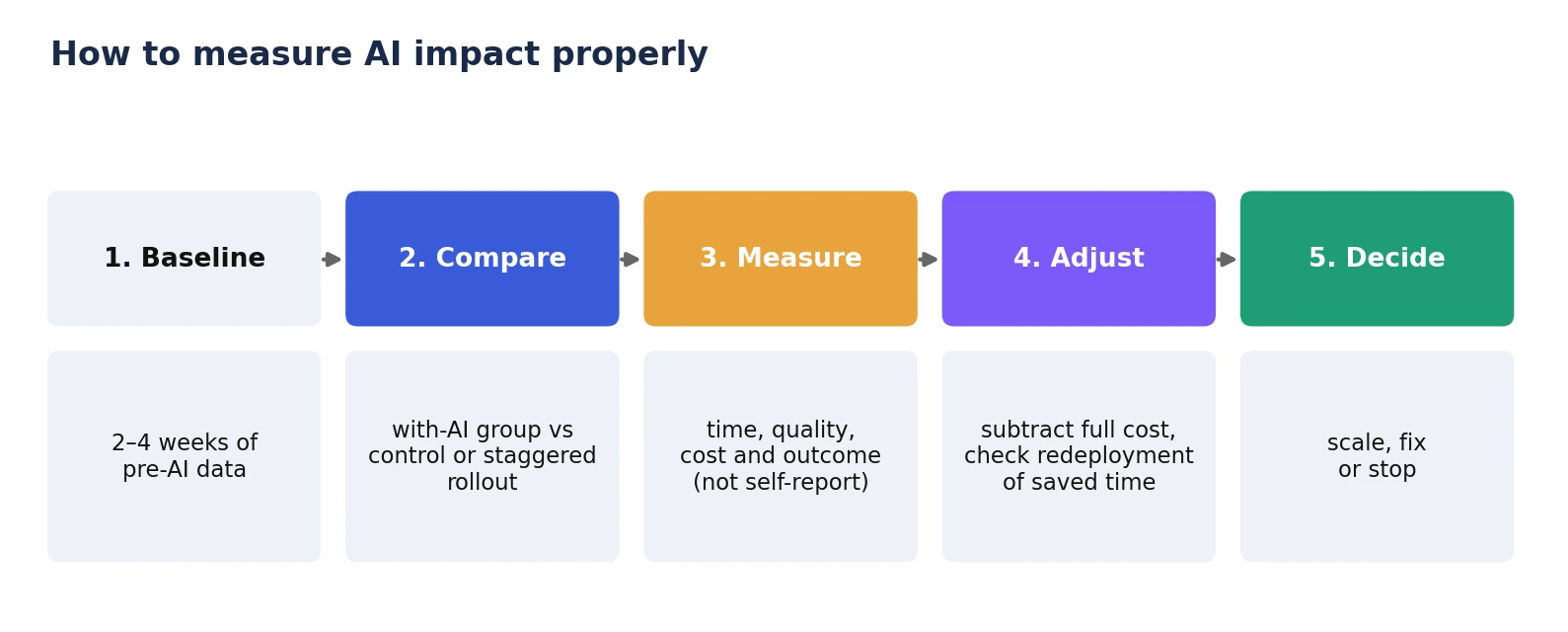
- Capture a baseline: record the target metrics for a few weeks before rollout, or use historical data for the same team and task mix.
- Create a comparison: roll out to one group first, or stagger rollout across teams, so you can compare with-AI and without-AI performance over the same period. This is the approach the customer support study used.
- Measure output, not opinion: use system data such as tickets closed, pull requests merged, documents processed and error rates. Surveys are useful for adoption barriers, not for productivity.
- Subtract the full cost: include licenses and usage fees, integration and data work, security review, training, the time people spend reviewing AI output, and rework from AI mistakes.
- Decide: scale, optimize, rethink or stop, and repeat the measurement after major model or workflow changes.
For AI agents, add per-task cost and quality tracking from production traces, because agent costs vary sharply between runs.
A Worked Example of an AI ROI Calculation
The example below is hypothetical and simplified; it shows the method, not expected results. A 20-person support team adopts an AI assistant.
| Item | Assumption | Year-1 amount |
| Agent time | 20 agents × 160 hours/month at a $30/hour loaded cost | $1,152,000 baseline cost |
| Measured productivity gain | 10% more tickets per hour vs baseline, quality unchanged | +$115,200 of capacity |
| Licenses | $40 per seat per month × 20 | −$9,600 |
| Integration and setup | One-off | −$6,000 |
| Ongoing admin and review | 10 hours/month × $50 | −$6,000 |
| Total cost | $21,600 | |
| ROI (year 1) | ($115,200 − $21,600) ÷ $21,600 | ≈ 433% |
The 10% gain is a net measured figure, so agents’ own time spent reviewing AI output is already inside it; the 10 hours a month above covers only administration and oversight. In year 2 the one-off setup cost drops out, so the ROI would be higher. Two adjustments change this answer completely. First, the $115,200 is capacity, not cash. It becomes financial return only if the team absorbs growth without hiring, reduces overtime or contractor spend, or redeploys the time to revenue-generating work. If the saved hours simply disappear into the day, the financial ROI is close to minus 100%. Second, if the measured gain were zero or negative, as METR found for experienced developers, the same costs would produce a total loss. That is why the measured gain, not the vendor’s claimed gain, belongs in the formula.
What Should You Do With the Results?
Once each AI tool has a measured value and a full cost, place it in one of four categories.
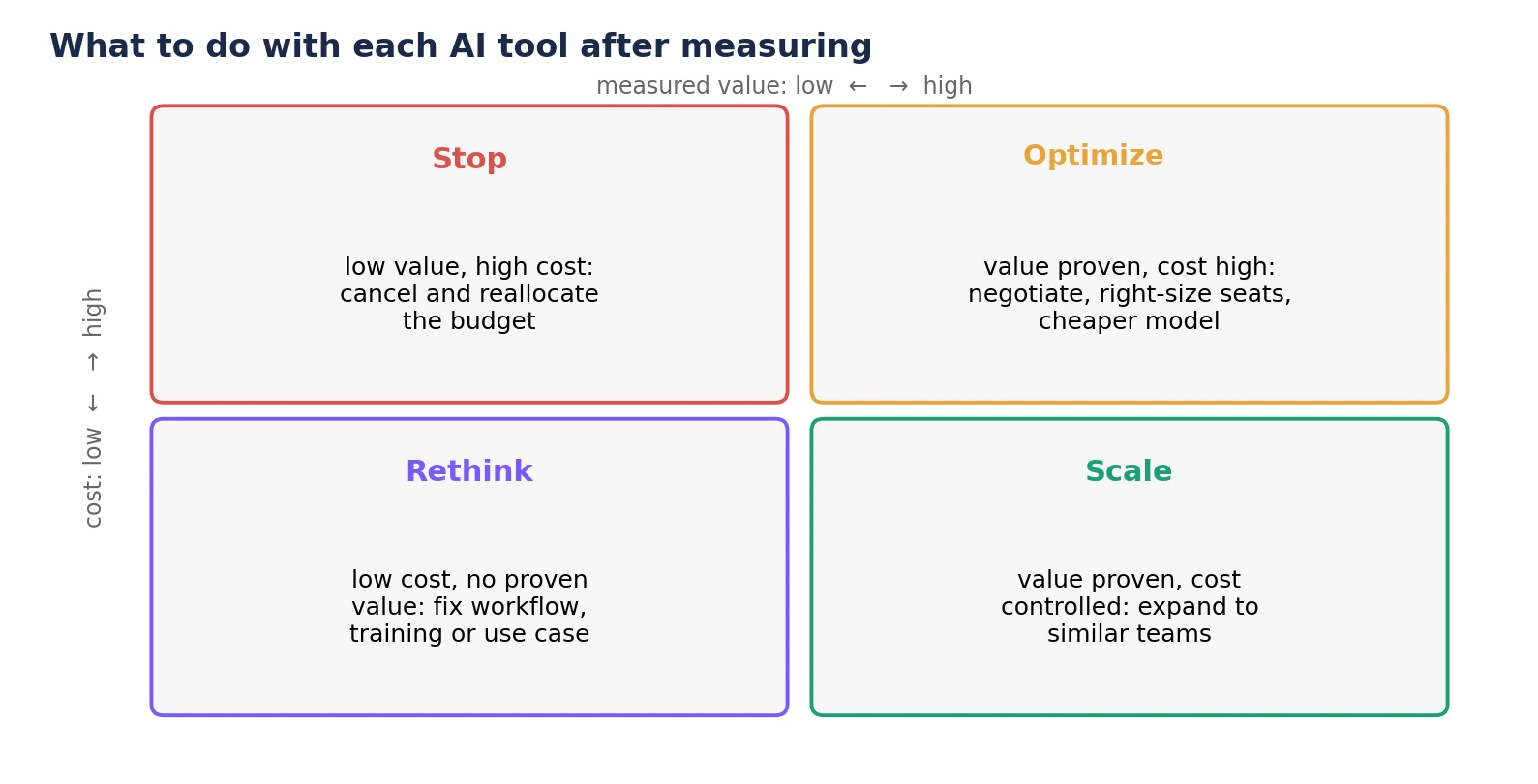 Scale tools with proven value and controlled cost to similar teams and workflows.
Optimize tools with proven value but high cost: right-size seats, negotiate, cache or switch to a cheaper model for routine tasks.
Rethink cheap tools with no proven value: the problem is often the workflow, training or use case, not the tool.
Stop tools with no measurable value and real cost, and move the budget to the use cases that are working.
Common Mistakes in Measuring AI ROI
Reporting adoption as success: activated seats and prompt counts show activity, not value.
Trusting self-reports: the METR trial shows how far perception and measurement can diverge.
Ignoring quality: faster output with more errors can reduce net productivity once rework is counted.
Counting time saved as money saved: only redeployed time or avoided cost appears in the financials.
Averaging across very different users: the support study found large gains for novices and minimal gains for experts. Segment results by role and experience.
Measuring once: models, prices and workflows change; re-measure after major updates.
Teams building custom AI agents with AB Ark’s agentic AI development service define these baselines and metrics before build starts, so ROI can be measured from the first release.
FAQs
How do you calculate AI ROI?
Subtract the total cost of the AI tool, including licenses, integration, training, oversight and rework, from its measured benefit, then divide by the total cost. Measure the benefit against a pre-AI baseline using real output and quality data.
What is a good ROI for AI tools?
There is no reliable universal benchmark, because results depend heavily on the task and the user. Set a target per use case before rollout, such as a cost-per-ticket reduction, and judge each tool against its own target.
How long does it take to see ROI from AI?
It depends on setup effort and learning curves. Measure early efficiency and quality signals within the first few weeks, but judge financial ROI only once saved time has been redeployed or costs have actually fallen.
Why do AI tools sometimes reduce productivity?
Time spent prompting, waiting for and reviewing AI output can outweigh the time saved, especially for experts working on familiar, complex tasks. METR’s trial found exactly this pattern for experienced developers.
Should we measure AI ROI with employee surveys?
Use surveys to understand adoption barriers and satisfaction, not to measure productivity. Self-reported speed-ups can be large even when measured performance has not improved.
AI tools pay off when you can prove it. Set a baseline, measure real output and quality, count every cost, and let the numbers decide what to scale and what to stop.
Head Of Engineering Department