
The AI pilot to production cost is the cost of turning a working AI demo into a system real users can rely on. It usually runs well above the pilot budget, because production adds work a pilot deliberately skips: data pipelines, integrations, security, evaluation, monitoring, user management and recurring model and hosting costs. A credible delivery quote itemizes each of these, states its assumptions and separates the one-time build from monthly run costs.
Key Takeaways
- An AI pilot proves a model can do the task; production proves the system can do it reliably, securely and affordably at real volume.
- In a July 2024 forecast, Gartner predicted that at least 30% of generative AI projects would be abandoned after proof of concept by the end of 2025, citing data quality, risk controls, costs and unclear value.
- The AB Ark Production Readiness Path names eight stages a pilot must pass before go-live, and each stage should appear as a line item in the delivery quote.
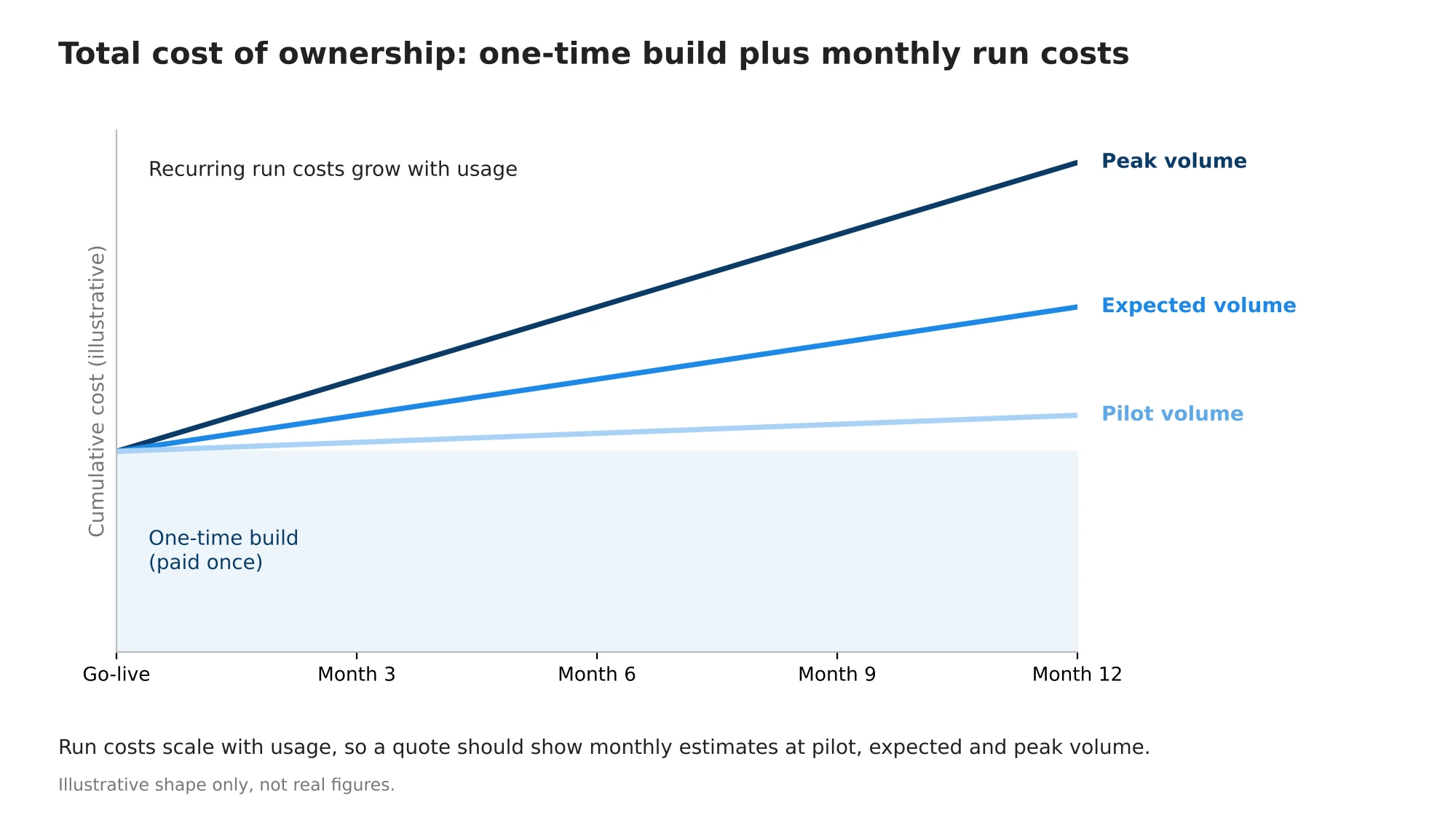
- Recurring run costs, such as model API usage, hosting and monitoring, should be quoted separately from the build at stated usage levels.
- A missing line item in an AI quote is not a saving; it is a change request waiting to happen.
Talk to Our Team About Your Project ->
What Is an AI Pilot to Production Cost?
AI pilot to production cost is the total cost of moving an AI system from a limited proof of concept or pilot into live use, plus the recurring cost of running it. It covers one-time build work and ongoing run costs, and it is distinct from the cost of the pilot itself.
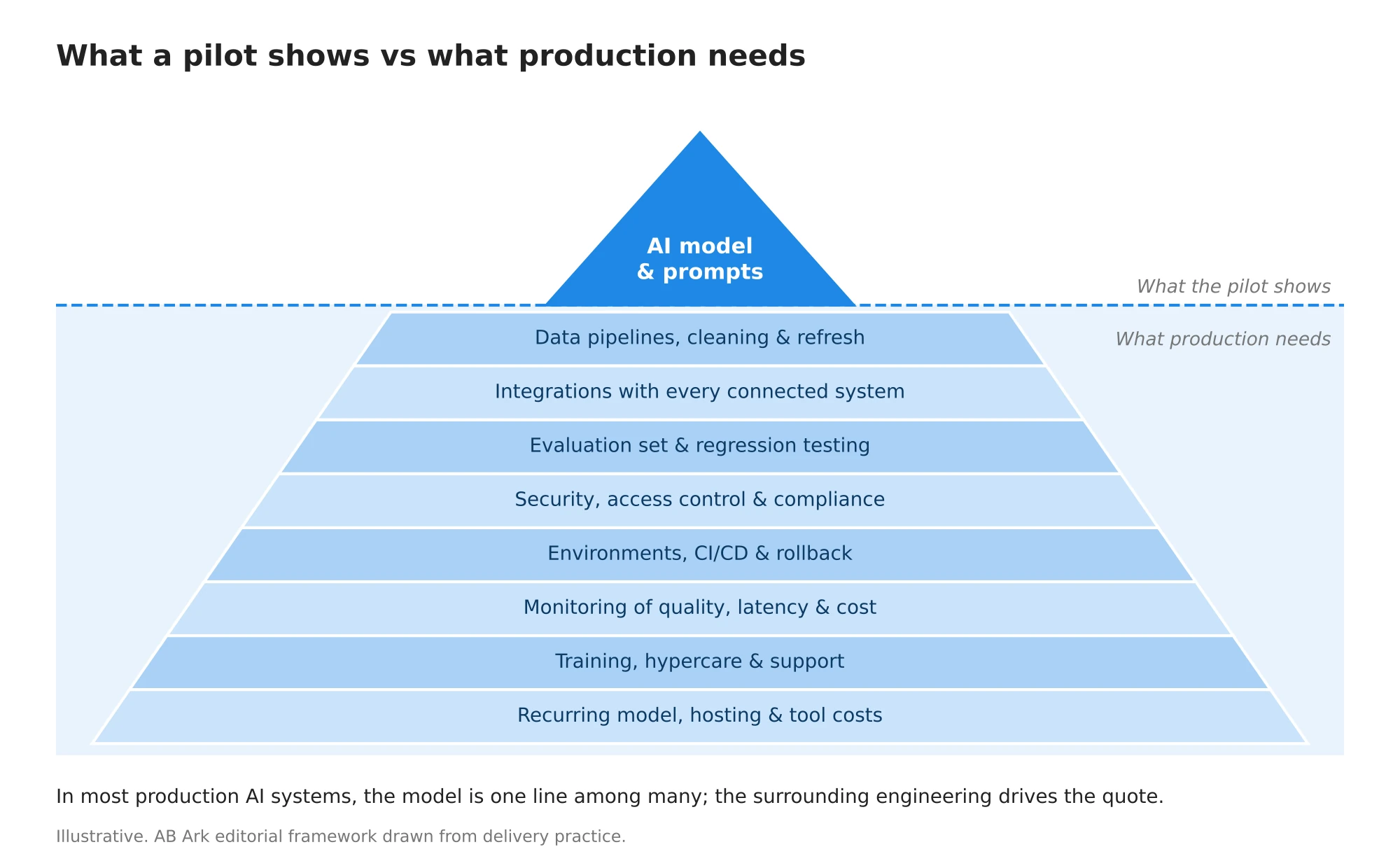
Includes: data engineering, integrations, evaluation, security and compliance work, infrastructure and deployment, monitoring, training, support, and recurring model, hosting and third-party costs. Excludes: the original pilot or proof of concept, and unrelated platform upgrades. Common misconception: that production cost is mostly model cost. In most production AI systems, the model is one line among many, and the surrounding engineering drives the quote.
Realities of Pilot and Production Systems
A pilot runs under controlled conditions: a known dataset, a handful of users and an engineer watching every output. A production system runs on live data, serves users who do not follow the happy path, and has to keep working when nobody is watching. The gap between the two is mostly the engineering around the model, which is why the production quote looks so different from the demo.
Why AI Pilot to Production Cost Matters
AI pilot to production cost matters because the gap between pilot budget and production cost is where many AI projects stall. Many pilots run on clean sample data, a small internal user group and heavy human oversight; production removes all three, and that is where cost and risk concentrate.
In a July 2024 forecast, Gartner predicted that at least 30% of generative AI projects would be abandoned after proof of concept by the end of 2025, citing poor data quality, inadequate risk controls, escalating costs or unclear business value. The same forecast put the cost of some generative AI deployment approaches at $5 million to $20 million. In AB Ark’s experience, narrow single-workflow systems cost far less.
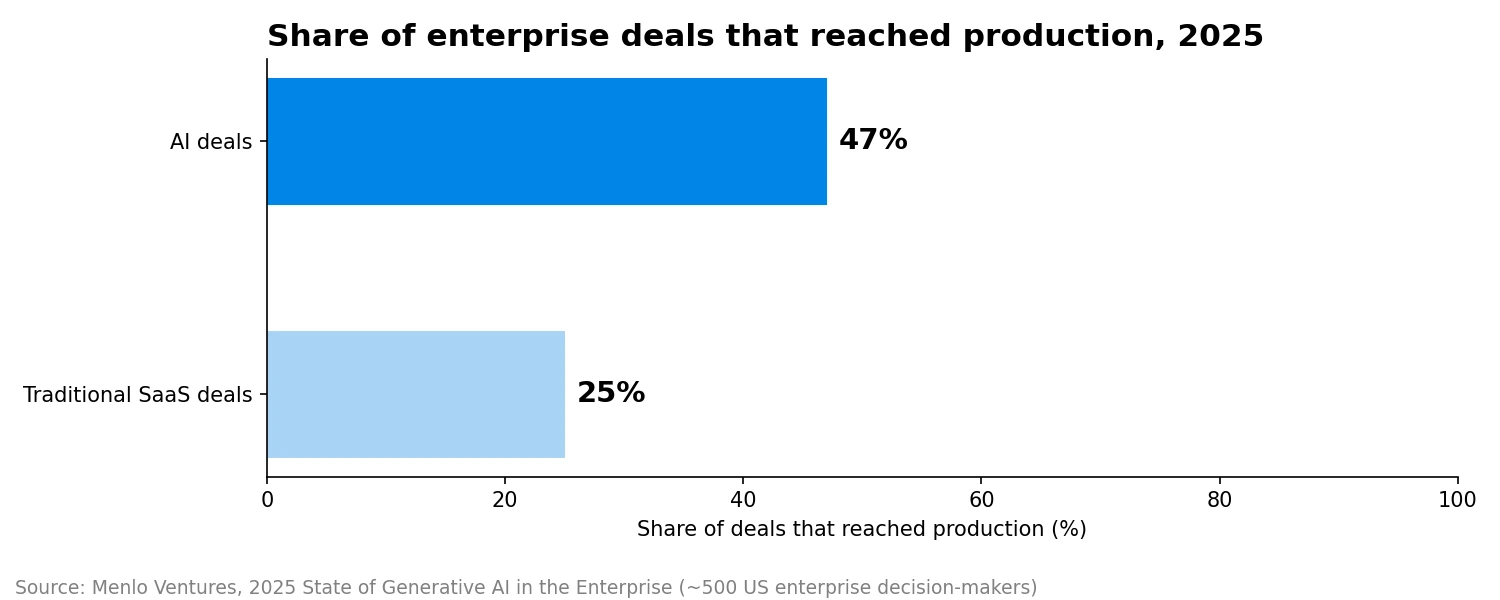
Production is achievable when it is planned for. Menlo Ventures’ 2025 survey of around 500 US enterprise decision-makers found that 47% of AI deals reached production, compared with 25% for traditional SaaS.
How Making Pilots Is Now Easier Than Ever
Building a pilot has never been easier. Hosted model APIs, managed vector databases and no-code orchestration tools let a small team produce a convincing demo in days. That speed is useful, but it widens the gap: the demo gets cheaper to build while the work production still needs stays the same.
Common pilot assumptions, and what each hides in the production budget:
| Pilot assumption | Why it feels safe | What production actually needs |
|---|---|---|
| Sample data is representative | “The model handled our test files well” | Pipelines, cleaning, refresh schedules and permissions for real data |
| A demo is an integration | “It already shows results on screen” | Connections to every system the AI reads from or writes to |
| Spot checks prove quality | “The team reviewed the outputs” | A golden test set, automated evaluation and regression testing |
| Internal use needs little security | “Only our staff use it” | Authentication, roles, logging and prompt-injection defenses |
| Usage costs are trivial | “The API bill was small” | A run-cost estimate at expected and peak volume |
| Someone will look after it | “The pilot team knows it” | Monitoring, support terms and a named owner after launch |
Implication: compare the production quote with the production scope, not with the pilot invoice.
How to Handle Cost Creep
Cost creep usually comes from unpriced scope: a new data source, an extra language or a stakeholder request added midway. Handle it with a written baseline scope, a change process in which every change is priced before work starts, a contingency range agreed at quote stage, and a monthly comparison of actual run costs against the estimate.
How Pilot to Production Works: The AB Ark Production Readiness Path
The AB Ark Production Readiness Path breaks the move from pilot to production into eight stages, each with a quote line item. It is an AB Ark editorial framework drawn from delivery practice rather than a published standard.
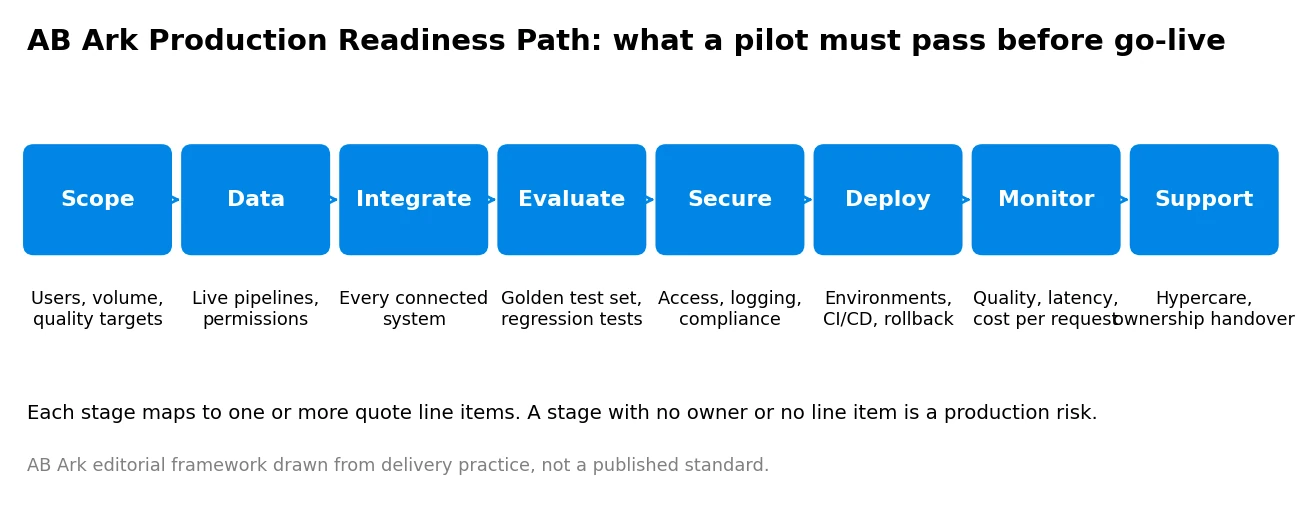
| Stage | What it covers | Ask the vendor |
|---|---|---|
| 1. Scope | Workflow, users, systems, volume and quality targets | Can I see the written scope and success metrics? |
| 2. Data | Ingestion, cleaning, chunking and indexing for retrieval-augmented generation (RAG), permissions, refresh | Who prepares the data and how often does it refresh? |
| 3. Integrate | CRM, ERP, document stores, identity provider, internal APIs | Is every system I listed priced in? |
| 4. Evaluate | Golden test set, automated evaluations, regression tests, safety filters | How will quality be measured before and after launch? |
| 5. Secure | Access control, encryption, logging, GDPR terms, EU AI Act transparency duties | Which data leaves our environment, and can it train models? |
| 6. Deploy | Environments, CI/CD, prompt and model versioning, rollback, scaling | Who owns the cloud accounts and pipeline at handover? |
| 7. Monitor | Latency, error rates, output quality, cost per request, user feedback | Which dashboards and alerts are included, and who responds? |
| 8. Support | Training, documentation, hypercare, maintenance terms | How long is hypercare, and which bug versus change definitions apply? |
AI Production Cost: One-Time Build vs Recurring Run Costs
A production AI quote should split costs into what the buyer pays once and what the buyer pays every month. Mixing the two hides the real cost of ownership and makes quotes impossible to compare. This article does not give benchmark figures; the table below shows what to price, not what it typically costs.
| Cost type | What it includes | How to quote it |
|---|---|---|
| One-time build | Discovery, data pipelines, integrations, evaluation set, security setup, infrastructure, interface work, training | Fixed fee or estimate per readiness stage |
| Recurring run | Model API usage or inference compute, vector database and app hosting, monitoring tools, third-party services | Monthly estimate at pilot, expected and peak volume |
| Recurring support | Maintenance, model and prompt updates, data refresh, incident response | Monthly retainer or support tier with response times |
Run costs move with usage: model API calls and hosting grow with users, request length and frequency, so a single monthly figure without a volume assumption is not a usable estimate.
 Worked example (illustrative)
A logistics company has piloted an assistant that answers customer questions about shipments from a sample of 200 help-center articles, used by ten internal staff for six weeks. The production scope adds live shipment data from the transport management system, sign-in through the customer portal, handover to human agents and support in two languages. In the production quote, the model work becomes one line among many: data pipelines for live shipment status, three integrations, a 300-question evaluation set, role-based access, staging and production environments, a monthly run-cost estimate at 500, 5,000 and 50,000 conversations, a separate line item for translation and evaluation of the second language, monitoring dashboards and a 30-day hypercare period. The quote is larger than the pilot because the scope is larger, not because the model changed.
An AB Ark Implementation Lens
AB Ark’s AI English Learning App case study shows why real-time AI features change a production quote. AB Ark describes the app as a personalized, AI-driven platform that helps learners improve vocabulary, grammar, speaking, reading and listening through adaptive lessons and real-time feedback.
A pilot of that kind of feature can run on a handful of test learners; production cannot. Feedback has to arrive fast enough to feel instant for every learner at once, model usage grows with every lesson completed, and feedback quality has to be tracked across skills and learner levels. Those requirements map directly to the Deploy, Monitor and recurring run-cost lines of the readiness path. The case study summary does not publish the project’s cost, timeline or a separate pilot phase.
Get a Custom Project Cost & Timeline Estimate ->
Comparing AI Delivery Quotes: Pilot Quote vs Production Quote
A pilot quote and a production quote price different scopes, so they should never be compared line for line. The core use case and model choice often stay the same; what changes is everything around them.
| Area | Typical pilot scope | Production quote must add |
|---|---|---|
| Data | Sample or manually prepared data | Pipelines, refresh schedules, permissions, data quality checks |
| Users | Small internal test group | Authentication, roles, onboarding for all target users |
| Integration | Standalone demo or one system | Every system the AI reads from or writes to |
| Quality | Manual spot checks | Golden test set, automated evaluations, regression testing |
| Security | Minimal; internal use only | Access control, logging, prompt-injection defenses, compliance |
| Infrastructure | Single environment | Development, staging and production; CI/CD; rollback; scaling |
| Running costs | Small, often absorbed | Itemized monthly estimate at stated usage levels |
| Support | Informal | Hypercare period, maintenance terms, response times |
Fixed price is better when: scope, data and integrations are well defined. Time and materials is better when: data readiness or requirements are still uncertain. Many teams run a short fixed-price discovery first, then quote production on firmer ground.
Decision Framework: The AB Ark AI Quote Completeness Check
The AB Ark AI Quote Completeness Check gives buyers seven tests to apply to every production AI quote before comparing totals. A quote that fails any test should be clarified before it is compared with others.
| Test | Why it matters | Pass when |
|---|---|---|
| Scope and metrics are written | Prices mean nothing without shared scope | Workflow, users, volume and quality targets are stated |
| Build and run costs are separate | Run costs are easy to underestimate | A build fee plus monthly costs at three volumes |
| Assumptions are explicit | Hidden assumptions become change requests | Data readiness, integrations, user counts and model choice are listed |
| Evaluation is described | Quality must be measurable | Test set, metrics and re-testing when models change |
| Ownership is clear | The buyer must be able to operate and switch | Code, prompts, data, cloud accounts and pipelines belong to the buyer |
| Model dependency is addressed | Model prices and versions change | A model swap or price change has a defined process |
| Support terms are defined | Production needs maintenance | Hypercare length, response times and bug versus change definitions |
Implementation: Moving From Pilot to Production
Moving an AI pilot to production works best as a short sequence with a decision gate at each step.
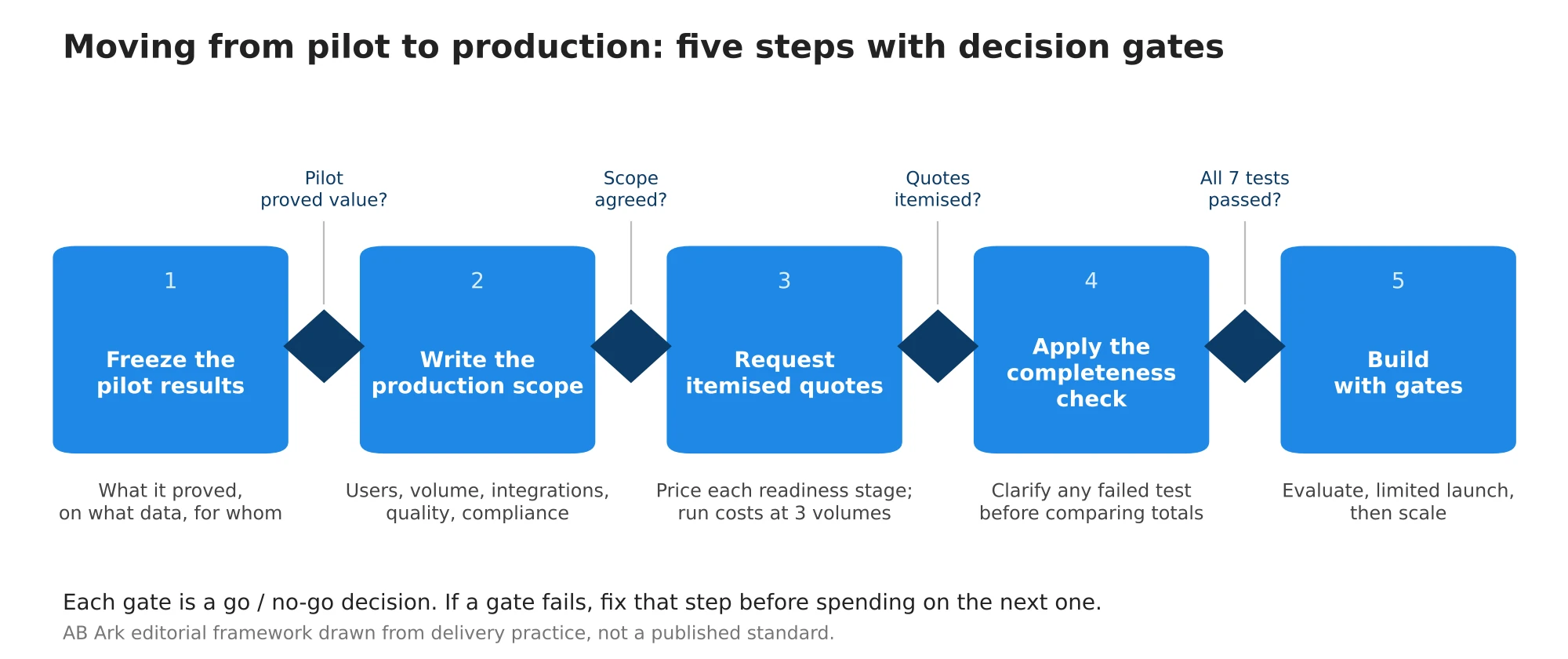
- Freeze the pilot results. Record what the pilot proved, on what data and for which users.
- Write the production scope. Define users, volume, integrations, quality targets and compliance needs.
- Request itemized quotes. Ask vendors to price each readiness stage and show run costs at three volumes.
- Apply the completeness check. Clarify any failed test before comparing totals.
- Build with gates. Evaluate before launch, launch to a limited group, then scale once monitoring shows stable quality and cost.
Roles: a business owner, a product owner, AI and data engineers, a security reviewer and a domain expert for the evaluation set. If you need extra capacity, AB Ark’s vetted AI engineers can join through staff augmentation.
Timeline variables: data readiness, number of integrations, security review cycles and procurement of model or cloud accounts.
Never cut from the quote:
- Evaluation: without a test set and quality metrics, nobody can prove the system works or catch regressions after a model update.
- Security and data protection: retrofitting access control, logging and consent after launch costs more than building them in.
- Monitoring: a production AI system without quality and cost alerts fails silently.
- Ownership and handover: code, prompts, evaluation sets, pipelines and cloud accounts should belong to the buyer, with documentation another team could follow.
Success metrics: output accuracy against the evaluation set, latency, cost per request, adoption by target users and incident rate after launch. For retrieval-based assistants, AB Ark’s guide to why RAG systems fail in production covers the quality issues most likely to appear after go-live.
FAQs
How much does it cost to move an AI pilot to production?
There is no reliable single figure, because cost depends on data readiness, integrations, security requirements, usage volume and model choice. Gartner’s July 2024 forecast put some generative AI deployment approaches at $5 million to $20 million. In AB Ark’s experience, narrow, single-workflow systems often cost far less. Ask for an itemized quote based on your own production scope.
Why do AI pilots fail to reach production?
Gartner’s July 2024 forecast linked abandonment after proof of concept to poor data quality, inadequate risk controls, escalating costs and unclear business value. In practice, pilots often skip the data, integration, evaluation and security work production needs, so the real cost and risk appear late.
What recurring costs come with a production AI system?
Typical recurring costs include model API usage or inference compute, vector database and application hosting, monitoring tools, third-party services and maintenance. They scale with usage, so the quote should show estimates at several volume levels.
What should I own at the end of an AI project?
You should own the source code, prompts, evaluation sets, data pipelines, infrastructure configuration and cloud accounts, with documentation sufficient for another team to operate the system. Put these ownership terms in the contract.
Should an AI production quote be fixed price or time and materials?
Fixed price works when scope, data and integrations are well defined. Time and materials suits projects where data readiness or requirements are still uncertain. A short fixed-price discovery phase often reduces that uncertainty before production is quoted.
The Rule for AI Pilot to Production Cost
Quote the system, not the model. A production AI quote should price every stage of the readiness path, state its assumptions and keep build and run costs separate. Never cut evaluation, security, monitoring or ownership terms to make the total look smaller. If you already have a pilot and a draft production scope, the most useful next step is an itemized estimate against that scope.
The best-value AI quote is not the one with the lowest total. It is the one with no missing line items.
Schedule a Free Consultation Call ->
Head Of Engineering Department