

Nearshore software development means working with a team in a nearby country with a small time-zone gap, such as Latin America for US companies or Eastern or Southern Europe for UK and EU companies. Onshore teams cost the most but share your location; offshore teams cost the least but overlap little with your working day. In 2026, senior nearshore rates through outsourcing partners in Latin America run about $60 to $75 an hour, against $31 to $41 in Asia. The right choice depends on how much real-time collaboration the work needs.
Key Takeaways
- Onshore, nearshore and offshore are defined by distance from the buyer: Mexico is nearshore for a US company, while Poland is nearshore for a German company but offshore for a US one.
- Accelerance’s 2026 survey puts senior developer rates at $60 to $75 an hour in Latin America, $64 to $76 in Europe and $31 to $41 in Asia.
- Nearshore teams in Latin America can overlap six to seven hours with a US East Coast workday; South Asian and Southeast Asian teams overlap only if they work shifted hours.
- Hourly rate is a poor comparison on its own. Total cost depends on management time, rework, ramp-up, retention and how well the model fits the work.
- Many companies use a hybrid model: onshore product leadership with a nearshore or offshore delivery team.
Talk to Our Team About Your Project ->
What Are Nearshore, Offshore and Onshore Software Development?
The three models describe where your development team is located relative to you, not a fixed list of countries.
Onshore: the team works in your own country, either in-house or through a domestic agency.
Nearshore: the team works in a nearby country, usually within about three hours of your time zone, with similar business hours.
Offshore: the team works in a distant country, typically four or more hours away, often on the other side of the world.
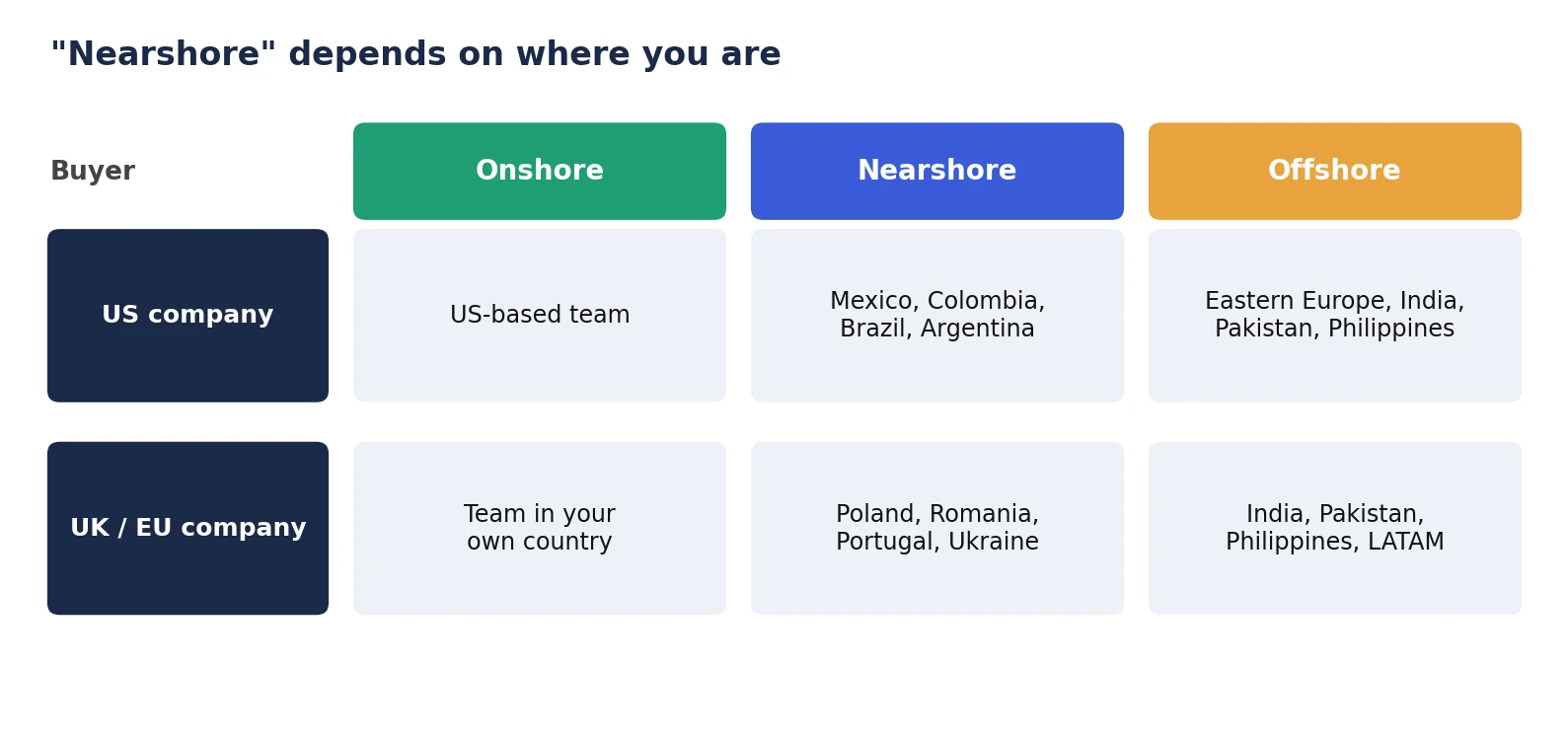 This matters for comparisons. Most nearshore content is written for US buyers and treats Latin America as the nearshore default. For a UK or German company, Latin America is offshore and parts of Eastern and Southern Europe are nearshore.
How Much Does Each Model Cost?
Nearshore and European teams cost roughly twice as much per hour as Asian teams at senior level, while onshore costs more again. The most current regional benchmark is Accelerance’s 2026 survey of software firms.
| Region (via outsourcing partners) | Junior developer | Senior developer | Change in 2025 |
| Latin America | $33–$45/hr | $60–$75/hr | Down 7.1% |
| Europe | $31–$39/hr | $64–$76/hr | Down 4.4% |
| Asia (incl. India, Pakistan, Bangladesh) | $24–$31/hr | $31–$41/hr | Down nearly 8% |
Source: Accelerance 2026 outsourcing rate trends. Rates are survey-based hourly figures reported by software development partners.
For onshore comparison, the US Bureau of Labor Statistics reports a median annual wage of $135,980 for software developers in May 2025, roughly $65 an hour before benefits, payroll taxes, equipment, recruiting and management overhead. A US agency billing rate would sit well above that wage.
This is not a like-for-like comparison. The BLS figure is a median across all experience levels, while the partner rates above are for senior developers, and a US agency billing rate also includes benefits, overhead and margin. Treat the wage as a reference point for US labor cost, not as the onshore price. The real saving from nearshore comes mainly from avoiding US employment overhead and recruiting time, not from a dramatically lower hourly number. Offshore Asian rates are about half the nearshore level, which is why offshore remains the cost leader.
How Much Time-Zone Overlap Does Each Model Give You?
Time-zone overlap is the main practical difference between nearshore and offshore. The chart compares a standard 9:00 to 17:00 local workday in common delivery locations with a US East Coast team.
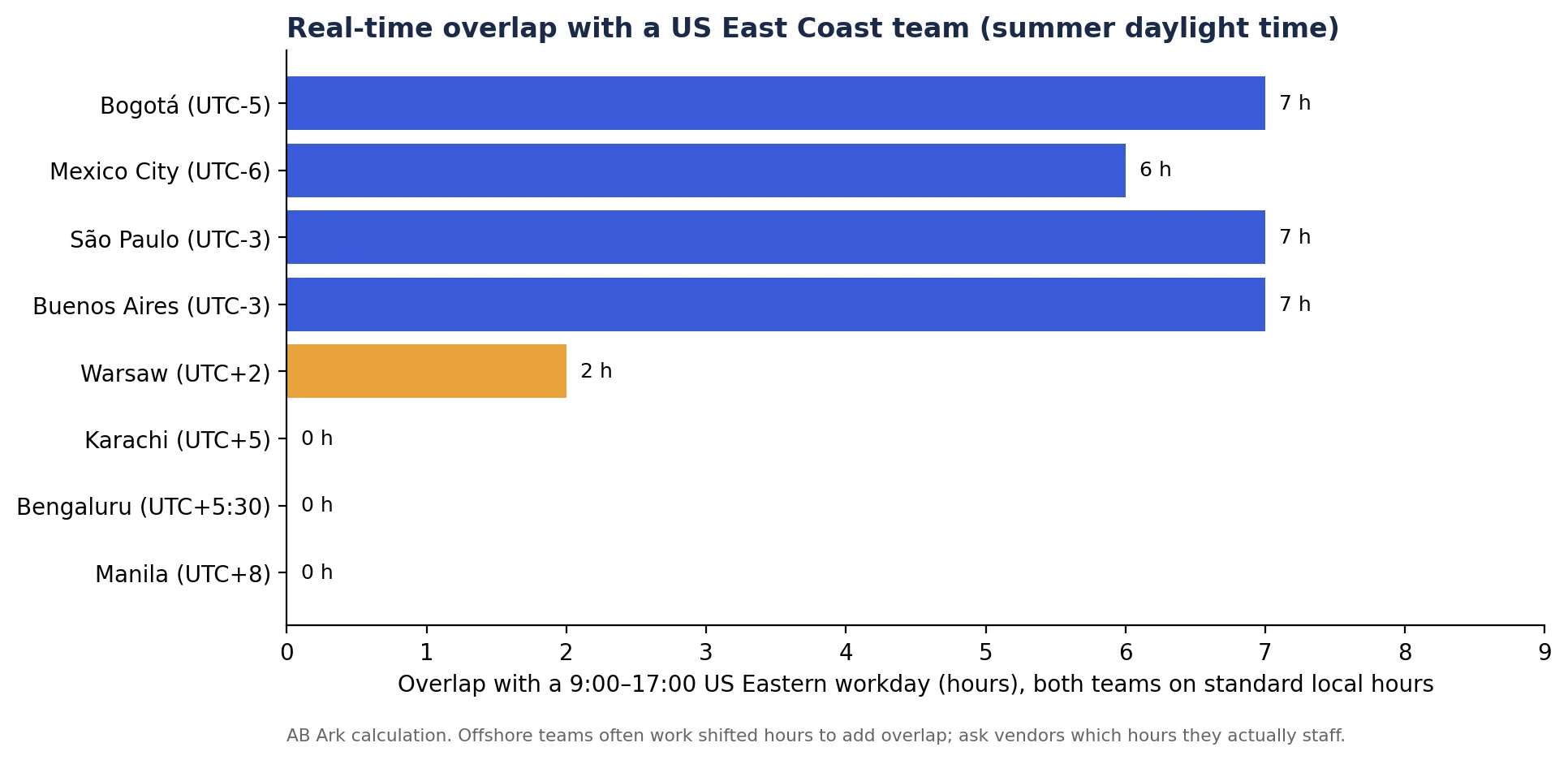 With standard hours, Latin American teams share six to seven hours with a US East Coast team, Central European teams share about two, and South and Southeast Asian teams share none. Offshore vendors commonly close that gap by running shifted or split hours, which works, but it is a staffing commitment to confirm in the contract rather than assume. The chart assumes summer daylight time, and overlaps change when clocks shift. In winter, for example, Bogotá rises to eight hours, Mexico City to seven, and São Paulo and Buenos Aires fall to six, while Warsaw stays at about two.
Overlap matters most for work that changes daily: product discovery, design iteration, pair programming and incident response. It matters least for well-specified builds, testing, maintenance and work that can hand over at the end of a day, where an offshore team can even shorten cycle times by working while your team sleeps.
Nearshore vs Offshore vs Onshore: How Do They Compare?
| Factor | Onshore | Nearshore | Offshore |
| Typical cost | Highest | Medium | Lowest |
| Real-time overlap | Full | High (LATAM for US; CEE for Europe) | Low unless hours are shifted |
| Travel and in-person meetings | Easy | Short flights, similar time zone | Long-haul, larger time shift |
| Talent pool size | Constrained by local market | Large and growing | Largest |
| Legal and data jurisdiction | Your own | Foreign; check data transfer rules | Foreign; check data transfer rules |
| Best for | Regulated, on-site or sensitive work | Collaborative, fast-changing product work | Well-defined, scalable or round-the-clock work |
| Main risk | Cost and hiring speed | Rates closer to onshore than expected | Communication gaps if overlap is not planned |
This is an editorial comparison based on the cost and time-zone evidence above; the talent pool row is an editorial assessment rather than a sourced figure. Quality varies more between individual vendors than between regions, so no model guarantees better or worse engineering.
What Does Each Model Really Cost Beyond the Hourly Rate?
Total cost of a development team includes several items that hourly rate comparisons leave out:
Management time: the hours your own leads spend writing specifications, reviewing work and answering questions. Less overlap usually means more written specification.
Rework: misunderstood requirements cost the same to fix whatever the rate. Clear acceptance criteria matter more than geography.
Ramp-up and turnover: every new developer needs onboarding time; ask vendors for retention data and replacement terms.
Travel and on-site time: useful for kickoffs and planning; cheaper and easier nearshore.
Compliance: contracts, data transfer agreements, security reviews and, in some sectors, restrictions on offshore data access.
A practical test is cost per accepted feature or story point over three months, not cost per hour.
Which Model Should You Choose?
Choose by the kind of work, not by the country list. This AB Ark summary is an editorial framework, not an industry standard.
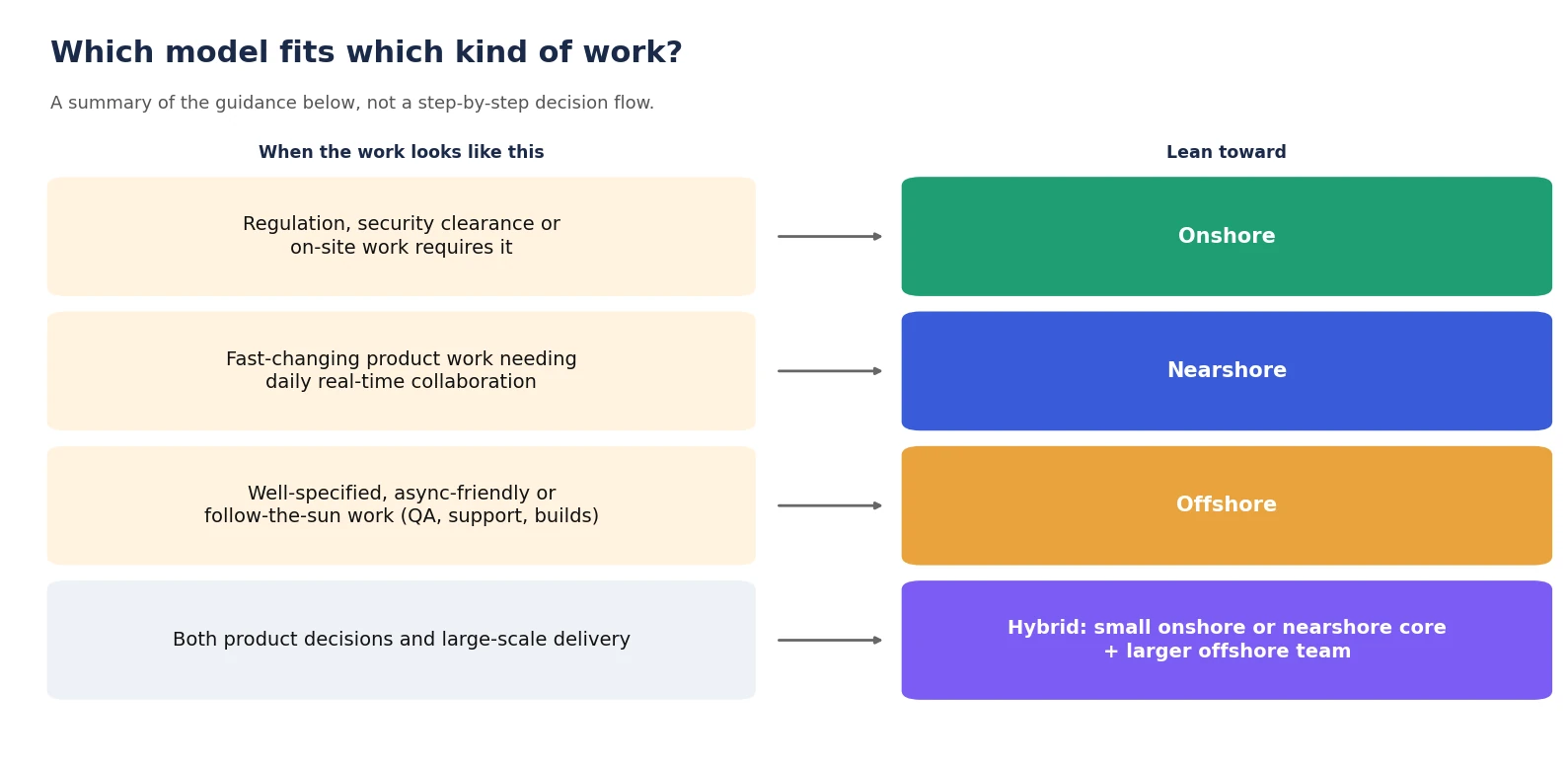 Choose onshore when regulation, security clearances, on-site work or very close stakeholder contact require it.
Choose nearshore software development when the product is changing quickly and the team needs several hours a day of live collaboration with your product owners.
Choose offshore when the work is well specified, budget is the main constraint, or you want coverage across more hours of the day. In each case, make sure the vendor commits to agreed overlap hours.
Choose a hybrid when you need both: a small onshore or nearshore core for product decisions and a larger offshore team for build, testing and maintenance.
What Should You Ask a Nearshore or Offshore Vendor?
| Question | Why it matters |
| Which hours will the team actually work, in our time zone? | Overlap is promised often and staffed less often. |
| What is your developer retention rate, and how fast do you replace someone? | Turnover is a hidden cost in every model. |
| Who on your side owns delivery and code quality? | Separates a managed team from a staffing agency. |
| Where will our data and code be stored and accessed? | Determines compliance with data protection rules. |
| Can we interview and approve every team member? | Protects seniority and fit. |
| What are the exit terms and IP assignment clauses? | Ensures you own the work and can switch vendors. |
If you are building AI features, the same questions apply, plus specialist skills checks. AB Ark’s AI agent development team works under the same criteria.
FAQs
What is nearshore software development?
Nearshore software development is outsourcing to a team in a nearby country with a small time difference, such as Latin America for US companies or Eastern or Southern Europe for UK and EU companies. It trades a moderate rate for strong real-time collaboration.
Is nearshore cheaper than onshore?
Usually, but by less than many buyers expect. Accelerance’s 2026 survey puts senior Latin American partner rates at $60 to $75 an hour. A fair onshore comparison needs senior US wages or agency billing rates, which the all-levels median wage understates. Savings come mainly from avoiding US employment overhead and hiring time.
Is offshore development lower quality?
Not inherently. Quality varies more between vendors than between regions. Offshore projects struggle most when overlap hours, specifications and ownership are not agreed upfront.
Which countries are best for nearshore development?
For US companies, Mexico, Colombia, Brazil and Argentina are common choices because of time-zone alignment. For UK and EU companies, Poland, Romania, Portugal and Ukraine are common nearshore options.
Can I combine onshore, nearshore and offshore teams?
Yes. Hybrid models are common: an onshore product lead, a nearshore team for collaborative work and an offshore team for build, testing or support. The key is clear ownership and agreed handover times.
The honest answer is that no model is best. Onshore buys proximity, nearshore buys collaboration and offshore buys capacity. Choose the one that matches how your work actually happens.
Request a Free Consultation ->
Head Of Engineering Department