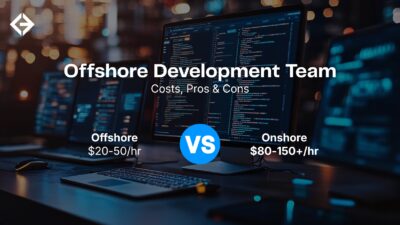

Offshore software development services let you outsource full-cycle engineering to a partner in another region, covering architecture, development, QA, DevOps, and ongoing support at rates 40-60% below local hiring. Firms like AB Ark Solutions, with delivery hubs across the UAE, USA, and Pakistan, use this model to solve the problem behind most stalled roadmaps: engineering demand growing faster than local talent supply.
Key Takeaways:
- Offshore rates typically run 40-60% lower than equivalent onshore hires, without sacrificing seniority.
- The model covers the full lifecycle: discovery, architecture, development, QA, deployment, and maintenance.
- Three engagement structures dominate: dedicated teams, staff augmentation, and fixed-price projects.
- Success depends on process, not geography: overlap hours, a single source of truth, and clear IP terms.
- Vet partners on shipped case studies, security standards, and verified reviews before signing anything.
📊 Request a Free Tech Stack & Architecture Review
What Offshore Software Development Services Actually Covers

Offshore development is not body-shopping cheap coders. A mature offshore partner owns outcomes across the full product lifecycle: requirements analysis, system architecture, sprint delivery, quality assurance, release management, and post-launch support.
The distinction from adjacent models matters. Onshore means the team sits in your country at the highest rates. Nearshore means a neighboring time zone at moderate rates. Offshore means a distant region with the deepest talent pool and the strongest cost leverage, provided the process is engineered for the distance.
The cost math is why the model keeps winning. A senior engineer who costs $150K+ fully loaded in the US or Western Europe has an offshore equivalent at a fraction of that, and the vendor absorbs recruitment, payroll, hardware, and compliance.
Choosing the Right Engagement Model
The contract structure shapes your budget more than the country does. Most offshore engagements fall into one of three models, and picking the wrong one is the most common source of overruns.
| Model | How you pay | Best for | Main risk |
| Dedicated Team | Monthly retainer per team | Long-term, evolving products | Requires 6+ month commitment |
| Staff Augmentation | Hourly or monthly per specialist | Filling skill gaps in your existing team | You carry all management overhead |
| Fixed-Price Project | Lump sum against defined scope | Small, fully specified builds | Every change triggers renegotiation |
A useful rule: fixed price only works when requirements are genuinely frozen (migrations, audits, prototypes). For anything with a living roadmap, a dedicated team on a monthly retainer keeps incentives aligned and costs predictable.
Best Practice 1: Budget for Total Cost, Not the Hourly Rate
The headline rate is never the full number. Realistic offshore budgets account for discovery and solution design, cloud infrastructure, third-party licenses, security audits, and knowledge transfer. Teams that skip this planning discover the gaps mid-project, at the worst possible price.
The biggest hidden cost is rework: code that meets the spec but misses the user. The antidote is a proper discovery phase before development starts and a named product owner on your side who reviews output weekly, not quarterly.
Best Practice 2: Engineer the Communication Layer
Distance is not the problem; asynchronous ambiguity is. Teams spread across five or more time zones see measurable delivery delays when feedback loops stretch overnight.
Three fixes neutralize most of it. Insist on a minimum four-hour daily overlap window with your core hours. Maintain a single source of truth for status (Jira, Azure DevOps, or Linear, not scattered chat threads). Run short daily standups within the overlap so blockers surface in hours, not days.
Best Practice 3: Demand Proof of Full-Cycle Delivery
Any vendor can show a portfolio page. What separates a real offshore software development services partner is evidence of end-to-end ownership: products they architected, built, shipped, and still maintain. This is also where team stability pays off, because the engineers who understand your architecture stay on your product year over year. For a full breakdown of how that continuity compounds, read our guide on the key benefits of an offshore development team in 2026 before shortlisting vendors.
AB Ark’s All-in-One Business Platform is a working example of that ownership. The client’s operations ran on disconnected systems for tasks, communication, data, and workflows; AB Ark’s offshore engineering team consolidated them into a single centralized platform covering accounting, task management, and team collaboration, delivered end to end (full case study). That engagement pattern, repeated across 500+ clients, 15K+ working hours, and an 80+ person professional team at 100% job success, is what full-cycle offshore delivery looks like in practice.
Best Practice 4: Lock Down IP and Security Before Kickoff
Offshore does not have to mean exposed. Layer the protections contractually: a master services agreement with explicit IP-assignment clauses, individual NDAs for every engineer, restricted access to source code and production, and audit trails on sensitive systems.
Ask directly about security certifications and QA workflow. A vendor who can explain how they test features, track defects, and control release stability is telling you how predictable your delivery will be.
Best Practice 5: Start with a Paid Pilot
Never scale a relationship you have not tested. A 4-6 week paid pilot on one real module reveals code quality, communication cadence, and estimate accuracy far better than any sales deck. It costs a fraction of a bad six-month contract and gives both sides an honest exit if the fit is wrong.

Frequently Asked Questions
What are offshore software development services?
Offshore software development services involve outsourcing software design, development, testing, and maintenance to a team in another country to reduce costs, access global talent, and accelerate project delivery.
What is ODC in software?
ODC (Offshore Development Center) is a dedicated remote team or facility in another country that provides software development, testing, maintenance, and support services exclusively for a client.
What is the biggest IT company in Pakistan?
Systems Limited is widely recognized as the biggest IT company in Pakistan due to its revenue, global presence, workforce, and position as the country’s largest listed technology company.
How much do offshore software development services cost?
Offshore rates generally run 40-60% below onshore equivalents, with hourly rates roughly $15-$50 depending on region, role, and seniority. Total budgets should also account for discovery, infrastructure, licenses, and QA, which sit outside the headline rate.
What is the difference between offshore and outsourcing?
Offshore describes geography: the team works from a distant country. Outsourcing describes the buying relationship: paying an external provider instead of employing staff. You can outsource onshore, nearshore, or offshore.
Engineering capacity is the constraint on most 2026 roadmaps, and local hiring cycles will not close the gap in time. A proven offshore partner can, starting in weeks.
👉 Book a Strategy Call to Scale Your Engineering Velocity

Syed Ahmad Ali is a tech writer at AB Ark with a knack for turning complex ideas into easy reads. He writes across a range of topics, but AI, software development, and the business of tech sit right at the top of his list.