
The most effective way to hire full stack web developer is through a vetted talent partner who pre-screens for both front-end and back-end proficiency cutting your time-to-hire from months to days. A qualified full stack developer owns the entire technology chain: UI/UX implementation, API architecture, database design, and cloud deployment.
Key Takeaways:
- Hire Full stack developer own the complete product lifecycle from frontend to server to database one hire covers what two specialists would otherwise split.
- Hiring through a vetted partner reduces misaligned placements that drain engineering budgets and delay launches.
- Dedicated full stack developers integrated into your team outperform freelance marketplace hires on accountability and architectural consistency.
- Businesses scaling digital products use staff augmentation to access senior-level full stack talent without the overhead of a permanent headcount expansion.
Why Finding a Strong Full Stack Developer Feels Impossible Right Now
Software developer employment is projected to grow 15% between 2024 and 2034 nearly five times the average U.S. job growth rate. That projection does not mean candidates are easy to find. It means demand is outpacing supply at an accelerating rate, and companies that delay building a hiring strategy are losing ground to competitors who already have full stack engineers shipping features.
The gap shows up in cost, too. Senior full stack developer salaries in the United States now sit between $118,000 and $174,000 depending on seniority and stack depth. That figure doesn’t include benefits, equity, onboarding, or the three to six months most new hires need before they’re producing at full output.
Most scaling companies are not losing the talent competition because of weak job postings. They’re losing it because the search-and-vet process is broken, slow, expensive, and calibrated for a hiring market that no longer exists.

The Real Cost of a Bad Full Stack Hire
A full stack developer who looks strong in an interview but struggles with production-grade architecture doesn’t just slow the project down. Full stack engineers own so much of the stack that a single weak hire can create cascading technical debt across the frontend, the API layer, and the database simultaneously.
The signs emerge slowly: APIs that can’t handle load spikes, frontend code that becomes unmaintainable after six months of iteration, database schemas that make future features structurally expensive to build. By the time the damage is visible, reversing it requires a senior engineer to audit and refactor code that should have been written correctly from the start.
Hiring for full stack roles demands a vetting process built around real production scenarios not coding challenges that measure trivia, but architecture reviews that reveal how a developer thinks when stakes are real. That vetting process is exactly what most internal recruiting teams don’t have the bandwidth to run.
In-House Hire vs. Freelancer vs. Dedicated Full Stack Partner: What the Numbers Show
| Factor | Internal Hire | Freelance Marketplace | AB Ark Dedicated Developer |
| Time to First Commit | 3–6 months | 1–3 weeks | 5–10 business days |
| Annual Cost (Senior) | $118K–$174K + benefits | $80K–$130K (variable) | 40–60% lower than onshore |
| Vetting Accountability | Self-managed | Self-managed | Partner-managed |
| Architecture Continuity | High | Low | High |
| Scalability | Slow | Unpredictable | On-demand |
| IP & Code Ownership | Full | Contractual risk | Full |
| Stack Matching | Manual | Browse-and-hope | Precision-matched |
The dedicated partner model wins across every dimension that matters for product quality and delivery speed. Freelance marketplaces offer volume; they don’t offer vetting. Internal hires offer permanence; they don’t offer speed.
How AB Ark Matches and Deploys a Full Stack Developer for Your Product
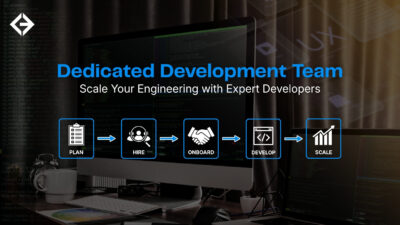
Step 1: Map Your Stack and Delivery Architecture
Before any matching begins, AB Ark’s technical leads document your full technology picture frontend framework (React, Next.js, Vue), backend language (Node.js, Python, Laravel), database layer (PostgreSQL, MongoDB), and deployment environment (AWS, GCP, Azure). Stack specificity at this step prevents mismatched placements downstream.
Step 2: Filter Against the Pre-Vetted Engineer Bench
AB Ark maintains an active bench of 80+ engineers spanning full stack, mobile, AI, and data engineering roles. Full stack candidates are screened against production scenarios, not theoretical frameworks. Engineers who can’t explain why they’d choose PostgreSQL over MongoDB for a given data model don’t make the bench.
Step 3: Run a Technical Alignment Session With Your Team
Before the engagement starts, your internal leads meet the matched developer for a structured technical session codebase walkthrough, architecture alignment, and sprint zero planning. Surprises get resolved before a single line of code is written.
Step 4: Embed Into Your Sprint Cadence
AB Ark developers operate inside your existing workflow, your Jira board, your GitHub repositories, your standup rhythm. The developer functions as a full team member, not a contractor completing tickets in isolation.
Step 5: Scale or Right-Size as the Product Evolves
AB Ark engagements are designed to flex. Add a second full stack developer when a feature set expands. Shift one engineer toward frontend specialization as the product matures. Transition high-performing engineers to longer-term roles when the fit is proven.
What a Full Stack Engagement Produces: The Qs Learning Build
A direct example of end-to-end full stack delivery is Qs Learning, a Smart Online Academy that AB Ark built from a traditional tutoring center into a fully operational digital platform. The project required simultaneous frontend development for parent-facing booking flows, backend architecture for automated scheduling logic, virtual classroom integrations, and an SEO-optimized public-facing website that made the platform discoverable in local search.
AB Ark’s full stack team delivered a cohesive, production-grade system where every layer from the student-facing interface to the server-side scheduling engine was designed to work together. The result was a platform where parents could find, book, and attend classes end-to-end with zero manual coordination from the Qs Learning team.
That kind of integrated output front, back, and database working in coherent architecture is what separates a dedicated full stack engineer from a patchwork of freelance specialists who each own one layer and nobody owns the seams.
The Skills a Production-Ready Full Stack Developer Must Actually Have
Listing “React and Node” on a resume doesn’t make someone a production-ready full stack developer. When evaluating candidates, the following technical depth indicators separate senior engineers from developers who perform well on tutorials but struggle at scale:
Frontend depth: Real experience with state management patterns, performance optimization on data-heavy UIs, and SSR/SSG decisions in frameworks like Next.js not just component construction.
Backend accountability: Understanding of caching strategies, connection pooling, API authentication (OAuth 2.0, JWT), and query optimization before the database becomes a bottleneck.
Database fluency: Ability to choose between SQL and NoSQL for a given data model and explain why not just knowledge that both exist.
DevOps baseline: Comfort with CI/CD pipelines, containerization (Docker), and cloud environment configuration. A full stack developer who can’t deploy their own code creates a dependency on a separate DevOps hire.
Communication architecture: Full stack engineers who can explain technical trade-offs to non-technical stakeholders actively reduce project risk. Those who can’t create decision gaps that slow product progress.
This guide to hire full stack developer covers the complete evaluation framework for companies building long-term engineering capacity, not just filling a short-term gap.

Frequently Asked Questions
What is a full-stack web developer?
A full-stack web developer is a professional who builds both the frontend (user interface) and backend (server, database, and APIs) of a website or web application.
Which language is used in full-stack?
Full-stack development commonly uses JavaScript for both frontend and backend, along with technologies like HTML, CSS, Node.js, Python, Java, PHP, and SQL.
What is a full-stack salary?
A full-stack developer typically earns $60,000 to $150,000+ per year globally, while in Pakistan salaries commonly range from PKR 80,000 to PKR 350,000+ per month, depending on experience and skills.
Which is better, DevOps or full-stack?
Neither is inherently better. Full-stack development focuses on building applications, while DevOps focuses on automating deployment, infrastructure, and operations. The best choice depends on your career goals and interests.
Your Engineering Velocity Shouldn’t Be Limited by a Slow Hiring Market
AB Ark Solutions has completed 15,000+ working hours across 300+ clients worldwide, with 80+ active engineers and a documented 99% job success rate. That track record exists because AB Ark doesn’t treat developer placement as a volume game every full stack match is precision-aligned to your stack, your delivery cadence, and your product architecture requirements.
Full stack engineering capacity that took three to six months to build through traditional hiring now takes under two weeks through a structured partner engagement. The product your roadmap is waiting on doesn’t have to wait.
Book a Free Technical Consultation to Hire Your Dedicated Full Stack Developer

Syed Ahmad Ali is a tech writer at AB Ark with a knack for turning complex ideas into easy reads. He writes across a range of topics, but AI, software development, and the business of tech sit right at the top of his list.