

The Jev AI model, from TypeSafe AI, is a decision model rather than a text generator. Instead of writing a reply token by token, Jev takes a state (text or JSON) and a set of typed questions, then returns choices, scores and probabilities in one parallel pass. That makes Jev faster and cheaper than LLMs for classification, routing and scoring, but unable to write, summarize or explain. Teams building AI agents and automated workflows typically use Jev alongside an LLM, not instead of one.
Key Takeaways
- Jev returns typed values defined in advance (Choice, Score and Noul answers), so the output cannot break the schema or require parsing.
- TypeSafe reports end-to-end responses of 70 to 500 milliseconds and prices input at $0.042 per million tokens, with output not billed.
- Every answer carries a probability, and Choice and Score answers add a confidence value, which lets code decide when to act and when to escalate.
- Jev gives up text generation entirely, so it complements LLMs for bounded decisions rather than replacing them.
- TypeSafe’s headline speed and cost multiples come from its own workflow evaluations; validate them on your own data before committing.
Talk to Our Team About Your Project ->
What Is the Jev AI Model?
Jev is the first “System One model” from TypeSafe AI, a lab founded by former OpenAI researcher Diogo Almeida. TypeSafe launched Jev in early access on September 15, 2026, describing it as a new class of model built to make fast, structured decisions that software can consume directly. The name System One comes from Daniel Kahneman’s fast, intuitive “System 1” thinking; the model name honours economist William Stanley Jevons.
TypeSafe frames Jev as a frontier-intelligence function call: unstructured state goes in, typed probabilistic decisions come out. The TypeSafe documentation puts the motivation plainly: LLMs are designed to produce text for people, so using them for decisions inside code means coercing a text generator into structured output and then parsing it back.
Jev is versioned. Developer guides report that the jev-latest alias resolved to jev-1.13.0 in September 2026, and OpenRouter now lists Jev 1.14 as the latest version.
How Is Jev Different From an LLM?
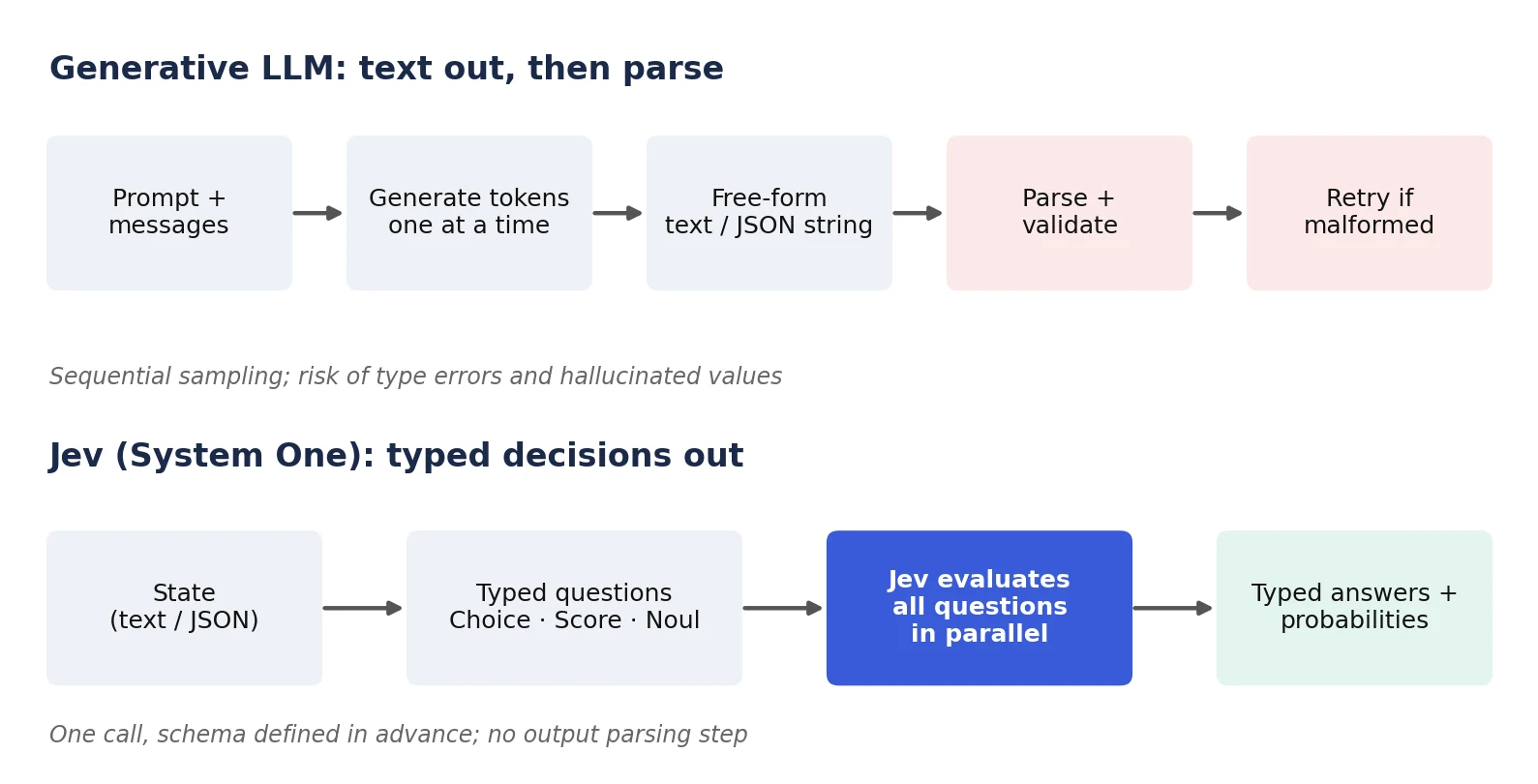
Jev differs from an LLM in what it outputs, how it samples, how it is trained and how it is priced. The diagram below shows the core difference in the request path.
| Dimension | Generative LLM | Jev (System One) |
| Output | Free-form text, including JSON strings that must be parsed and validated | Typed values from a schema defined in advance, with probabilities |
| Sampling | Sequential: one token at a time | Parallel: all answers in a single query |
| Training objective | RLHF / verifiable rewards (human preference, checkable outputs) | RLCD: Reinforcement Learning for Calibrated Decisions |
| Confidence | Self-reported confidence tends to be overconfident and inconsistent | Probability on every answer; calibrated confidence on Choice and Score |
| Speed | Seconds to minutes end to end for frontier models | 70 to 500 ms end to end (TypeSafe-reported) |
| Price | Output usually costs more than input | $0.042 per million input tokens; output not billed |
| Can it write or explain? | Yes | No |
Source: TypeSafe launch post, checked October 22, 2026. Speed and price figures are TypeSafe’s own; TypeSafe notes it cannot prove its pricing is not subsidised and that its service is currently based on the US West Coast, which affects latency elsewhere.
Typed outputs remove a class of failure
Because the possible outputs are fixed before the call, Jev cannot return an invalid category or a malformed value. TypeSafe argues this is a mathematical guarantee rather than an empirical result, and positions type safety as table stakes for automation buried inside software, where one hallucinated value can break a dependency chain. This does not mean the chosen answer is always correct; it means the answer is always one your code can handle.
Parallel evaluation keeps questions independent
The documentation explains that every question in a request is evaluated in parallel and in isolation against the same state. Adding questions barely changes response time, and because questions do not share a growing context, a long list of checks does not degrade later answers.
Calibration is the real product
An LLM that is right 95% of the time but cannot say when it is in the other 5% cannot safely automate a task. Jev’s training targets calibrated probabilities, so higher confidence should mean higher accuracy. That property, more than raw speed, is what lets an engineering team set thresholds and automate only the cases it trusts.
How Does a Jev Request Work?
A Jev request has three parts: the state, the questions and the answers. The diagram shows one support ticket evaluated against three question types at once.
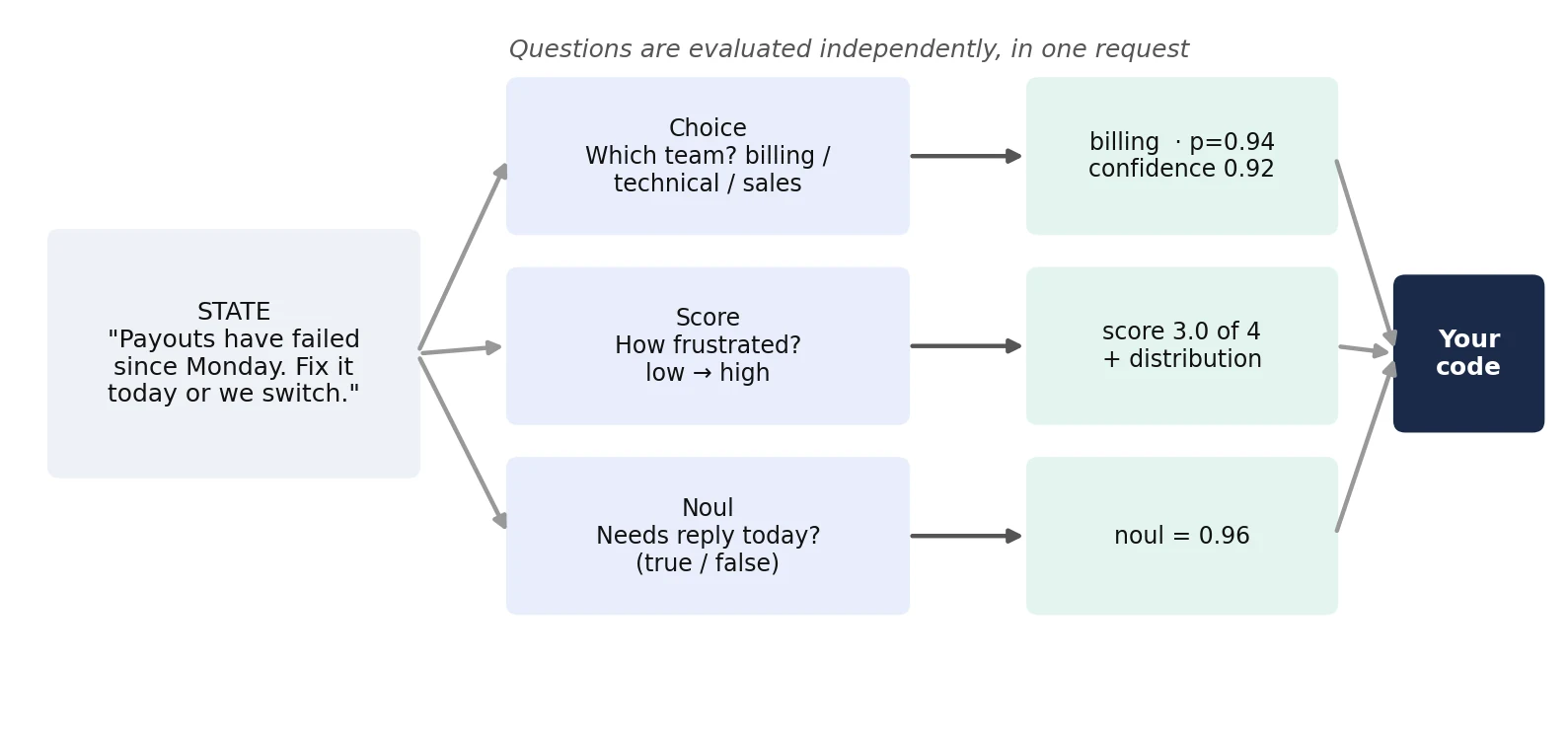
TypeSafe defines three question types:
Choice: picks one option from a list you define and returns the choice, the probability of every option and a confidence value. Best for routing and classification.
Score: places the state on an ordered rubric you define, returning a score, its probability distribution and confidence. Best for severity, quality or intensity.
Noul: returns a 0 to 1 probability that a single statement is true. Best for gut-check yes/no judgments such as “Does this need a human?”
The official endpoint is POST https://api.typesafe.ai/v1/systemone, with model, state and questions in the JSON body, according to gateway documentation that mirrors the TypeSafe API. Choice questions support up to 255 options; TypeSafe uses a two-stage score-then-choose approach for larger sets.
TypeSafe’s design advice is to keep each question atomic. Instead of asking Jev to “rate this startup pitch”, ask separately about market size, feasibility and differentiation, then combine the scores with a formula in code. When priorities change, the team edits a coefficient rather than rewriting a prompt.
How Should Teams Use Jev Confidence in Production?
Jev returns a signal; your code owns the action. A step-by-step developer guide on Hugging Face recommends a tiered policy: continue automatically on high probability and low risk, gather context on medium probability, and require human approval for low confidence or high-risk actions.
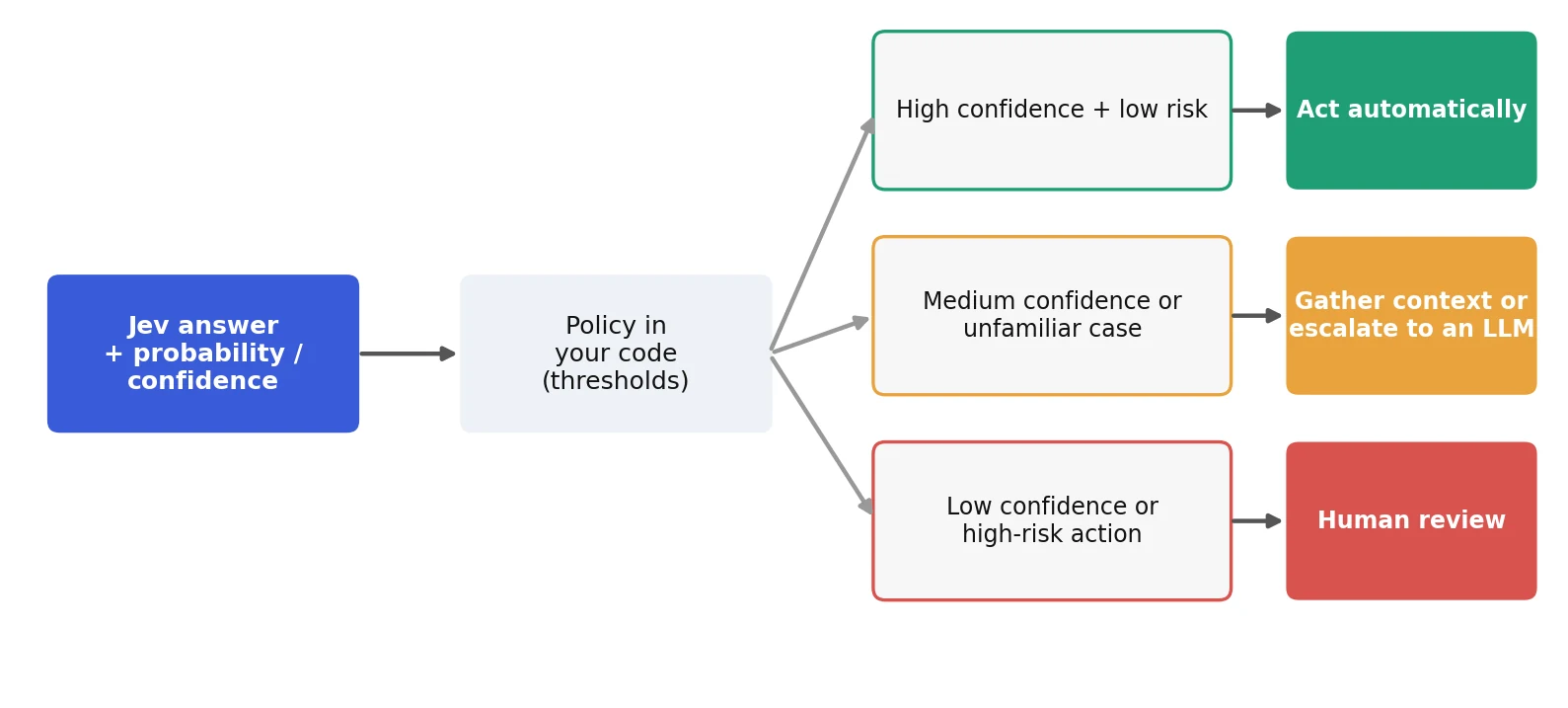
Thresholds should be set from labelled historical examples and monitored after launch for false positives and false negatives. A threshold that works for support routing may be unsafe for payments, account access or tool calls that change data, which should keep application-level permission checks regardless of the model’s confidence.
What Do Real Jev Workloads Look Like?
Early users report the clearest wins on high-volume classification. In Lenny’s Newsletter’s How I AI episode, Claire Vo describes analysing 1,700 pull requests for 9 cents, running 200,000 classifications across 1,100 product signals for ChatPRD, and turning 4,500 YouTube comments into an audience dashboard. She also explains that she stopped using Jev alone and now pairs it with an LLM.
That pairing is the pattern most teams should start with. Jev filters, tags and routes every item cheaply; only the small share that needs writing, summarising or deeper reasoning goes to an LLM.
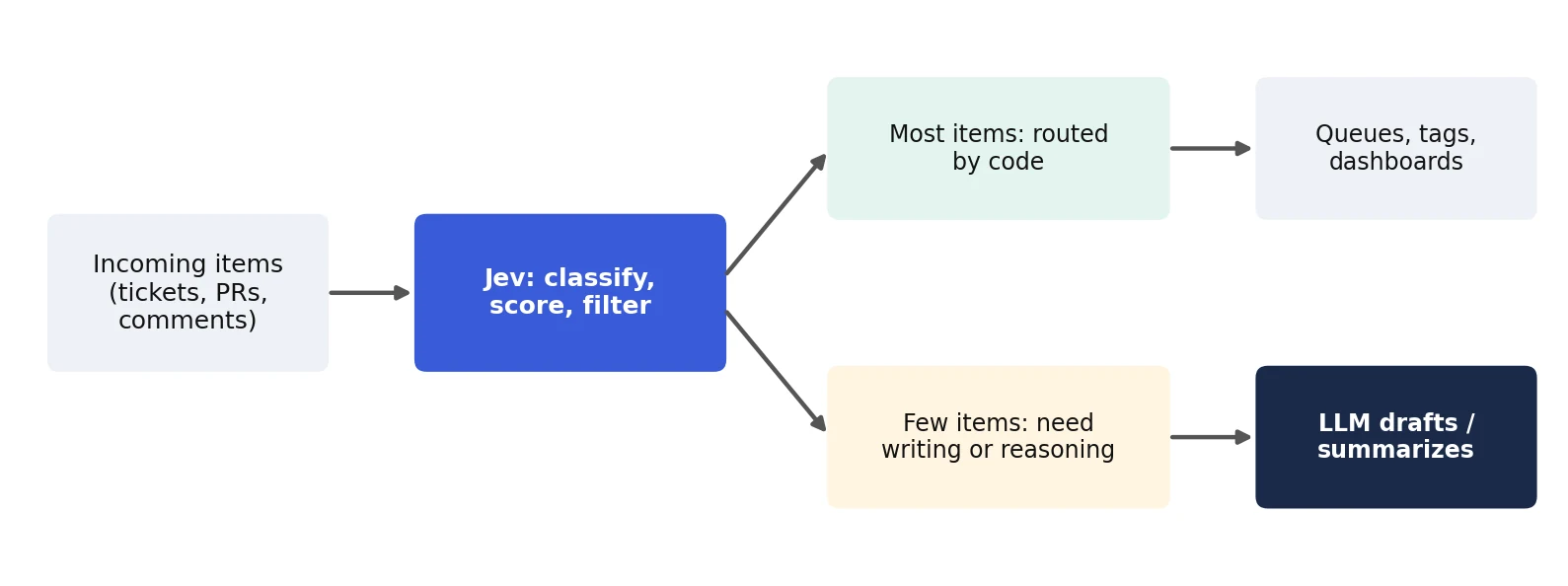
TypeSafe and the developer community point to similar use cases: support ticket triage, lead and sales-call scoring, LLM routing and tool selection, retrieval relevance checks before generation, prompt-injection detection, and LLM-as-a-judge evaluation of agent outputs. The last of these matters for RAG systems, where checking each retrieved passage before generation addresses failures covered in AB Ark’s guide to why RAG systems fail in production.
How Credible Are TypeSafe’s Speed and Cost Claims?
TypeSafe’s homepage multiples of 193.6x faster and 444.6x cheaper come from its own workflow evaluations, and TypeSafe itself expects these to be on the high end of real-world gains. The evaluation design is worth understanding before quoting the numbers:
The reference answers are the average of GPT-6 Astra and Claude Fable 5.1, so accuracy is measured as agreement with those models, not against human-labelled ground truth.
The workflows were built by TypeSafe’s own model-capabilities team; TypeSafe acknowledges some bias could exist, though it says they are outside its training data.
Competing LLMs were run through TypeSafe’s structured-decision wrapper, which TypeSafe says is the most accurate way to get decisions from LLMs but also slower and more expensive than plain prompting.
TypeSafe publishes examples, full queries and disagreements on its workflow evals site, which makes the claims inspectable. Treat them as a strong hypothesis and run a side-by-side test on 100 to 200 of your own labelled examples before routing production traffic.
What Are Jev’s Limitations?
Jev’s limitations follow directly from its design:
No text generation: Jev cannot draft replies, summarise documents or explain its reasoning in prose.
Bounded answer spaces: questions need predefined options or rubrics; open-ended tasks belong with an LLM.
Gut-check scope: TypeSafe recommends decomposing anything that needs extended multi-factor reasoning into several atomic questions.
Language and inputs: English is the primary and most accurate language, according to third-party playground documentation. Jev launched text-only; newer listings for Jev 1.14 reference multimodal decisions, which should be verified before relying on image input.
Early access: pricing sustainability, regional latency and enterprise terms are still being established.
Official versus third-party access: sites such as jev-ai.pro describe themselves as independent playgrounds and resellers for Jev with their own billing. For production use, confirm whether you are calling TypeSafe’s official API at console.typesafe.ai or a third-party wrapper, because data handling, pricing and support differ.
When Should You Use Jev Instead of an LLM?
Use this AB Ark checklist, an editorial framework rather than an industry standard, to decide whether a task belongs with Jev:
Is the answer space fixed? If the output is a label, score or yes/no, Jev fits. If it is prose, use an LLM.
Is volume high or latency tight? Thousands of items, real-time UX or per-request gates favour Jev’s speed and input-only pricing.
Does code act on the result? Typed answers remove parsing and retry logic from the pipeline.
Do you need to know when the model is unsure? Calibrated probabilities enable automatic escalation.
Can the question be made atomic? If not, decompose it or keep it with a reasoning LLM.
If most answers are yes, start with one low-risk Jev decision, measure agreement against labelled examples, and expand from there.
How Do You Work With Jev? A Step-by-Step Workflow
Once a task passes the checklist, this is the workflow AB Ark recommends for taking a Jev decision from idea to production.
- Pick one decision and gather labelled examples: Choose a single, low-risk decision with a clear owner, such as routing support tickets to a queue or flagging comments that need a human. Collect 100 to 200 real examples and label the correct answer for each.
- Define the state and the questions: Decide what the state is (the ticket text, or a JSON object with the fields that matter) and write each question as one atomic judgment. Use Choice for a fixed set of options (2 to 255), Score for an ordered rubric (2 to 10 levels, per the OpenClaw integration docs) and Noul for a single yes/no statement. Write options and rubric levels as plain, mutually exclusive descriptions.
- Test in the playground first: Sign in at console.typesafe.ai, create an API key and run your questions against a handful of labelled examples. Rewrite any question whose answers look unstable before writing code.
- Call the API from code: Send model, state and questions to POST https://api.typesafe.ai/v1/systemone. A simplified request looks like this; check the official API reference for exact field names:
{
“model”: “jev-1.13.0”,
“state”: “Customer says they were charged twice this month…”,
“questions”: [
{ “type”: “choice”, “id”: “queue”, “options”: [“billing”, “technical”, “account”, “other”] },
{ “type”: “score”, “id”: “urgency”, “levels”: [“low”, “medium”, “high”, “critical”] },
{ “type”: “noul”, “id”: “needs_human”, “statement”: “This ticket needs a human agent.” }
]
}
- Pin the model version: Use a pinned version such as jev-1.13.0 in production rather than jev-latest, so a model update cannot silently change your thresholds. Re-run your labelled set before moving to a new version.
- Measure agreement and set thresholds: Run all labelled examples, compare Jev’s answers with your labels, and plot accuracy against confidence. Choose the confidence level above which the decision is accurate enough to automate, and route everything below it to a person or an LLM.
- Launch in shadow mode: Run Jev alongside the current process for one to two weeks, logging its answers without acting on them. Switch on automation only for the high-confidence band once disagreements are understood.
- Wire it into the workflow and monitor: Combine scores in code rather than in a prompt, send only items that need written output to an LLM, and keep permission checks on any action that changes data. Track accuracy, the share of items escalated and cost per thousand decisions after launch.
What Are the Alternatives to Jev?
Jev is not the only way to get fast, structured decisions. The right alternative depends on whether data can leave your servers, which languages you serve and whether you have labelled data to train on.
Laya (open-source, self-hosted): An open-source decision model built on ModernBERT and released under Apache-2.0. Infrabase describes Laya as answering choice, score and yes/no questions across more than 100 languages in a single forward pass, with a server that mirrors TypeSafe’s API, so code written for Jev can point at a self-hosted instance. It suits teams whose data cannot leave their infrastructure or whose content is mostly non-English. It dates from September 2026, so expect rapid change.
Fine-tuned small classifiers: Encoder models such as ModernBERT, or few-shot frameworks such as SetFit, can be fine-tuned on your own labelled examples. They are cheap to run, private and often very accurate on a single narrow task, but each new decision needs its own training data and maintenance. Spanish-language coverage of the launch noted that TypeSafe has not yet published independent benchmarks against these options.
LLMs with structured outputs: GPT, Claude, Gemini and DeepSeek models can return schema-constrained JSON through structured outputs or tool calling. This is the most flexible option and handles open-ended reasoning, but responses are slower, output tokens are billed and confidence scores are not calibrated by default.
Small, low-cost LLMs: Fast, inexpensive LLMs such as DeepSeek V4.1 Flash with reasoning turned off, or the low-effort settings of mid-tier proprietary models, narrow the cost gap for simple classification while keeping the ability to explain an answer.
Embeddings with nearest-neighbour classification: Comparing a new item against labelled examples by vector similarity works well for routing into many categories and needs no model training, though it struggles with subtle or rubric-based judgments.
Rules and heuristics: For decisions with crisp criteria, such as keyword-based routing or thresholds on structured fields, plain code remains the fastest, cheapest and most auditable choice.
In practice, Jev competes most directly with LLM structured outputs and open decision models such as Laya. Run the same 100 to 200 labelled examples through your shortlist and compare accuracy, latency, cost per thousand decisions and data-handling terms before choosing.
Get a Custom Project Cost & Timeline Estimate ->
FAQs
Is Jev an LLM?
No. Jev is a System One model that returns typed decisions rather than generated text. TypeSafe says Jev reaches similar intelligence to LLMs on System One tasks, but it cannot write, chat or explain in prose.
How much does the Jev AI model cost?
TypeSafe prices Jev at $0.042 per million input tokens, or $42 per billion, and does not bill output tokens. Third-party platforms may charge differently.
Can Jev hallucinate?
Jev cannot return a value outside the schema you define, so it cannot invent a category or produce a malformed answer. It can still choose the wrong option, which is why its probabilities and confidence values should drive review thresholds.
How do I start using Jev?
Sign in at console.typesafe.ai, create an API key and send a request with model, state and questions to the /v1/systemone endpoint. Developer guides recommend testing a single well-scoped question in the playground on real examples first.
Does Jev replace ChatGPT or Claude?
No. Jev handles bounded, high-volume decisions; general-purpose LLMs handle writing and open-ended reasoning. Many teams use Jev to decide which items need an LLM at all.
What are the alternatives to the Jev AI model?
The main alternatives are the open-source Laya decision model, fine-tuned small classifiers such as ModernBERT or SetFit, LLMs with structured outputs, low-cost LLMs, embedding-based classification and plain rules. Laya is the closest like-for-like option when data must stay on your own servers.
Jev is not a smaller LLM; it is a different tool. Use it where your software needs a fast, typed, calibrated decision, and keep LLMs for the work that needs words.
Schedule a Free Consultation Call ->
Syed Ahmad Ali is a tech writer at AB Ark with a knack for turning complex ideas into easy reads. He writes across a range of topics, but AI, software development, and the business of tech sit right at the top of his list.