
MLOps services help organizations deploy, monitor and maintain machine learning models in production through automated pipelines for data, training, testing, release and monitoring. Running a model takes far more than the model itself. Google’s maturity framework runs from manual processes (level 0) to automated training pipelines (level 1) and automated CI/CD for the pipelines themselves (level 2). Buy MLOps services when valuable models are slow, manual or unreliable to deploy, retrain or monitor.
Key Takeaways
- MLOps applies DevOps principles to machine learning. Beyond testing code, it tests data, schemas and models, and adds continuous training so models are retrained and redeployed automatically.
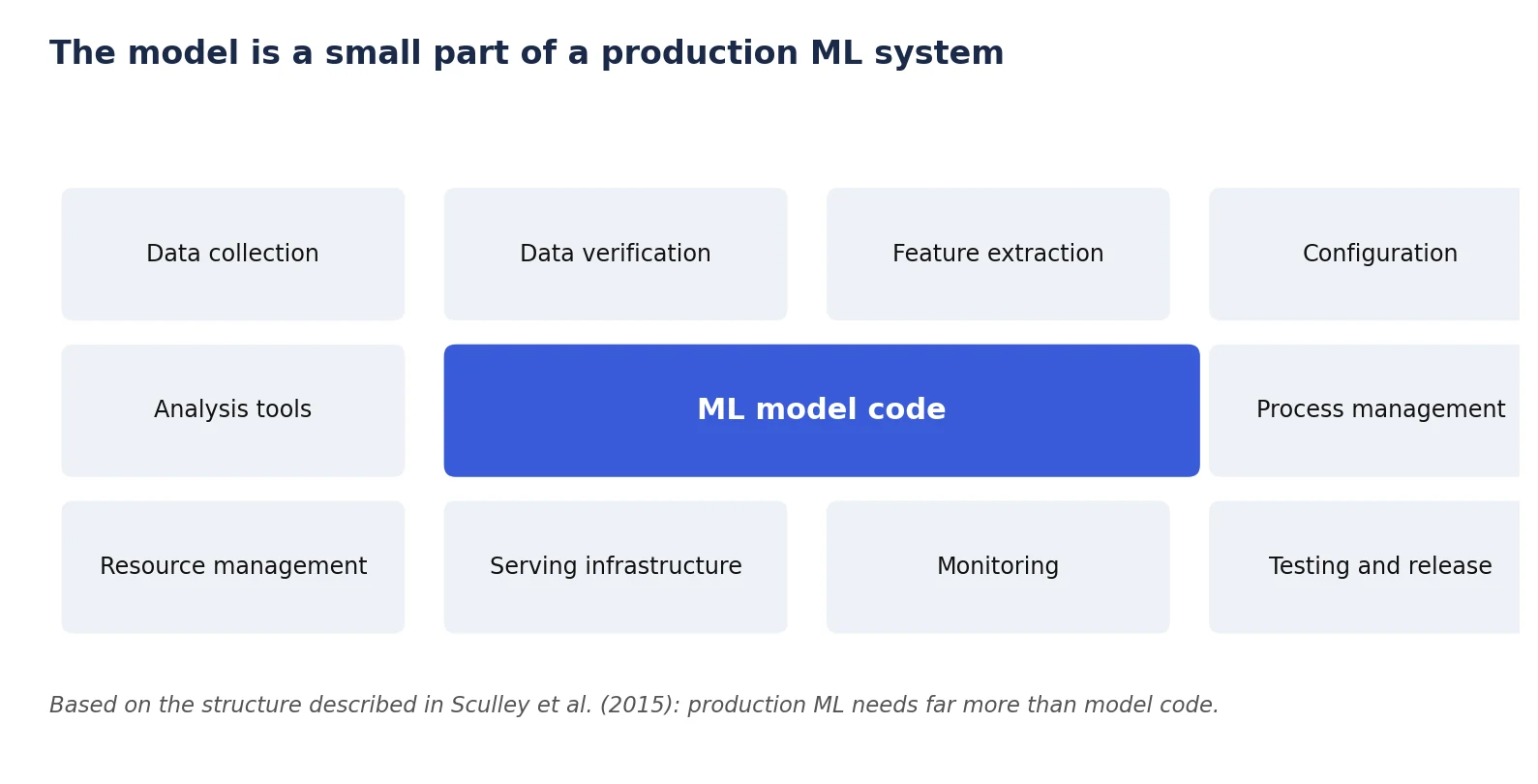
- The model is a small part of a production ML system. Sculley and colleagues at Google argued that ML systems carry heavy, ongoing maintenance costs from data dependencies, entanglement, feedback loops and changes in the external world.
- Models degrade silently. Monitor for training-serving skew and prediction drift, not just uptime, and tie alerts to retraining or rollback decisions.
- Choose MLOps services by the maturity level you need, the deliverables you will own and the monitoring you will receive, not by the tools a provider lists.
- LLM and agent systems add prompts, evaluation sets, tracing and model-retirement planning to the same discipline.
Talk to Our Team About Your Project ->
What Is MLOps?
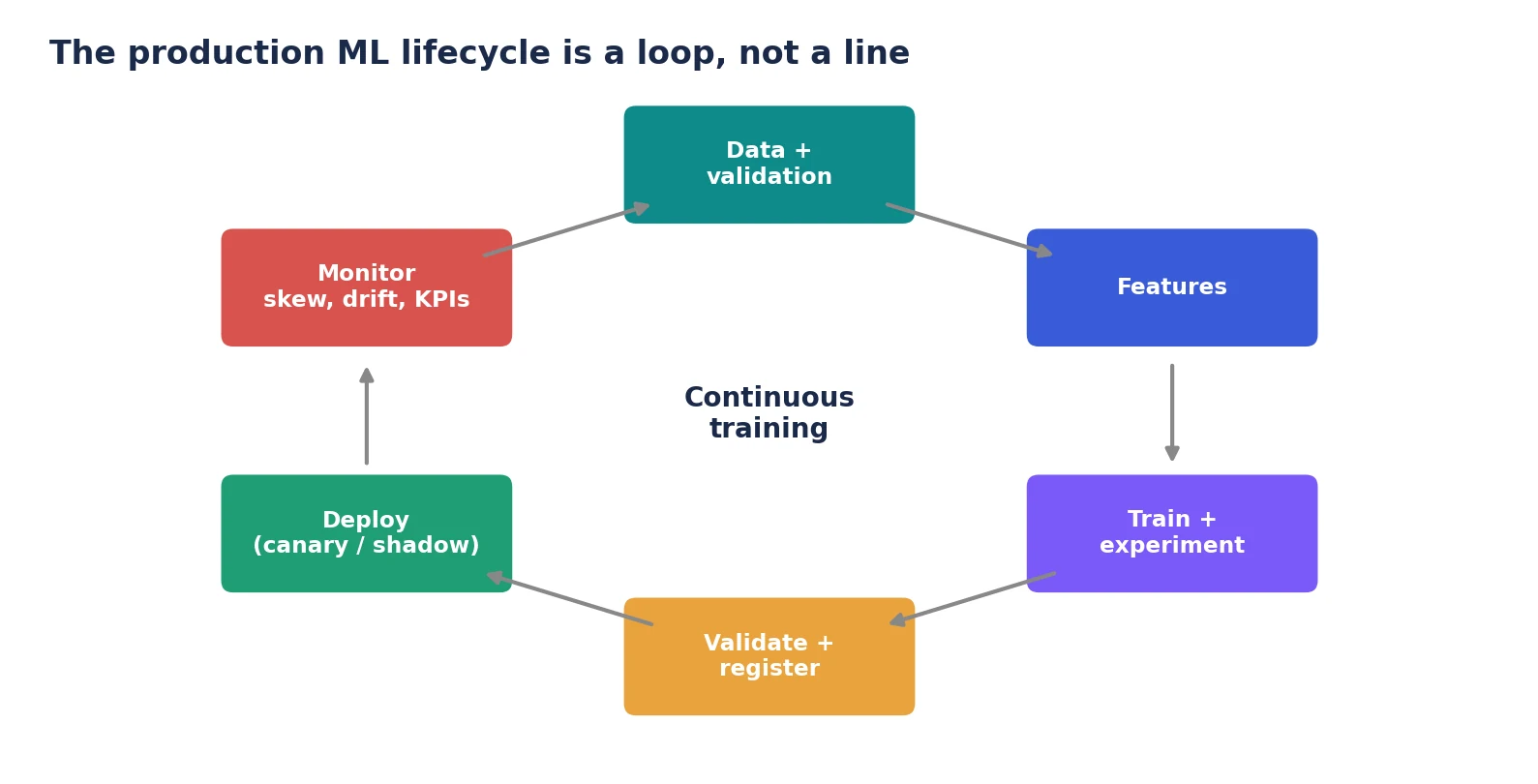
MLOps, short for machine learning operations, is the set of practices for building, deploying and running machine learning models reliably in production. Google’s Architecture Center guide to MLOps describes how DevOps ideas change for machine learning: continuous integration now tests and validates data, data schemas and models as well as code; continuous delivery targets an ML training pipeline that deploys a prediction service; and continuous training, unique to ML, automatically retrains and serves models.
The guide focuses mainly on predictive AI systems and also covers MLOps for generative AI. In practice, MLOps connects the work of data scientists, who build models, with the engineering, platform and security teams who run them.
Why Does Running Models in Production Take More Than the Model?
Because the model is a small part of the system and the rest decays, becomes entangled and is costly to maintain. Sculley and colleagues at Google argued in a NIPS 2015 paper (now NeurIPS) that it is dangerous to think of ML’s quick wins as coming for free, and that real-world ML systems commonly incur massive ongoing maintenance costs. Their paper lists boundary erosion, entanglement, hidden feedback loops, undeclared consumers, data dependencies, configuration issues and changes in the external world among the risk factors. A later analysis of ML deployments summarizes the same observation: only a small fraction of the code in production ML systems is used for core machine learning functionality.
These hidden costs often show up as project failure. RAND’s 2024 study of AI project failure interviewed 65 experienced data scientists and engineers and identified inadequate infrastructure to manage data and deploy completed models among the leading root causes. Those are MLOps problems, not modeling problems.
There is also a built-in decay problem. Google’s Vertex AI documentation notes that a deployed model performs best on prediction input data that is similar to its training data. When production data moves away from training data, accuracy can fall even though no code has changed.
What Does a Production ML System Need?
| Component | What it does | What goes wrong without it |
| Data validation | Checks schema, ranges and quality before training and serving | Bad or changed upstream data silently corrupts the model |
| Feature management | Keeps features consistent between training and serving | Training-serving skew; duplicated, inconsistent logic |
| Experiment tracking | Records code, data, parameters and results per run | Results cannot be reproduced or compared |
| Model registry | Versions models with metadata and approval status | No one knows which model is live or how to roll back |
| CI/CD for ML | Tests code, data and models; automates packaging and release | Manual, risky releases a few times a year |
| Serving infrastructure | Runs models with the needed latency, scale and rollback | Outages, slow predictions, unsafe changes |
| Monitoring and alerting | Tracks data quality, drift, model quality, latency, errors and cost | Failures are found by users, not by the team |
| Governance and security | Audit trail, access control, approvals and data protection | Compliance gaps; unclear accountability |
What Are the MLOps Maturity Levels?
Google describes three levels of MLOps maturity based on how much of the ML process is automated. The level you need depends on how often models change and how costly a bad model is.
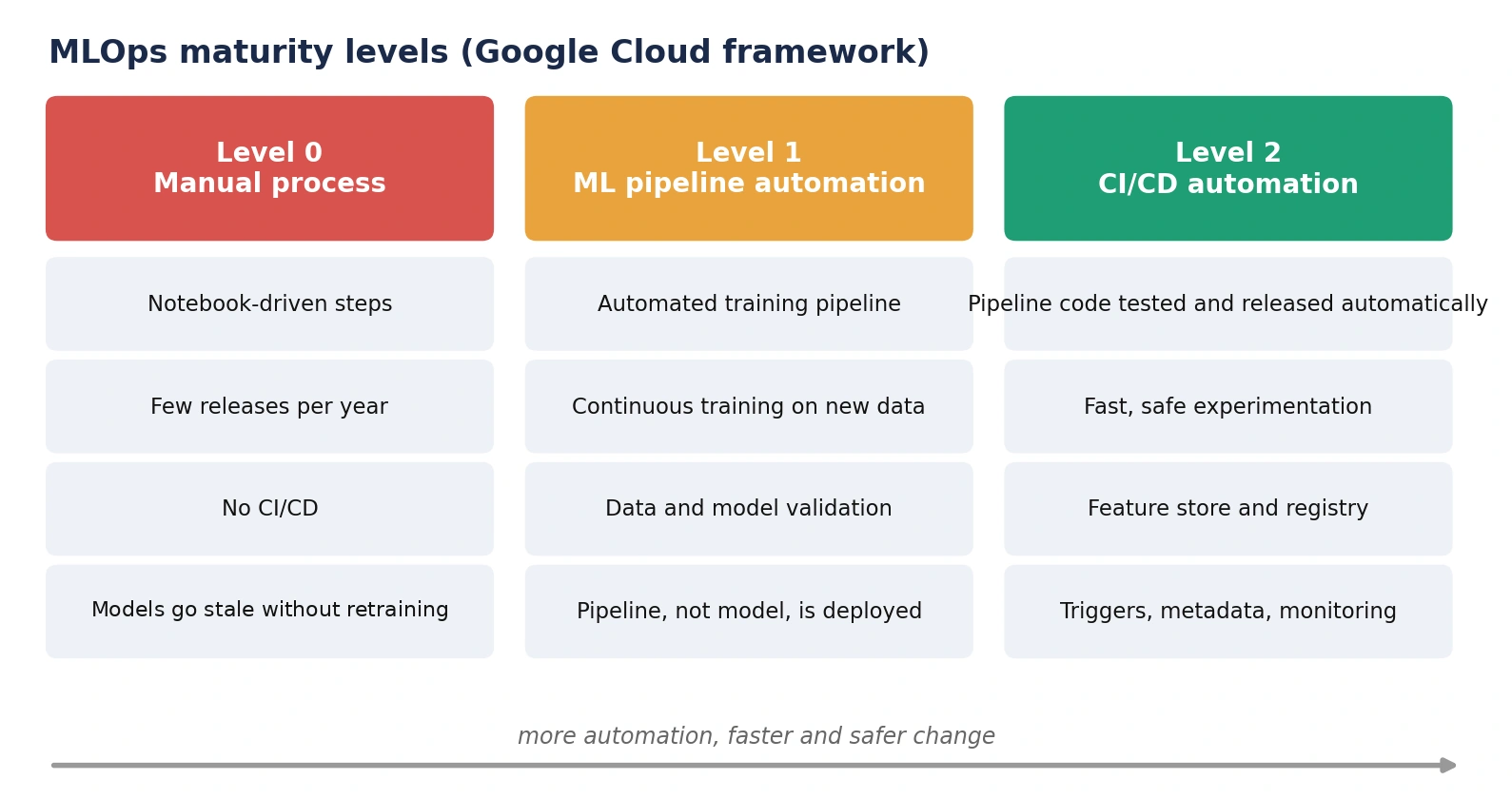
Level 0: manual process. Google describes this level as script-driven and interactive, with steps run by hand in notebooks, infrequent releases of new model versions, and no CI or CD. It suits teams that are new to ML or whose models rarely change, but without regular retraining, models go stale.
Level 1: ML pipeline automation. Google’s guide describes the goal as continuous training: an automated pipeline retrains and validates models on fresh data, and you deploy the whole training pipeline rather than a single trained model.
Level 2: CI/CD pipeline automation. The pipeline code itself is tested, built and released automatically, which supports fast, safe experimentation and frequent updates.
Google calls level 0 the most common level, and in our experience most organizations buying MLOps services are at level 0 or an uneven level 1. The practical first goal is a reliable level 1.
What Do MLOps Services Include?
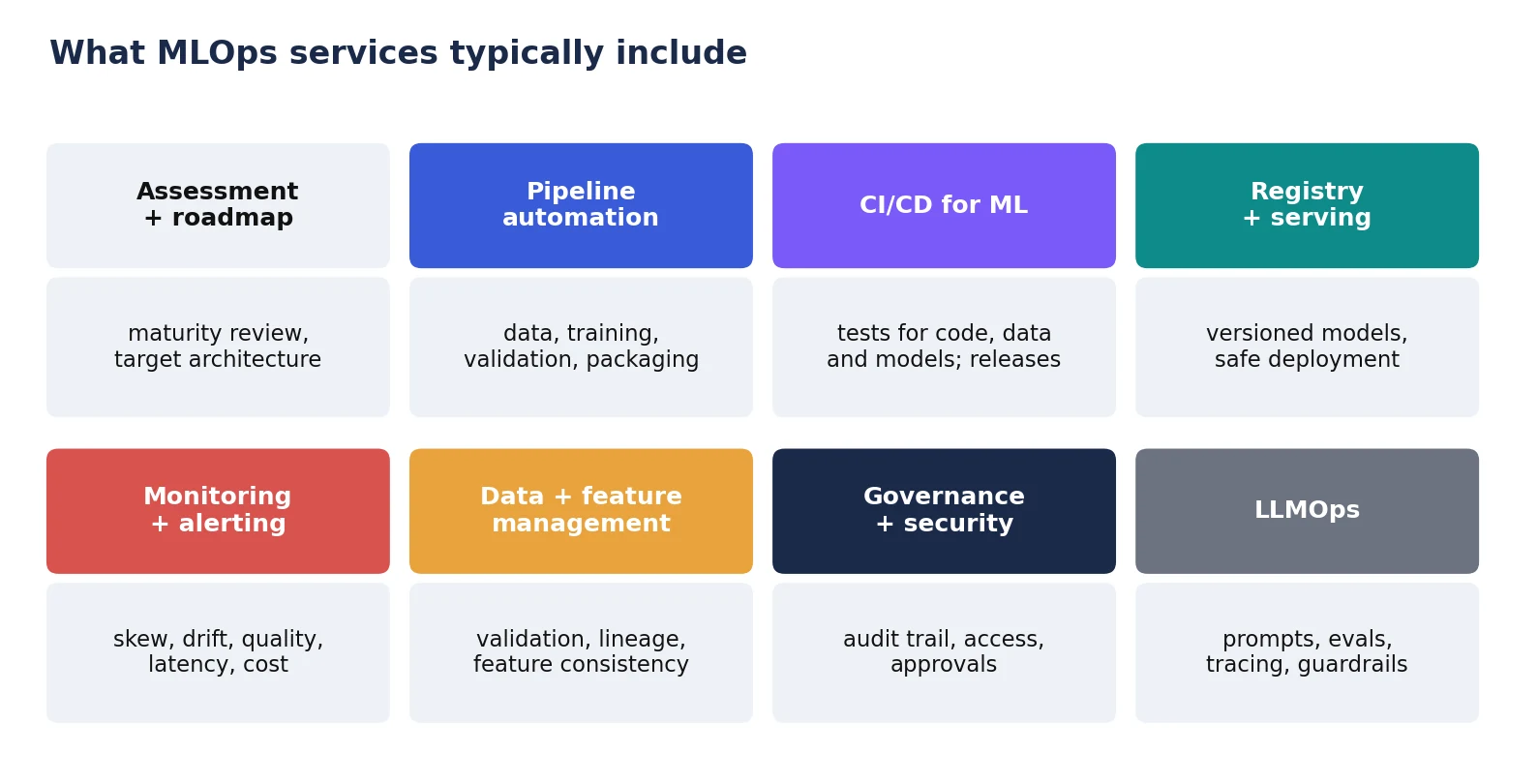
Assessment and roadmap: a review of current models, data flows, deployment practices and risks, with a target maturity level and plan.
Pipeline automation: repeatable data preparation, training, validation and packaging.
CI/CD for ML: automated tests for code, data and models, and controlled releases with rollback.
Model registry and serving: versioned models and safe deployment patterns such as shadow or canary releases.
Monitoring and alerting: data quality, skew, drift, model quality, latency, errors and cost, with owners and thresholds.
Data and feature management: validation, lineage and consistent features between training and serving.
Governance and security: audit trails, access control, approval workflows and data protection.
LLMOps: prompt and configuration versioning, evaluation sets, tracing and guardrails for generative AI systems.
Handover: documentation, runbooks and training so your team can operate what was built.
How Do You Monitor Models in Production?
Monitor the data going in as well as the predictions coming out, because input changes usually appear before accuracy drops. Two terms matter most.
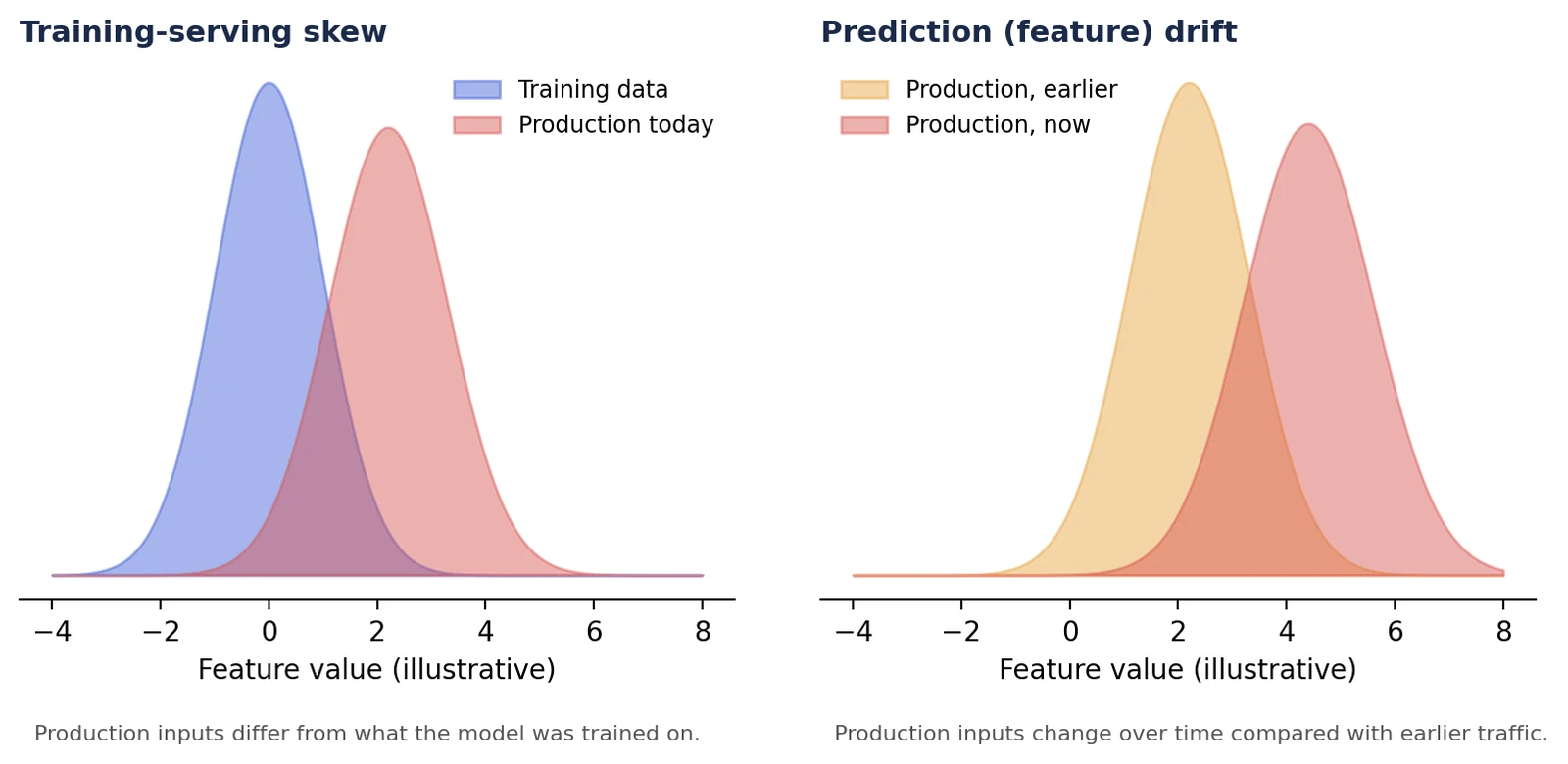 Training-serving skew occurs when the feature distribution in production deviates from the one used to train the model, as Vertex AI’s monitoring documentation defines it. The baseline is the training data, and it can occur from day one if the training data was not representative.
Prediction (feature) drift occurs when the feature distribution in production changes significantly over time. The baseline is earlier production data, so it can be detected even without the original training data.
Distribution checks are the early warning. A complete monitoring plan also tracks:
Data quality: missing values, schema changes, out-of-range inputs and upstream outages.
Model quality: accuracy or other business-relevant metrics once true outcomes arrive, which may be delayed.
Concept drift: cases where the relationship between inputs and outcomes shifts even if inputs look similar.
Operations: latency, error rates, throughput and compute cost.
Business outcomes: the downstream metric the model exists to improve.
Every alert needs a named owner and a defined response, such as investigate, retrain, roll back or switch to a fallback.
What Changes for LLM and Agent Systems?
Large language model systems need the same discipline with different artifacts. Instead of retraining on new data, teams manage prompts, retrieval, tools and provider models, and, instead of one accuracy number, they run evaluation suites.
Evaluation sets: Anthropic’s guide to agent evals stresses grading outcomes, reading transcripts and running tasks repeatedly, because agent behavior varies between runs.
Tracing: record every model call, tool call and decision, for example using OpenTelemetry’s emerging GenAI agent conventions, which are still in development.
Versioning: treat prompts, tool definitions and configuration as versioned, tested artifacts.
Model retirement: providers retire models on published schedules. Anthropic commits to at least 60 days’ notice before retiring publicly released models, so plan re-testing on replacements.
Cost and guardrails: track token spend per workflow and enforce limits on risky actions.
Should You Build, Buy a Platform or Hire MLOps Services?
| Option | Best when | Watch out for |
| Managed cloud ML platform (for example Google Vertex AI, Amazon SageMaker, Azure Machine Learning) | Your data and workloads already sit on that cloud; you want less infrastructure to run | Platform lock-in; you still need engineering to design pipelines and monitoring |
| Open-source stack (for example MLflow with orchestration and serving tools) | You need portability or custom control and have platform engineers | Integration and upkeep fall on your team |
| MLOps services partner | You have models in or near production but lack the pipelines, skills or capacity to run them reliably | Dependence on the partner unless you own the code, accounts and runbooks |
These options combine. A common approach is a managed or open-source platform, configured and handed over by an MLOps services partner.
How Do You Choose an MLOps Services Provider?
Which maturity level will we reach, and how will you measure it?
Which monitoring signals and alert thresholds will you set up, and who responds?
How do you test code, data and models before release, and how does rollback work?
Will pipelines, code, cloud accounts and documentation sit in our name from day one?
How tool-neutral are you, and what lock-in does your design create?
How will you train our team and hand over runbooks?
What security, audit and compliance controls are built in?
Red flags: tool lists with no maturity target, dashboards with no alerts or owners, no rollback plan, vendor-owned infrastructure, and a proposal that treats deployment as a one-off task.
What Drives the Cost of MLOps Services?
Number and complexity of models: more models and more varied data sources mean more pipelines and monitoring.
Current maturity: moving from manual to automated costs more than refining an automated setup.
Latency and scale needs: real-time serving with strict availability needs costs more than batch scoring.
Compliance requirements: auditability, approvals and data protection add work.
Infrastructure choices: training compute, storage, monitoring volume and platform fees continue after the project ends.
Team location and seniority: Accelerance’s 2026 rates guide puts general senior developer partner rates at about $31 to $41 an hour in Asia, $60 to $75 an hour in Latin America and $64 to $76 an hour in Europe. These are not MLOps-specific rates, and MLOps specialists often cost more.
Ask for an estimate that separates one-off build effort from recurring infrastructure and support costs.
Get a Custom Project Cost & Timeline Estimate ->
What Does a 90-Day MLOps Roadmap Look Like?
The roadmap below is an illustrative sequence, not a fixed timeline. Scope and starting maturity change it.
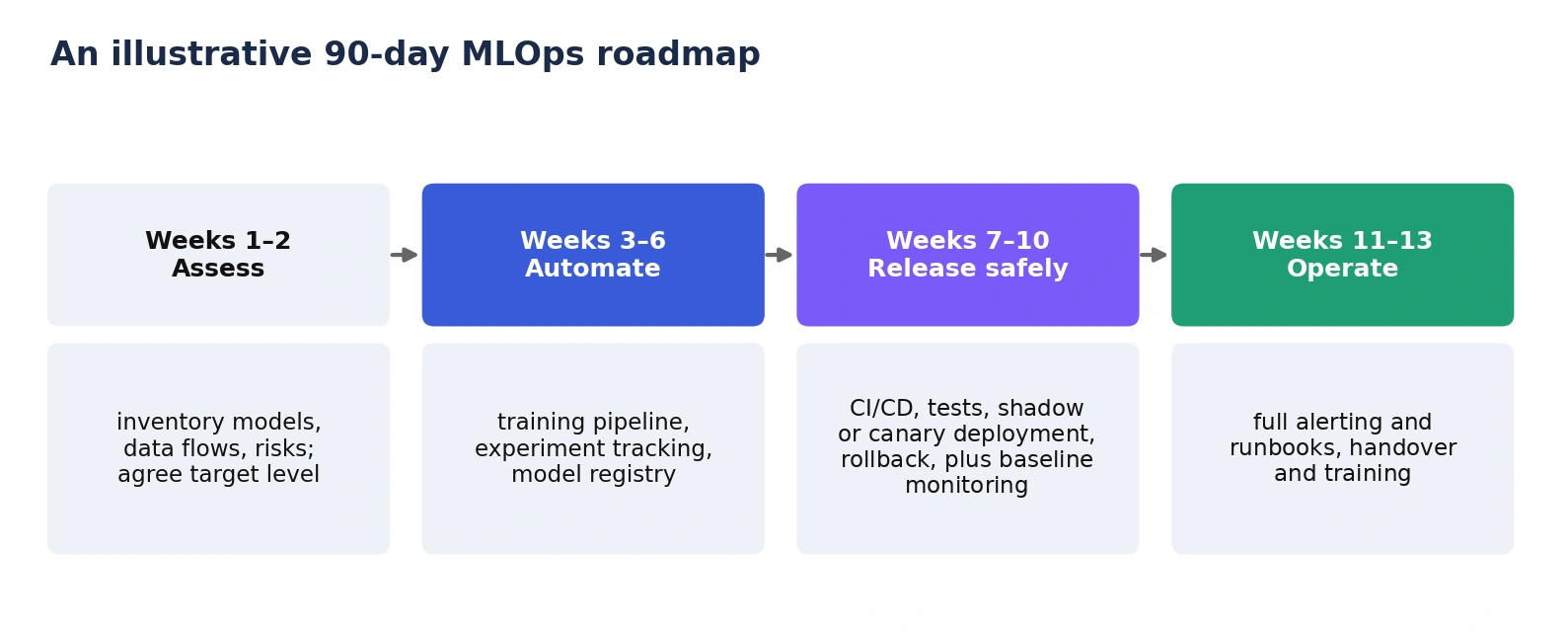
Weeks 1–2, assess: inventory models, data flows and risks, and agree on the target maturity level.
Weeks 3–6, automate: build the training pipeline, experiment tracking and model registry.
Weeks 7–10, release safely: add CI/CD, tests and shadow or canary deployment with rollback, with baseline monitoring starting alongside the first deployment.
Weeks 11–13, operate: complete alerting and finalize runbooks on top of the baseline monitoring, then hand over and train the team.
How AB Ark Helps Teams Run Models in Production
AB Ark Solutions is an AI and software development company that builds custom AI solutions and helps teams take them into production. For AI products, AB Ark works on the surrounding engineering that production needs: deployment, evaluation, tracing and monitoring, with limits and approval steps designed in. Its case studies include a 24/7 AI call agent that manages bookings across multiple branches, and teams building AI agents can start with the AI agent development service.
FAQs
What are MLOps services?
Services that help organizations deploy, monitor and maintain machine learning models in production, including pipeline automation, CI/CD for ML, model registry and serving, monitoring and alerting, governance and handover.
What is the difference between MLOps and DevOps?
DevOps automates building, testing and releasing software. MLOps does the same for ML systems and adds data and model validation and continuous training, because models depend on data that changes.
What is model drift?
Model drift is a decline in a model’s usefulness as production data or relationships change over time. Monitoring typically watches for training-serving skew and prediction drift in input features, plus model quality once outcomes are known.
When do I need MLOps?
When models are valuable enough that failures, stale predictions or slow releases cost money, or when deployment, retraining and monitoring are still manual. Teams with one rarely changing model may start at a lower maturity level.
Does MLOps apply to LLMs and AI agents?
Yes, with different artifacts: prompts, retrieval, tools and provider models, evaluation suites, tracing and cost controls instead of, or alongside, classic retraining pipelines.
A model is only valuable while it runs correctly. Automate the pipeline, monitor the data, plan for change, and keep ownership of everything that keeps it running.
Schedule a Free Consultation Call ->
Engineering Manager At AB Ark Solutions