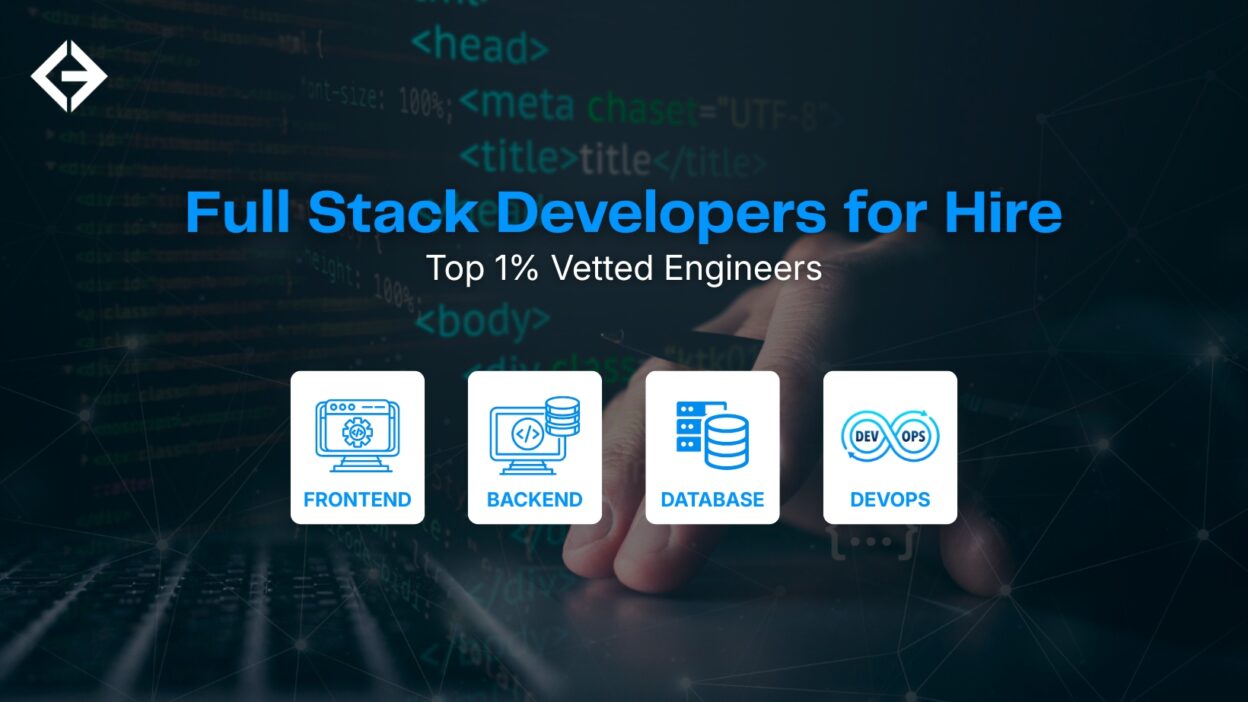
The fastest way to get full stack developers for hire is to hire pre-vetted engineers through a dedicated talent partner who has already screened for frontend, backend, database, and DevOps depth. Vetted developers start in 1-2 weeks at $25-$75 per hour, versus 8-12 weeks and $80-$150+ for local recruitment.
Key Takeaways:
- A true full stack developer owns the entire feature: UI, APIs, database, and deployment, cutting coordination overhead.
- Rates range from $25-$75 per hour offshore to $80-$150+ onshore; seniority and stack rarity move the number most.
- Pre-vetted hiring saves 15-20% of annual salary in recruitment costs and cuts time-to-start from months to weeks.
- One senior developer paired with 2-3 mid-level engineers costs 35-40% less than an all-senior team without losing quality.
- Vet for depth in 2-3 technologies, not a keyword list of ten frameworks.
📊 Contact Our Experts for a Free Tech Review
Every unfilled engineering seat costs real money: roughly $15,000 a month in lost productivity while the role sits open, and local full stack hiring averages 8-12 weeks when it goes smoothly. Meanwhile the roadmap does not pause. That gap between demand and hiring speed is exactly what vetted full stack talent exists to close.

What a Full Stack Developer Actually Owns
A full stack developer handles every layer of a product: responsive frontend interfaces, backend logic and APIs, database design, and increasingly cloud deployment and DevOps. One person ships an entire feature end to end instead of three specialists passing tickets between them.
That breadth is the economic argument. A senior full stack engineer at one salary often replaces a frontend hire plus a backend hire, and the coordination overhead between them. For teams under 20 engineers, generalists beat specialists almost every time.
The warning sign to watch for: a resume listing ten frameworks is depth in zero of them. The best full stack engineers know two or three tools extremely well (a MERN or Python/React core, for example) and pick up adjacent ones as needed.
What Full Stack Developers Cost in 2026
| Hiring Route | Typical Rate | Time to Start | Best For |
| Offshore vetted talent (Pakistan, India, SE Asia) | $25-$75/hr | 1-2 weeks | Best value at senior quality |
| Nearshore (Eastern Europe, LatAm) | $30-$80/hr | 2-4 weeks | Time zone overlap priority |
| US/Western Europe freelancers | $80-$150/hr | 2-6 weeks | Short engagements, local context |
| In-house US hire | $160K-$280K/year loaded | 8-12 weeks | Core IP, long-term ownership |
The hourly rate is not the whole cost. In-house hires carry recruitment fees of 20-30% of first-year salary, plus benefits, equipment, and ramp-up. Pre-vetted talent partners absorb the sourcing, screening, and replacement risk, which is where the 15-20% savings actually comes from.
Stack choice moves rates too. Popular stacks (MERN, MEAN, LAMP) stay competitive because the talent pool is deep; niche stacks like Web3 or AI-native tooling push rates up 30-50%.
What “Top 1% Vetted” Should Actually Mean
Any agency can claim elite vetting. Make them prove the filter has stages: technical screening on real scenarios rather than algorithm puzzles, a live build or paid test project, communication assessment in English, and reference checks against shipped products.
The interview signal that matters most is reasoning under ambiguity. Ask a candidate to design a simple API, handle a failure case, or debug a slow query out loud. How they think predicts on-the-job performance far better than what they recite.
One more modern filter: AI tooling fluency. Full stack developers who use AI coding assistants strategically ship 30-40% faster than those who treat them as autocomplete. Ask for a concrete example of when an AI tool saved them significant time on a real project.
Full Stack Hire vs. Full Stack Team
A single developer fits well-scoped products and early MVPs. Complex platforms usually need the surrounding roles: QA, UI/UX, DevOps, and a project manager coordinating delivery. Knowing which engagement your product needs before you start hiring prevents both understaffing and burn. For a breakdown of what an end-to-end engagement covers and when to choose it over individual hires, read our complete guide to full stack development services before scoping your team.
AB Ark’s QS Learning build shows what vetted full stack execution delivers. A traditional tutoring center needed to become a digital business; the team built a Smart Online Academy end to end, with automated scheduling, an integrated virtual classroom, and an SEO-optimized website that lets parents and students find, book, and attend classes anytime. That frontend-to-backend-to-launch ownership, repeated across hundreds of clients over 15K+ working hours by an 80+ person team at a 99-100% job success rate, is what the top-1% claim has to look like in shipped products.
How to Run the Hiring Process in 2 Weeks
Day 1-2: define the role precisely, including your stack, the first 90 days of deliverables, and the seniority you actually need. Day 3-7: review pre-vetted candidate profiles and hold technical interviews with the engineers themselves, never just sales representatives. Day 8-10: run a short paid trial task mirroring real work. Day 11-14: contract with clear IP assignment and a replacement guarantee, then onboard with repository access ready on day one.
The replacement guarantee is the clause that separates serious talent partners from body shops. If the engineer is not working out in the first weeks, a strong partner swaps them at no cost.

Frequently Asked Questions
Where can I hire a full-stack developer?
You can hire a full-stack developer through freelance platforms, recruitment agencies, or trusted software companies like AB Ark Solutions that provide dedicated full-stack development services.
How much does it cost to hire a full-stack developer?
Hiring a full-stack developer typically costs $20 to $150+ per hour or $3,000 to $12,000+ per month, depending on experience, location, and technology stack.
How much is a full-stack developer paid?
A full-stack developer typically earns $60,000 to $150,000+ per year globally, while in Pakistan salaries generally range from PKR 80,000 to PKR 350,000+ per month, depending on experience and skills.
Will AI replace full stack dev?
No, AI will not replace full-stack developers. It will automate routine coding tasks, while developers will continue to be essential for system design, architecture, problem-solving, and building complex applications.
Is it better to hire a full stack developer or separate frontend and backend developers?
For teams under 20 engineers and most startup products, one strong full stack developer beats two specialists on cost and coordination. Specialists win on large, complex platforms where depth in each layer matters more than flexibility.
What skills should a full stack developer have in 2026?
Deep command of one frontend framework (React, Vue) and one backend stack (Node.js, Python), plus database design, API architecture, and cloud deployment. Strategic use of AI coding tools is quickly becoming a baseline expectation.
Vetted talent is not about outsourcing risk. It is about compressing the two months of hiring uncertainty into two weeks of verified capability, so your roadmap runs on engineering speed instead of recruitment speed.
👉 Schedule Your Technical Strategy Session

Syed Ahmad Ali is a tech writer at AB Ark with a knack for turning complex ideas into easy reads. He writes across a range of topics, but AI, software development, and the business of tech sit right at the top of his list.