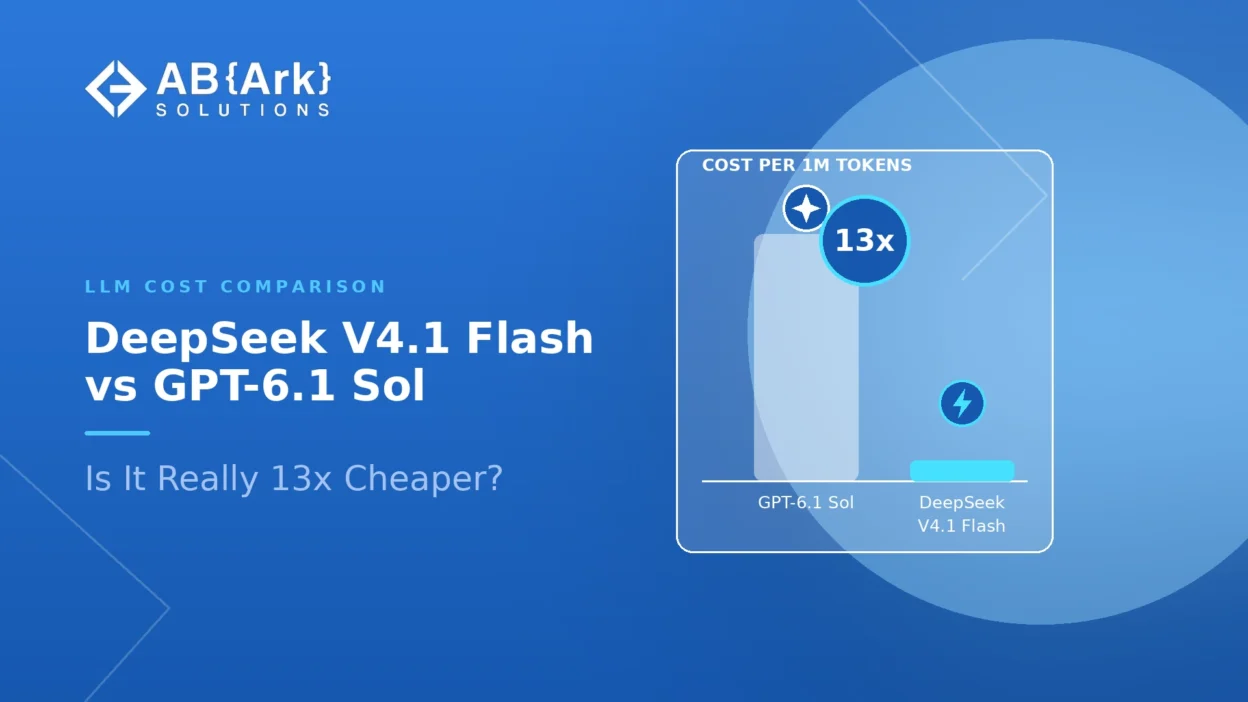

DeepSeek V4.1 Flash is 13x cheaper than GPT-6.1 Sol per token only on uncached input billed off-peak ($0.15 versus $2.00 per million). Per completed task, the gap is far smaller: independent testing puts DeepSeek V4.1 Flash 1017 at $0.26 per benchmark task against $0.32 for GPT-6.1 Sol at high effort, because the DeepSeek model writes many more tokens. Teams planning AI agent development should budget by cost per successful task, not price per token.
Key Takeaways
- The “13x” figure compares DeepSeek V4.1 Flash off-peak input with GPT-6.1 Sol standard input. At peak hours the token gap is 6.7x on input and 8.3x on output.
- On the Artificial Analysis Intelligence Index, DeepSeek V4.1 Flash 1017 (Max) scores 45 at $0.26 per task; GPT-6.1 Sol scores 48 to 52 at $0.21 to $0.72 per task depending on effort level.
- DeepSeek V4.1 Flash 1017 generated 210M output tokens on that index versus 67M for GPT-6.1 Sol at max effort, so verbosity erases most of the per-token discount.
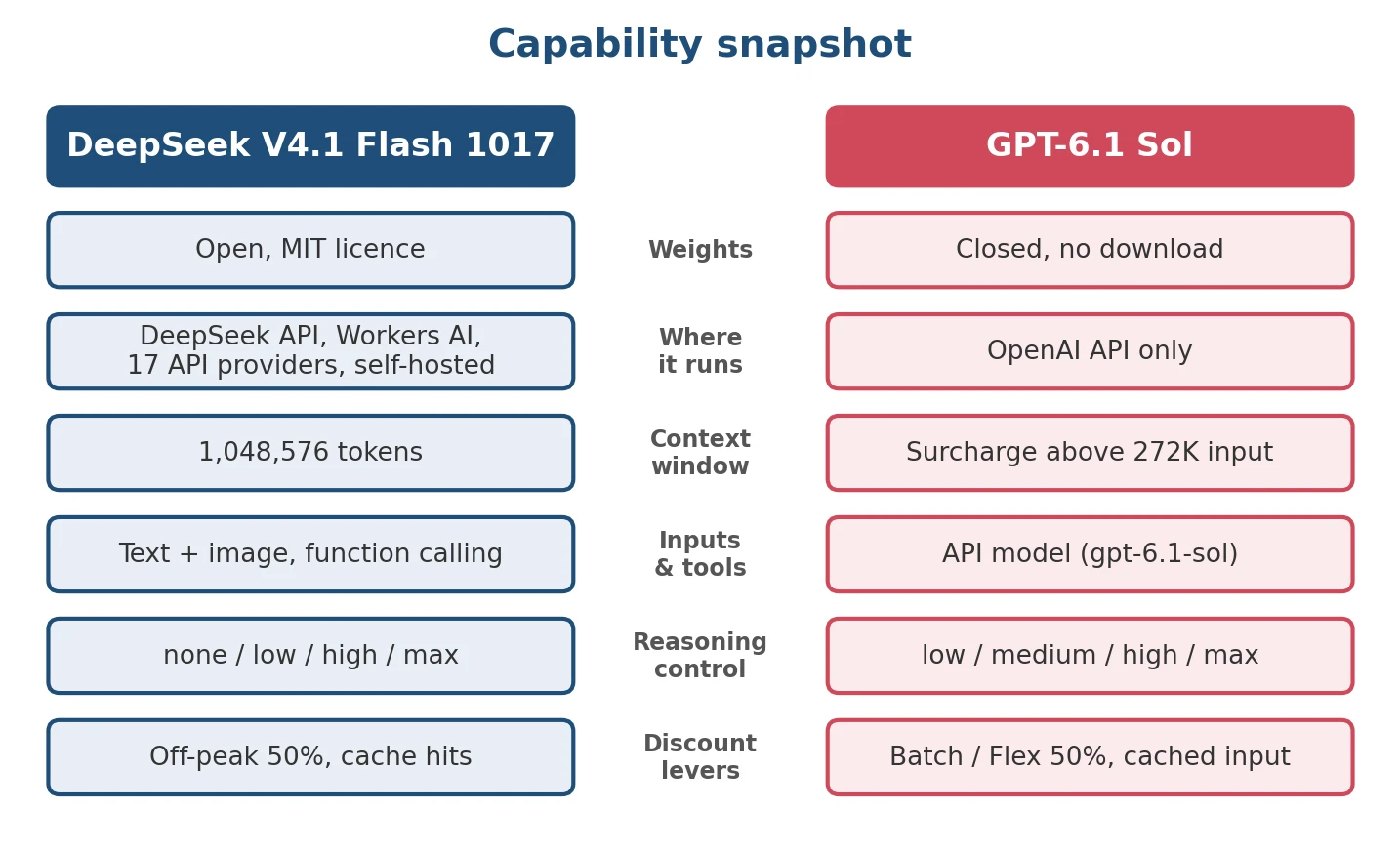
- DeepSeek V4.1 Flash has MIT-licensed weights and runs on the DeepSeek API, Cloudflare Workers AI and self-hosted stacks; GPT-6.1 Sol is API-only.
- The strongest economic case for DeepSeek V4.1 Flash is input-heavy, cache-heavy or schedulable work, plus deployments that need open weights.
Talk to Our Team About Your Project ->
What Is DeepSeek V4.1 Flash 1017?
DeepSeek V4.1 Flash is DeepSeek’s low-cost, open-weights mixture-of-experts model, served through the DeepSeek API as deepseek-flash. The Next Web reported the September 10, 2026 launch, and DeepSeek shipped the current checkpoint, DeepSeek-V4.1-Flash-1017, on October 17, 2026. DeepSeek’s release note describes 1017 as an update with stronger benchmarks, faster task completion and shorter outputs than the September version, with weights published on Hugging Face and ModelScope.
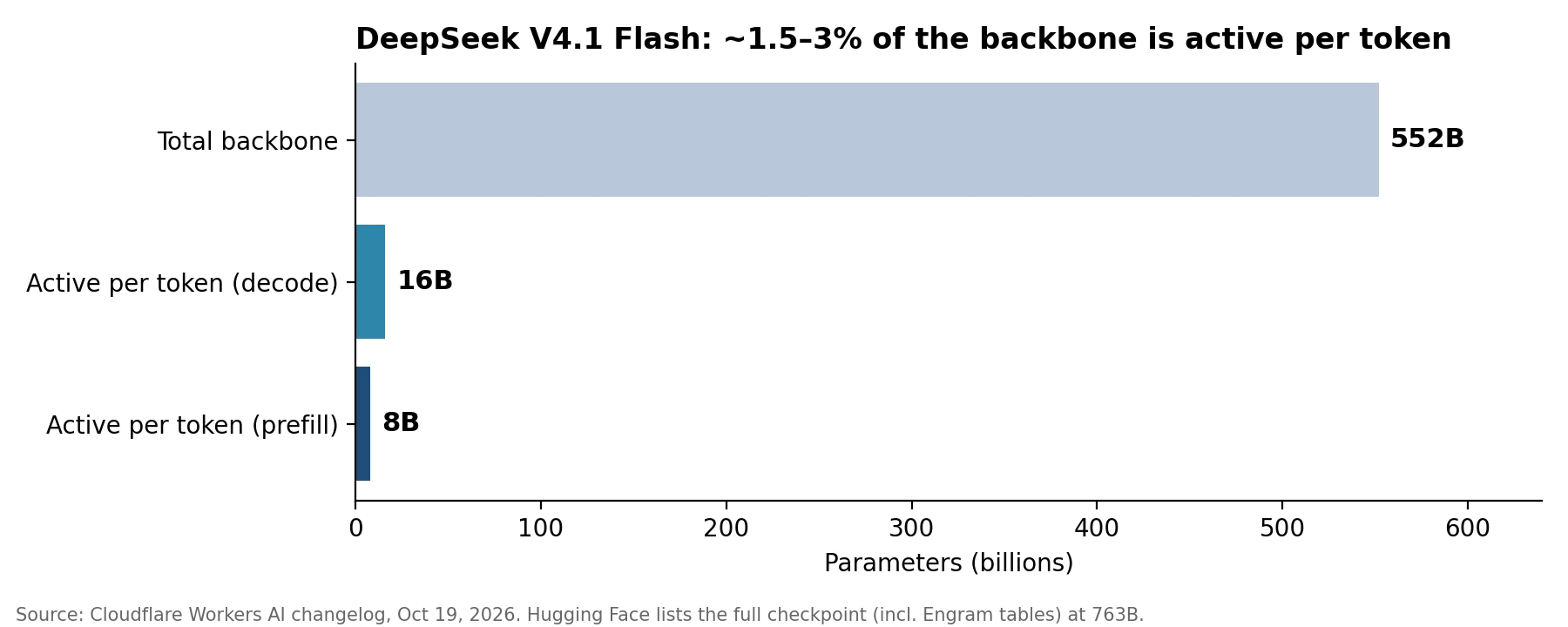
The architecture explains the pricing. Cloudflare’s Workers AI changelog describes a 552B-parameter backbone that activates 8B parameters per token during prefill and 16B during decode, which keeps input-heavy agentic workloads fast and inexpensive. The Hugging Face model card lists the full checkpoint at 763B parameters, cites a technical report titled around KV cache compression, and releases the weights under the MIT licence. The higher Hugging Face figure appears to include the separate Engram lookup tables that community deployers store alongside the backbone.
GPT-6.1 Sol is OpenAI’s mid-tier proprietary model. OpenAI describes GPT-6.1 Sol as near-Astra capability at a fifth of GPT-6 Astra’s price, available in the API as gpt-6.1-sol. There are no downloadable weights.
The capability snapshot below summarises what each model offers at the platform level, using the vendor and host documentation cited in this article.
Is DeepSeek V4.1 Flash Really 13x Cheaper Per Token?
DeepSeek V4.1 Flash is 13x cheaper than GPT-6.1 Sol on one price line. The table uses each vendor’s official list prices, checked October 22, 2026, in USD per one million tokens.
| Price line (per 1M tokens) | DeepSeek V4.1 Flash off-peak | DeepSeek V4.1 Flash peak | GPT-6.1 Sol standard | Sol vs Flash ratio |
| Input, cache miss | $0.15 | $0.30 | $2.00 | 13.3x off-peak / 6.7x peak |
| Input, cache hit | $0.003 | $0.006 | $0.10 | 33x off-peak / 17x peak |
| Output | $0.60 | $1.20 | $10.00 | 16.7x off-peak / 8.3x peak |
Sources: DeepSeek Models & Pricing and OpenAI’s GPT-6.1 Sol announcement. Ratios are AB Ark calculations. DeepSeek peak hours are 01:00 to 04:00 and 06:00 to 10:00 UTC on weekdays; all other hours bill at half price. GPT-6.1 Sol offers a 50% Batch and Flex discount and charges 2x input and 1.5x output above 272K input tokens.
What Makes DeepSeek V4.1 Flash Cheaper?
Four design and business choices drive the lower list price, and only one of them is a trade-off.
Sparse activation: DeepSeek V4.1 Flash is a mixture-of-experts model that runs 8B parameters per token on prefill and 16B on decode out of a 552B backbone. Compute per token, and therefore serving cost, tracks the active parameters rather than the total, so the model is priced like a small dense model while drawing on a much larger one.
Compressed KV cache: The technical report cited on the model card centres on KV cache compression. A smaller cache per token lets each GPU hold more concurrent requests and longer contexts, which is what makes the 1M-token window and the $0.003 cache-hit price viable.
Off-peak pricing: Half-price billing outside weekday peak windows fills GPU capacity that would otherwise sit idle. Workloads that can wait, such as nightly batch extraction or evaluation runs, capture this discount without any code change beyond scheduling.
Open-weights competition: Because the weights are MIT-licensed, 17 API providers compete to serve the same model, and self-hosting sets a hard ceiling on what any provider can charge. GPT-6.1 Sol has a single supplier.
The trade-off: The cost DeepSeek does not discount is verbosity. At max reasoning effort the model writes far more output tokens than GPT-6.1 Sol, which is why the per-task comparison in the next section narrows the gap so sharply.
What Does Each Model Cost Per Completed Task?
Per completed task, DeepSeek V4.1 Flash 1017 is between about 20% more expensive and 2.8x cheaper than GPT-6.1 Sol, depending on which GPT-6.1 Sol effort level you compare it with. That is the most important number in this comparison, because it captures how many tokens each model actually spends to finish work.
| Model and effort setting | AA Intelligence Index | Cost per index task | Output tokens to run index |
| DeepSeek V4.1 Flash 1017 (max) | 45 | $0.26 | 210M |
| GPT-6.1 Sol (low) | 42 | $0.13 | 9.0M |
| GPT-6.1 Sol (medium) | 48 | $0.21 | 15M |
| GPT-6.1 Sol (high) | 50 | $0.32 | 25M |
| GPT-6.1 Sol (max) | 52 | $0.72 | 67M |
Sources: Artificial Analysis pages for DeepSeek V4.1 Flash 1017 (max), GPT-6.1 Sol (low), medium, high and max, checked October 22, 2026. Artificial Analysis prices each run at the model’s first-party API rates; DeepSeek figures use the $0.30/$1.20 peak tier.
The explanation is verbosity. Artificial Analysis classifies DeepSeek V4.1 Flash 1017 (max) as very verbose: it produced 210 million output tokens across the index, more than three times GPT-6.1 Sol at max effort and more than eight times GPT-6.1 Sol at high effort. A model that is 8x cheaper per output token but writes 8x more tokens costs about the same per answer.
On these figures, GPT-6.1 Sol at medium effort scored higher (48 versus 45) and cost less per task ($0.21 versus $0.26). That does not make GPT-6.1 Sol cheaper for every workload. Benchmark tasks are reasoning-heavy; for short-output jobs such as classification, extraction and routing, DeepSeek V4.1 Flash with reasoning set low or off should keep much more of its per-token advantage. It does mean the reasoning-effort setting is a cost lever as large as the choice of vendor.
Where and When to Use Each Model
The per-token and per-task numbers point to a split rather than a single winner. The diagram and guidance below translate them into routing rules.
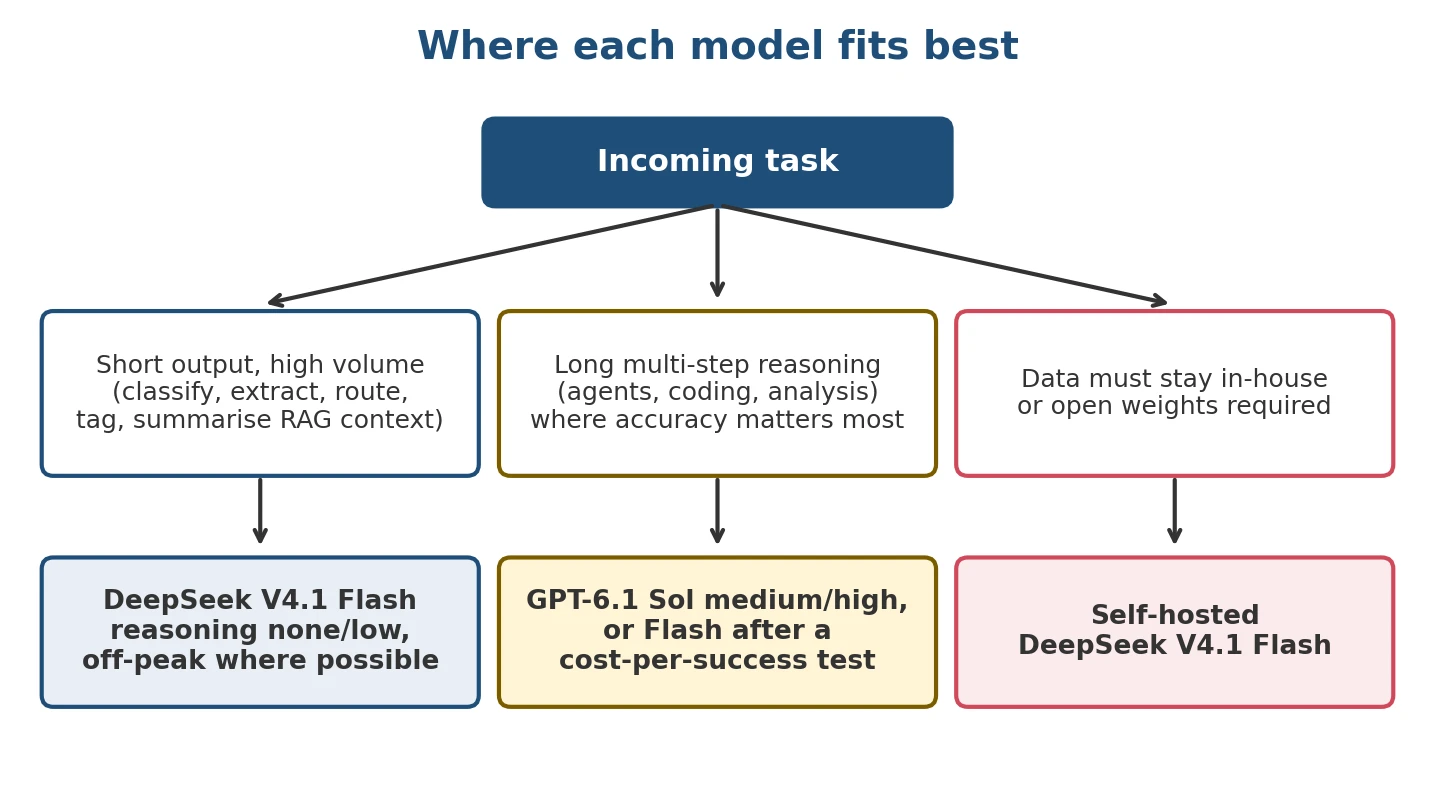
Use DeepSeek V4.1 Flash for high-volume, short-output work: Classification, entity extraction, intent routing, tagging, moderation and summarising retrieved context produce short outputs from long inputs. That is exactly where the cheap input, cache-hit and off-peak lines dominate the bill, and where DeepSeek V4.1 Flash with reasoning set to none or low keeps most of its 7x to 15x per-token advantage.
Use DeepSeek V4.1 Flash for RAG and cache-heavy pipelines: Long system prompts, policy documents or codebases reused across thousands of calls benefit from the $0.003 to $0.006 cache-hit price. Customer-support copilots and document Q&A over a stable corpus fit this pattern.
Use DeepSeek V4.1 Flash for schedulable batch jobs: Nightly enrichment, backfills, evaluation suites and report generation can run outside peak hours at half price.
Use GPT-6.1 Sol for reasoning-heavy, accuracy-critical tasks: On the Artificial Analysis index, GPT-6.1 Sol at medium effort scored higher and cost less per task than DeepSeek V4.1 Flash at max. For complex agents, multi-step coding and analysis where a failed run means a retry or human review, start with GPT-6.1 Sol at medium or high and switch only if a cost-per-success test favours Flash.
Use DeepSeek V4.1 Flash where open weights are mandatory: If prompts cannot leave your infrastructure, or procurement requires inspectable weights, DeepSeek V4.1 Flash is the only one of the two that qualifies.
Consider a hybrid router: Many production systems do best with both: Flash handles the high-volume first pass, and only hard or low-confidence cases escalate to GPT-6.1 Sol.
What Changed in the 1017 Update?
DeepSeek-V4.1-Flash-1017 improved agentic and coding scores over the September checkpoint, according to DeepSeek’s own testing. Independent scoring moved the same way: the earlier September release scored 39 on the Artificial Analysis index, and 1017 (max) now scores 45.
| Benchmark (DeepSeek-reported) | V4.1 Flash (Sep) | V4.1 Flash 1017 | GPT-5.6 Sol |
| DeepSWE v1.1 | 74.2 | 77.0 | 73.0 |
| Terminal-Bench 4.0 | 31.2 | 42.3 | 39.9 |
| Automation-Bench v1.0.6 | 54.8 | 60.5 | 45.8 |
| ProgramBench | 20.3 | 29.1 | 23.0 |
| HLE without tools | 36.8 | 42.6 | 44.5 |
Source: DeepSeek-V4.1-Flash-1017 model card. These are vendor-reported results, and DeepSeek compares against GPT-5.6 Sol, the previous OpenAI generation, not GPT-6.1 Sol. Treat them as evidence of the update’s direction, not as a head-to-head result against the model in this article’s title.
Where Can You Run DeepSeek V4.1 Flash?
DeepSeek V4.1 Flash can run through four routes, and the route changes both price and operational risk.
DeepSeek API
The DeepSeek API is the reference route, with peak and off-peak billing. Artificial Analysis measured about 206 output tokens per second and a 1.04-second time to first token on DeepSeek’s API. DeepSeek also opened Search and Fetch APIs at $0.75 per 1,000 calls per endpoint; calls through server-side tools in Claude Code, Codex and DeepSeek Harness are free until October 31, 2026, at 16:00 UTC, after which agent workloads that browse will see a new cost line.
Cloudflare Workers AI and other hosts
Cloudflare added the 1017 checkpoint to Workers AI on October 19, 2026 with vision, function calling and the full 1,048,576-token window. Reasoning defaults to high effort and can be set to low, max or none. It requires the Workers Paid plan or prepaid AI Gateway credits, with a default limit of 20 requests per minute (50 with prepaid credits), which matters for production throughput planning. Artificial Analysis lists 17 API providers in total.
Self-hosting from open weights
The Hugging Face model card points to vLLM, SGLang and DeepSeek’s own inference code. One integration detail is easy to miss: the release ships no Jinja chat template. DeepSeek provides an encoding.py reference and a Rust toolkit, deepseek-recipe, for prompt formatting instead, so off-the-shelf serving stacks may need adapter work. DeepSeek recommends temperature 1.0, top_p 1.0 and max_tokens of at least 256K.
Community workstation deployments
A community recipe from Mia’s AI Lab shows what small-scale self-hosting looks like. The project serves a 2.9-bit EXL3 quantization on two NVIDIA DGX Spark systems (128 GB each) and reports single-stream decoding of about 75 tokens per second on prose and 110 on code, rising to 130 to 155 tokens per second in total across four streams. Prefill runs near 2,100 tokens per second, so a 128K-token prompt takes about a minute before the first token.
The same repository documents the caveats: the quantization is labelled experimental with no published accuracy comparison against the full model; the weights fill about 98 GiB per machine; a 512K window is the practical limit on a busy head node; and exhausting unified memory can freeze a machine until it is power-cycled. This is a valuable data point for private or offline use, not a production reference architecture.
When Is Self-Hosting Cheaper Than the API?
Self-hosting DeepSeek V4.1 Flash is rarely cheaper than the DeepSeek API at moderate volume; it is justified mainly by data control. GetDeploying estimates that a 4-bit deployment on eight RTX A6000 GPUs costs about $3,514 a month and breaks even with the API at roughly 8 billion tokens a month, and an FP8 deployment on eight A100s needs about 23 billion tokens a month. Those are third-party estimates for rented GPUs, and they exclude engineering and on-call time.
The decision point is usually regulatory or contractual: if prompts cannot leave your infrastructure, MIT-licensed weights make DeepSeek V4.1 Flash an option where GPT-6.1 Sol is not. If they can, the API is simpler and, below billions of tokens a month, cheaper.
When to Host and When to Subscribe
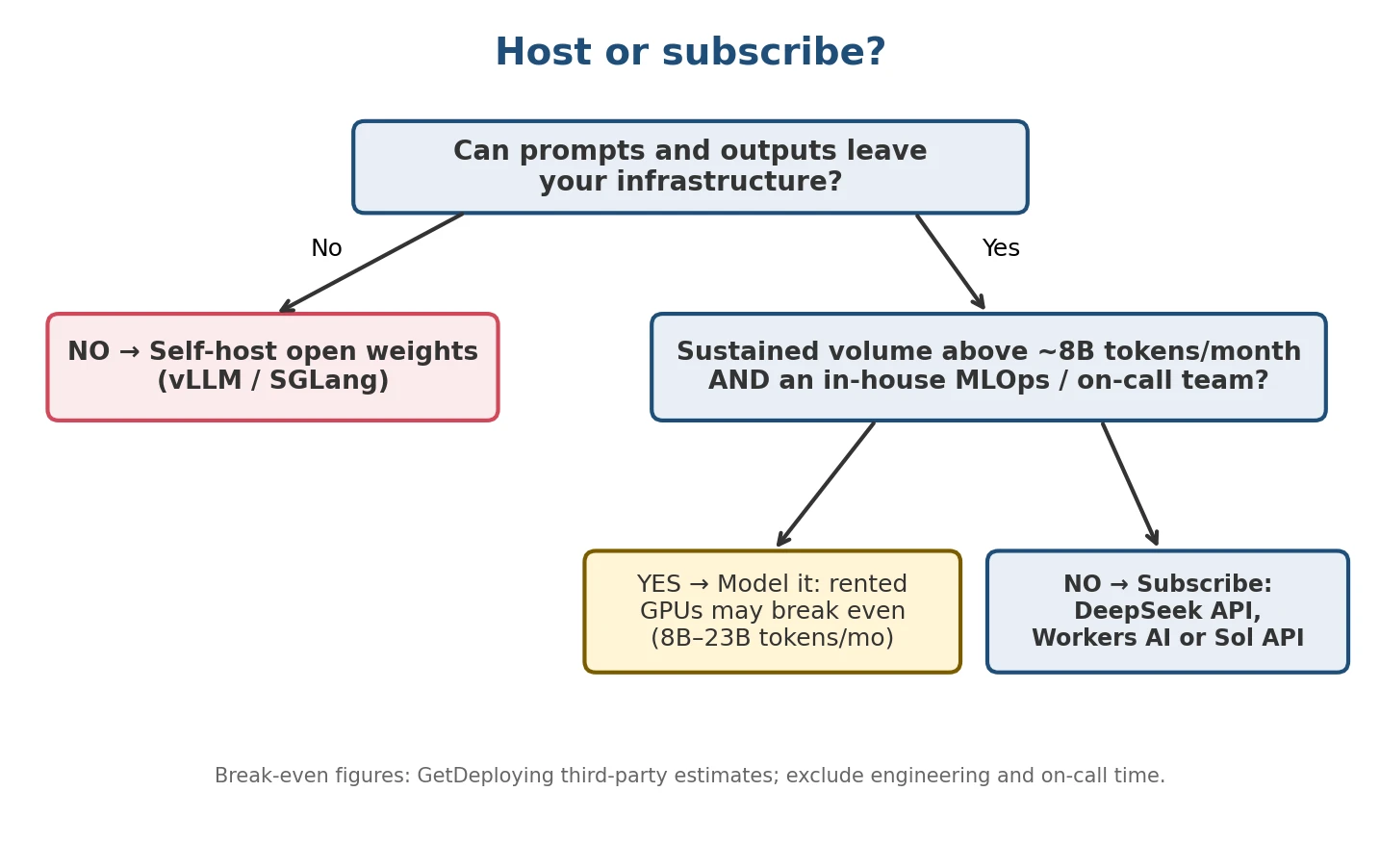
Subscribe to an API when: You are below roughly 8 billion tokens a month, traffic is spiky or still growing, you have no dedicated MLOps capacity, or you want new checkpoints such as 1017 the day they ship. The DeepSeek API, Cloudflare Workers AI and other hosts give per-token billing with no idle GPU cost; GPT-6.1 Sol is subscription-only by design.
Self-host when: Data residency, client contracts or regulation prevent prompts from leaving your environment; you need fixed, auditable model versions; or you run sustained volume in the 8 to 23 billion tokens a month range with a team that can own serving, upgrades, monitoring and on-call.
Use a hybrid when: Many teams prototype on the DeepSeek API, then move only the regulated or highest-volume workloads to self-hosted weights while keeping the API for burst capacity and GPT-6.1 Sol for escalations. Because the same weights run in both places, prompts and evaluations carry over with little rework.
What Does a Real Workload Cost on Each Model?
A blended workload shows the per-token range. The scenario is an illustrative AB Ark calculation, not client data: 100 million input tokens and 20 million output tokens per month at list prices, with no cache-write fees and no router markups.
| Scenario | DeepSeek V4.1 Flash | GPT-6.1 Sol | Gap |
| No caching, Flash off-peak vs Sol standard | $27 | $400 | 14.8x |
| No caching, Flash peak vs Sol standard | $54 | $400 | 7.4x |
| No caching, Flash off-peak vs Sol Batch | $27 | $200 | 7.4x |
| 80% input cache hits, Flash peak vs Sol standard | $30.48 | $248 | 8.1x |
This calculation holds output volume equal. The per-task data above shows that assumption rarely holds for reasoning work: if DeepSeek V4.1 Flash writes three to eight times as many output tokens for the same job, multiply its output line accordingly before comparing.
How Should Teams Decide Which Model to Use?
Treat the choice as a routing decision. The AB Ark Cost-per-Success Check below is an editorial framework, not an industry standard.
Measure output tokens per task first: run 50 to 100 representative tasks on both models and record output tokens, not only accuracy. Verbosity decides most of the bill.
Tune reasoning effort before switching vendors: compare DeepSeek V4.1 Flash at none, low and high against GPT-6.1 Sol at low and medium. The cheapest accurate setting may belong to either model.
Price retries and review: cost per success equals token cost plus retry cost plus human-review time, divided by accepted outputs.
Exploit the cheap lines: input-heavy RAG, long cached system prompts and batch jobs that can run off-peak favour DeepSeek V4.1 Flash most.
Check deployment constraints: data residency, procurement policy, rate limits on hosts such as Workers AI, and whether open weights are required.
Plan for change: both vendors changed models or prices within the last 60 days; keep the model behind an abstraction layer and re-run the evaluation each release.
The same evaluation and fallback discipline applies to retrieval systems, covered in AB Ark’s guide to why RAG systems fail in production.
Get a Custom Project Cost & Timeline Estimate ->
FAQs
How much does DeepSeek V4.1 Flash cost?
DeepSeek V4.1 Flash costs $0.30 per million input tokens and $1.20 per million output tokens at peak, and $0.15 and $0.60 off-peak. Cache-hit input is $0.006 at peak and $0.003 off-peak, per DeepSeek’s pricing page.
How much does GPT-6.1 Sol cost?
GPT-6.1 Sol costs $2 per million input tokens, $0.10 per million cached input tokens and $10 per million output tokens at standard rates, per OpenAI. Batch and Flex processing are 50% cheaper; prompts above 272K tokens cost more.
Is DeepSeek V4.1 Flash 1017 better than GPT-6.1 Sol?
Not on independent composite scoring. Artificial Analysis rates DeepSeek V4.1 Flash 1017 (max) at 45 and GPT-6.1 Sol at 48 to 52 depending on effort. DeepSeek’s own benchmarks show the 1017 model ahead of GPT-5.6 Sol on several coding and agent tests, but that is the previous OpenAI generation.
Can I run DeepSeek V4.1 Flash locally?
Yes, with substantial hardware. The weights are MIT-licensed on Hugging Face and supported by vLLM and SGLang. A community recipe runs a 2.9-bit quantization on two 128 GB DGX Spark systems, though full-precision deployments need multi-GPU servers.
What context window and features does DeepSeek V4.1 Flash support?
DeepSeek V4.1 Flash supports a 1,048,576-token context window, image input, function calling and adjustable reasoning. Cloudflare’s Workers AI listing notes that reasoning runs at high effort by default and can be set to low, max or none, which directly changes output length and cost per task.
The cheaper model is the one that finishes the task correctly at the lowest total cost. Measure that, and the “13x” headline becomes a routing rule rather than a buying decision.
Schedule a Free Consultation Call ->
Head Of Engineering Department