
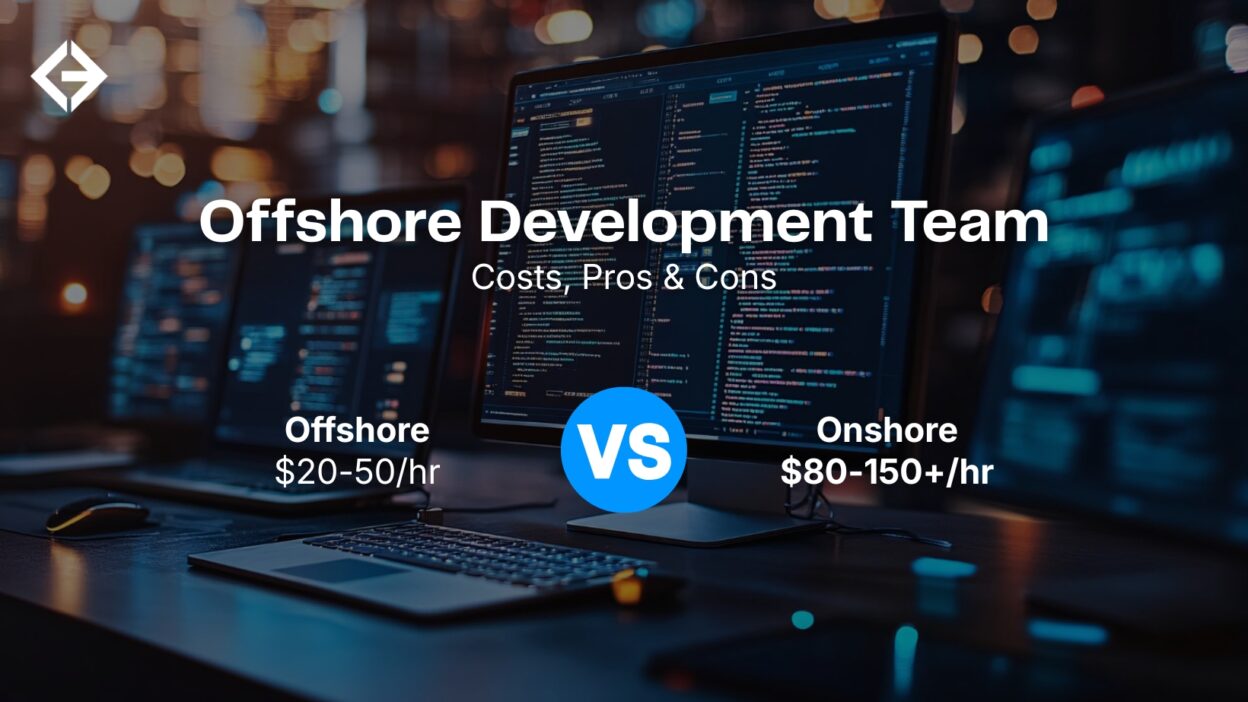
An offshore development team is a group of engineers in another region who work exclusively on your product as a dedicated squad, typically costing $20-$50 per hour versus $80-$150+ onshore. Vendors like AB Ark Solutions handle recruitment, payroll, and infrastructure while you keep control of the roadmap, architecture, and delivery priorities.
Key Takeaways:
- Offshore rates run 40-70% below onshore equivalents; a 4-6 person team typically costs $12,000-$30,000 per month.
- The biggest pros are cost leverage, a global talent pool, elastic scaling, and faster starts than local hiring.
- The biggest cons are time zone friction, communication overhead, and quality risk with unvetted vendors.
- Total cost of ownership matters more than the hourly rate: budget for management, tools, and ramp-up.
- Every con is manageable with overlap hours, a single source of truth, and a paid pilot before scaling.
📊 Request a Free Tech Stack & Architecture Review
The math forcing this decision is simple. A fully loaded senior engineer in a major US market costs $195,000-$260,000 a year, hiring one takes 40+ days, and your roadmap does not pause while you search. An offshore development team attacks all three constraints at once, but only when you understand the real costs and trade-offs going in.
What an Offshore Development Team Costs in 2026

Rates are local, not global. Where your team sits sets the baseline, and seniority mix sets the rest.
| Region | Typical Hourly Rate | Best Known For |
| South Asia (Pakistan, India) | $18-$40 | Full-stack, AI, deep talent pool, lowest rates |
| Southeast Asia (Vietnam, Philippines) | $20-$45 | Node.js, React, cloud-native work |
| Eastern Europe (Poland, Romania) | $25-$55 | Strong engineering education, EU compliance |
| Latin America (Brazil, Mexico) | $30-$75 | US time zone overlap, nearshore convenience |
| US / Western Europe (onshore) | $80-$150+ | Maximum overlap, highest cost |
In monthly terms, a dedicated offshore team of 4-6 engineers usually lands between $12,000 and $30,000. The same squad built in-house in the US or UK typically runs 2-3x that after salaries, benefits, recruitment, and overhead.
One number most buyers miss: total cost of ownership. Communication tools, project management, and ramp-up can add 25% or more to the headline rate. Teams reach roughly 85% productivity around month four, so budget the first quarter as an investment, not full output.
The Pros of an Offshore Development Team
1. Cost Leverage Without Seniority Loss
Savings of 40-70% are standard, and companies that account for hidden costs still report average net savings around 50%. Critically, the discount comes from regional cost of living, not from hiring worse engineers.
2. A Global Talent Pool on Tap
Niche skills that take months to source locally (AI engineers, DevOps specialists, less common stacks) are available offshore in weeks. You stop competing in your local hiring market entirely.
3. Elastic Scaling
Add or remove developers with 1-4 weeks’ notice instead of carrying fixed payroll through slow quarters. For project-phase or seasonal workloads, that elasticity alone can save 30% over a year.
4. Speed to Start
Vetted offshore teams deploy in 2-4 weeks. Local senior hires average 40+ days each, and you need several of them.
The Cons of an Offshore Development Team
1. Time Zone and Communication Friction
Teams spread across 8+ time zones lose 15-20% productivity to asynchronous delays when the process is unmanaged. The fix is structural: a guaranteed 4-hour daily overlap window, standups inside that window, and one source of truth for status.
2. Quality Risk With the Wrong Vendor
Cheap code that needs a 60% rewrite is more expensive than good code at twice the rate. Vet vendors on shipped case studies, verified Clutch and GoodFirms reviews, technical interviews with the actual engineers, and a paid pilot before any long contract.
3. Security and IP Exposure
Your code and data leave your jurisdiction, so the contract has to carry the protection: IP-assignment clauses, engineer-level NDAs, restricted production access, and audited security practices. Done properly, offshore IP protection matches domestic outsourcing.
How Mature Offshore Teams Neutralize the Cons
The pattern across successful engagements is consistent: the cons are process failures, not geography failures. Vendors who run structured delivery, full-cycle ownership from discovery through QA and maintenance, remove most of the risk before it appears. For a complete breakdown of how that delivery model works end to end, read our guide to offshore software development services before shortlisting partners.
AB Ark’s ChatRod build shows the model at full stretch. The client needed a short-video and messaging platform for markets where competitors drained mobile data and buried local creators; AB Ark’s offshore team engineered data-light streaming, live video, built-in creator monetization, and messaging in a single platform, owned end to end (full case study). That delivery pattern, repeated across 15K+ working hours by an 80+ person team for hundreds of clients at a 99-100% job success rate, is the difference between offshore as a risk and offshore as leverage.
When to Choose Offshore, and When Not To
Choose an offshore development team for long-term products, continuous development, or scaling beyond your local hiring market. The model compounds: the longer the engagement, the more product knowledge the team accumulates.
Skip it for one-off projects under four weeks (onboarding eats the savings), pre-product-market-fit startups that need in-person iteration, or regulated IP that legally cannot leave your jurisdiction.

Frequently Asked Questions
What is an offshore development team?
An offshore development team is a group of software professionals located in another country who work remotely to design, develop, test, and maintain software for your business.
What is an offshore development company?
An offshore development company is a software firm that provides development, testing, maintenance, and IT services to clients in other countries, helping businesses access global talent and reduce development costs.
What is the difference between GCC and offshore development center?
The main difference is that a Global Capability Center (GCC) is a fully owned offshore branch of a company that manages core business operations, while an Offshore Development Center (ODC) is a dedicated remote team, often managed by a third-party provider, focused primarily on software development and IT services.
How much does an offshore development team cost per month?
A dedicated offshore team of 4-6 engineers typically costs $12,000-$30,000 per month, depending on region and seniority mix. Comparable onshore teams in the US or UK run $40,000-$80,000+ monthly.
Are offshore developers cheaper than hiring locally?
Yes, offshore rates are typically 40-70% lower than onshore due to regional cost-of-living differences. Net savings after management and communication overhead still average around 50%.
The offshore question is no longer whether the savings are real. It is whether your partner runs the process that protects them. Pick one that has already proven it in production.
👉 Book a Strategy Call to Scale Your Engineering

Syed Ahmad Ali is a tech writer at AB Ark with a knack for turning complex ideas into easy reads. He writes across a range of topics, but AI, software development, and the business of tech sit right at the top of his list.