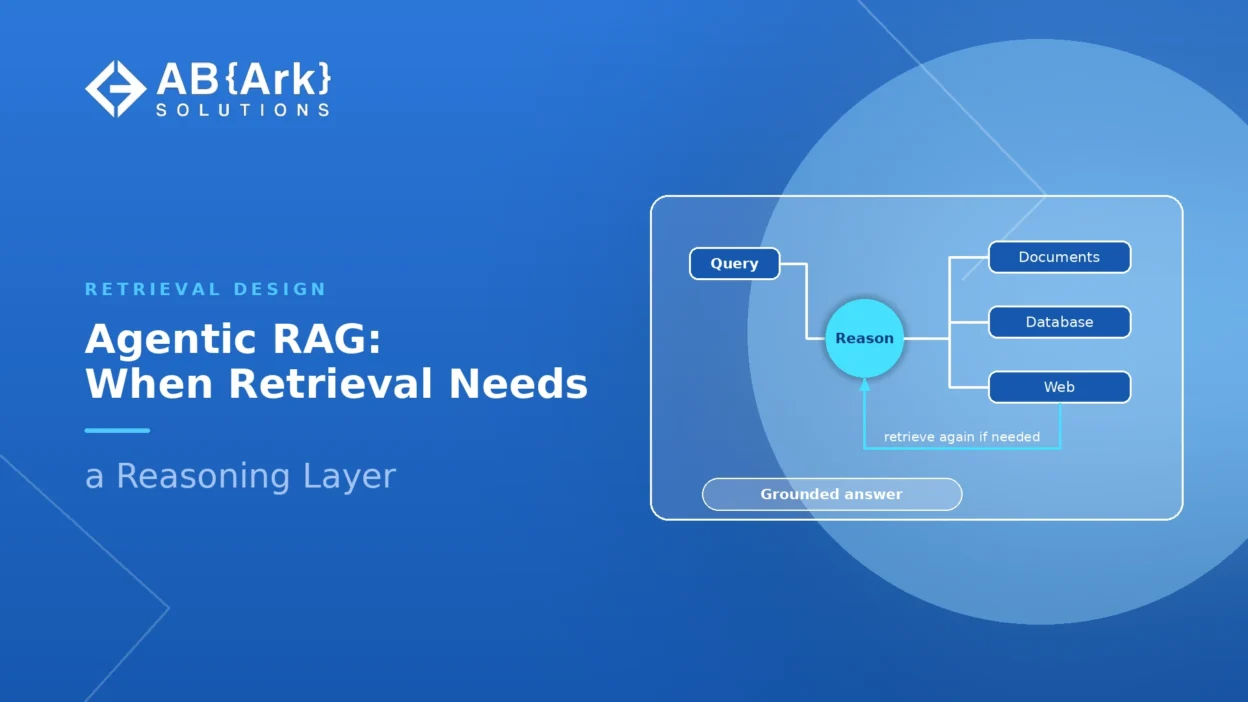

Agentic RAG is retrieval-augmented generation with an AI agent in control of retrieval. Instead of running one fixed search and passing the top results to a language model, an agentic RAG system decides whether to retrieve, where to look, whether the evidence is good enough and whether its answer is supported, then retries or escalates when it is not. It suits multi-source, multi-step questions, but costs more and responds more slowly than standard RAG, so it should be used only where that reasoning pays off.
Key Takeaways
- Agentic RAG adds a reasoning layer that plans, routes, grades evidence and checks answers; standard RAG retrieves once and answers.
- The design builds on research such as Self-RAG, which decides when to retrieve and critiques its own output, and Corrective RAG, which evaluates retrieval quality and takes corrective action.
- Use agentic RAG for questions that span several sources or need several steps. Simple lookups are cheaper, faster and often just as accurate with standard RAG.
- Agentic RAG is not a fix for bad data: weak indexing, chunking and permissions still break it, only more expensively.
- Production agentic RAG needs step limits, cost budgets, tracing and evaluation from day one.
What Is Agentic RAG?
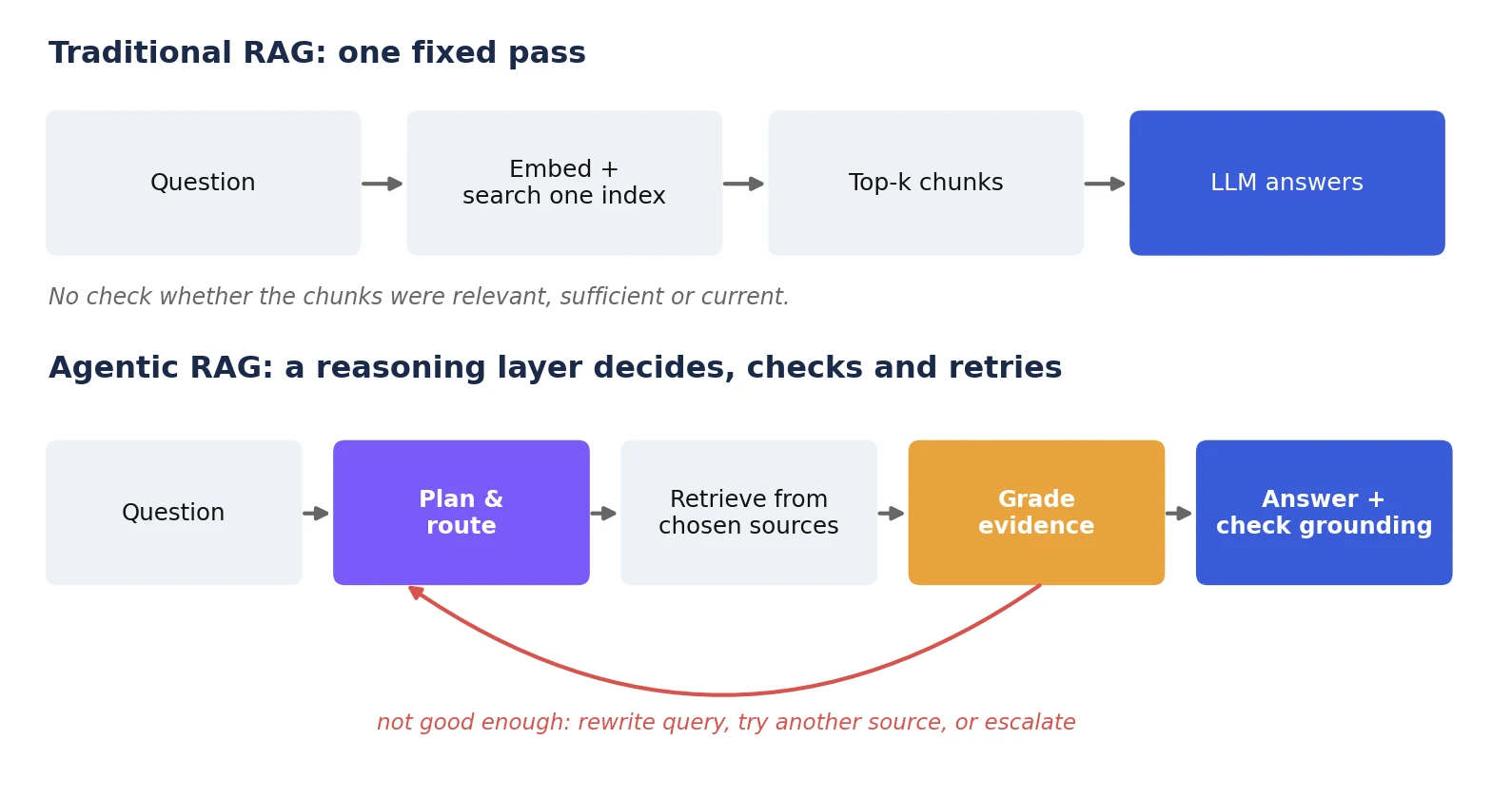
IBM defines agentic RAG as the use of AI agents to facilitate retrieval-augmented generation, adding agents to the RAG pipeline to increase adaptability and accuracy. In practice, the agent acts as a reasoning layer between the user’s question and the knowledge sources. It can break a question into parts, choose which source answers each part, inspect what comes back, and decide what to do next.
Standard RAG, by contrast, is a fixed pipeline: an embedding model turns the question into a vector, a vector database returns the most similar chunks, and a language model writes an answer from them. IBM notes that standard RAG systems do not validate or optimize their own results, so people must judge whether the system is finding the right data.
 Why Does Retrieval Need a Reasoning Layer?
Retrieval needs a reasoning layer because a single similarity search fails in predictable ways. It retrieves when no retrieval is needed, searches the wrong source, returns chunks that look similar but do not answer the question, and passes them to the model without checking. The model then writes a fluent answer from weak evidence.
Research on RAG has targeted these failures directly. The authors of Self-RAG argue that indiscriminately retrieving a fixed number of passages, whether or not retrieval is needed or the passages are relevant, can lead to unhelpful generation. Their framework trains a model to retrieve on demand and critique both the retrieved passages and its own output. Corrective RAG (CRAG) starts from the observation that RAG relies heavily on the relevance of retrieved documents, and adds a lightweight evaluator that assesses retrieval quality and triggers corrective actions, including web search, when results are poor.
Agentic RAG generalizes these ideas. Rather than training one special model, it uses an agent with tools and explicit decision points.
What Decisions Does the Reasoning Layer Make?
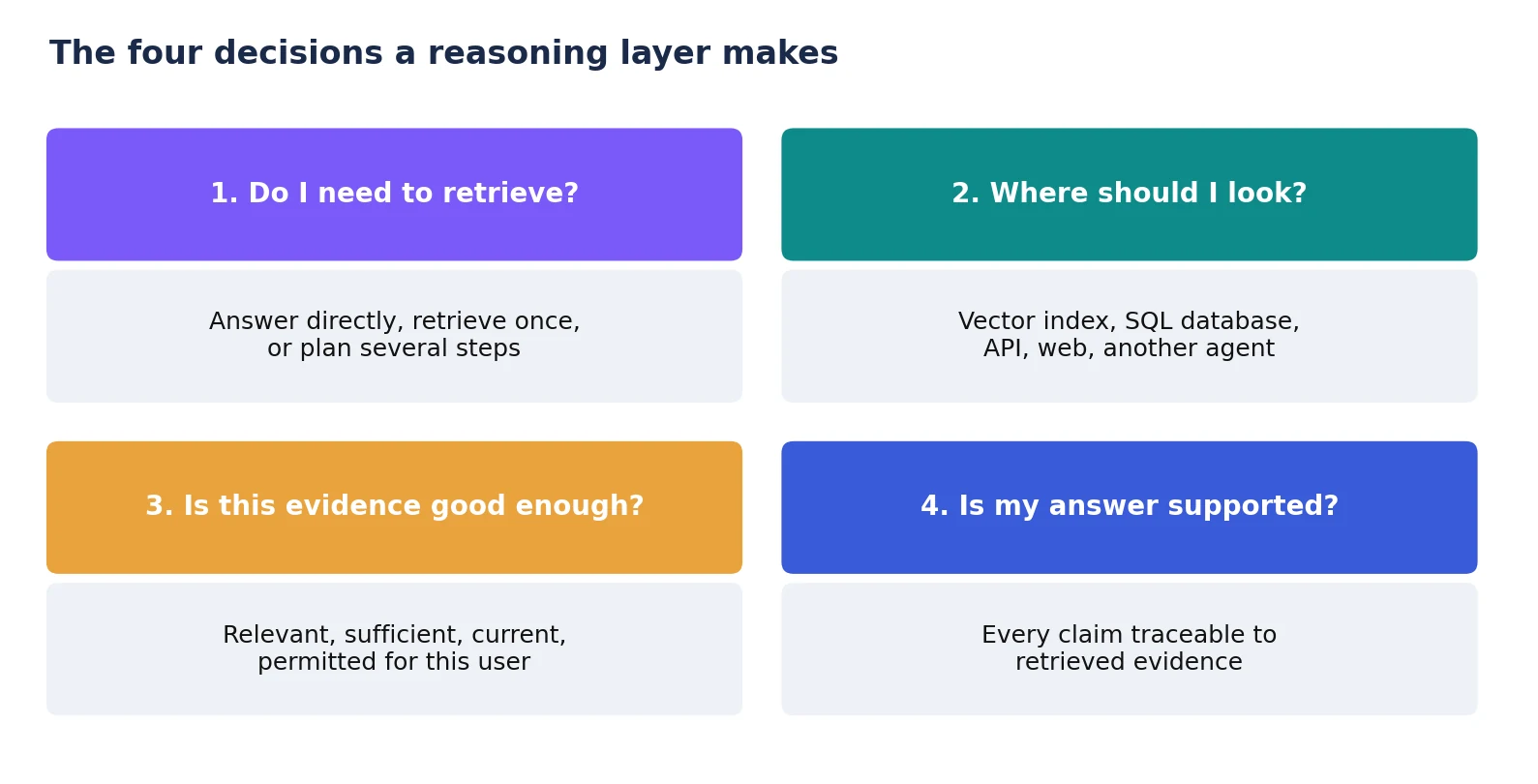
A reasoning layer in agentic RAG can make up to four decisions per question.
| Decision | What the agent does | Research or pattern behind it |
| Do I need to retrieve? | Answers directly, retrieves once or plans multiple steps based on question complexity | Self-RAG on-demand retrieval; Adaptive-RAG routing by complexity |
| Where should I look? | Routes to a vector index, SQL database, API, web search or another agent | Routing agents |
| Is the evidence good enough? | Grades relevance, sufficiency, freshness and access rights; rewrites the query or switches source if not | Corrective RAG retrieval evaluator |
| Is my answer supported? | Checks each claim against retrieved evidence before responding, or escalates | Self-RAG critique of its own output |
Adaptive routing by complexity comes from Adaptive-RAG (Jeong et al., NAACL 2024), which uses a trained classifier to route queries between no retrieval, single-step retrieval and multi-step retrieval.
What Agent Patterns Are Used in Agentic RAG?
IBM describes four common agent types in agentic RAG systems: routing agents, query planning agents, ReAct agents and plan-and-execute agents.
 Routing agents choose which knowledge source or pipeline should handle a query. They are the simplest upgrade from standard RAG and a sensible first step.
Query planning agents break a complex question into sub-queries, send them to other agents or tools, and combine the results.
ReAct agents alternate between reasoning and acting, adjusting each next step based on what the previous one returned. They suit open-ended research but are harder to bound.
Plan-and-execute agents plan all steps upfront and then execute them; IBM notes that this can reduce cost compared with calling back to a primary agent after every step.
Agentic RAG vs Standard RAG: Which Should You Use?
Use the simplest pipeline that answers the question reliably. Agentic RAG wins on hard, multi-part questions; standard RAG wins on cost and speed for straightforward lookups.
| Factor | Standard RAG | Agentic RAG |
| Sources | Usually one index | Several indexes, databases, APIs and web |
| Question types | Single, direct questions | Comparisons, multi-step and ambiguous questions |
| Self-checking | None by default | Grades evidence and answers, retries on failure |
| Cost per question | Low and predictable | Higher and variable (more model calls and tokens) |
| Latency | Low | Higher; each step adds model time |
| Failure mode | Confident answer from weak evidence | Loops, over-retrieval and cost blow-ups if unbounded |
| Debugging | Inspect one retrieval | Requires full traces of every step |
IBM is explicit that agentic RAG is not always the better choice: more agents mean greater expense and more tokens, models add latency, agents are not always reliable, and no RAG system eliminates hallucinations entirely.
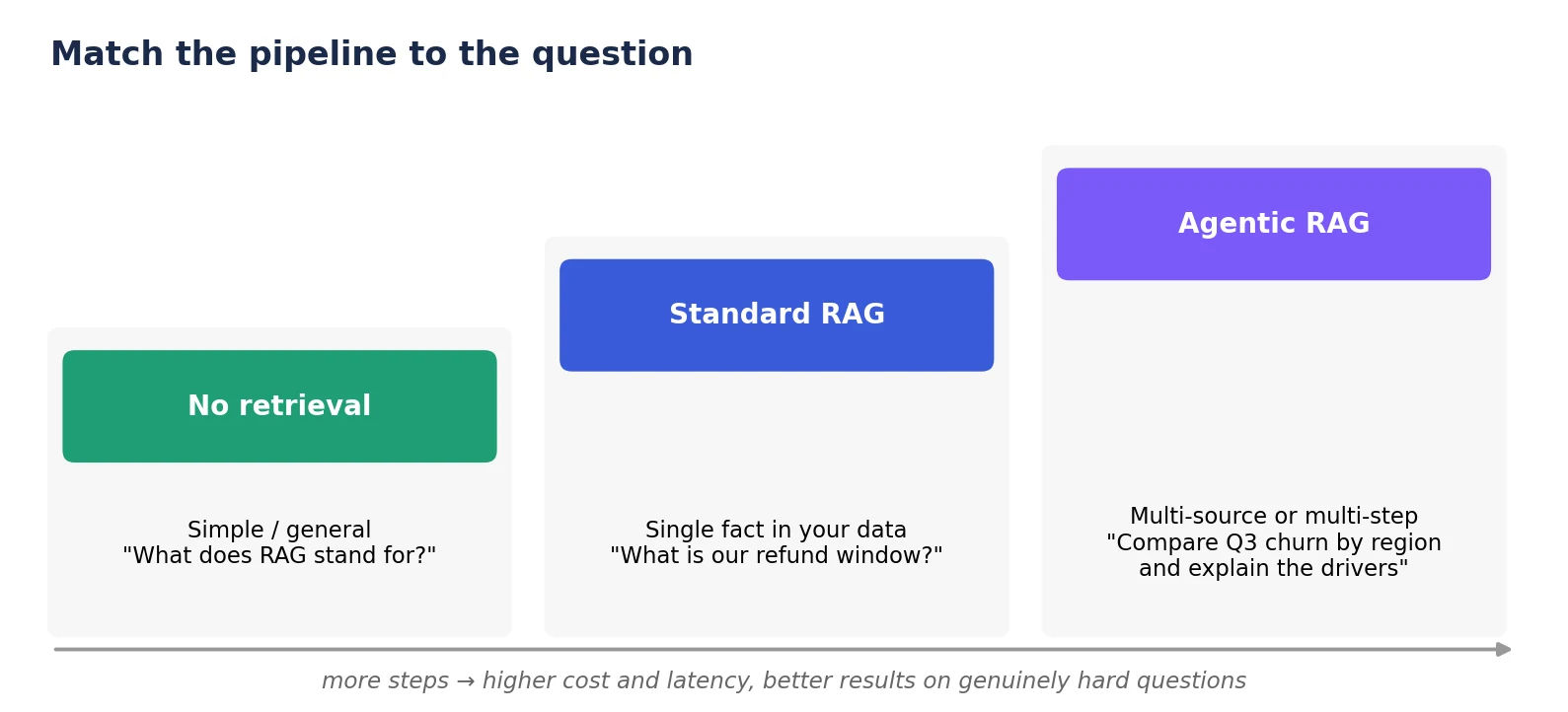 The practical pattern is a router at the front: send simple questions down a cheap path and reserve the agentic path for questions that need it.
Talk to Our Team About Your Project →
What Breaks Agentic RAG in Production?
Agentic RAG inherits every standard RAG problem and adds new ones. The inherited problems sit in the data layer: poor chunking, stale indexes, duplicate documents and missing permission metadata. AB Ark covers those in why RAG systems fail in production; a reasoning layer cannot rescue evidence that was never indexed correctly.
The new problems come from autonomy:
Retrieval loops: the agent keeps rewriting and re-searching without converging. Set a maximum number of steps and a stop condition.
Cost and latency spikes: long chains multiply tokens. Track cost per answered question and set per-query budgets.
Over-trusting the grader: if the evidence grader is weak, the agent confidently accepts poor results. Evaluate the grader separately.
Permission leaks: an agent that can query many sources can surface data a user should not see. Enforce access control in the tools, not in the prompt.
Opaque reasoning: without traces of each step, failures cannot be diagnosed. Instrument every retrieval and tool call, for example with OpenTelemetry’s GenAI agent conventions, which are still in development and now live in a dedicated repository.
These risks matter commercially. Gartner predicted in June 2025 that over 40% of agentic AI projects would be canceled by the end of 2027 due to escalating costs, unclear business value or inadequate risk controls.
How Do You Build an Agentic RAG System?
Build agentic RAG incrementally, adding reasoning only where evaluation shows it helps:
- Start with a measured baseline: build standard RAG and an evaluation set of real questions with expected answers and sources.
- Fix the data layer first: chunking, metadata, freshness and permissions should come before adding agents, because an agent cannot fix evidence that was never indexed correctly.
- Add routing: route questions to the right source or to a no-retrieval path. Measure the change.
- Add evidence grading and one retry: grade retrieved chunks, rewrite the query once if they fail, and escalate if the retry fails.
- Add query planning for multi-part questions only: decompose comparisons and multi-step questions; leave simple questions on the fast path.
- Add grounding checks and guardrails: verify claims against evidence, enforce step limits, budgets and tool-level permissions.
- Trace and evaluate continuously: record every step and re-run the evaluation set before each change.
Frameworks such as LangChain, LlamaIndex and LangGraph make experimenting with these patterns straightforward, but the evaluation set and data quality decide whether the result is reliable. Teams building this with AB Ark’s agentic AI development service start from the same sequence.
Where Does Agentic RAG Work Best?
Enterprise knowledge assistants that must combine policy documents, ticket history and structured data.
Analytical questions that compare figures across regions, periods or systems.
Customer support where the agent must check account data, policies and past cases, and escalate when evidence is missing.
Research and due diligence that needs several searches, cross-checking and cited answers.
It is usually unnecessary for FAQ bots, single-document Q&A and simple lookups, where standard RAG is faster and cheaper.
FAQs
What is agentic RAG?
Agentic RAG is retrieval-augmented generation controlled by an AI agent that plans, chooses sources, grades evidence and checks its answers, instead of running one fixed search-and-answer pipeline.
What is the difference between RAG and agentic RAG?
Standard RAG retrieves once from one source and answers. Agentic RAG can decide whether to retrieve, use several sources, retry when evidence is weak and verify the answer, at higher cost and latency.
Is agentic RAG always better than RAG?
No. It improves results on multi-source and multi-step questions, but adds cost, latency and new failure modes. Simple questions are usually better served by standard RAG.
What are Self-RAG and Corrective RAG?
Self-RAG trains a model to decide when to retrieve and to critique retrieved passages and its own output. Corrective RAG adds an evaluator that scores retrieval quality and triggers corrective actions such as web search. Both inspired agentic RAG designs.
Does agentic RAG stop hallucinations?
It reduces them by checking evidence and grounding, but cannot eliminate them. Data quality, evaluation and human escalation for uncertain answers remain necessary.
Add reasoning to retrieval only where the question needs it. Route simple questions down a fast path, give hard questions an agent, and measure both.
Head Of Engineering Department