
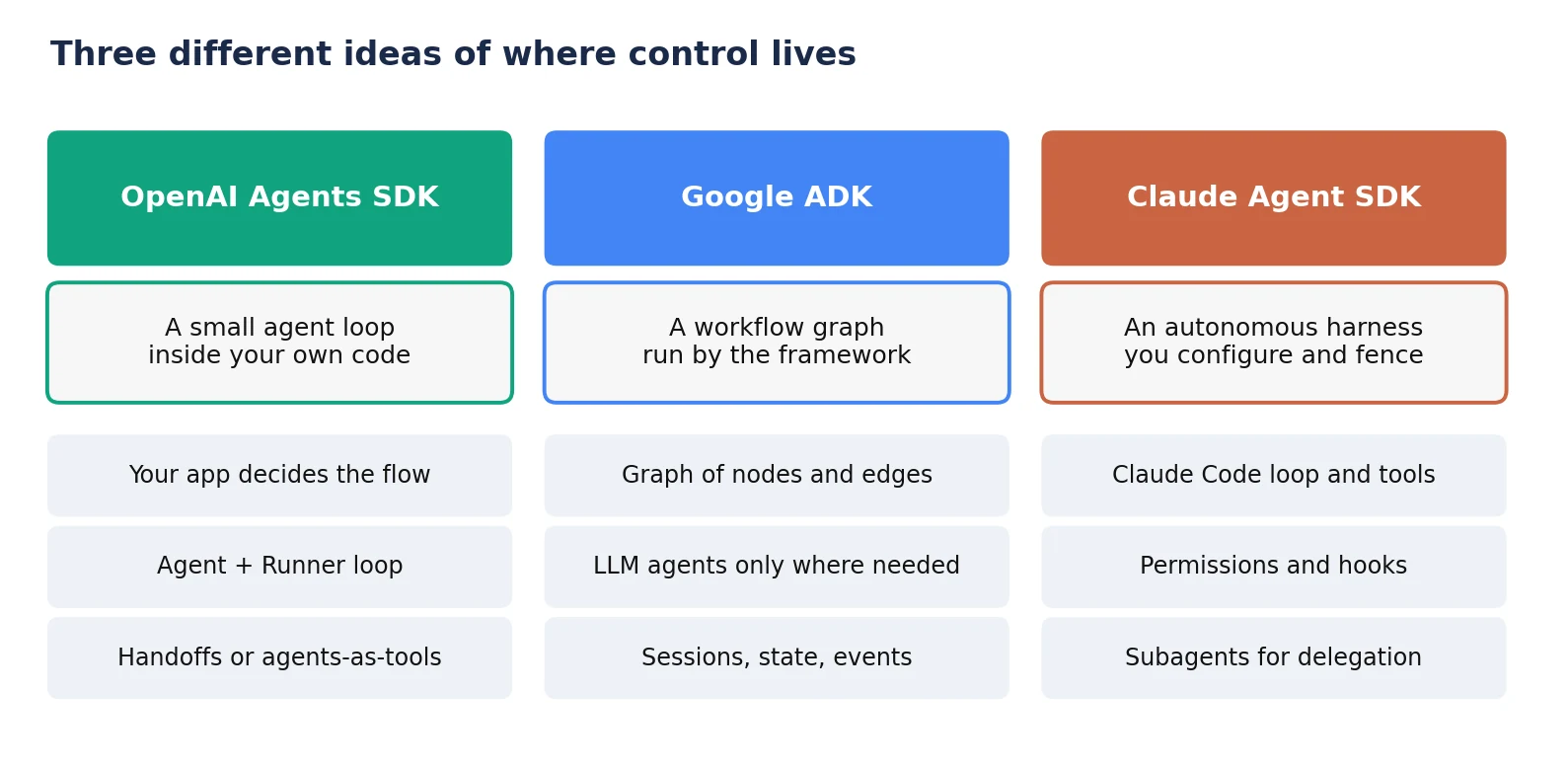
The OpenAI Agents SDK, Google’s Agent Development Kit (ADK) and the Claude Agent SDK all help developers build agents that reason, call tools and complete multi-step tasks, but each puts control in a different place. The OpenAI Agents SDK is a light agent loop inside your own code; Google ADK runs agents inside a framework-managed workflow graph; the Claude Agent SDK packages the autonomous harness behind Claude Code. Choose by where you want control to live, which models you must support and how you will manage state in production.
Key Takeaways
- All three SDKs are free to use; production cost comes from models, tools, hosting, storage and engineering, not from the SDKs.
- Model portability differs most: Google ADK and the OpenAI Agents SDK reach other providers through adapters or connectors, while the Claude Agent SDK is limited to Claude models, though it can run them on several clouds.
- State handling is the main production difference: application-owned sessions (OpenAI), framework-managed scoped state (ADK) or local session transcripts (Claude).
- Check a few defaults and breaking changes early: OpenAI tracing is on and sends data to OpenAI, ADK 2.0 sessions cannot be read by ADK versions older than 1.28, and Claude Agent SDK sessions have no built-in timeout.
- Start with one focused agent and add orchestration only when the workflow needs it.
Talk to Our Team About Your Project ->
What Is an AI Agent SDK?
An AI agent SDK is a library that runs the core agent loop: send a task to a model, let the model call tools, feed results back and repeat until the task is done. Around that loop, agent SDKs add tool integration, multi-agent orchestration, session state, guardrails and tracing. Choosing one is effectively choosing a runtime model for your agents, so the differences matter far more in production than in a quickstart.
This comparison covers the three SDKs from the major model providers. Vendor-neutral frameworks such as LangGraph and CrewAI are covered in AB Ark’s separate comparison of agentic AI frameworks.
How Do the Three SDKs Differ in Architecture?
OpenAI Agents SDK: a small loop inside your application
The OpenAI Agents SDK is built around a few primitives: agents, tools, handoffs, guardrails, human-in-the-loop approvals, sessions and tracing, according to its documented core concepts. An agent bundles a model with instructions and tools; a runner executes the loop. Everything else, such as how agents fit into your product, stays in ordinary Python or TypeScript code. It is MIT-licensed.
Google ADK: a workflow engine with agents inside it
Google ADK treats execution as a workflow. The ADK 2.0 release introduced a graph-based workflow runtime supporting routing, fan-out and fan-in, loops, retries, state management, human-in-the-loop and nested workflows, with agents, tools and functions acting as nodes. Google’s ADK release notes list ADK 2.0 as generally available for Python on May 19, 2026. One guide reports that Go reached general availability on June 30 and TypeScript on August 21, with SDKs also available for Java and Kotlin. ADK is licensed under Apache 2.0.
Claude Agent SDK: the Claude Code harness as a library
The Claude Agent SDK packages the same engine that powers Claude Code. Anthropic’s documentation lists its main capabilities as built-in tools, hooks that run custom code at points in the agent lifecycle, subagents for focused subtasks, permissions that decide which tools run automatically and which need approval, and sessions that can be resumed or forked. Rather than assembling the loop, developers configure the environment and the boundaries within which the agent works.
Which Models Can Each SDK Use?
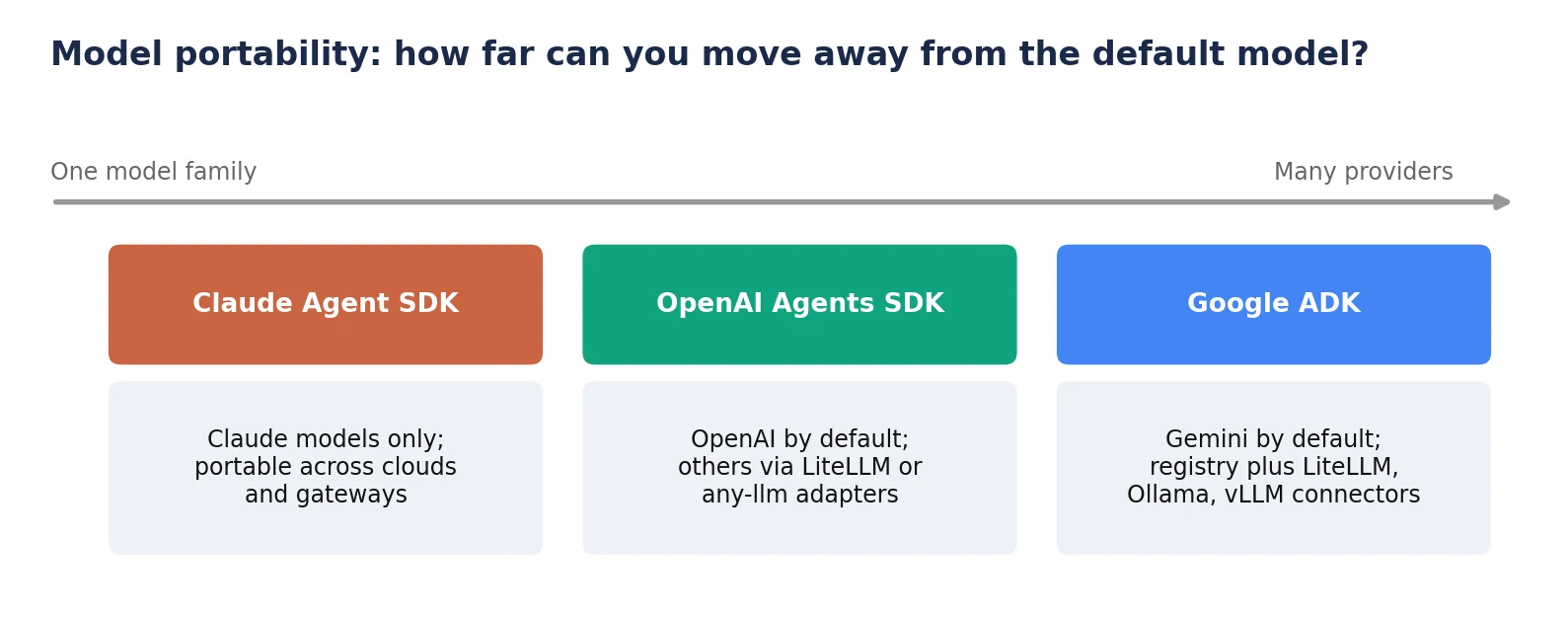
OpenAI Agents SDK: defaults to OpenAI models but works with other providers through adapters such as LiteLLM. Features tied to OpenAI’s hosted tools and APIs may not carry over when you switch.
Google ADK: tuned for Gemini and Google Cloud, with other models reached through LiteLLM or dedicated connectors, according to an independent review.
Claude Agent SDK: built around Claude models such as Opus, Sonnet and Haiku. Claude can run through several cloud providers, but infrastructure portability is not the same as model portability.
If the ability to change model vendors is a hard requirement, weigh this before anything else.
How Do Tools and Orchestration Compare?
| Area | OpenAI Agents SDK | Google ADK | Claude Agent SDK |
| Tools | Hosted tools, function tools, MCP servers, agents as tools | Built-in tools, function tools, MCP; tools can read session state | Built-in file, search and shell tools, custom tools, MCP servers |
| Multi-agent pattern | Handoffs (transfer control) or agents as tools (keep control) | Developer-defined graphs: sequential, parallel, conditional, loops | Main agent delegating to subagents with separate context |
| Approvals | Pause a run for human approval and resume | Human-in-the-loop as a native workflow step | Permission modes, hooks and approval prompts per tool |
| Agent-to-agent protocol | Not a native focus | Supports the A2A protocol | Not a native focus |
Sources: vendor documentation and the reviews linked in this article. Protocol support changes often; confirm before relying on it.
Where Does State Live, and What Breaks in Production?
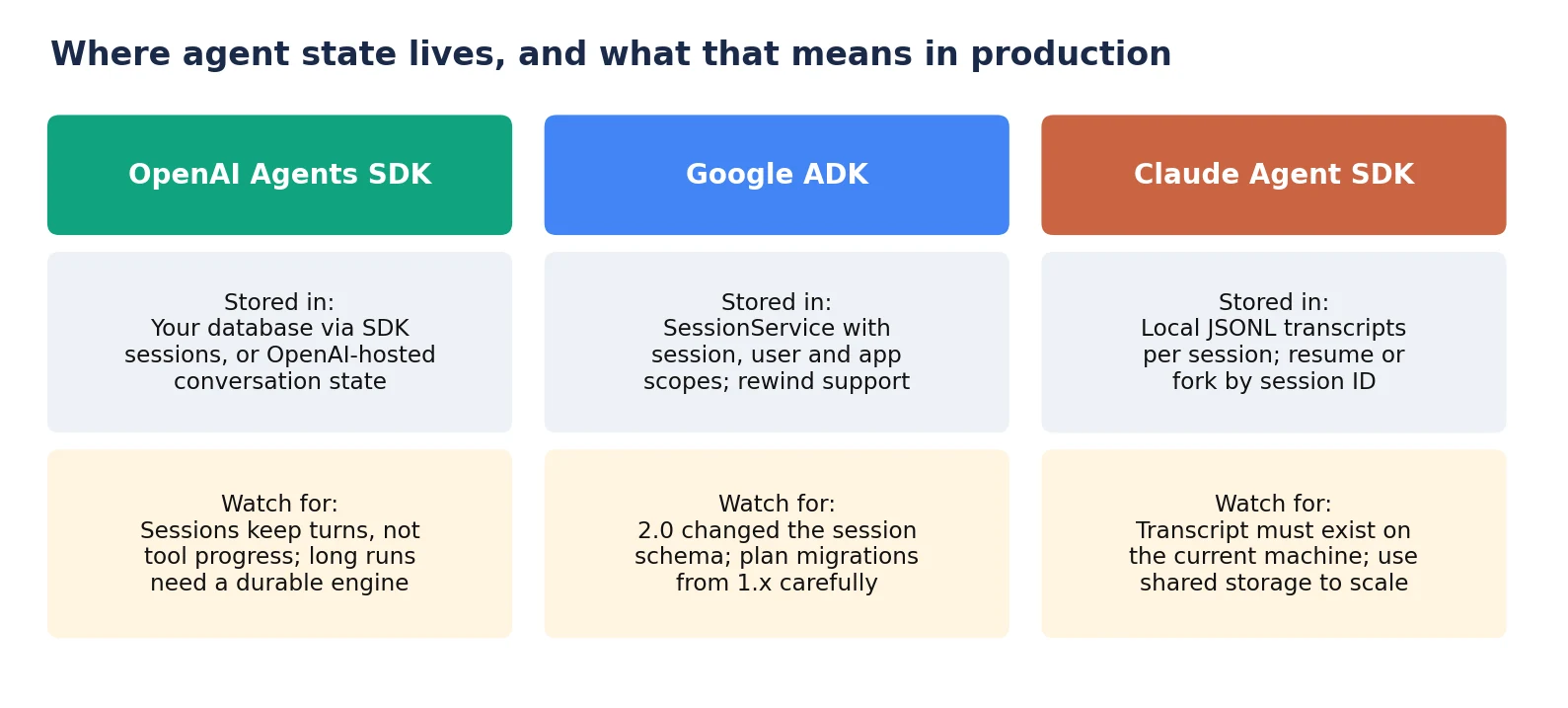
OpenAI Agents SDK: conversation history can live in your own database through SDK sessions or with OpenAI. One production review notes that sessions persist conversation turns rather than tool progress, so exact resumption of long-running work needs a separate durable execution engine.
Google ADK: a session service stores events and state at session, user and application scope. The ADK 2.0 release notes warn of breaking changes to the agent API, event model and session schema: 2.0 sessions can be read by ADK 1.28 and later, but not by older 1.x versions.
Claude Agent SDK: sessions are stored as local transcript files. An analysis of Anthropic’s documentation quotes it as saying that to resume, the session file must still exist on the current machine, so multi-machine deployments need shared session storage.
Production Surprises Worth Knowing
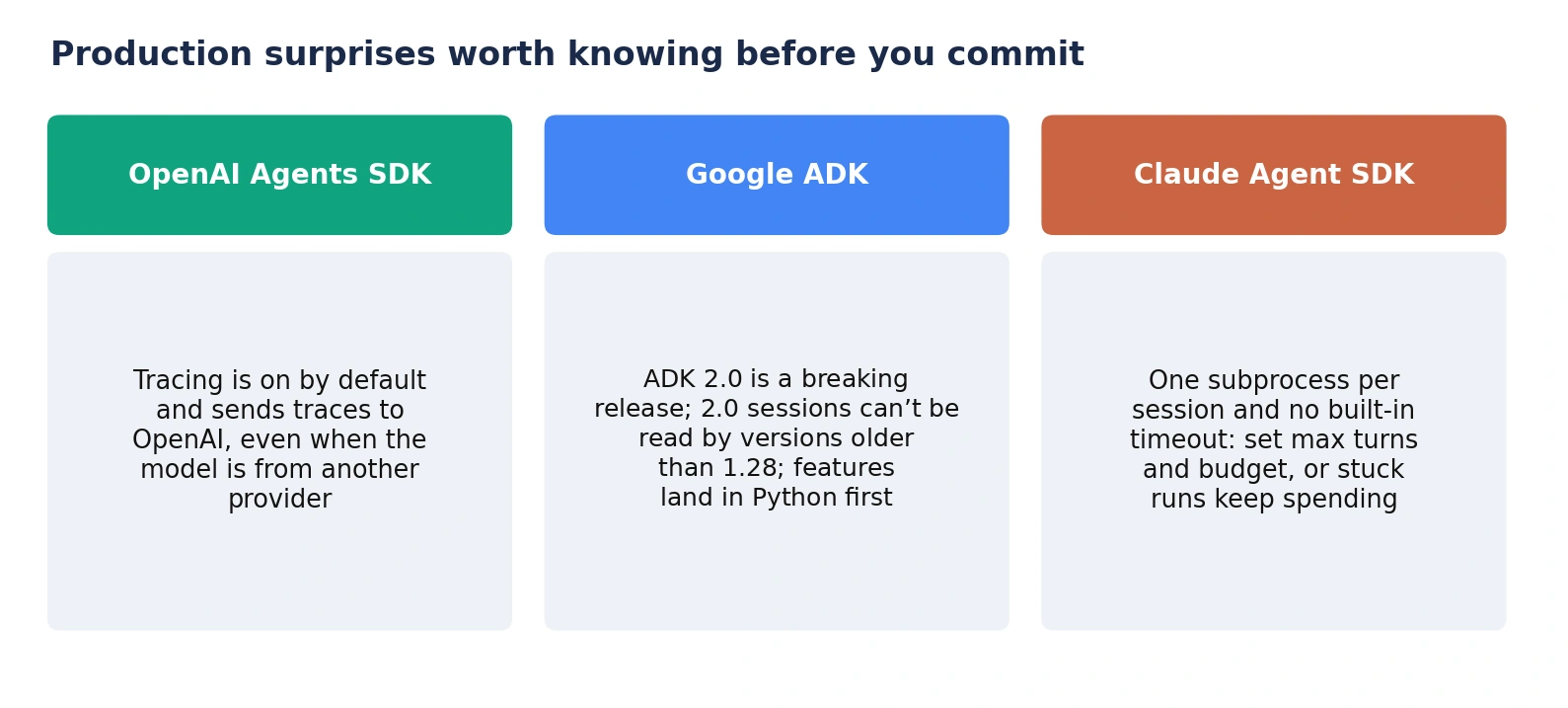
OpenAI tracing defaults: independent testing found that tracing is on by default and sends runs to OpenAI’s trace dashboard even when the model comes from another provider, until it is turned off or redirected to your own trace processor. Review this against your data policies.
ADK version pace: according to Geekflare’s ADK review, features land in Python first and versions differ by language, so check feature parity if your team works in Java, Go or TypeScript.
Claude Agent SDK resource limits: according to Anthropic’s hosting guidance, as quoted by Capital & Compute, one agent session maps to one subprocess and a session does not time out on its own, so teams must set maximum turns and budgets. The guidance also suggests about 1 GiB of RAM, 5 GiB of disk and 1 CPU per agent as a starting point, and notes that model token costs typically far exceed container costs.
Claude product terms: according to Anthropic’s documentation, unless previously approved, third-party developers may not offer claude.ai login or rate limits in products built on the Claude Agent SDK. Products must use API access.
What Does Each SDK Cost in Production?
None of the three SDKs charges a per-run fee. Production cost comes from:
Model usage: usually the largest line; prompt caching reduces repeated input costs on all three platforms.
Hosted tools: web search, file search and code execution are billed by each provider when you use their hosted versions.
Runtime and hosting: your own servers or containers, or managed runtimes. Claude Managed Agents, Anthropic’s separate hosted product (launched in public beta on April 8, 2026), is reported at $0.08 per running session-hour plus model usage.
Storage and observability: session databases, trace volume and log retention grow with usage.
Engineering time: integrations, security controls, recovery logic and monitoring are often the largest hidden cost.
Get a Custom Project Cost & Timeline Estimate ->
At-a-Glance Comparison
| OpenAI Agents SDK | Google ADK | Claude Agent SDK | |
| License | MIT | Apache 2.0 | Anthropic Commercial Terms |
| Languages | Python, TypeScript | Python, TypeScript, Go, Java, Kotlin | Python, TypeScript |
| Control model | Agent loop in your code | Framework workflow graph | Autonomous harness with permissions |
| Models | OpenAI default; others via adapters | Gemini default; many via connectors | Claude models only |
| State | Your DB or OpenAI-hosted | Session service with scopes | Local transcripts; shared store to scale |
| Managed hosting | None (self-host in your app) | Agent Runtime (formerly Agent Engine), Cloud Run, GKE | Self-host, or Managed Agents (separate) |
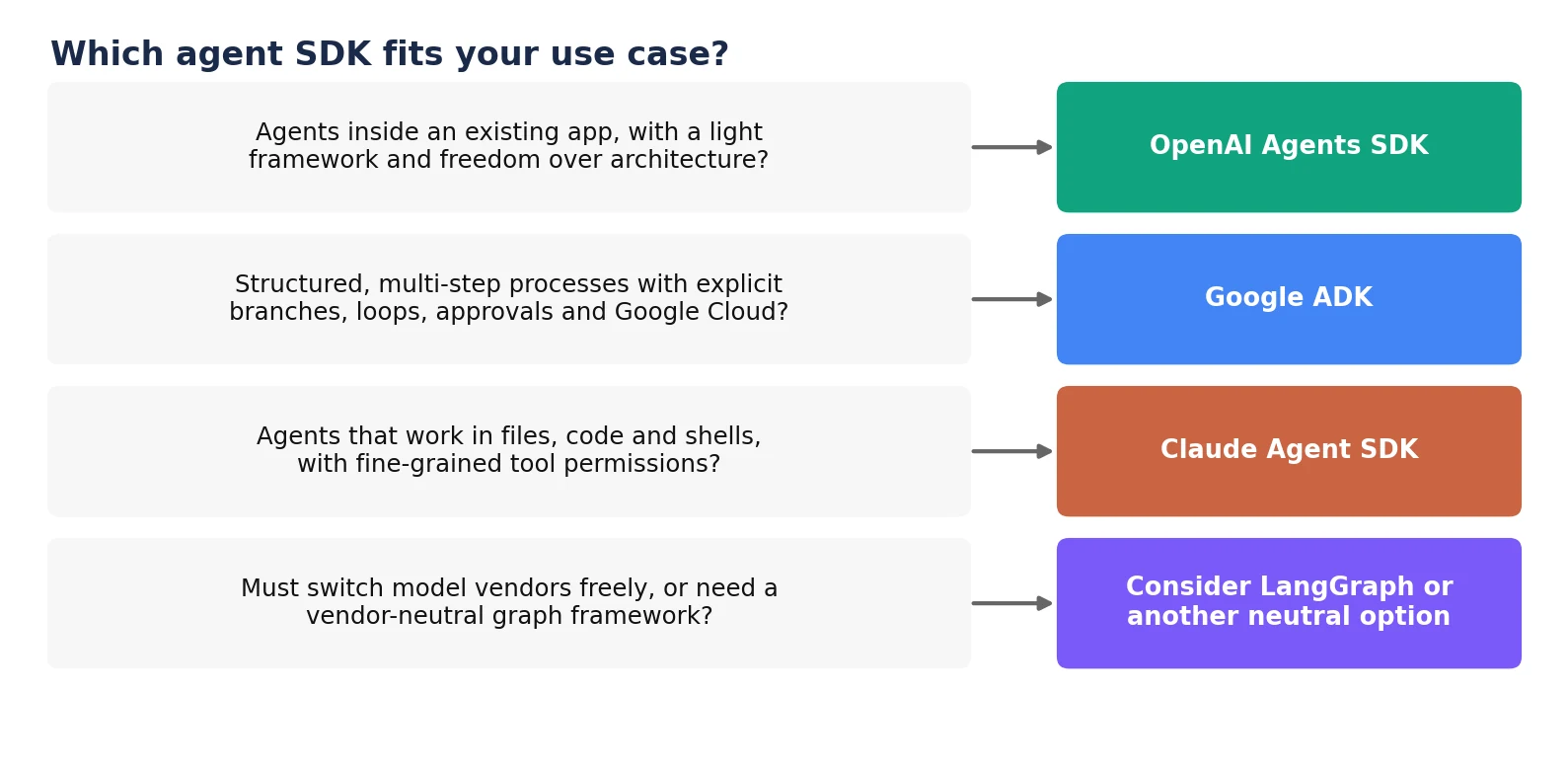
| Best fit | Agents inside existing apps | Structured, multi-step workflows | Coding and tool-heavy agents |
What Matters More Than the SDK?
Make side effects safe to retry, using stable operation IDs so a retry cannot repeat a payment or message.
Keep workflow state separate from chat history; a transcript is not a reliable record of where a business process stands.
Use ordinary code for deterministic steps such as routing, sequencing and error handling.
Treat external content as data, not instructions, and enforce permissions in tools rather than prompts.
Evaluate the path, not just the answer: check tool choice, approvals and recovery as well as the final output.
Start with one focused agent and split it only when ownership, permissions or instructions genuinely differ.
AB Ark applies these practices whichever SDK a project uses, as part of its AI agent development work; see AB Ark’s case studies for examples of agents in production.
FAQs
Which AI agent SDK is best?
There is no single best SDK. The OpenAI Agents SDK suits agents embedded in existing applications, Google ADK suits structured multi-step workflows, and the Claude Agent SDK suits tool-heavy agents that work with files, code and shells.
Are these AI agent SDKs free?
Yes. The OpenAI Agents SDK is MIT-licensed, Google ADK is Apache 2.0, and the Claude Agent SDK is governed by Anthropic’s Commercial Terms of Service rather than a standard open-source license. Costs come from model usage, hosted tools, hosting, storage and engineering time.
Can the OpenAI Agents SDK use non-OpenAI models?
Yes, through adapters such as LiteLLM, though features tied to OpenAI’s hosted tools may not carry over, and default tracing still sends data to OpenAI unless changed.
Can the Claude Agent SDK use models other than Claude?
No, it is built for Claude models, although those models can run through several cloud providers.
What is the difference between MCP and A2A?
MCP connects an agent to tools and data sources. A2A is a protocol for agents to communicate with other agents as peers. All three SDKs support MCP; Google ADK also supports A2A.
Choose the SDK whose idea of control matches your system: a loop in your code, a workflow graph or an autonomous harness. Then invest in state, safety and evaluation, which decide success in production.
Schedule a Free Consultation Call ->
Head Of Engineering Department