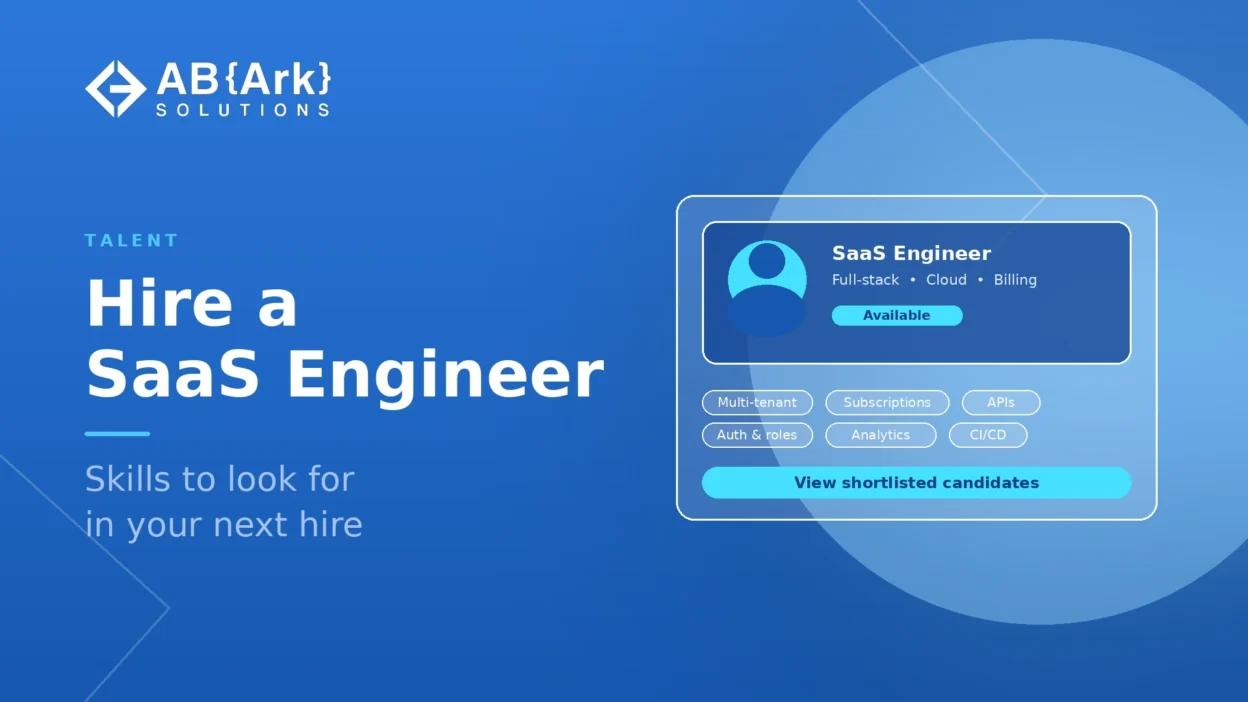

To hire a SaaS engineer well, hire in sequence. Start with one senior full-stack engineer who can own the whole product, then add a second engineer when one person becomes the bottleneck, followed by frontend or mobile, QA, DevOps, backend, security and data specialists, and an engineering manager, as specific signals appear. Hiring specialists too early burns runway; hiring them too late creates outages, slow releases and blocked enterprise deals.
Key Takeaways
- The first engineering hire for most SaaS startups should be a senior full-stack engineer who can own architecture, delivery and operations.
- Add roles when a concrete signal appears, such as slipping releases, rising incidents or security questionnaires, not when funding arrives.
- Hire full-time for core, long-term ownership; use contractors for bounded specialist work and staff augmentation for flexible capacity.
- Test SaaS-specific skills: multi-tenancy, billing and authentication, safe releases, operations and security basics.
- Each early hire is a large share of a seed-stage budget, so sequencing directly affects runway.
Talk to Our Team About Your Project →
What Makes Hiring for a SaaS Startup Different?
Hiring for a SaaS startup is different because the product is a continuously running service, not a one-off build. From the first paying customer, the team must ship features, keep the service available, protect customer data and handle billing and access control. Early engineers therefore need breadth: they build, deploy, monitor and fix the same system.
Budget is the other constraint. The US Bureau of Labor Statistics reports a median annual wage of $135,980 for software developers in May 2025, before benefits, equipment and recruiting costs. Each early hire is a large share of a seed-stage budget, so the order of hires matters as much as their quality.
What Is the Right Hiring Sequence for a SaaS Startup?
The right sequence follows the product’s stage. The roles below are typical; the exact order depends on your product, market and founders’ skills.
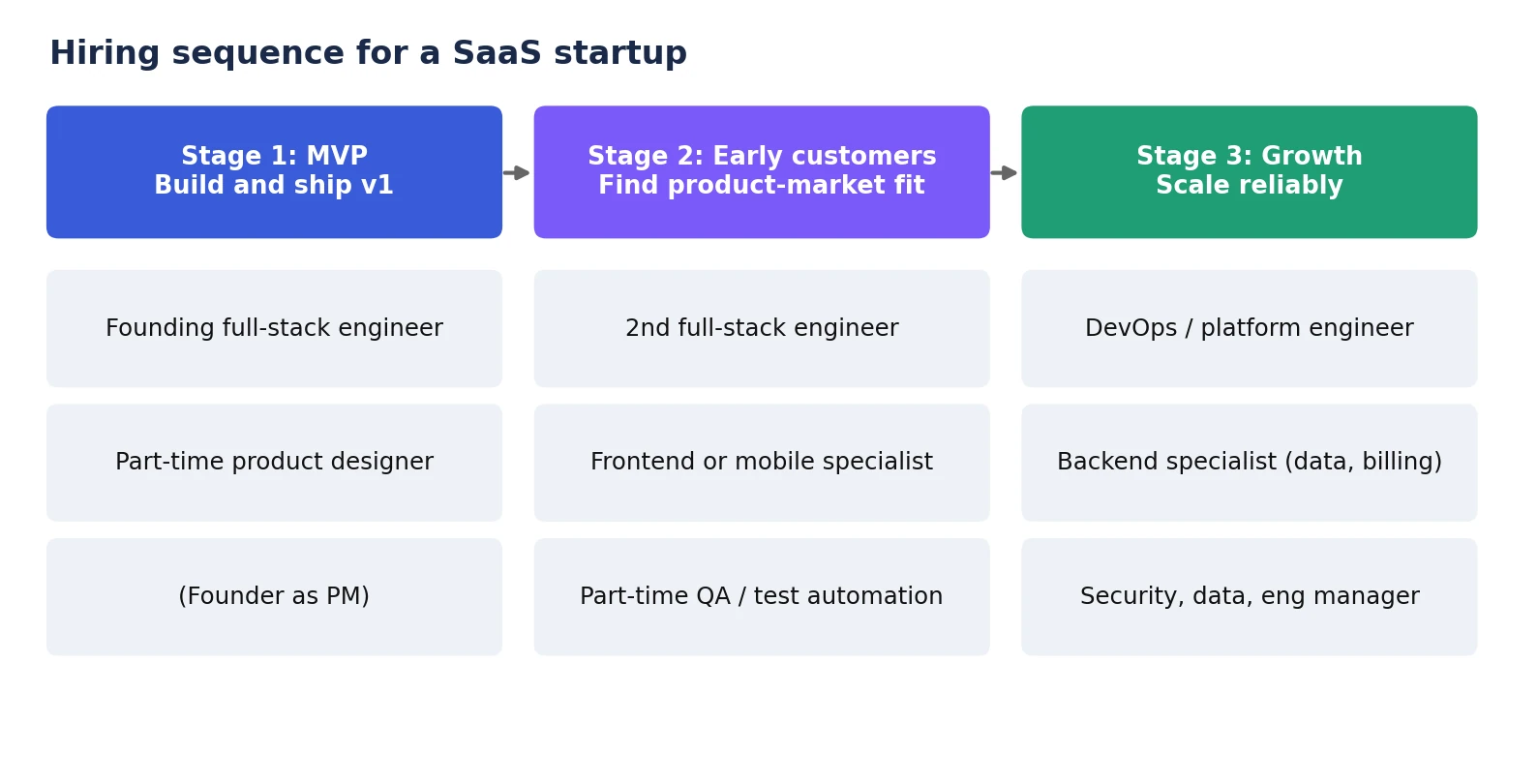 Stage 1: MVP — build and ship version one
Founding full-stack engineer: the most important technical hire. They choose the stack, design the data model, set up deployment and ship the first version. Look for senior experience, product judgment and comfort with ambiguity.
Part-time product designer: often freelance at this stage, to make onboarding and core flows usable.
Founder as product manager: a dedicated PM is rarely needed before the team has several engineers.
If no founder is technical, the first hire may need to act as a CTO, or the startup may use an experienced external team to build the MVP while recruiting a technical lead. Either way, someone senior must own architecture decisions.
Stage 2: Early customers — find product-market fit
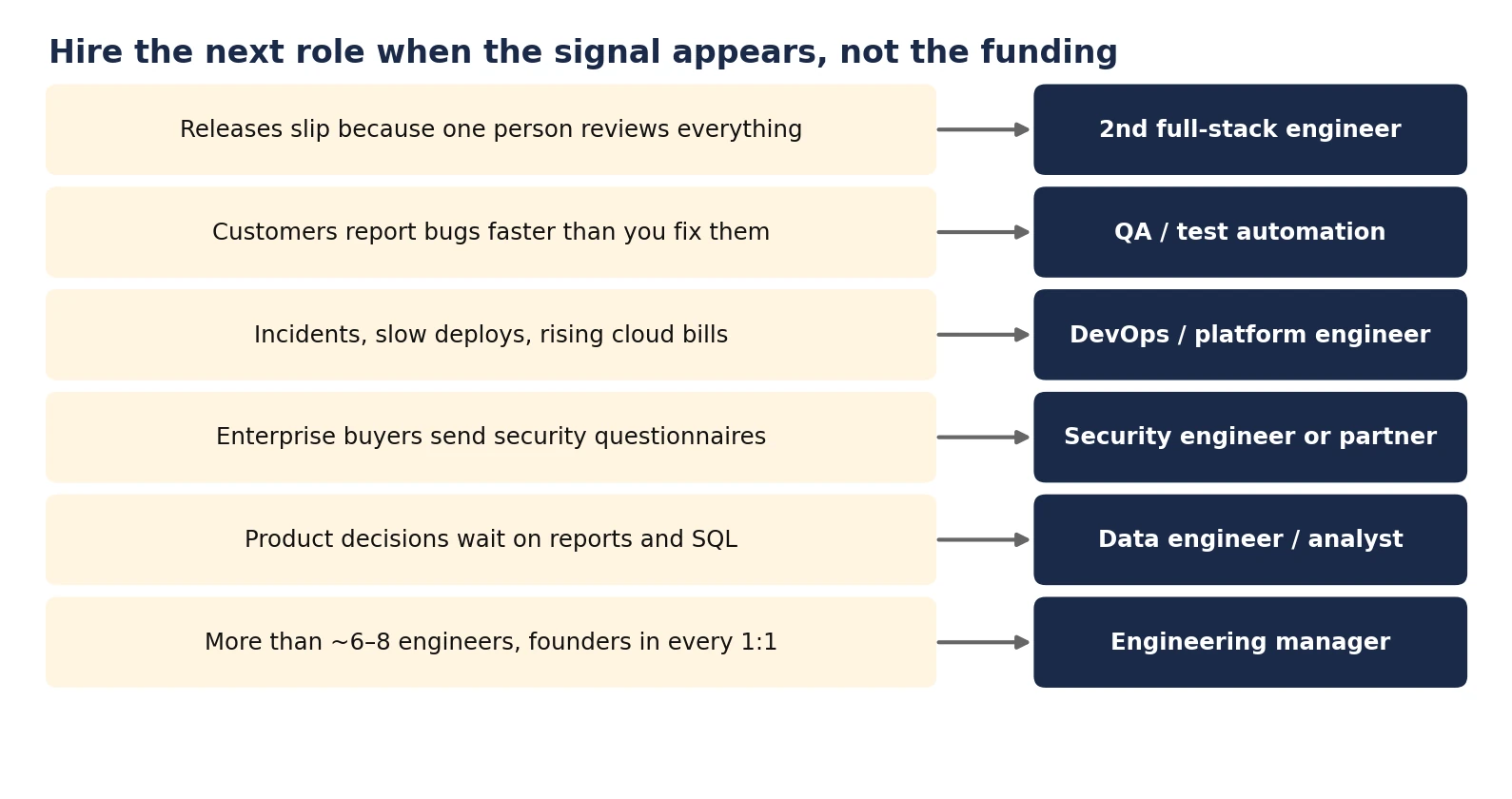
Second full-stack engineer: removes the single point of failure and lets the team ship in parallel.
Frontend or mobile specialist: when the user experience becomes a competitive factor, or customers demand a mobile app.
QA or test automation, often part-time: when bug reports start to outpace fixes and regressions reach customers.
Stage 3: Growth — scale reliably
DevOps or platform engineer: when deployments slow down, incidents increase or cloud costs rise faster than revenue.
Backend specialists: for billing, integrations, performance or data-heavy features.
Security engineer or partner: when enterprise buyers send security questionnaires or compliance work begins.
Data engineer or analyst: when product decisions wait on reports and ad hoc queries.
Engineering manager: when founders can no longer give every engineer meaningful time and feedback, often at around six to eight engineers.
When Should You Hire Each Role?
Hire the next role when a specific signal appears. Funding rounds are a budget event, not a hiring plan.
What Should You Look For When You Hire a SaaS Engineer?
Beyond general coding ability, test for the skills that SaaS products depend on.
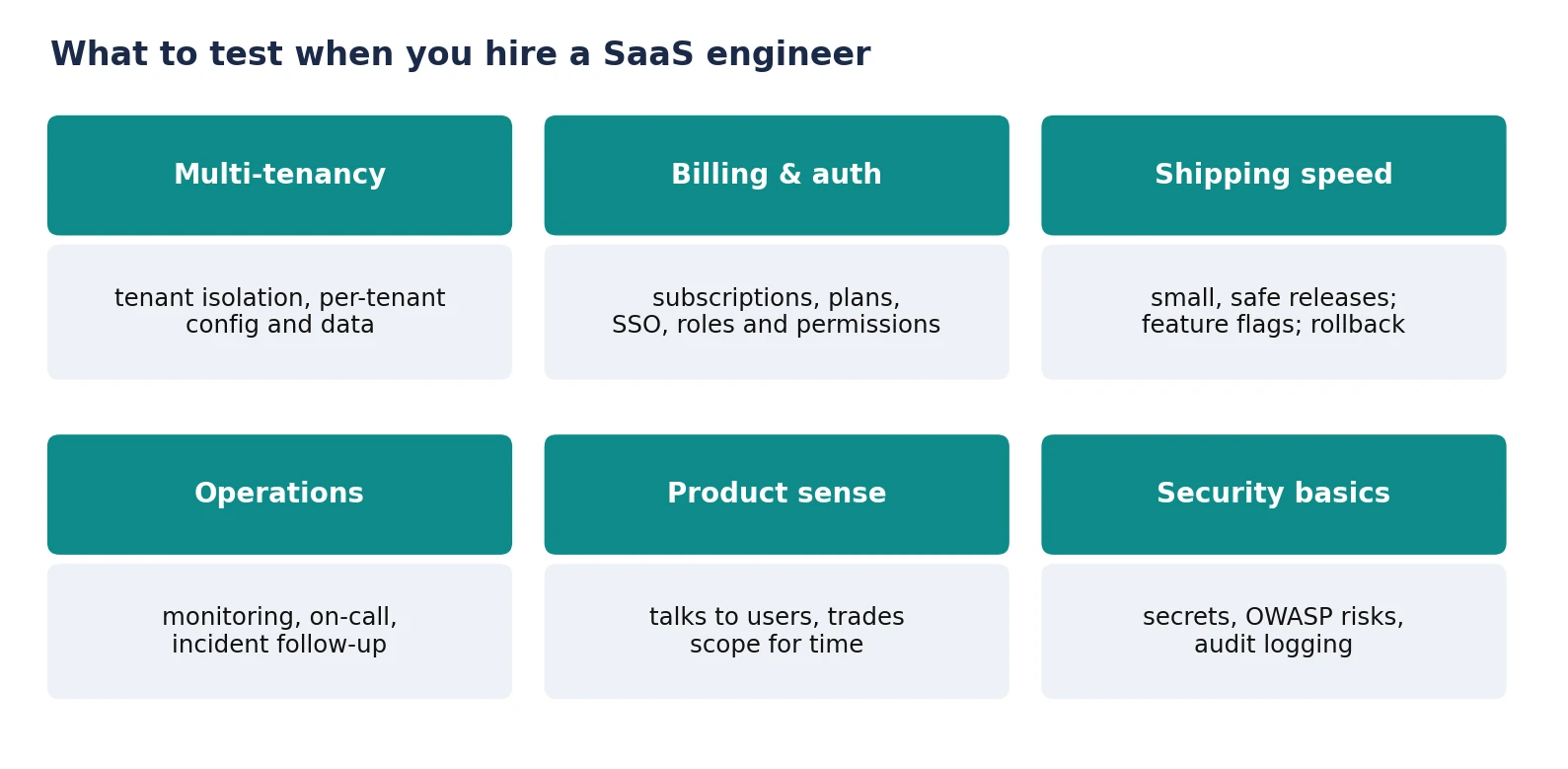
| Skill area | What good looks like | How to test it |
| Multi-tenancy | Designs tenant isolation and per-tenant configuration deliberately | Discuss how they separated customer data in a past system |
| Billing and authentication | Has built subscriptions, plans, roles and SSO, or knows the pitfalls | Walk through an upgrade, downgrade and failed-payment flow |
| Shipping speed | Ships small, reversible changes with feature flags and rollback | Ask for a recent release they would do differently |
| Operations | Sets up monitoring and learns from incidents | Review an incident they handled end to end |
| Product sense | Talks to users and trades scope for time | Give a vague feature request and see what they ask |
| Security basics | Handles secrets, access control and audit logging | Ask how they would answer a customer security questionnaire |
For the founding engineer, weight ownership and judgment above specific framework experience. A strong generalist can learn a new framework; it is harder to learn to make sound trade-offs under uncertainty.
Should You Hire Full-Time, Freelance or Use Staff Augmentation?
Use each engagement model for what it does best. Most SaaS startups combine them.
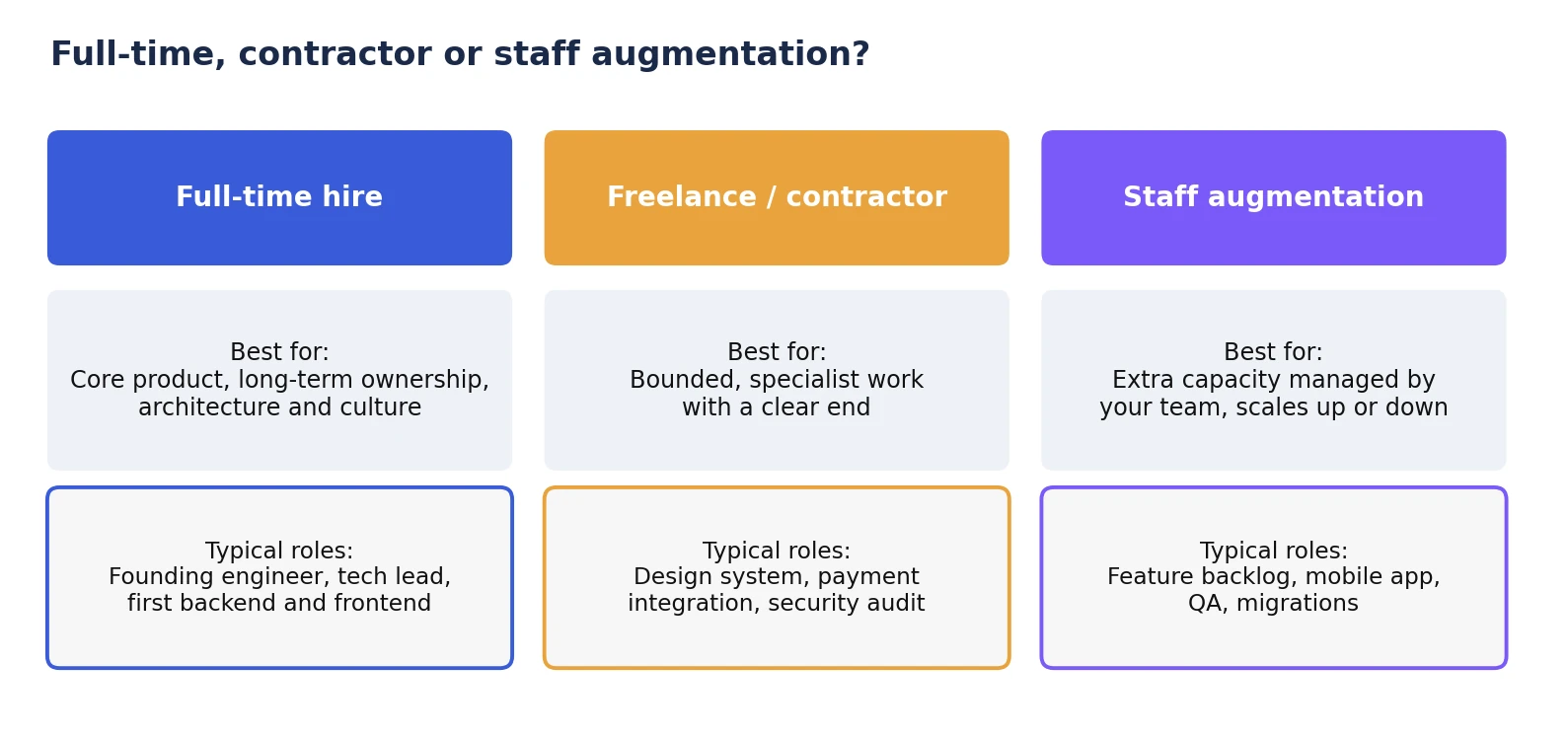
| Model | Best for | Watch out for |
| Full-time hire | Core product ownership, architecture, culture | Slow to hire; hard to reverse; highest fixed cost |
| Freelancer or contractor | Bounded, specialist tasks with a clear end | Knowledge leaving with the person; availability |
| Staff augmentation | Flexible capacity managed by your own team | Needs strong internal technical leadership and clear processes |
A common pattern is to keep architecture and product ownership in-house and add augmented or contract capacity for well-defined work. Rates vary widely by region; Accelerance’s 2026 outsourcing rate trends report puts senior developer partner rates at roughly $31 to $41 an hour in Asia, $60 to $75 in Latin America and $64 to $76 in Central and Eastern Europe. Whatever the model, retain ownership of the code, documentation and access credentials.
What Mistakes Do SaaS Startups Make When Hiring Developers?
Hiring juniors first to save money: early systems need senior judgment; juniors thrive later with mentoring and structure.
Hiring specialists before the product needs them: a dedicated DevOps or data engineer before real usage often has too little to do.
No technical owner: outsourcing everything without an internal or fractional technical lead leaves no one accountable for architecture.
Hiring for a framework, not for ownership: the stack will change; judgment and reliability will not.
Skipping the trial project: a paid, time-boxed task on a real problem reveals more than several interviews.
Losing control of code and accounts: repositories, cloud accounts and domains should always belong to the company.
How Do AI Features Change SaaS Hiring?
Many SaaS products now include AI features such as assistants, search or automation. Early on, a strong full-stack engineer who understands AI APIs can usually build the first version. Dedicated AI or ML engineers become necessary when the product depends on retrieval quality, evaluation, custom models or agentic workflows. Teams in that position can bring in specialist help, for example through AB Ark’s agentic AI development service, rather than hiring a full AI team before the use case is proven.
FAQs
Who should be the first engineer at a SaaS startup?
A senior full-stack engineer who can own architecture, delivery and operations, and who is comfortable talking to users. If no founder is technical, this person may also need to act as the technical leader.
How many engineers does an early SaaS startup need?
Many startups reach their first customers with one to three engineers. Add engineers when concrete bottlenecks appear, such as slipping releases or rising incidents, rather than to a fixed headcount target.
When should a SaaS startup hire a DevOps engineer?
When deployments become slow or risky, incidents increase, or cloud costs grow faster than revenue. Before that, a full-stack engineer with good deployment practices usually covers the work.
Is it better to hire in-house or outsource SaaS development?
Keep product and architecture ownership in-house, and use contractors or staff augmentation for defined work and extra capacity. Fully outsourcing without a technical owner creates long-term risk.
What does it cost to hire a SaaS engineer?
In the US, a software developer’s median wage is roughly $136,000 a year before benefits and hiring costs. Outsourcing partner rates in 2026 range from about $31 to $76 an hour for senior developers depending on region.
Hire one owner first, add roles when real signals appear, and match each engagement model to the work. Sequence protects both your runway and your product.
Head Of Engineering Department