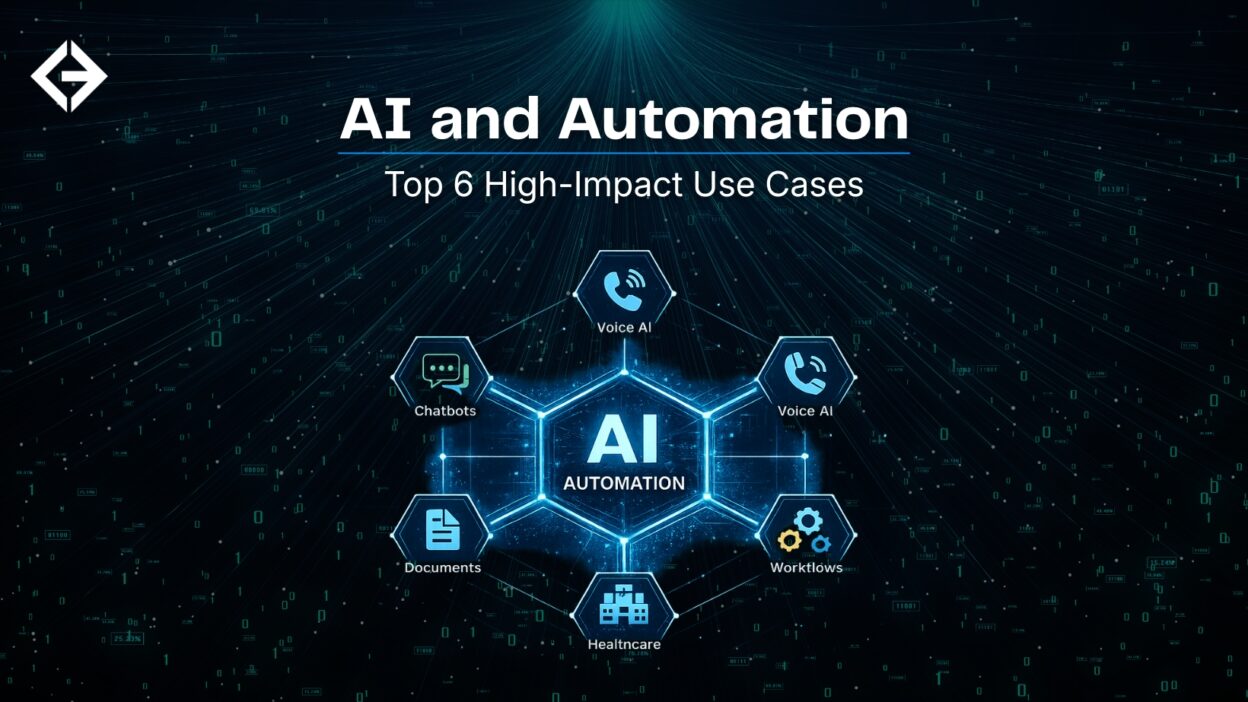
An AI and automation service designs and deploys intelligent agents that execute business workflows with minimal human intervention, combining machine learning, natural language processing, and agentic AI. The highest-value use cases are customer support, appointment and call handling, document processing, healthcare operations, and predictive analytics, where firms like AB Ark Solutions deliver measurable ROI within months.
Key Takeaways:
- AI chatbots and voice agents now resolve up to 80% of routine customer inquiries without human escalation.
- Unlike rule-based automation, AI adapts to messy inputs: varied phrasing, unstructured documents, changing patterns.
- The strongest candidates are high-volume workflows that still depend on human judgment calls.
- Documented ROI across implementations ranges from 20% to 260%, depending on scope and industry.
- Start with one pilot use case, establish baseline metrics first, then scale what proves itself.
📊 Request a Free Tech Stack Architecture Review
Every operations leader faces the same ceiling: headcount grows linearly while workload grows exponentially. Support queues, appointment calls, invoices, and reports pile up faster than teams can hire, and the repetitive work burns out the people you already have. The use cases below are where an AI and automation service breaks that ceiling first.

What Separates AI And Automation Service From Traditional Automation
Rule-based automation follows fixed scripts and breaks the moment inputs vary. AI automation handles the variation: it reads different writing styles, interprets intent, classifies messy requests, and improves as people correct it.
A simple test tells you which one you need. If you can write stable rules for the task, traditional automation is enough. If the task still relies on experience or judgment (routing a ticket, reading an invoice, answering a phrased-a-hundred-ways question), that is an AI use case.
The 6 Highest-Value Use Cases
1. Customer Support and Conversational AI
AI-powered chatbots and virtual assistants handle up to 80% of common customer issues instantly, at any hour, in any volume. Human agents keep the complex cases where empathy and judgment actually matter, and support costs drop while response times collapse.
2. AI Voice Agents for Calls and Bookings
Businesses lose revenue every time a call rings out. AI voice agents answer instantly, hold natural conversations, book appointments, and escalate to humans when needed, turning the front desk into a 24/7 function without night shifts.
3. Document and Data Processing
Invoices, contracts, emails, and forms arrive unstructured. AI extraction turns them into clean data automatically, eliminating manual entry errors and unlocking downstream automation in finance, legal, and operations.
4. Healthcare Operations and Patient Support
Hospitals and clinics deploy AI assistants for symptom triage, appointment scheduling, medication reminders, and round-the-clock patient questions, freeing clinical staff for actual care. The design bar is higher here: accuracy, empathy, and compliance are non-negotiable in patient-facing systems. For a complete look at how these deployments work in clinical settings, read our guide to AI virtual assistants in healthcare and hospitals before scoping one.
5. Workflow Orchestration and Back-Office Automation
Agentic AI coordinates multi-step processes end to end: employee onboarding, IT ticket resolution, compliance checks, payroll workflows. Instead of automating isolated steps, agents plan, decide, and execute across systems.
6. Predictive Analytics and Fraud Detection
Machine learning models spot patterns humans miss at scale: demand forecasts, churn risk, transaction fraud. Because the “bad patterns” keep changing, learning systems outperform static rules by design, with predictive maintenance alone cutting equipment failures by as much as 70% in documented deployments.
Use Case Priority Matrix
| Use Case | Best For | Typical Impact | Implementation Effort |
| Support chatbots | High ticket volume | Up to 80% queries deflected | Low to medium |
| AI voice agents | Missed calls, bookings | Zero unanswered calls | Medium |
| Document processing | Manual data entry | Near-zero entry errors | Medium |
| Healthcare assistants | Patient support load | 24/7 coverage, staff relief | Medium to high |
| Workflow orchestration | Multi-system processes | Hours per task reclaimed | High |
| Predictive analytics | Fraud, churn, forecasting | 20-260% ROI range | High |
What Full-Scale Automation Looks Like in Production
The use cases above compound when combined. AB Ark’s Eventas engagement shows the end state: an event management company running on manual coordination chaos needed operations that ran themselves, so the team rebuilt Eventas AI into a self-operating ecosystem with a high-precision AI Command Center coordinating the workflows humans previously juggled by hand (full case study). It sits in a portfolio of shipped AI systems, from voice agents to habit-tracking ecosystems, delivered by an 80+ person team across 15K+ working hours for hundreds of clients at a 99-100% job success rate.
How to Choose Your First Use Case
Do not start with the most impressive automation. Start with the one that removes the most friction with the least risk.
Audit your operations for high-volume, repetitive tasks that still need human judgment. Check data readiness for your top three candidates, because AI is only as good as what it learns from. Then pick one pilot, define baseline metrics before deployment, and measure honestly. The pilot that proves ROI becomes the business case for everything after it.
Two failure modes account for most stalled projects: automating an unstable process (fix the process first) and expecting full autonomy on day one (start assistive, scale with controls and human feedback loops).

Frequently Asked Questions
What is an AI and automation service?
An AI and automation service designs, builds, and deploys intelligent systems, such as chatbots, voice agents, and workflow agents, that execute business tasks with minimal human intervention. It covers strategy, custom development, integration with existing systems, and ongoing model improvement.
What are 7 types of AI?
The seven commonly recognized types of AI are Reactive Machines, Limited Memory, Theory of Mind, Self-Aware AI, Artificial Narrow Intelligence (ANI), Artificial General Intelligence (AGI), and Artificial Superintelligence (ASI).
What jobs can I get with AI automation?
AI automation skills can lead to roles such as AI Automation Specialist, AI Engineer, Machine Learning Engineer, Prompt Engineer, RPA Developer, AI Solutions Consultant, Data Analyst, and Workflow Automation Developer.
Which 3 jobs will survive AI?
Three jobs likely to remain in high demand despite AI are AI Engineer, Software Developer, and Cybersecurity Specialist, as they require complex problem-solving, creativity, and strategic decision-making.
What are AI automation examples?
Examples of AI automation include AI chatbots, email automation, voice assistants, document processing, workflow automation, fraud detection, predictive analytics, and customer support automation.
What are the most common AI automation use cases?
The most common use cases are customer support chatbots, AI voice agents for calls and bookings, document and data processing, healthcare patient support, workflow orchestration, and predictive analytics for fraud and forecasting.
What ROI can businesses expect from AI automation?
Documented implementations report ROI improvements from 20% to 260%, depending on scope and industry. Customer-facing automation typically shows returns fastest, with chatbots deflecting up to 80% of routine inquiries.
The gap between companies experimenting with AI and companies compounding with it comes down to execution: picking the right use case and building it properly the first time. That is a partner decision before it is a technology decision.

Syed Ahmad Ali is a tech writer at AB Ark with a knack for turning complex ideas into easy reads. He writes across a range of topics, but AI, software development, and the business of tech sit right at the top of his list.