E-learning app development means designing and building a mobile or web platform for online education, covering course players, progress tracking, AI personalization, and live classes. Costs range from $15,000 for a basic MVP to $200,000+ for an AI-powered, multi-platform learning product, with a focused MVP typically taking 4-6 months to build.
Key Takeaways:
- A realistic e-learning app budget in 2026 runs $30,000-$60,000 for an MVP and $60,000-$200,000+ once live classes and AI personalization are added.
- Engagement, not the feature list, determines success; an app only works if learners actually come back and finish what they started.
- AI personalization and adaptive tutoring have shifted from differentiator to baseline expectation in 2026 EdTech products.
- The global e-learning market is projected to grow from roughly $356 billion in 2025 to over $1.3 trillion by 2032, making the build decision a strategic one, not a side project.
- Offline access, video infrastructure, and gamification depth are the three features most likely to determine whether users actually finish a course.
Corporate training budgets are shifting into digital learning ecosystems, hybrid K-12 education has become permanent rather than a pandemic-era workaround, and every EdTech founder pitching a new platform faces the same question: what should this app actually include, and what will it really cost to build. Most vendor pages answer that question with a feature checklist. Very few explain what actually makes learners finish a course instead of abandoning it in week one.
What E-Learning App Development Actually Involves
E-learning app development covers the full lifecycle of building a digital education product: course creation and content management, learner assessment and grading, communication tools between instructors and students, and the analytics that show whether people are actually learning anything. It spans mobile, web, and cross-platform builds, and increasingly integrates AI for personalization and cloud infrastructure for scale.
The technology decision that matters most early is platform strategy. Building separate native apps for iOS and Android doubles development cost and timeline; for most EdTech startups, a cross-platform framework like Flutter launches on both app stores simultaneously while cutting initial cost significantly, without meaningfully compromising the user experience.
What an E-Learning App Development Costs in 2026
| Tier | Typical Cost | Timeline | What It Includes |
| Basic MVP | $15,000-$40,000 | 4-6 months | Course player, quizzes, progress tracking, basic dashboards |
| Mid-complexity | $40,000-$90,000 | 6-9 months | Video streaming, live classes, third-party integrations, custom UI |
| Advanced / AI-powered platform | $90,000-$200,000+ | 9-14 months | AI personalization, adaptive tutoring, AR/VR modules, multi-language support |
Annual maintenance typically adds 15-20% of the initial build cost, and regional developer rates shift the total significantly: $20-$80/hour in South Asia versus $100-$250/hour in the US and Western Europe for comparable seniority. Content licensing, multimedia production, and certification integrations can also add meaningfully to the budget depending on your subject matter.
The Features That Actually Drive Completion, Not Just Downloads
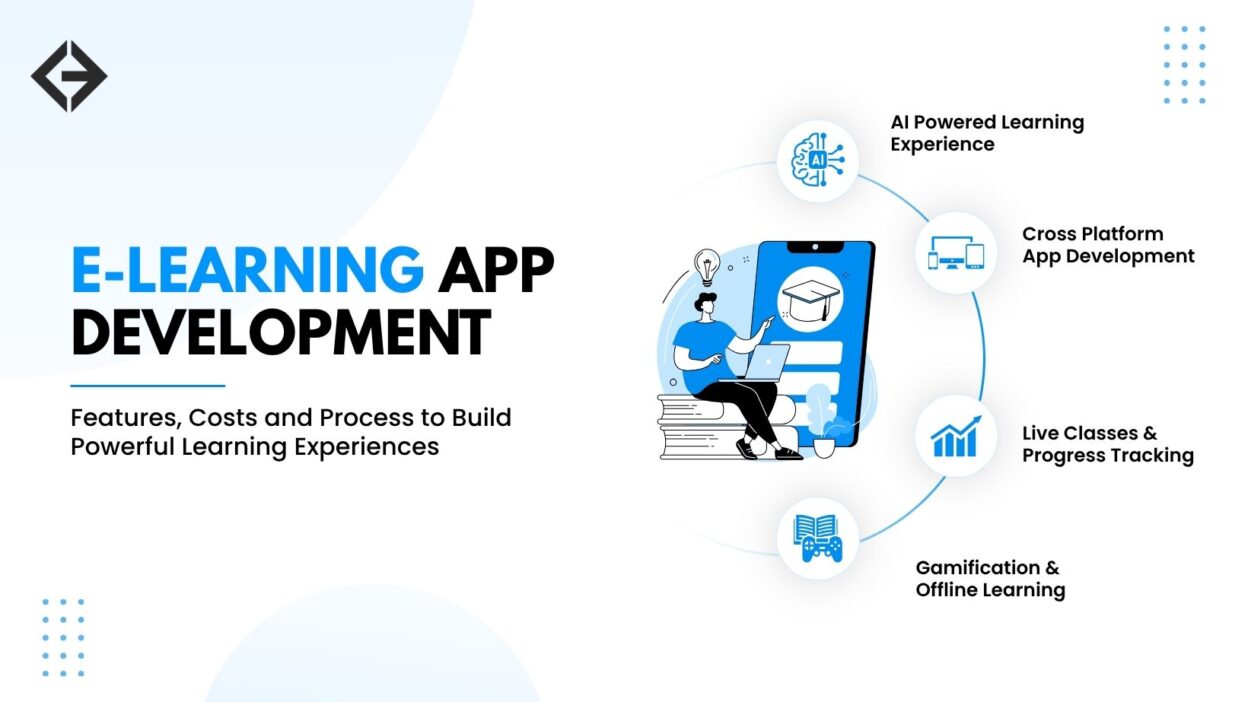
A course library with clean navigation gets downloads. It does not get completions, and completion is the metric that determines whether an e-learning product survives past its first cohort. The features that move that number are specific: a clean course player supporting video, audio, and text lessons, gamification (streaks, badges, leaderboards) that gives learners a reason to return, and offline mode, one of the most requested features in 2026, since learners on a plane, a subway, or a spotty data plan should not lose access to lessons they already started.
AI personalization has moved from nice-to-have to baseline expectation. Adaptive systems now track a learner’s performance in real time and flag exactly where they are struggling with a specific concept, adjusting difficulty and content sequence automatically rather than pushing every learner through an identical, fixed path.
MVP vs. Full Platform: Choosing Your Starting Scope
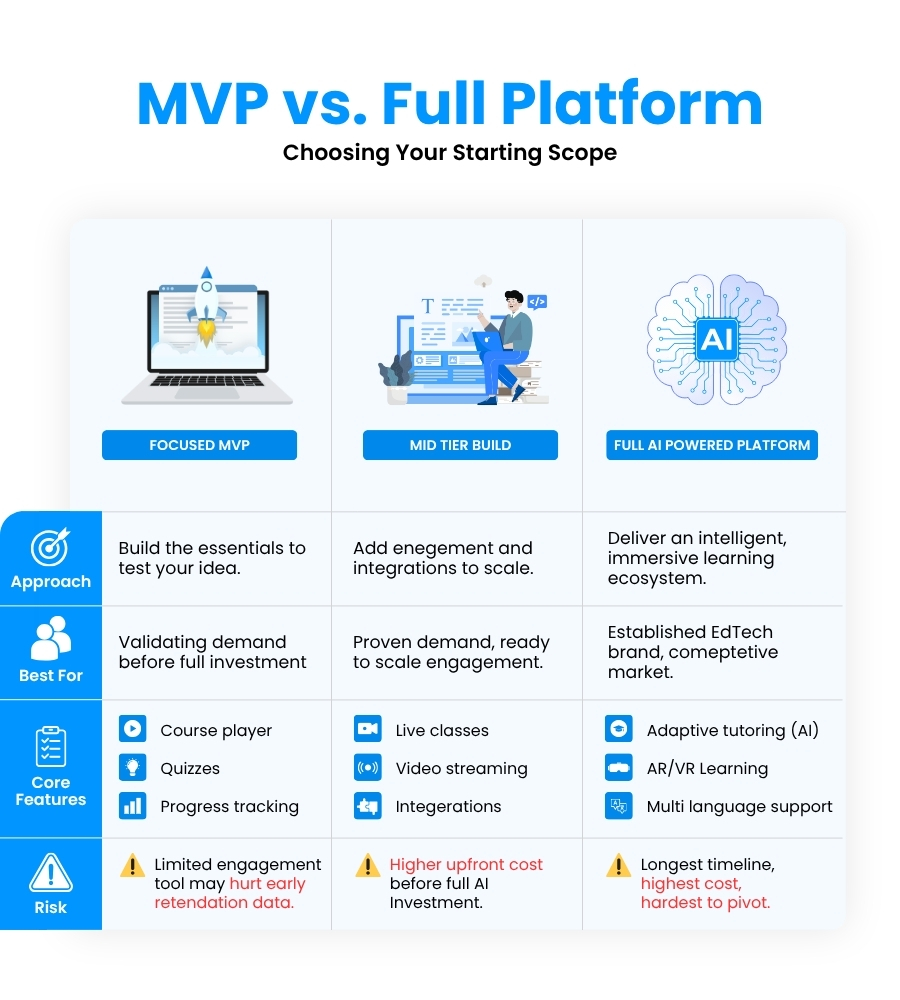
Starting with 3-5 core features executed well beats launching a feature-complete platform that does none of them properly. A focused MVP with courses, video lessons, quizzes, and progress tracking is enough to validate whether learners actually engage, and that validation should inform every dollar spent afterward, not the other way around.
Choosing Between a Native App and a Broader Platform Strategy
The mobile-versus-web decision compounds with every other technical choice in this build, and getting it wrong early is expensive to reverse later. Many EdTech products eventually need both a mobile app for on-the-go learning and a web dashboard for instructors, administrators, and detailed reporting, which means the underlying architecture has to support both from day one rather than being retrofitted after launch. Weighing that full platform strategy against a mobile-only build is worth doing before committing to a specific scope. Our complete guide to top web app development services covers that broader architecture decision in detail.
What a Production-Grade E-Learning Platform Delivers
AB Ark’s Vocaliv build shows what disciplined e-learning engineering produces when engagement, not just features, is the design goal. The client needed to prove that AI could genuinely reduce trainer workload while keeping learners engaged, not just digitize existing content; AB Ark’s team built and launched a platform with AI-powered lesson planning, voice-based content creation, automated quizzes, and 24/7 student support, now serving training providers in production (full case study). That engagement-first standard, delivered by an 80+ person team across 15,000+ working hours for 300+ clients at a 99% job success rate, is what separates an e-learning app people finish from one they abandon.
How to Scope Your Build Without Overcommitting
Start by defining your monetization model before writing a single feature spec, since B2B licensing, consumer subscriptions, and one-time course sales each imply different priority features. Pick 3-5 core features that directly serve completion, not impressiveness, and treat everything else as a post-launch roadmap item. Choose a cross-platform framework unless you have a specific technical reason not to, since most EdTech startups do not need native-only performance advantages at their current scale.

How much does it cost to build an e-learning app in 2026?
A realistic e-learning app costs $30,000-$60,000 for a focused MVP with courses, quizzes, and progress tracking, and $60,000-$200,000+ once live classes, AI personalization, and multi-platform support are added. Annual maintenance typically adds 15-20% of the initial build cost.
How long does it take to build an e-learning app?
A focused MVP with core features typically takes 4-6 months to build and launch. Adding live classes, AI personalization, or AR/VR modules extends that timeline to 9-14 months depending on scope.
What features matter most for e-learning app success?
Completion-driving features matter more than a long feature list: a clean course player, gamification, offline access, and AI-powered personalization that adapts to individual learner performance. Downloads without these features rarely translate into finished courses.
Should I build a native app or a cross-platform e-learning app?
For most EdTech startups, a cross-platform framework like Flutter is the smarter choice, since it launches on both iOS and Android simultaneously at a significantly lower cost than building two separate native apps, without meaningfully compromising user experience.
The e-learning apps that survive past their first year are not the ones with the longest feature list. They are the ones engineered around whether a learner actually comes back tomorrow.

Syed Ahmad Ali is a tech writer at AB Ark with a knack for turning complex ideas into easy reads. He writes across a range of topics, but AI, software development, and the business of tech sit right at the top of his list.