
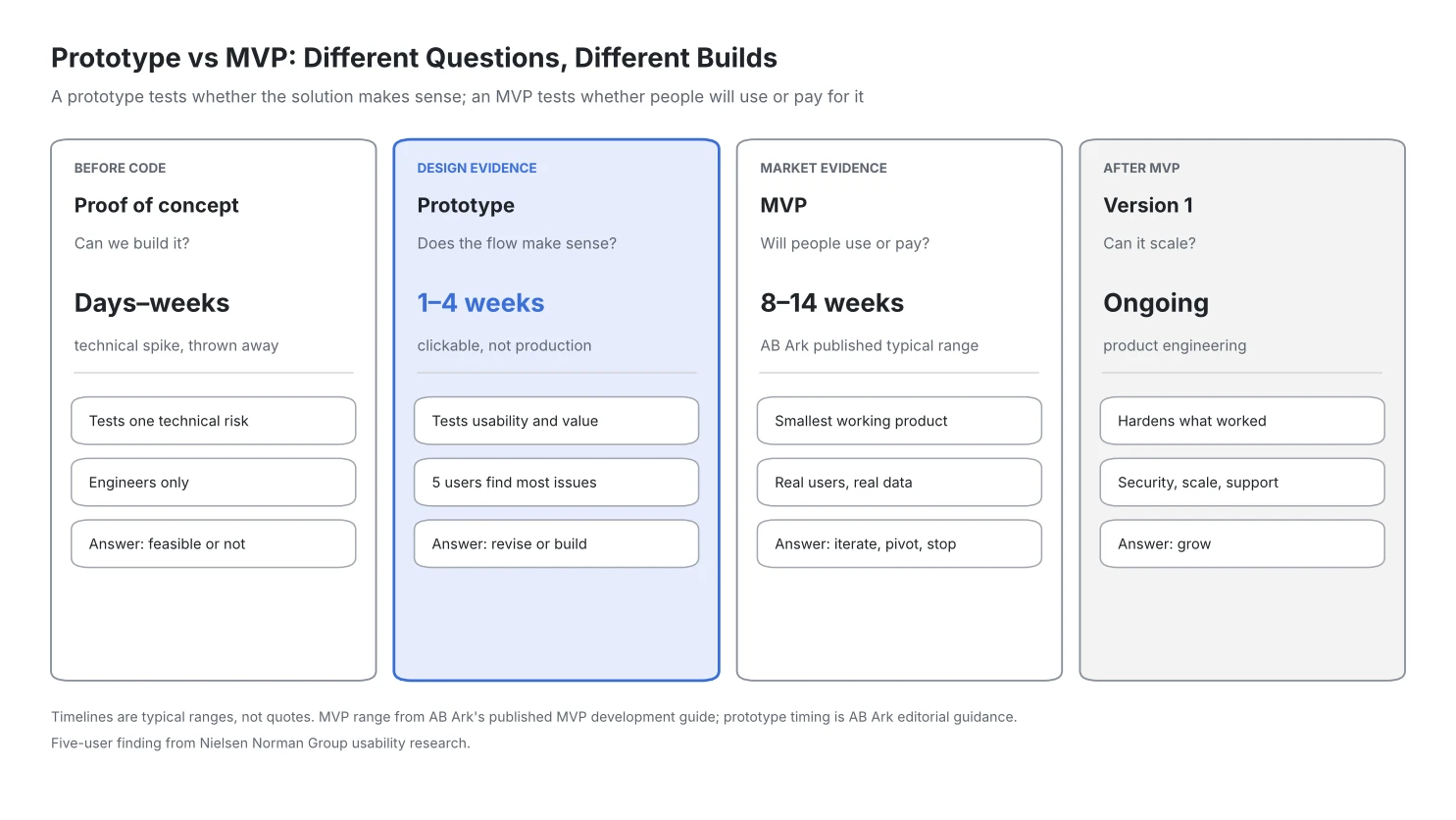
 An MVP prototype is a clickable or partly working model of your minimum viable product used to test the idea with users before you build it; an MVP is the smallest working version released to real users to test whether they will use or pay for it. A prototype answers “does this make sense?” in days or weeks; an MVP answers “will people adopt it?” and typically takes 8 to 14 weeks to build. Build the prototype first when the user experience is uncertain.
This guide is for founders and product managers deciding what to build before committing an MVP budget. It defines each stage, including the proof of concept, compares them side by side, explains what drives the cost of an MVP prototype and an MVP, and gives a simple rule for which to build first, including for AI products.
Key Takeaways
- A prototype simulates the product to test usability and value; an MVP is a real product, used by real users, that tests demand.
- Prototypes are disposable by design; an MVP is the first version you keep and build on.
- Testing a prototype with about five users finds most usability problems, according to Nielsen Norman Group research.
- AB Ark publishes a typical MVP range of $15,000 to $80,000 and 8 to 14 weeks; a clickable prototype is a small fraction of that effort.
- If the technology is uncertain, such as AI accuracy or an unknown integration, run a proof of concept before either.
Talk to Our Team About Your Project ->
What Is an MVP Prototype?
An MVP prototype is a model of the minimum viable product built to test the idea before engineering it. It is usually a clickable design in a tool like Figma, sometimes with a thin coded front end and fake data. It is shown to target users and stakeholders to check that they understand the flow and see its value. It is not production software: there is no real backend, security or scalability.
The term is used loosely, so agree on fidelity before you price it:
|
Prototype type |
What it is |
Best for |
|---|---|---|
|
Paper or wireframe |
Sketches or gray boxes of key screens |
Testing flow and information structure in hours |
|
Clickable high-fidelity |
Designed screens linked into a realistic flow |
Usability tests, investor demos, sales conversations |
|
Coded prototype |
Real front end with mocked data or services |
Interactions too complex to fake in a design tool |
What Is an MVP?
A minimum viable product (MVP) is the smallest version of a product that delivers the core value to real users, in production, with real data. Its job is to produce evidence of demand: sign-ups, usage, retention, payment. An MVP needs working backend logic, authentication, basic security, analytics and support, because real people depend on it. AB Ark’s guide to custom MVP development services covers how an MVP build is scoped.
Prototype vs MVP: Key Differences
|
Dimension |
Prototype |
MVP |
|---|---|---|
|
Question answered |
Does the solution make sense to users? |
Will users adopt, return to or pay for it? |
|
Who uses it |
Test participants, stakeholders, investors |
Real users and early customers |
|
Functionality |
Simulated; little or no backend |
Working core features, end to end |
|
Evidence produced |
Observed task success, confusion, feedback |
Usage, retention, conversion, revenue |
|
Lifespan |
Thrown away or used as a design reference |
Kept and extended into version 1 |
|
Typical timeline |
1–4 weeks |
8–14 weeks (AB Ark published range) |
|
Main risk reduced |
Usability and value risk |
Market risk |
A proof of concept (POC) sits before both when the technology is uncertain. A POC answers “can we build this at all?”, for example whether a model can reach the accuracy you need on your data, and is usually a short engineering spike with no user interface. AB Ark covers this separately on its POC development services page.
How Much Does an MVP Prototype Cost?
The cost of an MVP prototype is driven mainly by design time: usually one product designer, sometimes supported by a researcher, for one to four weeks depending on the number of screens and the depth of testing. The cost is the hours multiplied by your design or development partner’s hourly rate. AB Ark does not publish a fixed prototype price because scope varies so much; ask for an estimate against a screen list.
|
Cost driver |
Lower cost |
Higher cost |
|---|---|---|
|
Number of key flows |
One core flow, 8–12 screens |
Several roles and flows, 30+ screens |
|
Fidelity |
Wireframes |
High-fidelity design with a design system |
|
User testing |
Informal feedback |
Recruited participants, scripted sessions, report |
|
Coded elements |
None |
Front-end prototype for complex interactions |
Illustrative calculation, not a quote: a clickable prototype that takes a designer 80 hours costs 80 × the designer’s hourly rate. At a hypothetical $50 an hour that is $4,000; at $100 an hour, $8,000. Replace the rate with the quotes you receive.
How Much Does an MVP Cost?
AB Ark’s published guide puts most MVPs at $15,000 to $80,000 and 8 to 14 weeks. Where a project lands depends on the number of user roles and core features, integrations, platforms (web, iOS, Android), compliance needs and whether AI is part of the core value. A prototype tested before the build usually narrows scope, which is where much of its value shows up. AB Ark’s guide to scoping a startup MVP in 12 weeks shows how to cut scope to one user, one job and one metric, and its guide to MVP development agencies covers choosing who builds it.
Contract model affects cost risk as well as price. AB Ark’s guide to fixed price vs time and materials for AI MVPs explains which suits a clear scope and which suits an uncertain one.
Get a Custom Project Cost & Timeline Estimate ->
Which Should You Build First: Prototype or MVP?
Build a prototype first when you are unsure users will understand or want the workflow; build a narrow MVP first when the workflow is familiar and buyers are already asking for it; and run a proof of concept first when the technology itself is uncertain.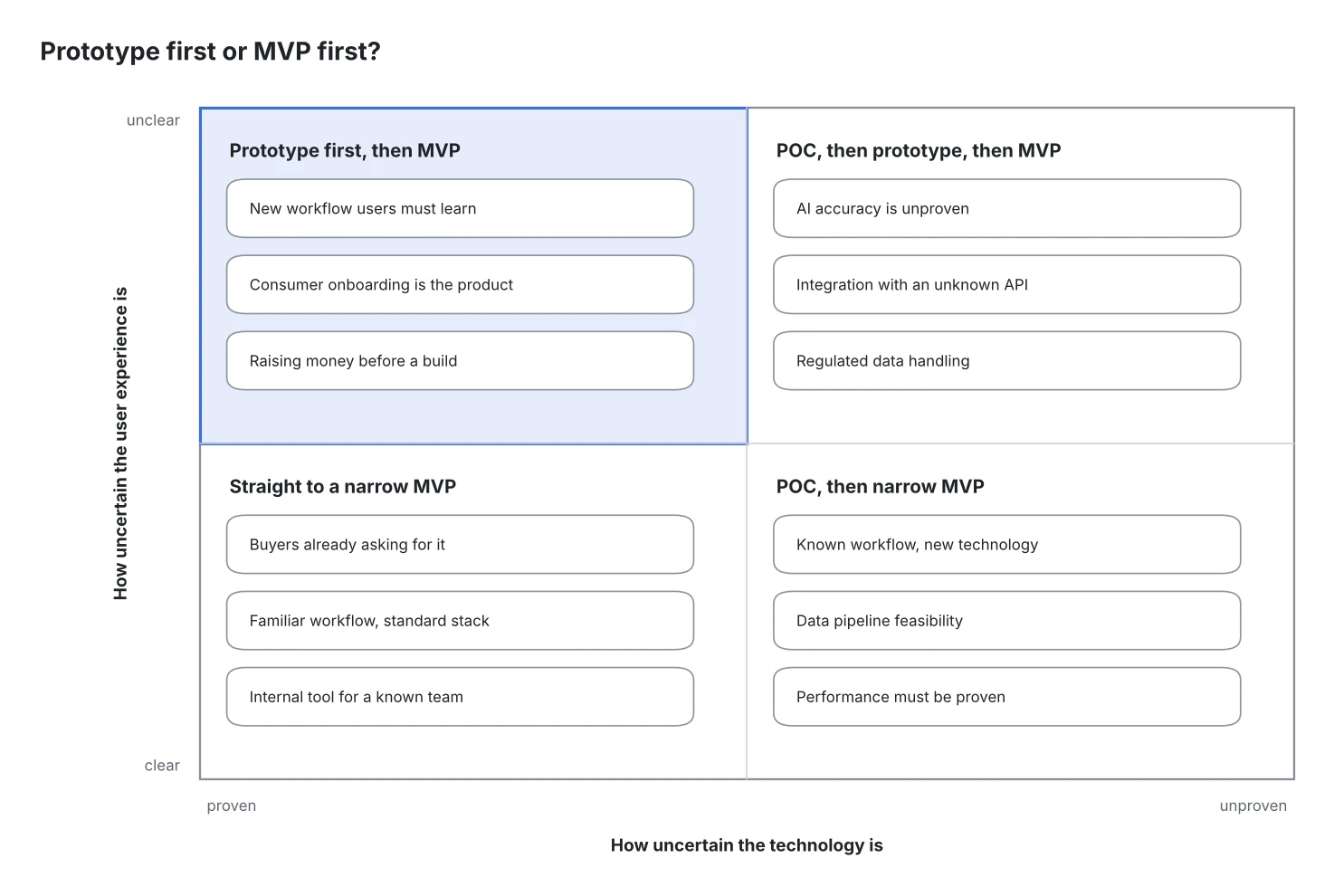
- Build a prototype first if: the product introduces a new workflow, onboarding is the product, or you need to show investors something before funding a build.
- Go straight to a narrow MVP if: you are digitizing a familiar workflow on a standard stack, or customers have already committed to try it.
- Run a proof of concept first if: the product depends on AI accuracy, an undocumented integration or performance you have not proven.
- Do all three in sequence if: the technology and the experience are both uncertain. Order: POC, then prototype, then MVP.
The quadrant is AB Ark editorial guidance. Use it to decide the order, not to skip validation entirely.
How to Test an MVP Prototype
Test a prototype with real target users doing real tasks, and watch rather than ask. Nielsen Norman Group’s research found that testing with about five users uncovers most usability problems, so several small rounds with changes in between beat one large study.
- Write three to five tasks: for example, “sign up and book your first appointment”.
- Recruit five people who match the target user, not colleagues or friends.
- Observe and record where they hesitate or fail: ask them to think aloud; do not help.
- Fix the biggest problems and test again: repeat until the core tasks succeed.
- Decide with evidence: move to the MVP, change the concept, or stop.
Prototype and MVP for AI Products
AI products add a third risk: whether the model performs well enough on real data. Run a short proof of concept on representative data first (AB Ark describes a six-week format on its AI POC development page), then prototype the experience around the model’s real behavior, including its errors, then build the MVP. Prototypes that assume a perfect model test the wrong thing. If an early version was built quickly with AI coding tools, AB Ark’s vibe coding audit guide explains what to check before turning it into the MVP.
FAQs
What is the difference between a prototype and an MVP?
A prototype is a simulated model of the product used to test usability and value with a few users; it usually has no working backend and is thrown away. An MVP is the smallest working product released to real users to test demand; it is kept and extended.
Is an MVP prototype the same as an MVP?
No. “MVP prototype” usually means a clickable or partly coded model of the planned MVP, used before building it. The MVP itself is production software used by real customers.
Can I skip the prototype and build an MVP?
Yes, when the workflow is familiar, the scope is narrow and buyers have already shown demand. Skipping it is riskier when users must learn a new workflow, because usability problems discovered after the build cost more to fix than problems found in a prototype.
How long does it take to build a prototype and an MVP?
A clickable prototype typically takes one to four weeks, depending on the number of flows and testing rounds. AB Ark’s published range for an MVP is 8 to 14 weeks. A proof of concept, when needed, usually adds a few days to a few weeks before either.
Should investors see a prototype or an MVP?
Pre-seed investors often invest based on a strong prototype plus evidence of user interest; later investors usually want MVP traction such as active users, retention or revenue. Show the stage that matches what you are asking them to believe.
The Rule for Prototype vs MVP
Use a prototype to buy certainty about the experience cheaply, an MVP to buy certainty about the market, and a proof of concept to buy certainty about the technology. Build them in the order of your biggest unknown, and throw away what was only meant to answer a question.
A prototype tells you what to build. An MVP tells you whether it was worth building.