
For AI MVPs, fixed price software development works only for well-defined, low-uncertainty scope. Time and materials fits work where scope or model performance is unknown, but it needs a budget cap and weekly review. The most reliable structure is a hybrid: a fixed-price discovery phase to test feasibility on your real data, then capped time and materials for the build, then milestone payments tied to evaluation results once thresholds are known.
Key Takeaways
- Fixed price puts estimating risk on the vendor and gives you cost certainty, but only for the scope you can define upfront. Change requests and contingency pricing are the usual costs.
- Time and materials gives flexibility to learn as you build, but it removes the contractor’s incentive to control cost, so it needs a ceiling, regular demos and spend reporting.
- AI MVPs are hard to price because model quality is unknown until tested on real data, output varies between runs, and running costs continue after launch.
- Do not buy a fixed price for an unproven AI idea. Buy a short fixed-price discovery phase, then decide how to contract the build with evidence in hand.
- Whichever model you choose, write acceptance as pass rates on an agreed evaluation set, not as a feature list.
Talk to Our Team About Your Project ->
What Are Fixed-Price and Time-and-Materials Contracts?
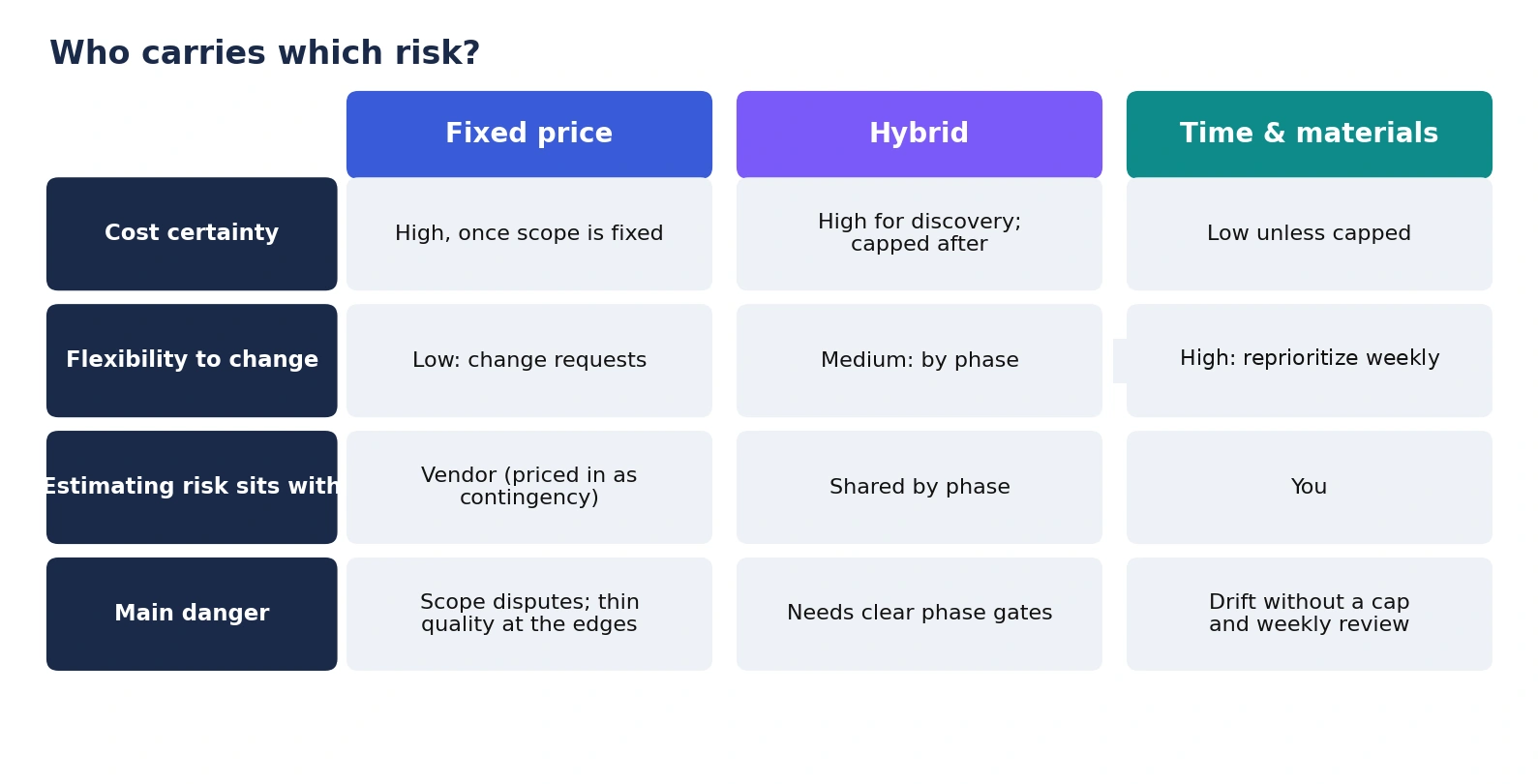
In a fixed-price contract, the buyer and vendor agree on a scope and a total price before work starts, and the vendor delivers that scope for that price. In a time-and-materials (T&M) contract, the buyer pays for the hours worked and materials used, usually at agreed rates, as the work happens. Each model allocates risk differently.
The clearest public statement of the trade-off comes from US federal procurement rules. FAR 16.601 states that a time-and-materials contract provides no positive profit incentive to the contractor for cost control or labor efficiency, so appropriate oversight of performance is required, and that such contracts may be used only when no other contract type is suitable and with a ceiling price that the contractor exceeds at its own risk. The FAR also notes that time-and-materials and labor-hour contracts are not fixed-price contracts. One summary of the FAR adds that firm-fixed-price contracts give the maximum incentive to control costs and suit work where risk is minimal or can be predicted with acceptable certainty.
These are government rules, but the logic applies to any buyer: fixed price rewards the vendor for controlling cost when the work can be defined, while T&M leaves cost control to you.
Why Are AI MVPs Harder to Price Than Normal Software?
AI MVPs are harder to price because the biggest unknowns are not features. They are data, model behavior and running cost, and none of them can be known from a requirements document.
Model quality is unknown until tested. Whether a model reaches the accuracy you need on your real data cannot be established on paper. A fixed price for an outcome nobody can yet promise is a bet, and the vendor will price in that bet.
Data readiness is often the real problem. RAND’s 2024 study of AI project failure interviewed 65 experienced data scientists and engineers and found missing or inadequate data, and inadequate infrastructure to manage data and deploy models, among the leading root causes.
Output varies between runs. Anthropic’s guidance on agent evals explains that agents are non-deterministic, so a single successful run can hide how often the system fails. Acceptance therefore has to be a pass rate across repeated runs on an agreed evaluation set, and defining that set is itself part of the work.
Running costs continue after launch. Model usage (tokens), tool and API calls, hosting and human review are recurring costs that a build price does not include.
Models change. Anthropic commits to at least 60 days’ notice before retiring publicly released models, so even a finished MVP may need re-testing on a replacement model.
Scope moves as users react. An MVP exists to learn. Early users often change what the product should do.
When Does Fixed Price Software Development Work for an AI MVP?
Fixed price software development works when the scope is stable, testable and based on proven technology. For AI MVPs, that usually means specific, bounded pieces rather than the whole product.
A defined user interface, dashboard or admin tool around an AI feature.
Integration with a known system that has a documented API.
A discovery phase with a fixed duration and defined deliverables.
A hardening phase for a slice whose evaluation thresholds are already agreed.
Advantages
Cost certainty for the agreed scope, which suits tight budgets and investor reporting.
The vendor carries the risk of estimating wrongly.
Less day-to-day management time for you, because delivery is the vendor’s responsibility.
Drawbacks
Contingency is built into the price. The vendor prices uncertainty in, and you pay for that cushion whether or not the risk occurs.
Change is expensive. Learning from users produces change requests, each negotiated and priced.
Quality thins at the edges. When the scope is fixed but the work is uncertain, shortcuts appear where the contract is vague, such as testing, error handling and documentation.
Weak acceptance criteria cause disputes. A feature list does not say how well an AI feature must perform.
When Does Time and Materials Work for an AI MVP?
Time and materials works when you are still discovering what to build and the cost of being wrong is lower than the cost of locking scope too early. The US government’s former 18F team (disbanded in 2025) wrote that with agile work you are not buying a defined product but developers’ time, and that if you can constantly measure and accept software quality, a time-and-materials contract with a ceiling on total spending gives the team more flexibility. A 2016 report on federal agile contracting noted that 18F preferred time and materials for agile work.
Advantages
Flexibility to change priorities every week as you learn from users and model tests.
You pay for work done, not for a contingency.
You can see and steer progress continuously.
Drawbacks
No built-in cost control. As the FAR notes, T&M gives the contractor no profit incentive to control cost, so you must supply it through a ceiling, reporting and review.
Budget can drift. Without a cap or priorities, work expands to fill the budget.
It needs a capable buyer. You must review demos, decide priorities and challenge estimates every week.
Done well, T&M still has guardrails: a not-to-exceed budget, hours and burn reported weekly, working software demonstrated every sprint, and the right to stop at any review.
Fixed Price vs Time and Materials: Side-by-Side
| Factor | Fixed price | Time and materials |
| Cost certainty | High for the agreed scope | Low unless capped |
| Flexibility | Low; changes via change requests | High; reprioritize at any time |
| Who carries estimating risk | Vendor, priced as contingency | Buyer |
| Cost-control incentive | On the vendor | On the buyer, through oversight and a cap |
| Best for | Defined scope on proven technology | Uncertain scope or technology; learning while building |
| Typical AI MVP use | Discovery, UI, integrations, hardening slices | Core experimentation and iteration |
| Main danger | Scope disputes and thin quality at the edges | Drift without a cap and weekly review |
What Is the Best Contract Structure for an AI MVP?
A hybrid structure usually fits best, because an AI MVP changes character as it matures: first the question is whether it can work, then what to build, then whether it is ready.
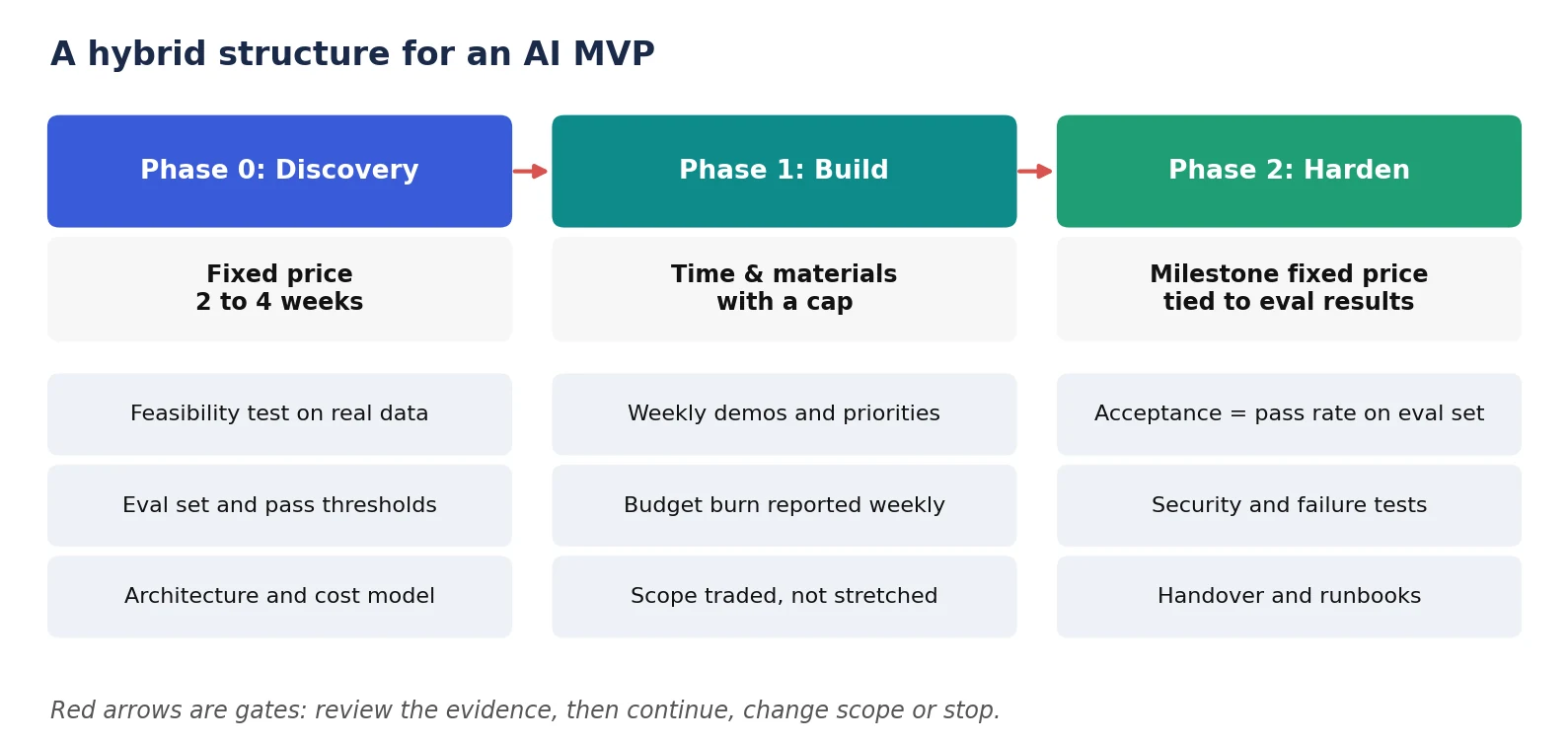
Phase 0, fixed-price discovery (two to four weeks): test feasibility on your real data, define the evaluation set and pass thresholds, and produce an architecture and cost model. This buys the information both sides lack.
Phase 1, capped time and materials: build and iterate with weekly demos, weekly budget reporting, and a not-to-exceed cap. Trade scope against the cap instead of stretching the cap.
Phase 2, milestone-based fixed price: once thresholds are agreed for a defined slice, tie payments to evaluation results. This phase also covers security and failure testing, and handover.
At each gate, review the evidence and decide to continue, change scope or stop. The structure turns a single large bet into a series of smaller decisions.
Other hybrids worth considering
Capped T&M: time and materials with a not-to-exceed amount and alerts at set percentages of spend.
Fixed price for must-haves, T&M for the rest: lock the essential scope and keep the remainder flexible.
Fixed monthly team fee: a dedicated team at a fixed monthly price, with scope flexing inside it.
How Do You Decide Which Contract to Use?
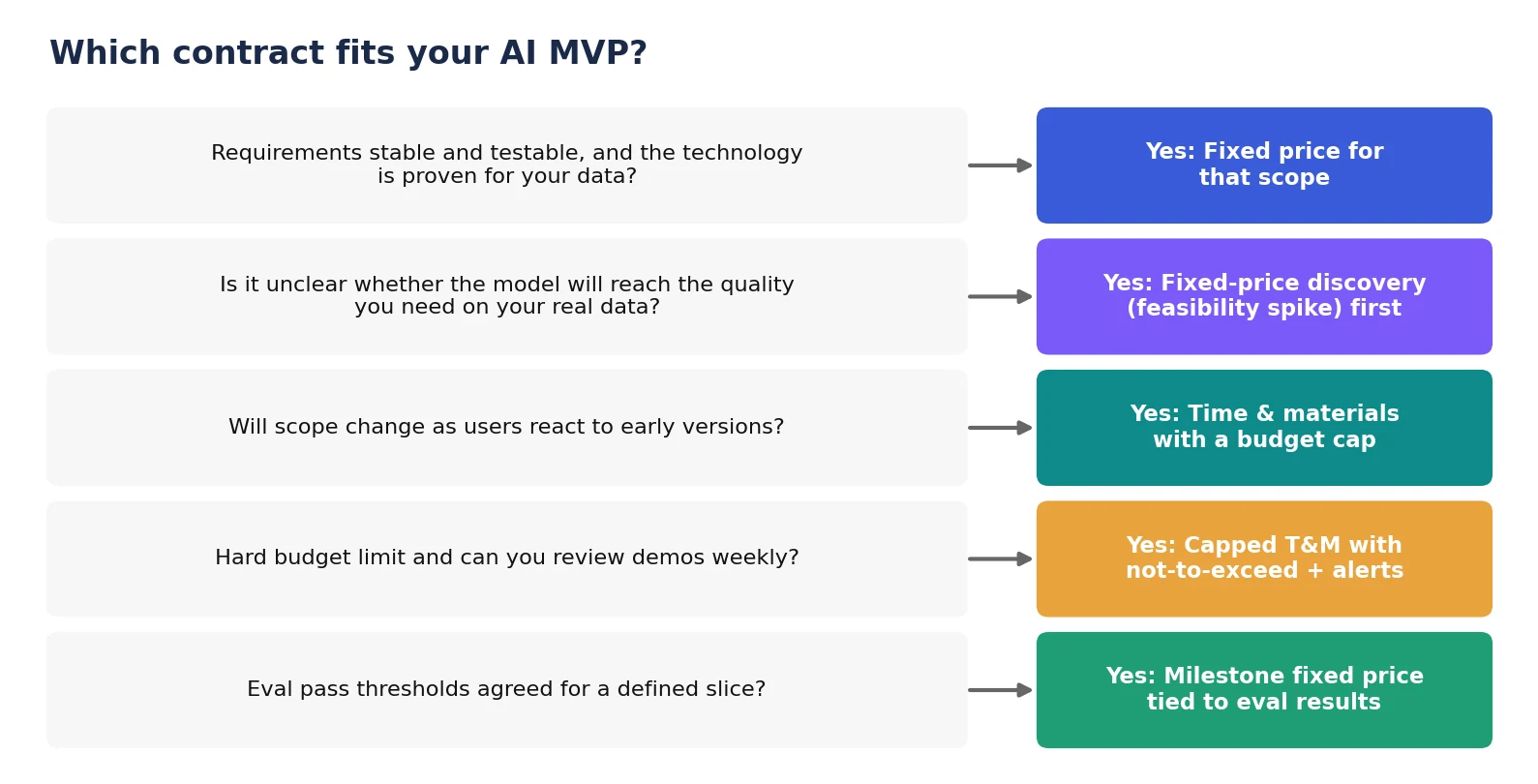 If several answers point to different models, that is the signal to use a hybrid and put the uncertain part first.
What Should an AI MVP Contract Include?
Acceptance based on evidence: pass rates on an agreed evaluation set across repeated runs, with zero tolerance for defined critical errors.
Running costs stated separately: who pays model, tool and hosting bills, with an estimated cost per task and alerts.
Change control: how scope changes are proposed, priced and approved.
Budget cap and reporting: a not-to-exceed amount, weekly burn reports and a right to stop at any gate.
Model-change clause: who monitors provider deprecation notices and re-tests on replacements.
Ownership: code, prompts, evaluation sets, tool definitions and accounts transfer to you.
Data handling: what data the vendor may use, where it is processed, and a ban on training on your data without consent.
Named team and replacement terms: who works on your project and what happens if someone leaves.
AB Ark’s guide to AI agent scope of work covers acceptance criteria and clauses in more detail. Have legal counsel review any contract.
What Does an AI MVP Cost? An Illustrative Budget
Actual prices depend on scope, so treat this as a method, not a quote. The chart shows labor cost for three senior engineers working full time (40 hours a week) for 12 weeks, 1,440 hours in total, at Accelerance’s 2026 senior partner rates of $31 to $41 an hour in Asia, $60 to $75 in Latin America and $64 to $76 in Europe.
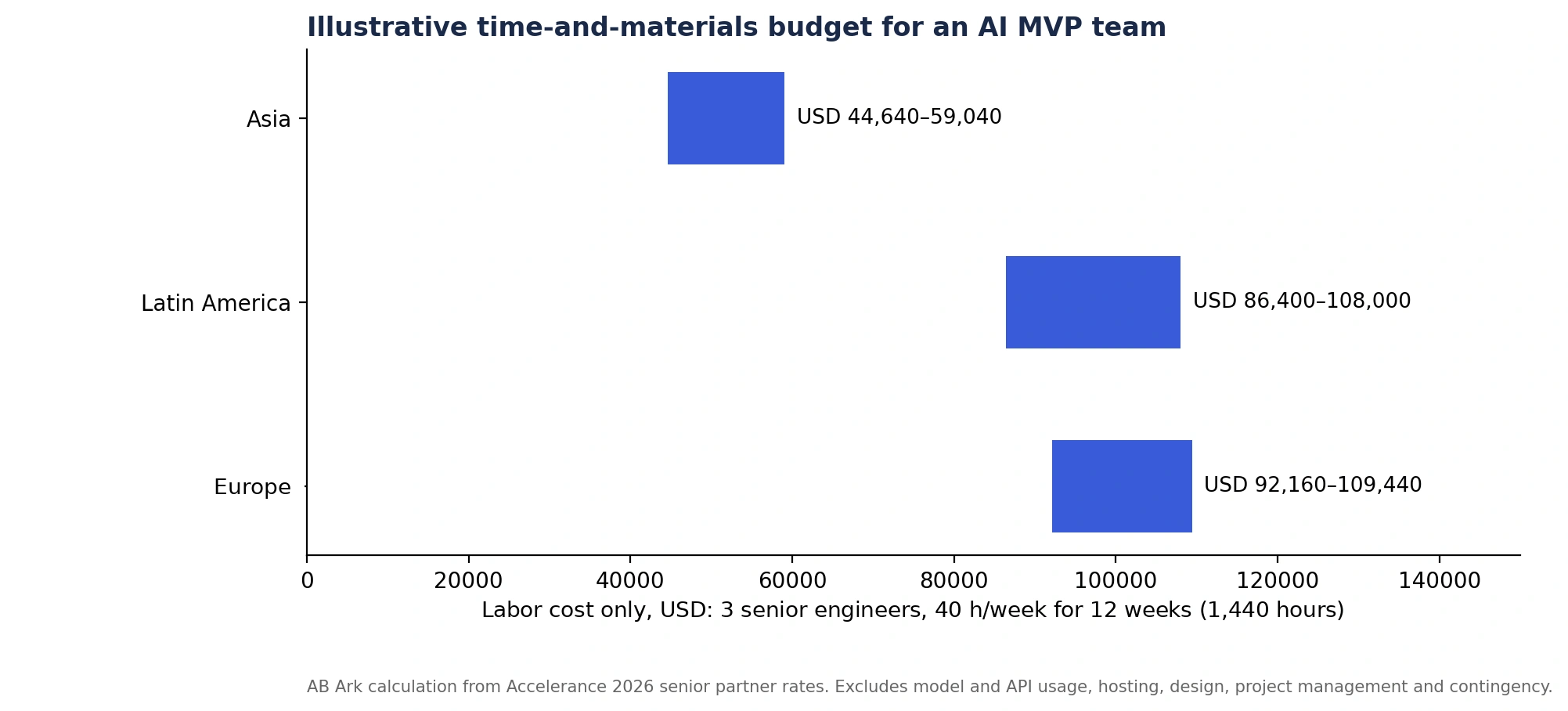
A fixed-price quote for the same work will add contingency for uncertainty. A T&M estimate shows the expected hours but leaves the final figure open. Compare quotes by asking each vendor for its assumptions, what is excluded, and how changes and overruns are handled. For wider context on why scope and schedule risk matter, McKinsey and Oxford research found that large IT projects ran 45% over budget on average.
Red Flags in AI MVP Quotes
A fixed price offered before any discovery on an unproven AI idea.
No evaluation criteria, so “done” means “the features exist”.
A large unexplained contingency, or none at all on uncertain work.
T&M with no cap, no weekly reporting and no right to stop.
Running costs missing from the estimate.
The vendor owns the code, prompts or accounts.
No plan for model changes or data handling.
How AB Ark Approaches AI MVP Engagements
For AI MVPs, AB Ark recommends starting with a short, scoped discovery before committing to a build model. Teams can agree on the evaluation criteria and cost model first, then choose between capped time and materials or milestone pricing for the build. Examples of AB Ark’s AI work are in its case studies, and teams planning an AI MVP can start with the AI agent development service.
Get a Custom Project Cost & Timeline Estimate ->
FAQs
Is fixed price or time and materials better for an AI MVP?
Neither alone. Fixed price suits defined, low-risk pieces; time and materials suits uncertain scope. A hybrid of fixed-price discovery, capped time and materials, then milestone-based hardening usually works best.
What is fixed price software development?
A contract where scope and total price are agreed upfront and the vendor delivers that scope for that price. It gives cost certainty for the defined scope, and changes are handled through change requests.
How do you control costs in a time-and-materials contract?
Set a not-to-exceed cap, require weekly reporting of hours and spend, review working software at every sprint, prioritize ruthlessly and keep the right to stop at any gate.
Why is it risky to fix the price of an AI project upfront?
Model quality, data readiness and running costs cannot be known until tested on real data, so a fixed price either hides a large contingency or sets up disputes when the AI feature underperforms.
What is a hybrid contract for an AI MVP?
A structure with a fixed-price discovery phase to test feasibility, capped time and materials for the build, and milestone payments tied to evaluation results for the hardening phase.
Resolve the unknowns first, then price the build. Pay a fixed fee to learn whether the AI works, then choose the contract that fits what you learned.
Schedule a Free Consultation Call ->

Head Of Product