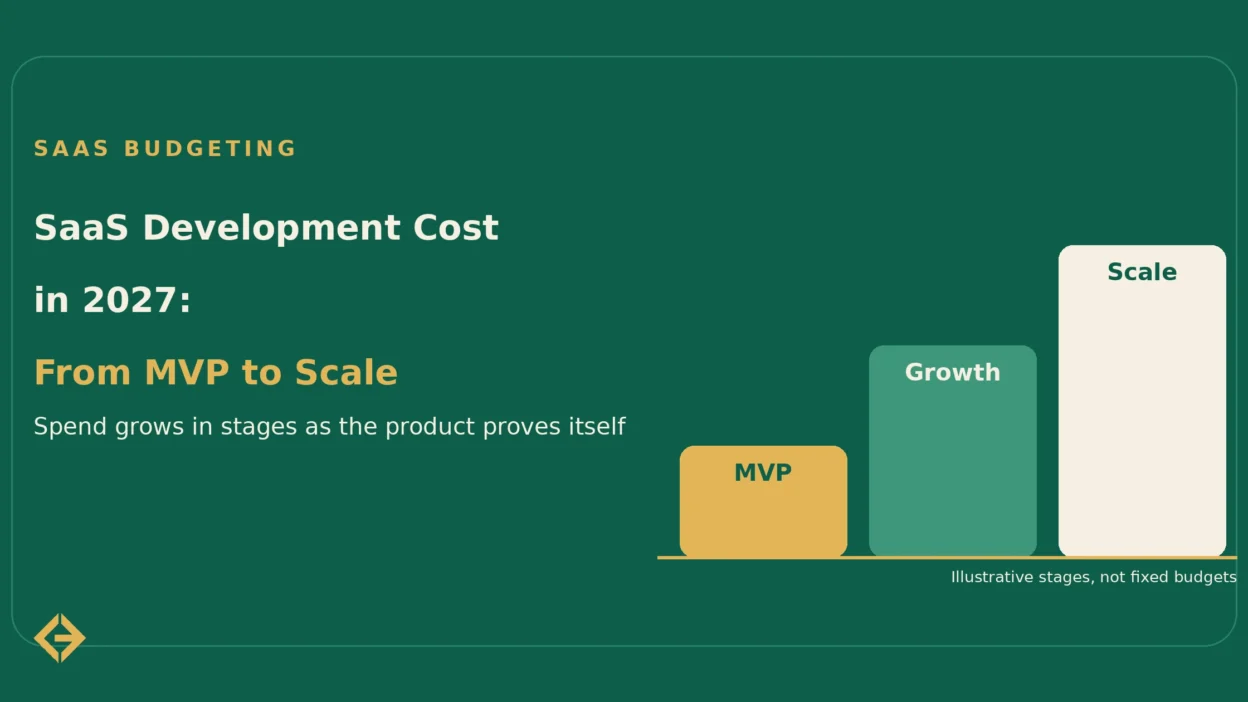

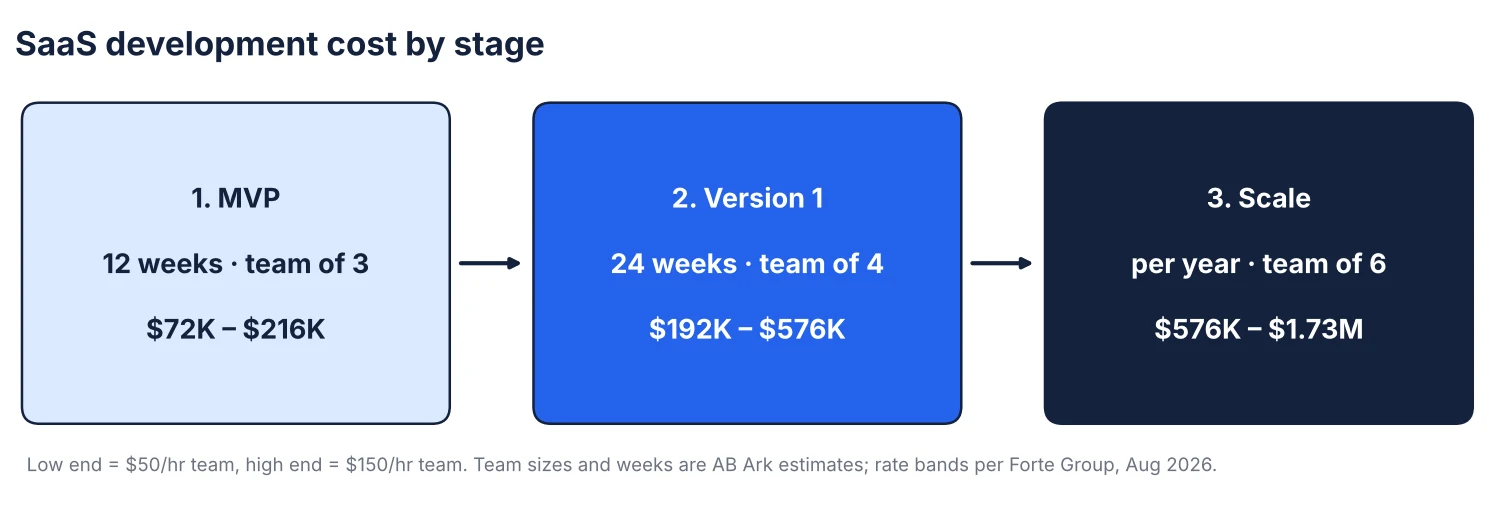
SaaS development cost depends on which stage you are paying for. In AB Ark’s cost model, a SaaS MVP costs roughly $72,000–$216,000. Growing it into a full first version over the next six months costs another $192,000–$576,000. Running a scaling product with a dedicated team costs $576,000–$1.7 million a year. The low end of each range assumes a $50/hour offshore or nearshore team, and the high end assumes a $150/hour US agency.
If you want a stage-by-stage estimate for your product, AB Ark’s SaaS development services can scope it with you. The rest of this guide shows how each number is built.
Key takeaways
- SaaS cost is a series of stages, not one project. Budget the MVP and the next six months together.
- Multi-tenancy, subscription billing, roles and security are what make SaaS cost more than a simple web app.
- Payment fees start with the first customer: Stripe’s standard US card rate is 2.9% + 30¢ per payment.
- The biggest long-term cost is the product team you keep after launch.
Talk to Our Team About Your SaaS Product →
What is SaaS and why do companies build it?
SaaS (software as a service) is software that customers use over the internet on a subscription, instead of buying it once and installing it. The provider runs the product on its own servers, updates it for every customer at the same time and charges a monthly or yearly fee. Project management tools, accounting software and online learning platforms are common examples.
Companies build SaaS products for three main reasons. Subscriptions create recurring revenue. One codebase serves many customers, so each new customer costs little to add. And updates reach everyone at once, so the product can start small and grow from customer feedback. Customers like SaaS because there is nothing to install, the upfront cost is lower and they can use it from any device. The same features that make SaaS attractive are what make it cost more to build than a single-company web app, as the sections below explain.
SaaS development cost by stage
Each range uses the same formula as our other cost guides: team size × weeks × 40 hours × hourly rate.
| Stage | What gets built | Team (FTE) | Weeks | Hours | Cost at $50/hr | Cost at $150/hr |
|---|---|---|---|---|---|---|
| 1. MVP | Accounts, one core workflow, basic roles, subscription billing | 3 | 12 | 1,440 | $72,000 | $216,000 |
| 2. Version 1 (product-market fit) | Features from early customer feedback, integrations, admin tools, analytics | 4 | 24 | 3,840 | $192,000 | $576,000 |
| 3. Scale (per year) | Performance, security reviews, enterprise features, new modules | 6 | 48 | 11,520 | $576,000 | $1,728,000 |
How these ranges were built
Team sizes and timelines are AB Ark editorial estimates for a typical B2B SaaS product. They are not an industry benchmark. Stage 3 is an annual cost because a scaling SaaS product needs a permanent team, not a one-time project.
The two hourly rates reflect published market bands. A review of Chicago software firms found that local US engineering teams generally charge $100–200 per hour, and nearshore or offshore delivery roughly $50–150 per hour (Forte Group, August 2026). We used $50 and $150 as the low and high scenarios.
The Stage 1 figures match the SaaS row in our MVP development cost guide, which compares SaaS with other product types.
What makes SaaS cost more than a regular web app
A SaaS product serves many paying customers from one codebase, which adds engineering work that a single-company web app does not need:
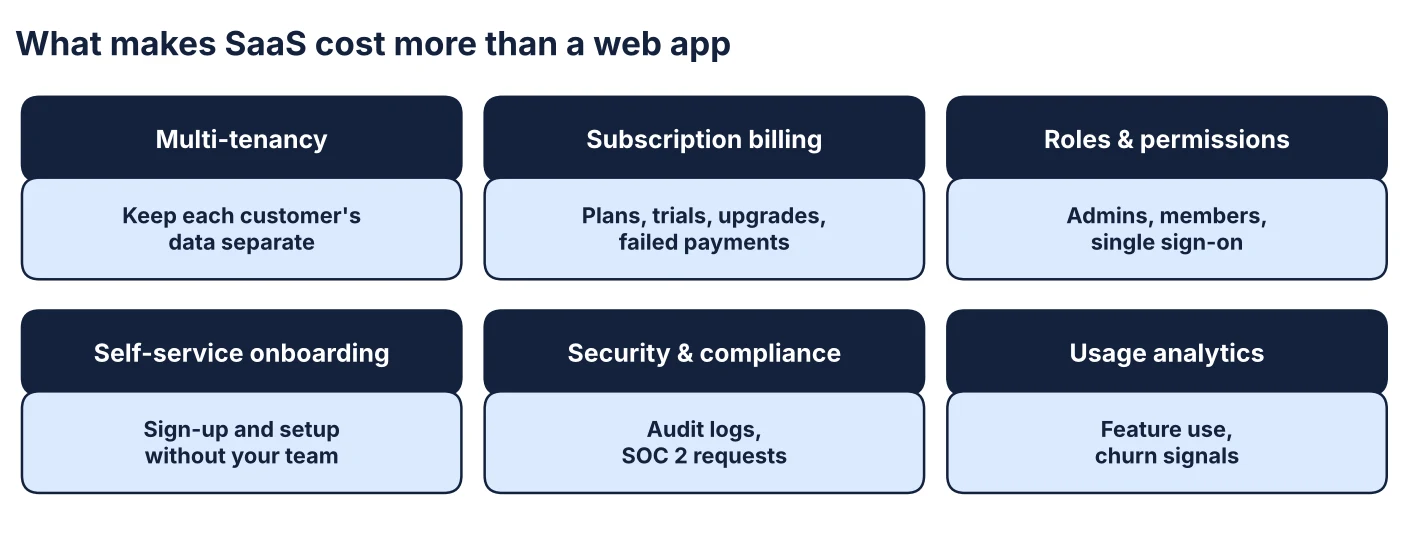
- Multi-tenancy. Each customer’s data must stay separate, and every query must respect that boundary. Getting this wrong is a data breach, so it needs careful design and testing.
- Subscription billing. Plans, trials, upgrades, downgrades, failed payments, invoices and tax all need handling, usually through a billing provider plus custom logic.
- Roles and permissions. Customers expect admins, members and read-only users, and larger customers expect single sign-on.
- Self-service onboarding. Sign-up, setup and in-app guidance have to work without your team stepping in.
- Security and compliance. B2B buyers often ask for security questionnaires, audit logs and certifications such as SOC 2 before they sign.
- Usage analytics. You need to know which customers use which features to price, sell and reduce churn.
The MVP can keep each of these simple. Version 1 and the scale stage are where most of this work lands, which is why those stages cost more than the MVP.
SaaS running costs after launch
Beyond the team, a live SaaS product has costs that grow with customers and revenue.
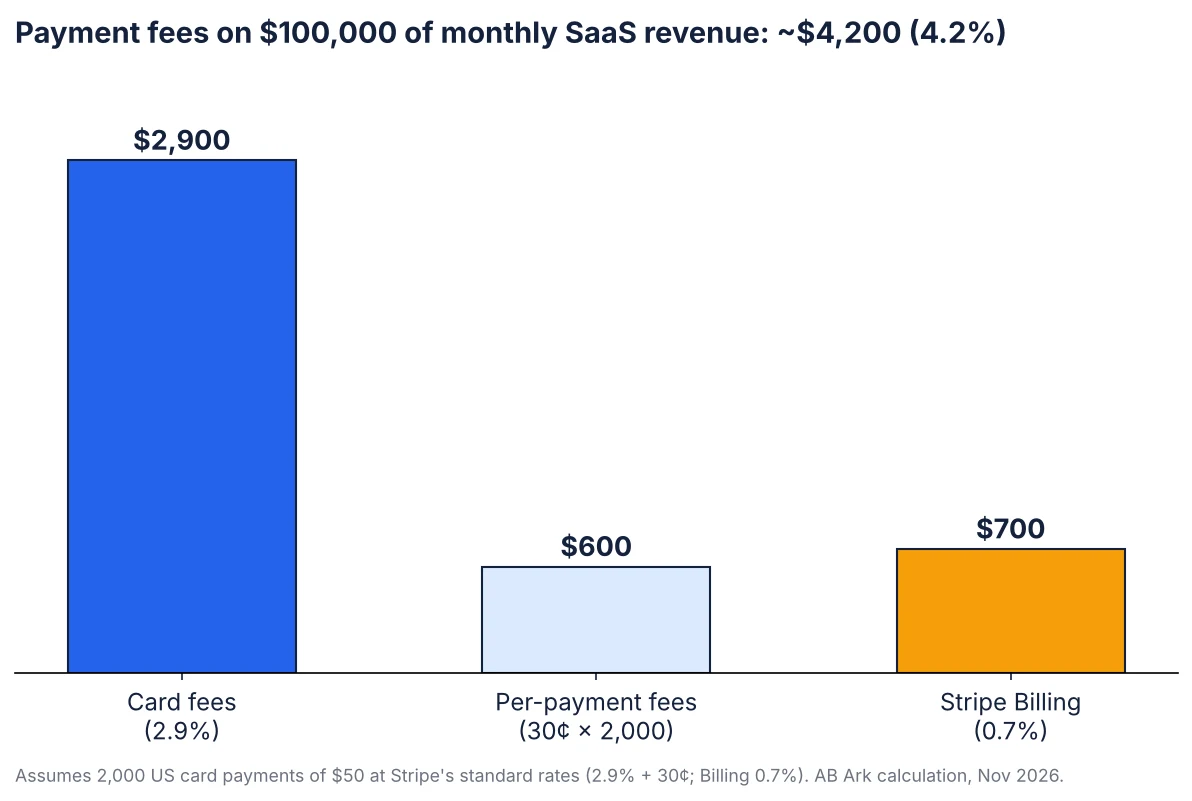
Payment processing. Stripe’s standard US rate is 2.9% + 30¢ per successful domestic card payment, and its Billing product for subscriptions adds 0.7% of billing volume on the pay-as-you-go plan. On $100,000 a month of subscription revenue paid in $50 charges, that is about $3,500 in card fees plus $700 in Billing fees, roughly 4.2% of revenue. This is an AB Ark calculation from Stripe’s published rates; other providers price differently.
Cloud hosting. Servers, databases, storage, backups and bandwidth. Costs start low for an MVP and rise with usage and data volume.
Third-party services. Email delivery, error monitoring, logging, analytics, customer support tools and, for AI features, model usage fees. For AI-specific running costs, see our AI agent development cost guide.
Compliance. Security audits and certifications such as SOC 2, and HIPAA compliance if your product handles protected health information, have their own recurring costs once enterprise or healthcare customers require them.
Ask any development partner to list these costs alongside the build estimate, so your pricing covers them.
How to control SaaS development cost
- Charge from the MVP. Build billing into the first version, even with one plan. Paying customers give you the clearest signal of what to build next.
- Use a billing provider instead of custom billing. Stripe, Paddle and similar services handle subscriptions, invoices and failed payments, so your team builds only the logic specific to your product.
- Design multi-tenancy once. Choose the data isolation model before the build starts. Changing it later means touching nearly every part of the code.
- Delay enterprise features until a customer asks. Single sign-on, audit logs and custom contracts can wait until a paying enterprise prospect needs them.
- Keep a small permanent team. A steady team of three to six that knows the codebase is usually cheaper over a year than repeatedly hiring for one-off projects.
Case study: replacing five tools with one SaaS platform
AB Ark’s SaaS e-Learning case study shows the kind of product many SaaS founders build. An education company was paying for five separate tools to host videos, take payments, send emails, grade quizzes and issue certificates.
AB Ark built one learning management platform where teachers upload videos and quizzes in three clicks, payments unlock lessons automatically and certificates are issued when a student finishes. The client was able to cancel its separate software subscriptions and automate quiz grading and student emails.
The cost lesson: payments, content and progress tracking were built as one system, so there was no ongoing cost of keeping five tools in sync.
Get a Custom Quote for Your SaaS Product →
Frequently asked questions
How much does it cost to build a SaaS MVP?
A simple SaaS MVP takes about 4 to 6 weeks, and a complex one with many modules takes about 8 to 10 weeks. A 4-week MVP, which founders often need for a fundraising round, works when the scope is limited to one core workflow. For budgeting, AB Ark’s cost model uses a team of about three for a full MVP with accounts, one core workflow, basic roles and subscription billing, which is roughly $72,000 at $50 per hour and $216,000 at $150 per hour. A narrower scope or a single user type can bring it lower.
Is it cheaper to build SaaS with no-code tools?
No-code tools can cut the cost of a first version sharply, and they work well for validating demand. The trade-off comes later: multi-tenancy, complex permissions, performance and integrations can hit platform limits, and moving off a no-code platform usually means rebuilding. Use no-code to test the idea, and custom code once customers are paying.
How much should I budget for SaaS maintenance each year?
Once a SaaS product has paying customers, plan for a permanent team rather than a maintenance percentage. Even a small team of two or three covers bug fixes, security updates, dependency upgrades and small improvements. Add hosting and third-party services on top.
Should I hire in-house or outsource SaaS development?
Outsourcing suits the MVP and early versions, when speed matters and the product is still changing. Many SaaS companies bring core engineering in-house once the product and revenue are stable. A dedicated outsourced team sits between the two, giving you a stable team without full-time hiring.
Budgeting SaaS from MVP to scale
SaaS development cost is a sequence: an MVP, a first full version shaped by paying customers, and an ongoing team once the product scales. Budget the MVP and the following six months together, build billing and multi-tenancy right from the start, and plan running costs such as payment fees and hosting into your pricing.
AB Ark’s SaaS development team can estimate each stage for your product, and you can also hire dedicated SaaS developers for an ongoing team.
Schedule a Free Consultation Call →

Head Of Product