
AI agent development cost has three parts: the build, the running cost, and maintenance. Using AB Ark’s cost model, building a knowledge-base assistant costs roughly $24,000–$72,000, and a multi-step agent with five or more tool integrations costs $72,000–$216,000. Running costs depend mostly on the AI model you choose. In our worked example, 10,000 support conversations a month cost about $36 in model fees on a small model and $720 on a mid-tier model.
If you want a fixed estimate for your own use case, AB Ark’s AI agent development services can scope the build, model choice and running costs together. The rest of this guide shows how each number is calculated.
Key takeaways
- Build cost is set by the number of tools and systems the agent connects to, not by the AI model.
- Model choice can change running costs by about 20 times for the same workload, so test whether a smaller model is good enough.
- Budget for maintenance from day one: AI providers retire model versions, and every retirement means retesting.
- Human review steps add build cost but reduce the cost of agent mistakes.
Talk to Our Team About Your AI Agent →
AI agent build cost by agent type
An AI agent is software that uses a language model to decide what to do next and then acts through tools, such as searching documents, updating a CRM or booking an appointment. The more tools and decisions involved, the more engineering and testing the build needs.
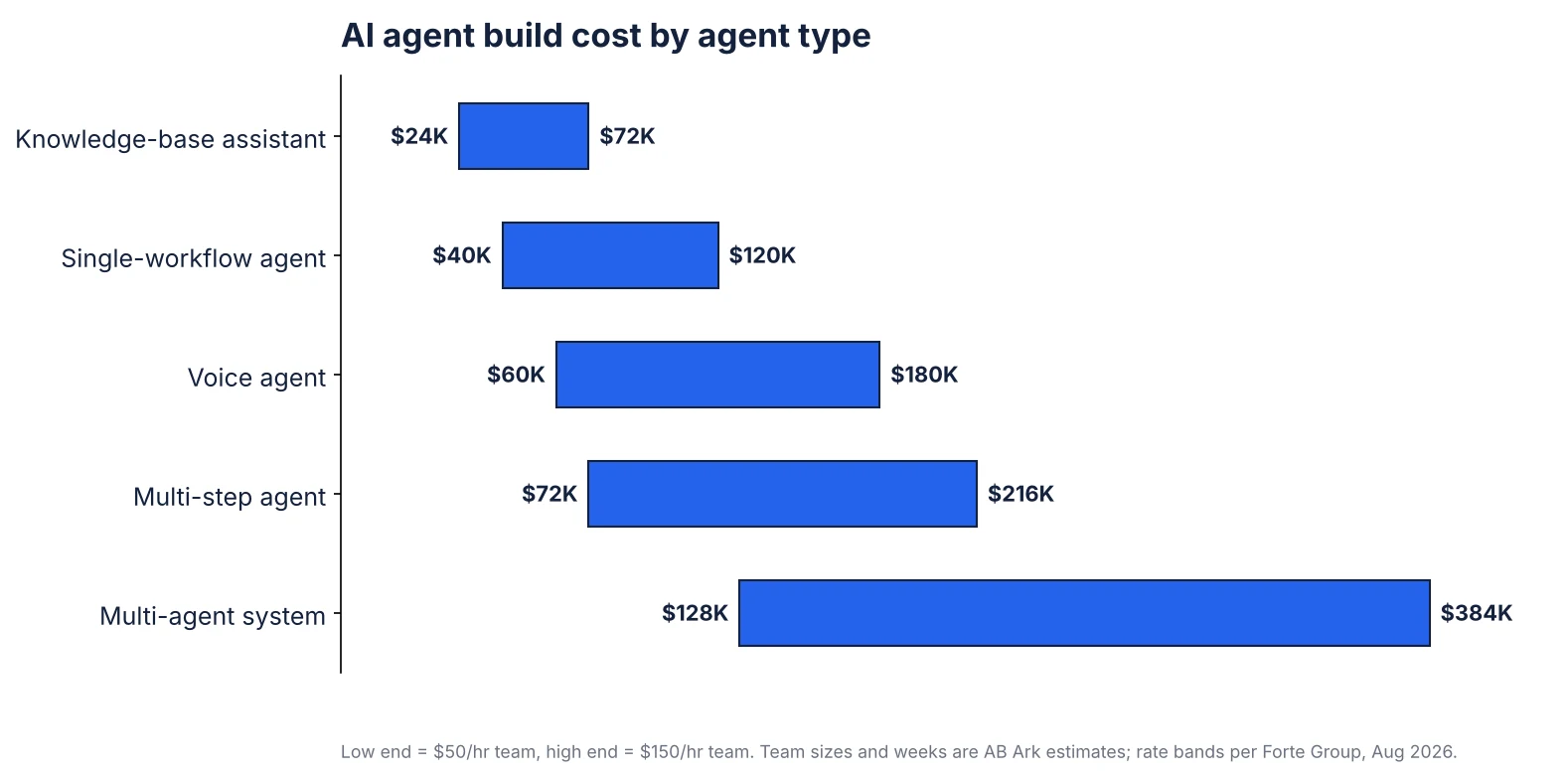
Each range below uses the same formula: team size × weeks × 40 hours × hourly rate.
| Agent type | Example | Team (FTE) | Weeks | Hours | Cost at $50/hr | Cost at $150/hr |
|---|---|---|---|---|---|---|
| Knowledge-base assistant | Answers questions from your documents (RAG) | 2 | 6 | 480 | $24,000 | $72,000 |
| Single-workflow agent | Qualifies leads and writes them to a CRM, 2–3 tools | 2.5 | 8 | 800 | $40,000 | $120,000 |
| Voice agent | Answers phone calls and books appointments | 3 | 10 | 1,200 | $60,000 | $180,000 |
| Multi-step agent | Handles support cases across 5+ systems, with human approval steps | 3 | 12 | 1,440 | $72,000 | $216,000 |
| Multi-agent system | Several specialized agents coordinating on one process | 4 | 16 | 2,560 | $128,000 | $384,000 |
How these ranges were built
Team sizes and timelines are AB Ark editorial estimates for a production-ready first version with a clear scope, including testing and guardrails. They are not an industry benchmark.
The hourly rates reflect published market bands: a review of Chicago software firms found that local US engineering teams generally charge $100–200 per hour, and nearshore or offshore delivery roughly $50–150 per hour (Forte Group, August 2026). We used $50 and $150 as the low and high scenarios.
The build covers design of the agent’s decision flow, tool integrations, prompt and evaluation work, guardrails, a user interface where needed, and deployment. For phone-based agents specifically, see our breakdown of AI voice agent cost.
How much does it cost to run an AI agent?
The running cost of an AI agent is mostly model usage: the AI provider charges per token (roughly per word fragment) the agent reads and writes. Hosting, a vector database for document search, logging and monitoring add a smaller monthly amount that depends on your infrastructure.
Current model prices
As of November 2026, Anthropic’s API prices per million tokens are $0.10 input and $0.50 output for Claude Haiku 5.5, and $2 input and $10 output for Claude Sonnet 5.5. Other providers price their small and mid-tier models in similar bands. Check the provider’s own pricing page before you budget, because prices change with new model releases.
Worked example: a customer support agent
Assume a support agent handles 10,000 conversations a month. Each conversation makes 6 model calls, and each call reads about 4,000 tokens (instructions, conversation history and retrieved documents) and writes about 400 tokens. That is 24,000 input and 2,400 output tokens per conversation. These usage figures are AB Ark assumptions for illustration.
| Claude Haiku 5.5 | Claude Sonnet 5.5 | |
|---|---|---|
| Input cost per conversation | $0.0024 | $0.048 |
| Output cost per conversation | $0.0012 | $0.024 |
| Model cost per conversation | $0.0036 | $0.072 |
| Monthly model cost (10,000 conversations) | ~$36 | ~$720 |
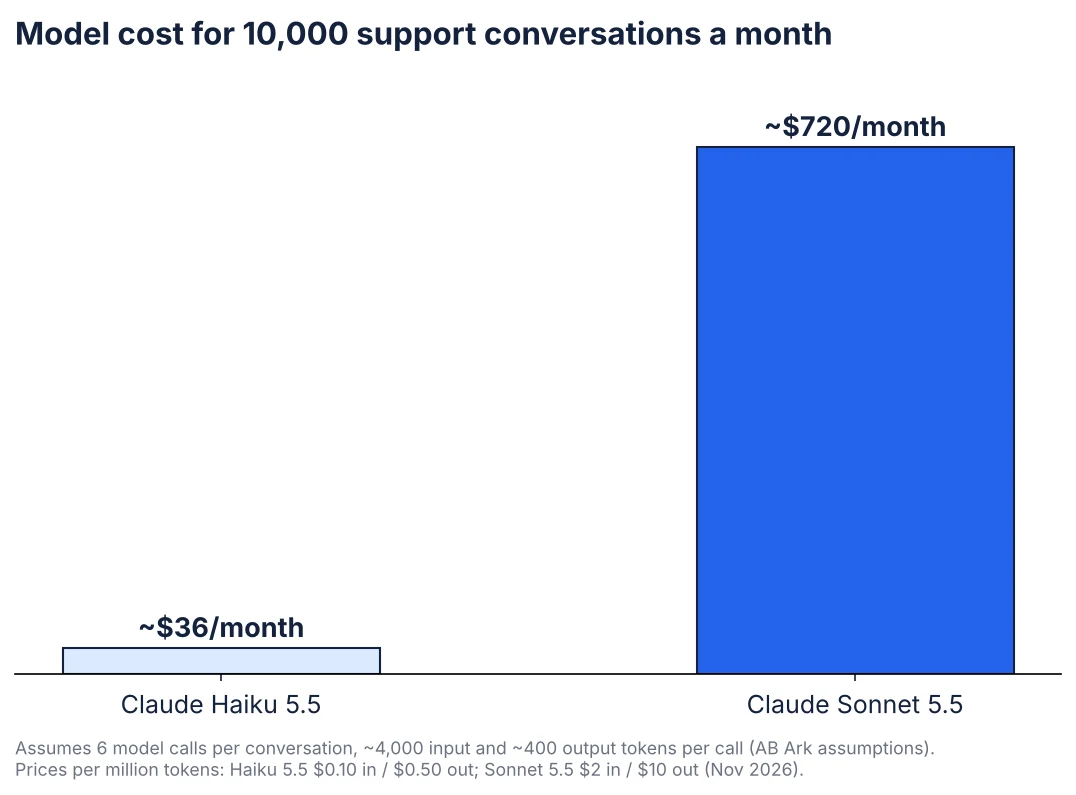
The same workload costs about 20 times more on the mid-tier model. Many teams send routine steps to a small model and only hard steps to a larger one. Prompt caching, which reuses repeated instructions at a lower rate, can cut the input cost further.
To estimate your own cost, multiply: conversations per month × model calls per conversation × tokens per call × price per token.
GPU cost for reference. The model costs above assume you call an AI provider’s API. If you self-host an open model instead, you rent GPU time. As of November 12, 2026, RunPod lists these on-demand pod rates on Secure Cloud, billed per second:
| GPU (RunPod pod) | VRAM | System RAM | vCPUs | Price per hour |
|---|---|---|---|---|
| RTX 4090 | 24 GB | 41 GB | 6 | $0.89 |
| A100 PCIe | 80 GB | 117 GB | 8 | $2.09 |
| H100 PCIe | 80 GB | 188 GB | 16 | $2.89 |
| H100 SXM | 80 GB | 125 GB | 20 | $4.39 |
Running one GPU around the clock (about 730 hours a month) costs roughly $650 for an RTX 4090, $1,526 for an A100 PCIe and $2,110 for an H100 PCIe at these rates. Community Cloud lists lower rates for some of these GPUs, such as A100 PCIe from $1.19 and H100 PCIe from $1.99 an hour. Prices change often, so check RunPod’s pricing page before you budget. GPU costs are billed separately from the build price.
AI agent maintenance cost
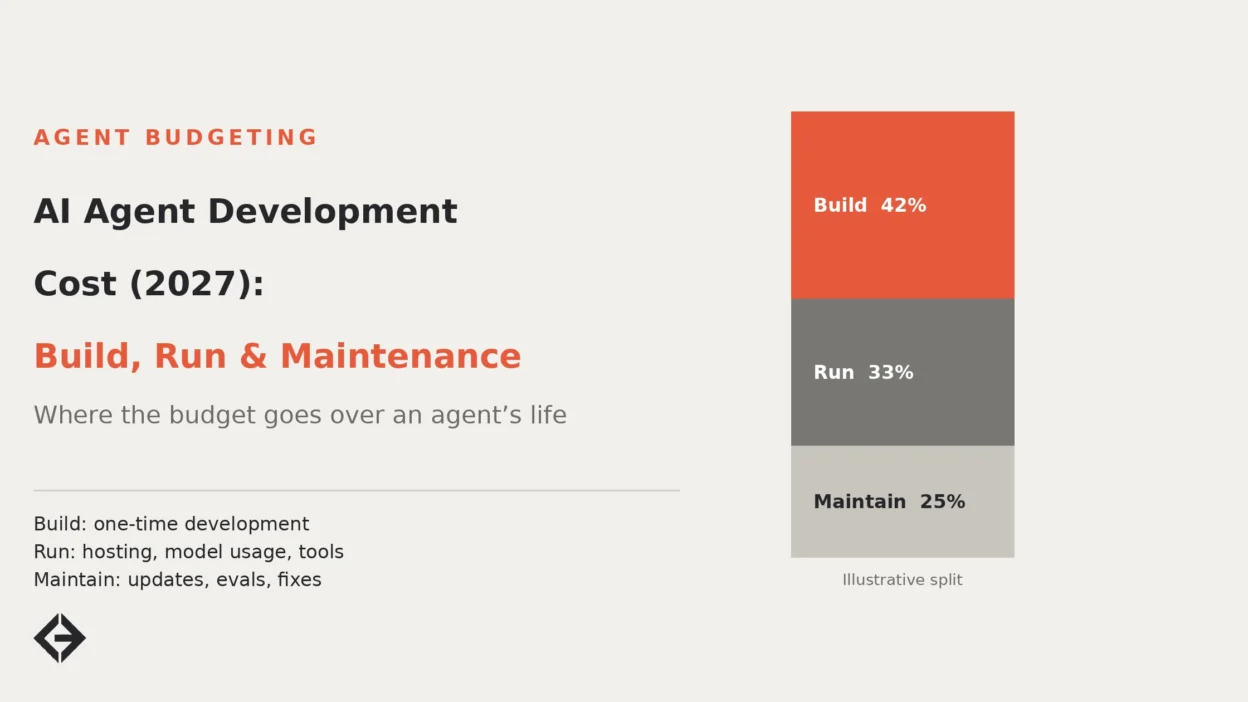
An AI agent needs ongoing engineering after launch, because the models and tools it depends on keep changing. As a planning rule of thumb, AB Ark budgets about 15–25% of the original build cost per year for maintenance. That is our estimate, not a market benchmark.
Maintenance usually covers four kinds of work:
- Model updates. AI providers retire older model versions. For example, Anthropic retired Claude Haiku 3.5 on February 19, 2026. Each switch to a newer model means retesting the agent’s answers and tool use.
- Evaluation and monitoring. Reviewing conversations, tracking wrong answers and failed tool calls, and adding new test cases as real users find edge cases.
- Integration upkeep. Fixing breakages when a CRM, calendar or internal API changes.
- Knowledge updates. Keeping the documents and data the agent searches accurate and current.
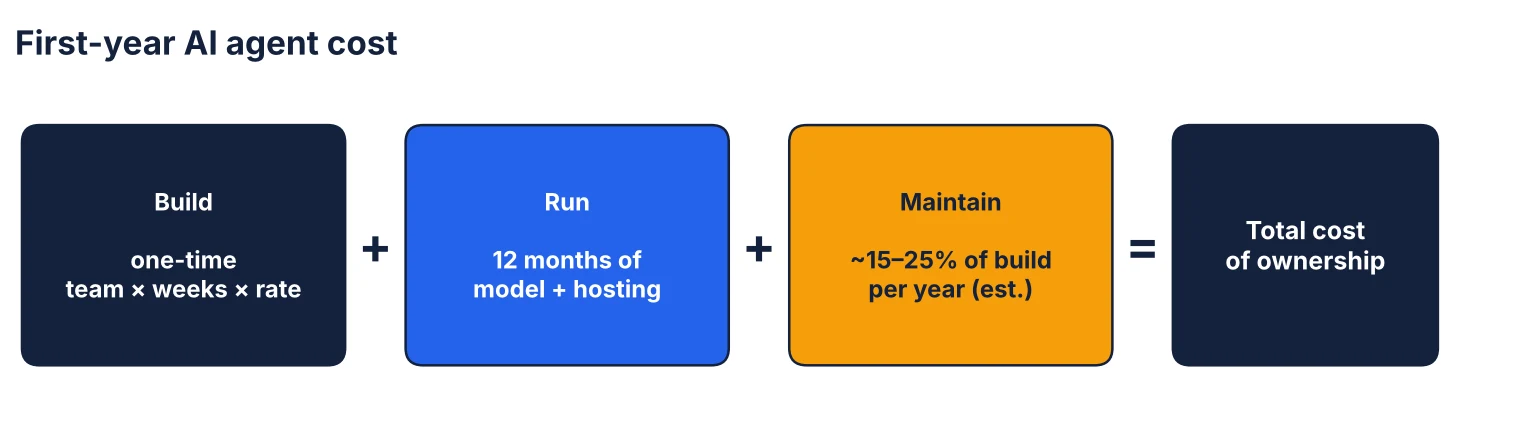
A simple way to plan the first year: total cost of ownership = build cost + 12 months of running cost + annual maintenance.
What makes AI agents cost more
Four factors push an agent’s build cost toward the top of its range:
- Number of tool integrations. Each system the agent reads from or writes to needs connection code, permissions, error handling and tests.
- Autonomy level. An agent that only drafts actions for a person to approve is cheaper to build safely than one that acts on its own, such as issuing refunds.
- Accuracy requirements. Regulated or customer-facing answers need a larger test set, more guardrails and often human review.
- Channels. Phone and voice add speech recognition, speech generation and latency work on top of the text agent.
How to reduce AI agent cost
- Start with one workflow. Automate one high-volume task fully before adding more.
- Keep a human in the loop at first. Let the agent draft actions for approval, then remove approval steps where the data shows it is reliable.
- Route by difficulty. Use a small, cheap model for routine steps and a larger model only where needed.
- Connect to existing systems instead of rebuilding them inside the agent.
- Build an evaluation set early. A few hundred real examples with correct answers make every later model switch faster and cheaper to test.
Case study: an AI support agent connected to existing systems
AB Ark’s EnzoAI case study shows an agent built on top of a business’s existing tools. An automotive business was struggling to keep up with questions about vehicle inventory, service appointments and support.
AB Ark built an AI support platform that connects to the client’s CRM, inventory database and live chat, schedules appointments and hands conversations to staff when needed. The case study reports 70% faster response times and 95% of routine customer queries automated.
The cost lesson: the agent’s value came from its tool integrations, which is also where much of the build effort sits.
Case study: VEIT, from architecture advice to full delivery
On the VEIT project, AB Ark first recommended the architecture, then provided project management, QA and full-stack developer services to deliver it. The cost lesson: settling the architecture before the build starts gives the team a clear scope, and keeping management, QA and engineering in one team keeps the whole delivery under one estimate.
Get a Custom Quote for Your AI Agent →
Frequently asked questions
Is it cheaper to use an AI agent platform than to build a custom agent?
A no-code or low-code agent platform is usually cheaper to start with, because you pay a subscription instead of a build cost. A custom agent costs more upfront but gives you full control over integrations, data handling and model choice. If your workflow fits a platform’s built-in connectors, start there. If it needs custom systems or strict data rules, build.
How long does it take to build an AI agent?
In AB Ark’s cost model, a production-ready first version takes about 6 weeks for a knowledge-base assistant and up to about 16 weeks for a multi-agent system. Integrations with older internal systems and accuracy testing are the parts that most often extend the timeline.
Do AI agents get cheaper to run over time?
AI model prices per token have tended to fall as providers release new models, and caching and routing can cut usage further. But usage usually grows as more people use the agent, so total monthly spend can still rise. Track cost per conversation, not only the monthly bill.
What is the difference between a chatbot and an AI agent in cost?
A chatbot answers questions, so its cost is mostly the conversation design and the knowledge base. An AI agent also takes actions in other systems, so it needs tool integrations, permissions and safeguards. That is why the single-workflow agent in our table costs more than the knowledge-base assistant.
Planning your AI agent budget
AI agent development cost is the build, plus the running cost, plus maintenance. The build is set by the number of tools and the level of autonomy. The running cost is set by conversation volume and model choice. Maintenance runs every year the agent is live. Start with one workflow, test whether a smaller model is good enough, and budget the first year in full before you commit.
AB Ark’s AI agent development team can estimate all three for your use case before you build.
Schedule a Free Consultation Call →
CTO & Co-founder At AB Ark Solutions