
A vibe coding audit is a structured review of an application built mostly with AI coding tools such as Cursor, Lovable, Bolt, Replit, v0 or Claude Code, checking whether the code is secure, maintainable, and ready for real users. It goes beyond a normal code review because AI-built apps fail in specific ways: invented packages, open database tables, hollow tests, and inconsistent architecture. The audit ends with a severity-rated list of problems, a fix-or-rebuild recommendation, and a remediation plan.
Key Takeaways
- A working prototype can still hide serious defects, because most AI-introduced problems do not stop the app from running.
- Veracode found AI-generated code introduced security flaws in 45% of its test cases across more than 100 models, and security performance did not improve as models got better at writing code.
- A USENIX Security 2025 study found that 19.7% of packages suggested by code-generating models did not exist, which attackers can exploit by publishing malicious packages under those names.
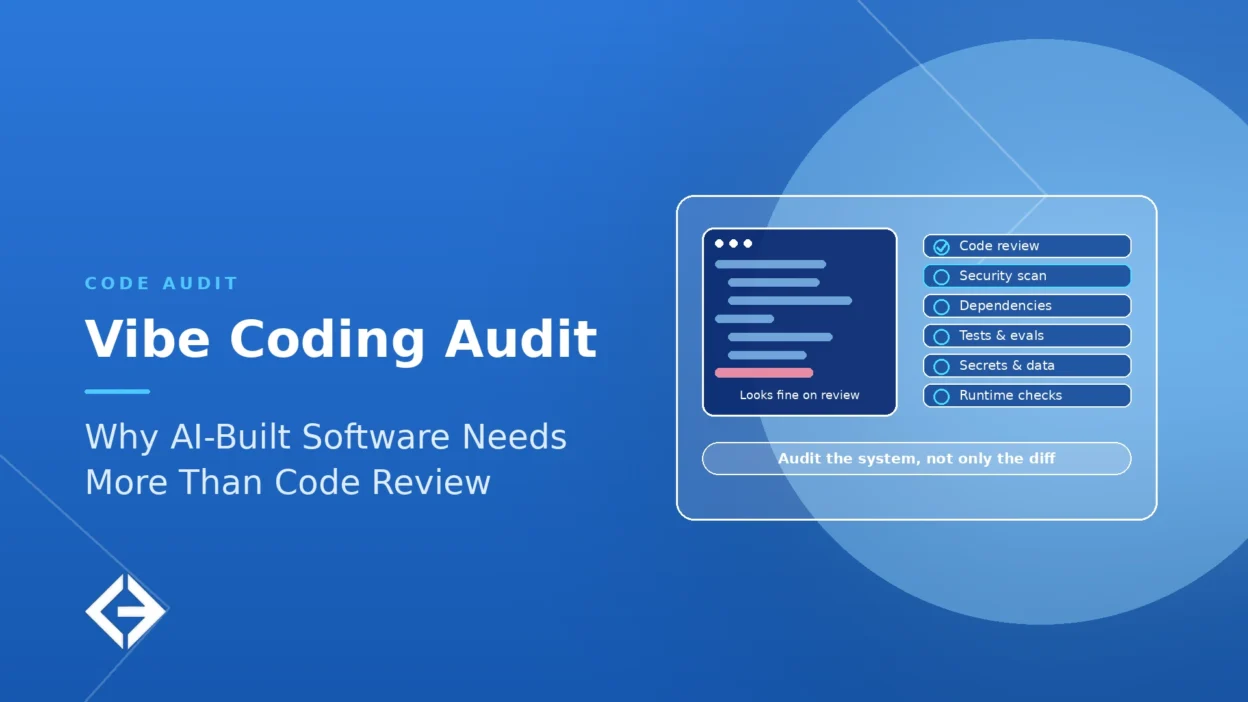
- A vibe coding audit checks the whole system, including dependencies, database access rules, test quality, and architecture, not just individual changes.
- Most AI-built apps do not need rebuilding from scratch; the audit decides what to fix, what to rebuild and in what order.
Talk to Our Team About Your Project →
What Is a Vibe Coding Audit?
A vibe coding audit is an assessment of a codebase written largely by AI tools, designed to answer one question: can this software be trusted in production? It examines security, dependencies, data access, business logic, architecture, test quality, performance, and operations, with extra checks for problems that AI tools typically introduce.
“Vibe coding,” a term coined by Andrej Karpathy in February 2025, means building software by telling an AI model what you want and accepting much of what it writes. It is fast, and it can turn an idea into a working app in days. The audit exists because “working” and “safe to ship” are different standards.
Why Do AI-Built Apps Need an Audit?
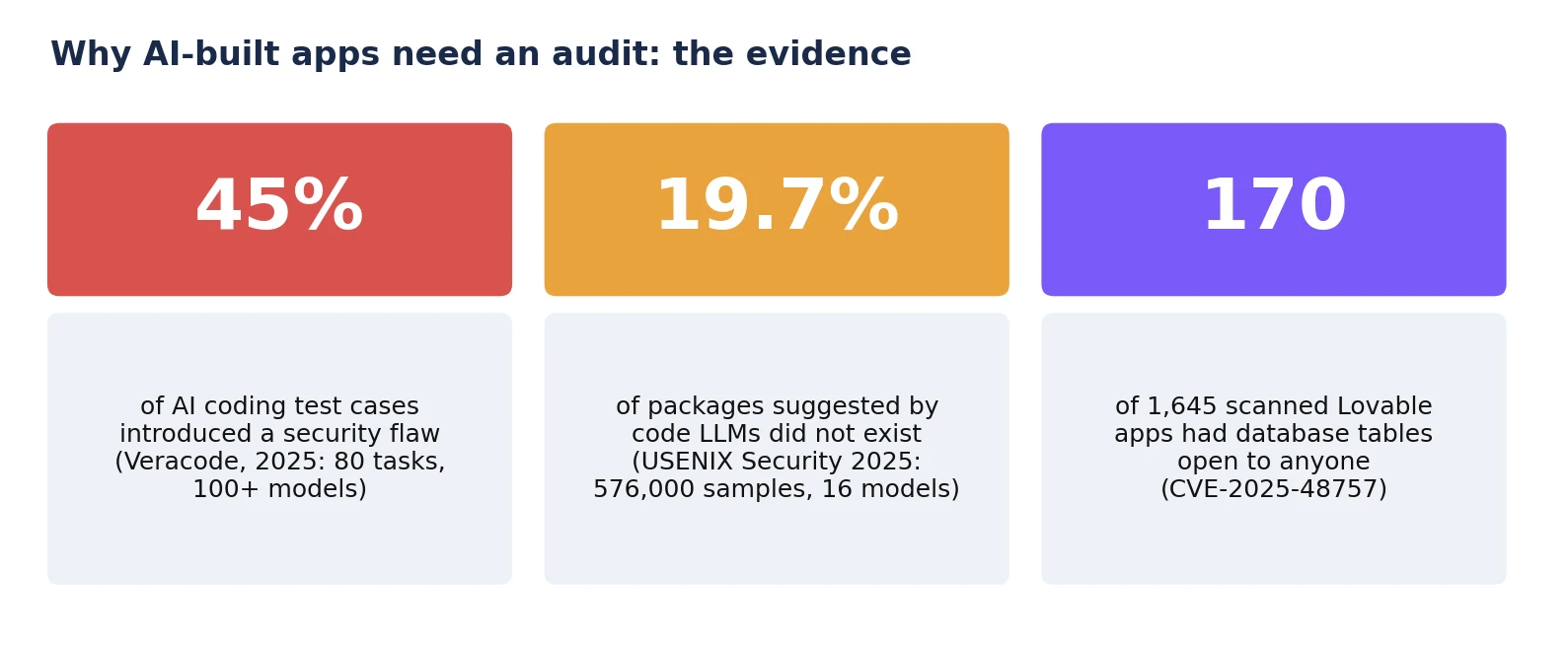
AI-built apps need an audit because the most common AI coding defects are invisible in a demo. Three pieces of evidence show the scale.
AI-generated code often chooses the insecure option
Veracode’s 2025 GenAI Code Security Report tested more than 100 large language models on 80 coding tasks and found that the generated code introduced security vulnerabilities in 45% of cases. Java failed in 72% of cases, and Python, C#, and JavaScript failed in 38% to 45% of cases. The report also found that models failed to defend against cross-site scripting and log injection in 86% and 88% of relevant cases. Veracode noted that models are getting better at writing working code but are not improving at security.
AI models invent packages that attackers can register
A study presented at USENIX Security 2025 analyzed 576,000 code samples from 16 code-generating models and found that 19.7% of suggested packages did not exist, including 205,474 unique invented package names. The researchers found that when a prompt that produced an invented package was repeated ten times, 43% of those invented names reappeared every time. That predictability enables “slopsquatting”: an attacker publishes a malicious package under a name the AI is likely to suggest, and the next developer installs it.
Platform defaults can expose whole databases
CVE-2025-48757 describes how insufficient database row-level security (RLS) in apps generated by Lovable allowed unauthenticated attackers to read or write arbitrary database tables, and is rated 9.3 (Critical) on the CVSS scale. The record is marked as disputed: Lovable’s position is that each customer is responsible for protecting their own application’s data. The researcher’s follow-up scan found 303 vulnerable endpoints across 170 projects. The apps worked; their data was simply open to anyone who looked.
SENIOR AI REVIEW REQUIRED Evidence section: a senior engineer should confirm the statistics against the original Veracode report, the USENIX paper and the CVE record before publishing.
What Defects Hide Inside a Working Prototype?
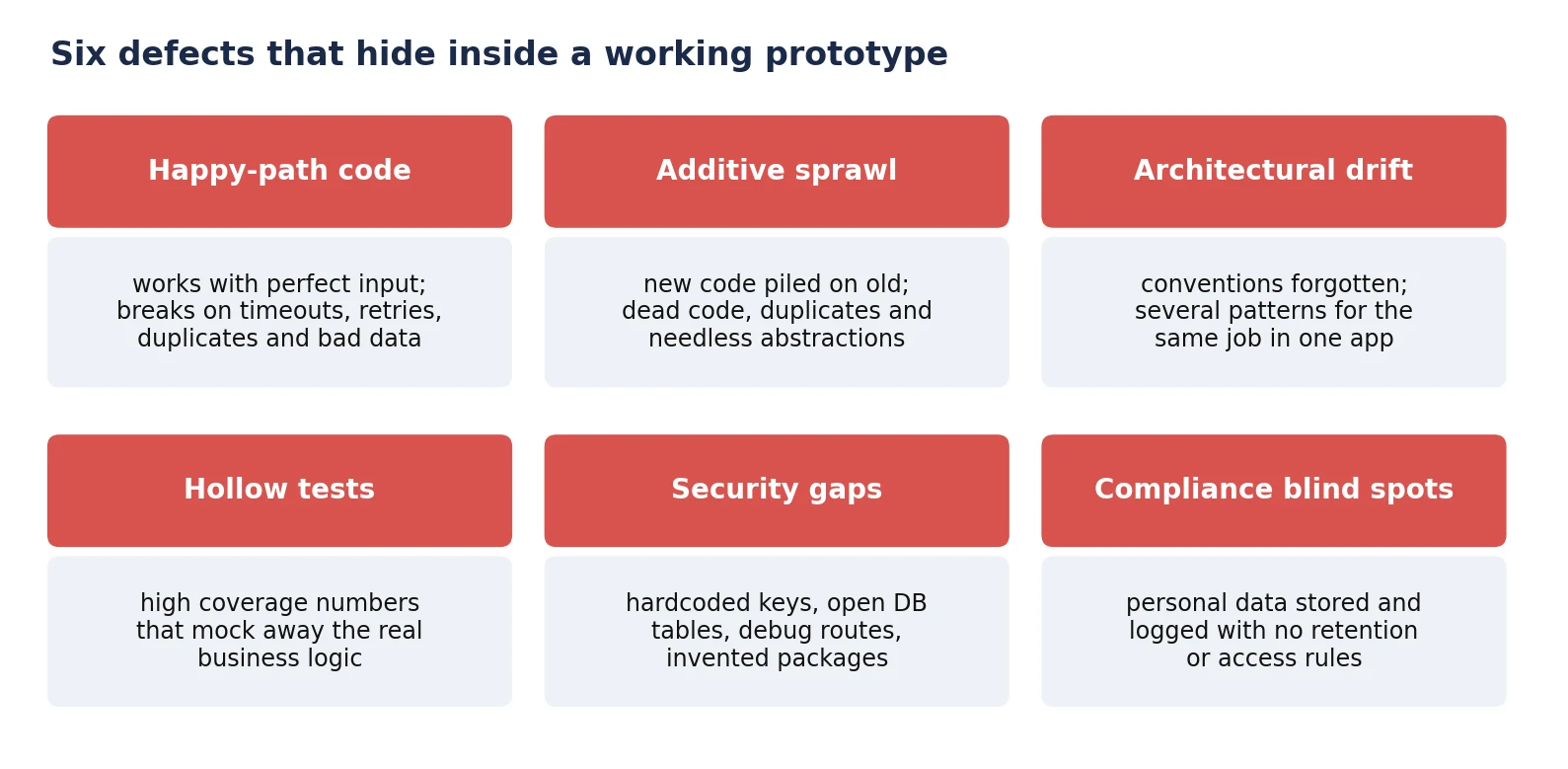
Happy-path code: logic that assumes valid input and reliable networks, and fails on timeouts, retries, duplicate records, or out-of-order events.
Additive sprawl: AI tools tend to add new code rather than refactor, leaving dead code, duplicated functions, and unnecessary layers.
Architectural drift: as a project grows past what the model keeps in context, earlier conventions are forgotten and several patterns appear for the same job.
Hollow tests: high coverage figures built from trivial assertions or heavy mocking that never exercise the real business logic.
Security gaps: hardcoded API keys, missing database access rules, debug or test routes left active, and dependencies that do not exist or are unmaintained.
Compliance blind spots: personal data collected, stored, or logged without retention rules, access controls, or consent handling.
How Is a Vibe Coding Audit Different From a Code Review?
A code review asks whether one change was implemented correctly. A vibe coding audit asks whether an entire AI-built system can be trusted.
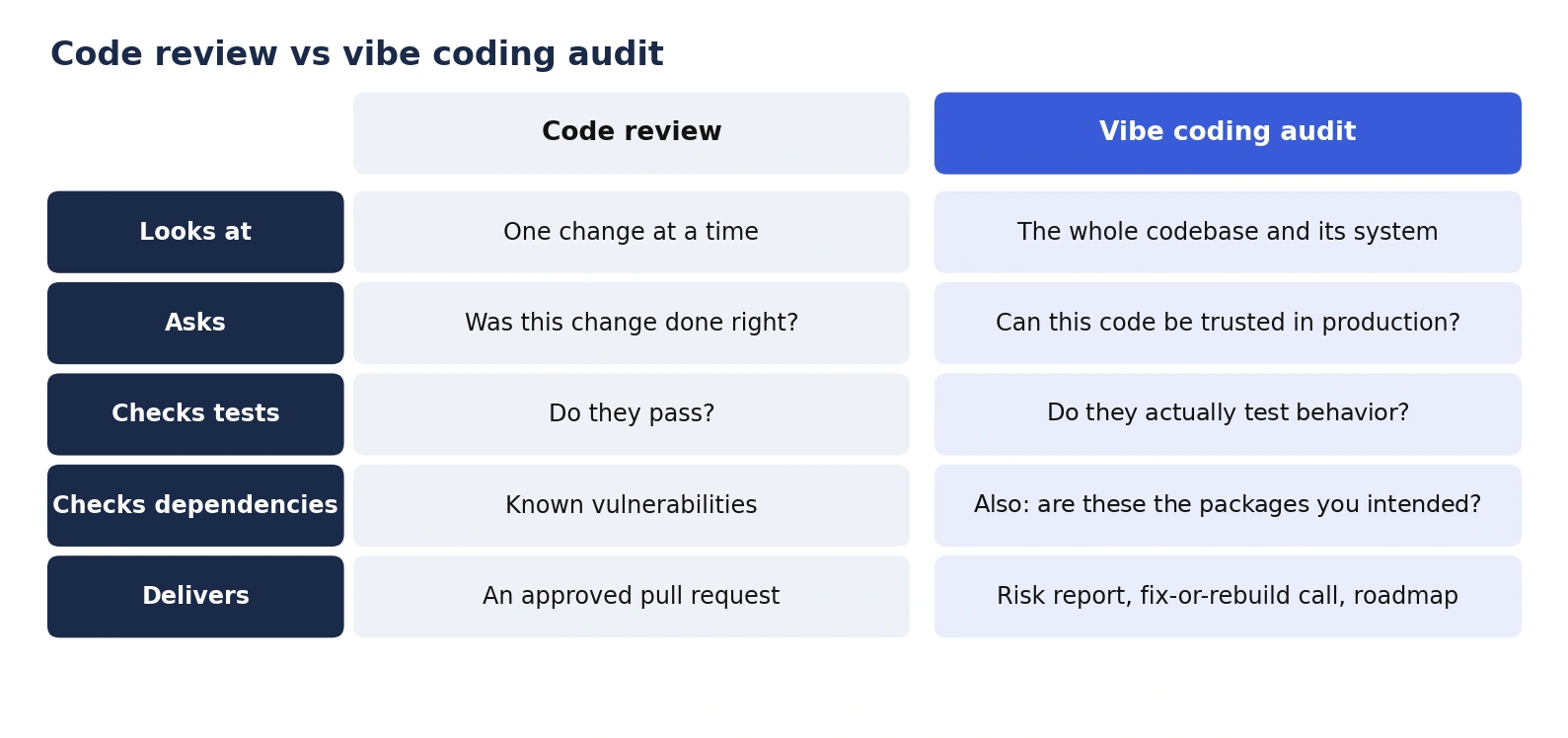
A code review remains essential for every future change. The audit is the one-time, system-wide assessment that establishes a trustworthy baseline, typically before launch, before fundraising due diligence, or before scaling to more users.
What Does a Vibe Coding Audit Check?
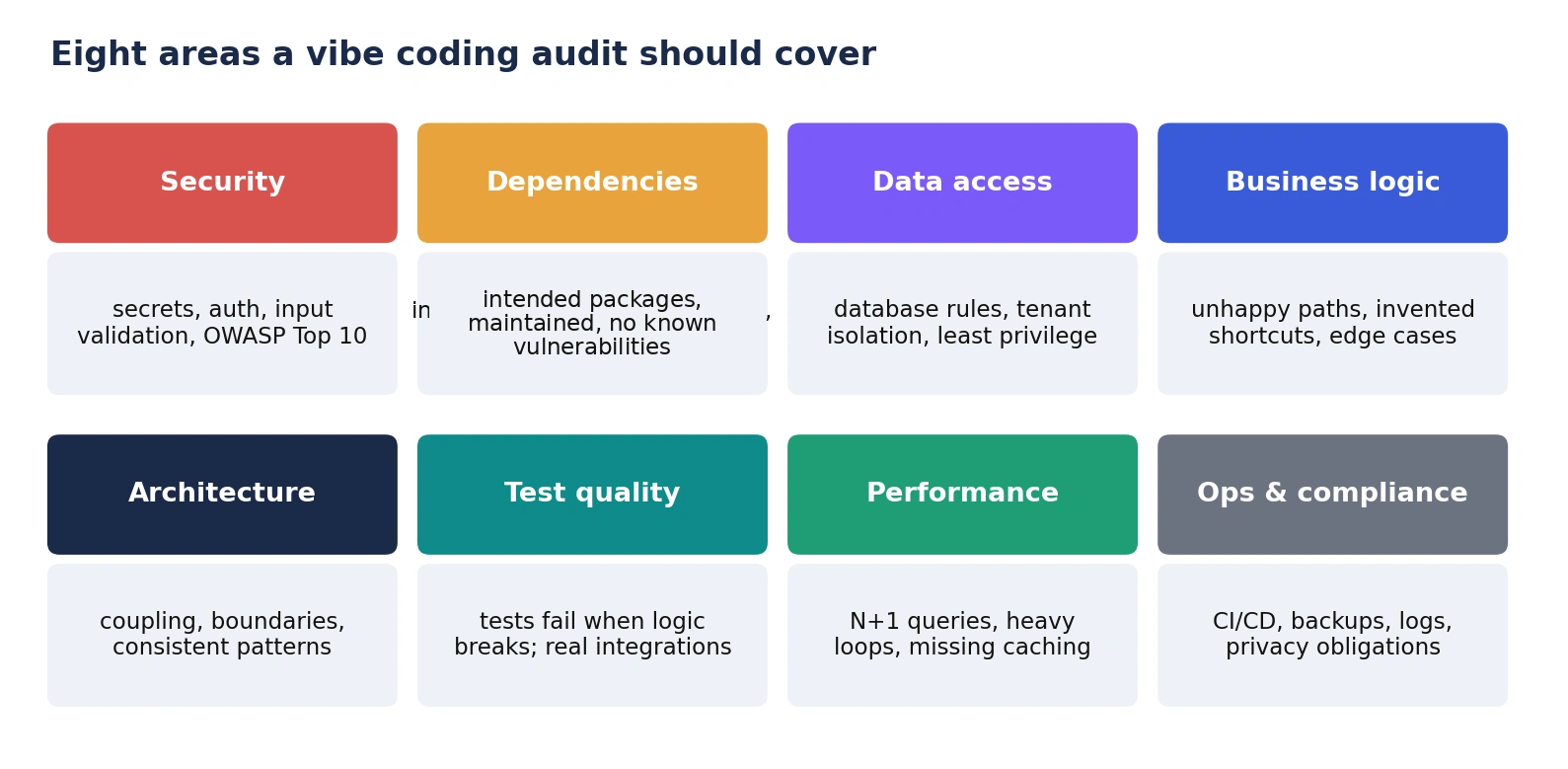
| Area | What gets checked | Typical AI-specific finding |
| Security | Secrets, authentication, authorization, input validation, OWASP Top 10 risks | API keys in client code; admin routes without checks |
| Dependencies | Every package is the intended one (publisher, age and source checked), is maintained, and has no known vulnerabilities | Invented or look-alike package names |
| Data access | Database access rules, tenant isolation, least-privilege service accounts | Tables readable with the public (anon) API key |
| Business logic | Unhappy paths, edge cases, and requirements the AI may have simplified | Validation skipped to make a feature “work” |
| Architecture | Coupling, boundaries, consistency of patterns, circular dependencies | Three ways of managing state in one app |
| Test quality | Whether tests fail when the logic is broken; integration coverage | 100% coverage that tests mocks, not behavior |
| Performance | Query patterns, loops, caching, and payload sizes under realistic load | Database queried once per list item (N+1) |
| Operations and compliance | CI/CD, backups, logging, monitoring, and privacy obligations | No backups; personal data in logs |
What Can You Check Yourself Today?
Before commissioning an audit, a founder or product owner can run a few quick checks:
Search the code for secrets: look for API keys or passwords in the repository (including its git history) and in anything shipped to the browser. Any exposed key must be rotated, not just deleted.
Check database access rules: if you use Supabase or a similar backend, confirm row-level security is enabled with a policy on every table that holds user data.
Verify your dependencies: confirm every package in your dependency file is the well-known one you intended: check the publisher, download count, age, and linked source repository.
Break something on purpose: change a key business rule and see whether any test fails. If none do, the tests are not protecting you.
Look for leftover routes: search for test, debug, or admin endpoints that should not be public.
Any finding here is a reason to stop new feature work and fix the basics first.
What Happens After the Audit?
The audit should end with a clear decision about the codebase, not just a list of problems.
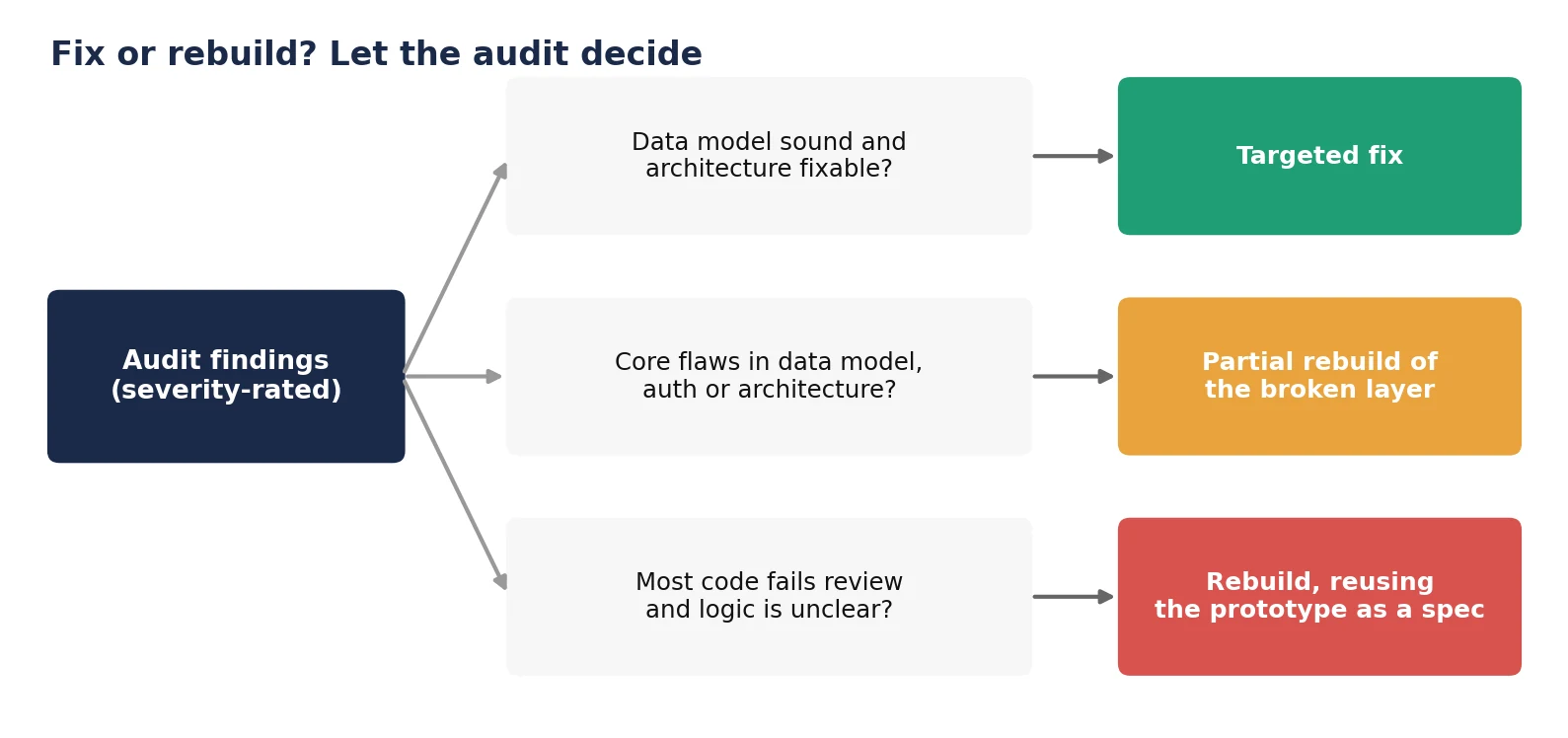
Most AI-built apps need either targeted fixes or a partial rebuild of one layer, such as the data model. Even when a rebuild is needed, the prototype remains valuable as a precise, working specification of what the product should do.
Remediation then follows a risk-first order:
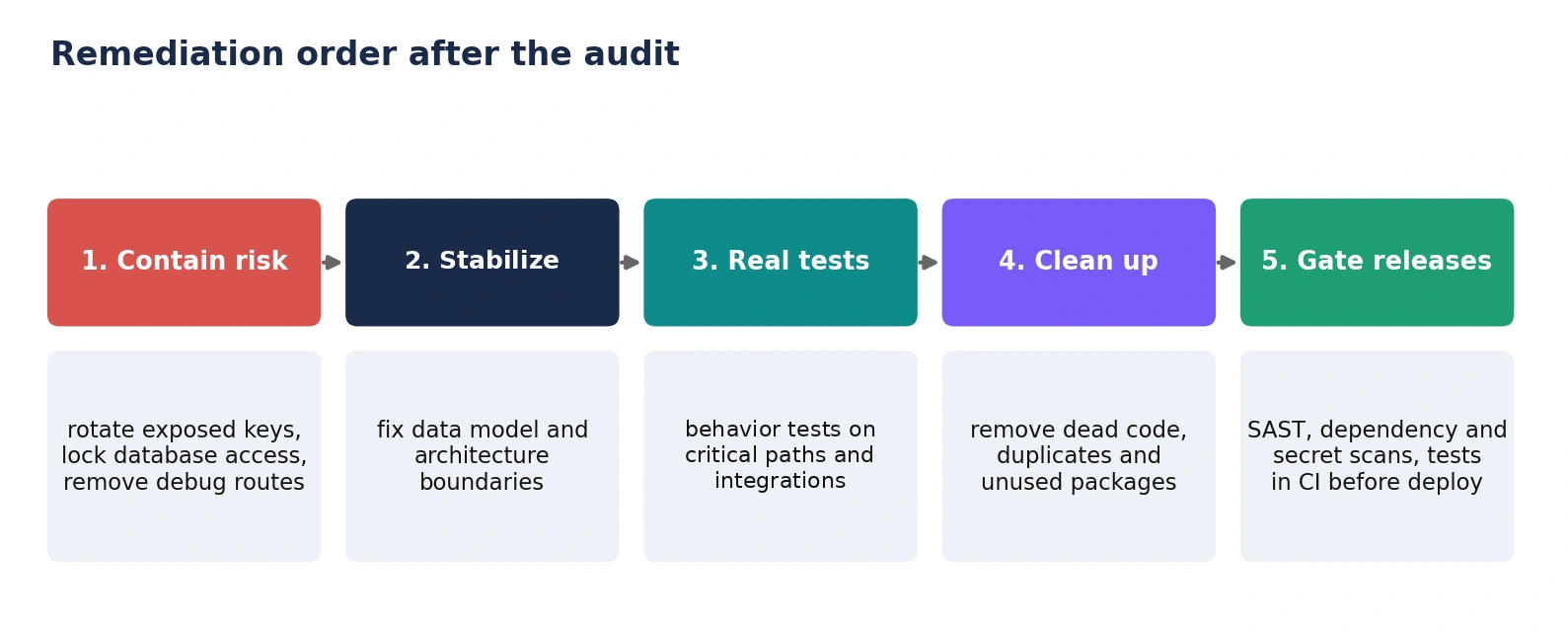
Contain risk first: rotate exposed keys, lock down database access, and remove debug routes before anything else.
Stabilize the foundation: fix the data model and architecture boundaries so later changes stop causing regressions.
Add real tests: cover critical paths and integrations with tests that fail when behavior breaks.
Clean up: remove dead code, duplicates, and unused dependencies.
Gate every release: run static analysis, dependency and secret scanning, and the test suite automatically before each deployment.
Get a Custom Project Cost & Timeline Estimate →
How Do You Keep Vibe Coding Safe After the Audit?
AI coding speed is worth keeping. These practices preserve it while preventing the same problems from returning:
Give the AI fixed project rules: maintain a shared file of architecture conventions, approved libraries, and coding patterns that every AI session must follow.
Treat AI output as untrusted: every change should pass automated security, dependency, and secret checks before a human reviews it.
Pin and verify dependencies: install only verified, well-established packages from official registries and lock their versions with a lockfile.
Require human review on critical paths: authentication, payments, data access, and anything touching personal data.
Specify security in the prompt: Veracode noted that developers often do not state security constraints, leaving those decisions to the model.
For products that include AI features themselves, the same discipline extends to agent design, an area AB Ark covers through its AI agent development work.
FAQs
What is a vibe coding audit?
A system-wide review of software built mainly with AI coding tools, checking security, dependencies, data access, business logic, architecture, tests, performance, and operations, and ending with a fix-or-rebuild recommendation and remediation plan.
Is AI-generated code secure?
Not by default. Veracode found security flaws in 45% of AI coding test cases. AI-generated code can be made secure with automated security checks, verified dependencies, and human review of critical paths.
Is a vibe coding audit the same as a code review?
No. A code review checks individual changes. A vibe coding audit assesses the whole system for AI-specific risks such as invented packages, open database access, hollow tests, and architectural drift.
Do I need to rebuild my vibe-coded app?
Usually not. An audit identifies whether targeted fixes are enough, whether one layer such as the data model needs rebuilding, or, less often, whether a rebuild is the faster path.
What is slopsquatting?
An attack in which criminals publish malicious packages under names that AI models tend to invent, so developers who trust AI suggestions install them. Verifying every dependency before installing it greatly reduces the risk.
Vibe coding gets you to a working product fast. An audit tells you whether that product is safe to put in front of real users, and what to fix first.
Schedule a Free Consultation Call →
CTO & Co-founder At AB Ark Solutions