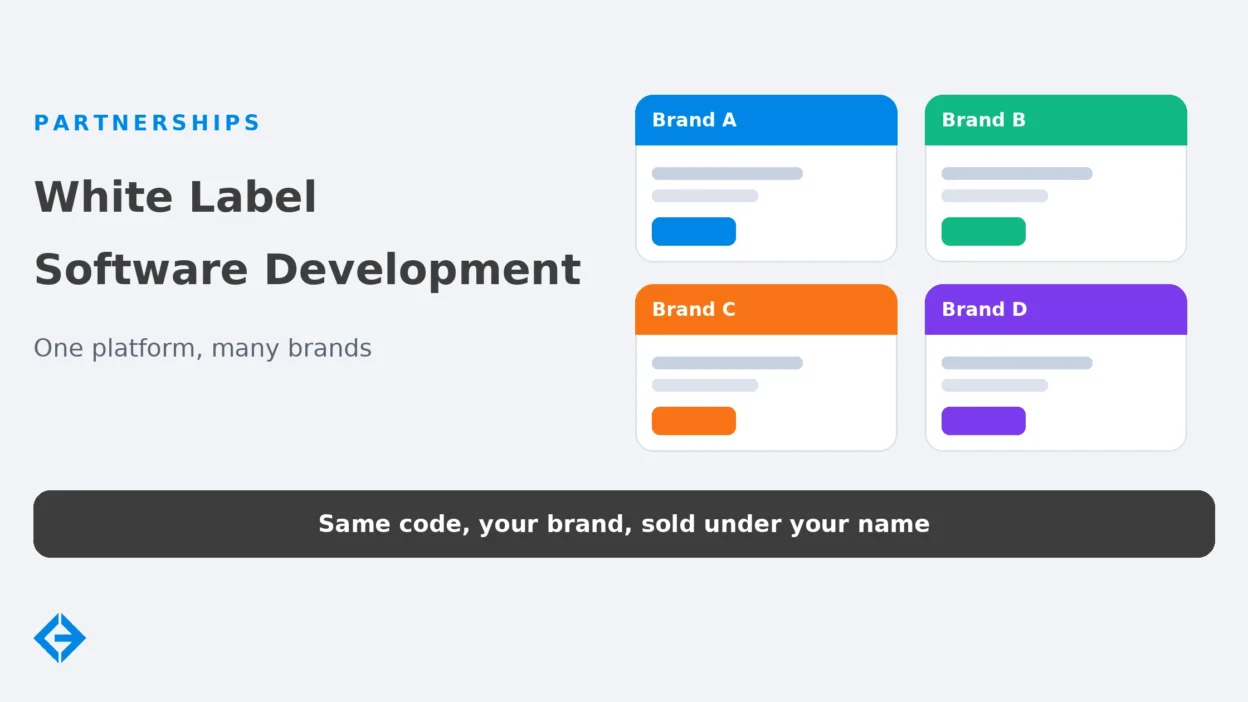

 White label software development is an arrangement where a development partner builds software that an agency or consultancy delivers to its own clients under the agency’s brand. The agency owns the client relationship, pricing and account management; the partner supplies engineering, works unbranded and assigns the intellectual property. It lets agencies sell software without hiring a full engineering team, provided that contracts, quality control, and IP transfer are set up correctly.
This guide is for digital agencies, marketing firms, IT consultancies, and product studios that want to add or scale software services through a partner. It explains how the model works, the engagement and pricing models, the contract terms that matter most (especially IP), how to protect quality and the client relationship, and how to choose a white label partner. It is not legal advice.
Key Takeaways
- White label development means a partner builds software that you deliver under your brand; it is different from reselling a white label SaaS product.
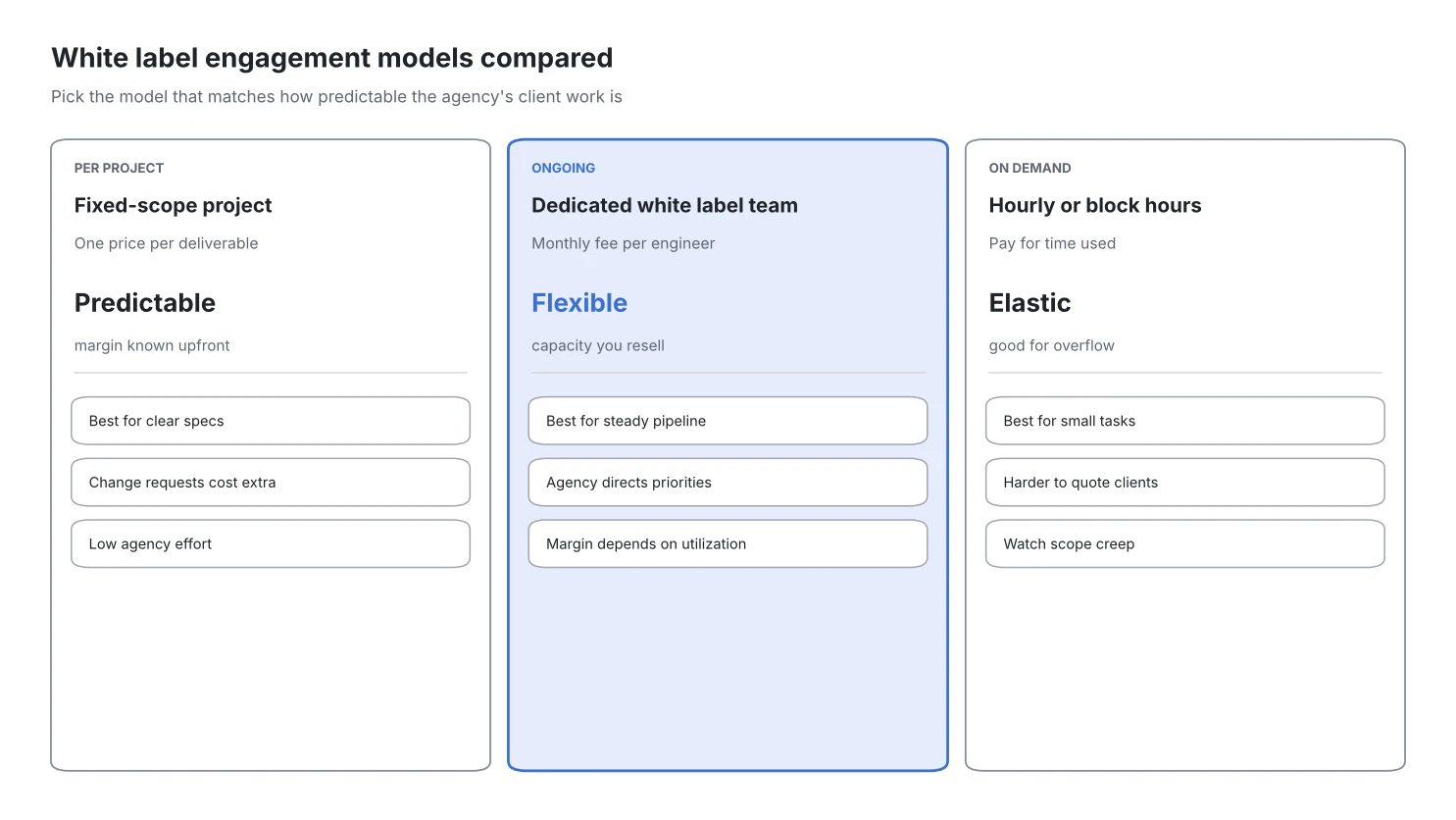
- Choose the model by how predictable your pipeline is: fixed-scope projects, a dedicated white label team, or block hours for overflow work.
- Software generally does not fall within the nine categories of commissioned work that can qualify as a “work made for hire”, so use an explicit IP assignment, not only a work-made-for-hire clause.
- Protect the relationship with confidentiality, non-solicitation, and unbranded deliverables, and keep code in repositories you own.
- Review the partner’s work yourself before the client sees it; your brand carries the quality risk.
Talk to Our Team About Your Project ->
What Is White Label Software Development?
White label software development is outsourced custom development delivered under the reseller’s brand. The end client contracts with the agency, the agency contracts with a development partner, and the partner’s name usually does not appear in the deliverables or communications. The agency is responsible to its client for scope, quality, and support.
| Term | What it means | Example |
|---|---|---|
| White label development | A partner builds custom software that you deliver under your brand | An agency sells a client portal built by a partner |
| White label SaaS or reselling | You rebrand and resell an existing product | An agency resells a branded booking platform |
| Subcontracting (disclosed) | A partner works on your project, and the client knows | A consultancy names its engineering partner in the proposal |
| Staff augmentation | A provider’s engineers join your team under your direction | An agency adds two developers to its own team |
How White Label Software Development Works
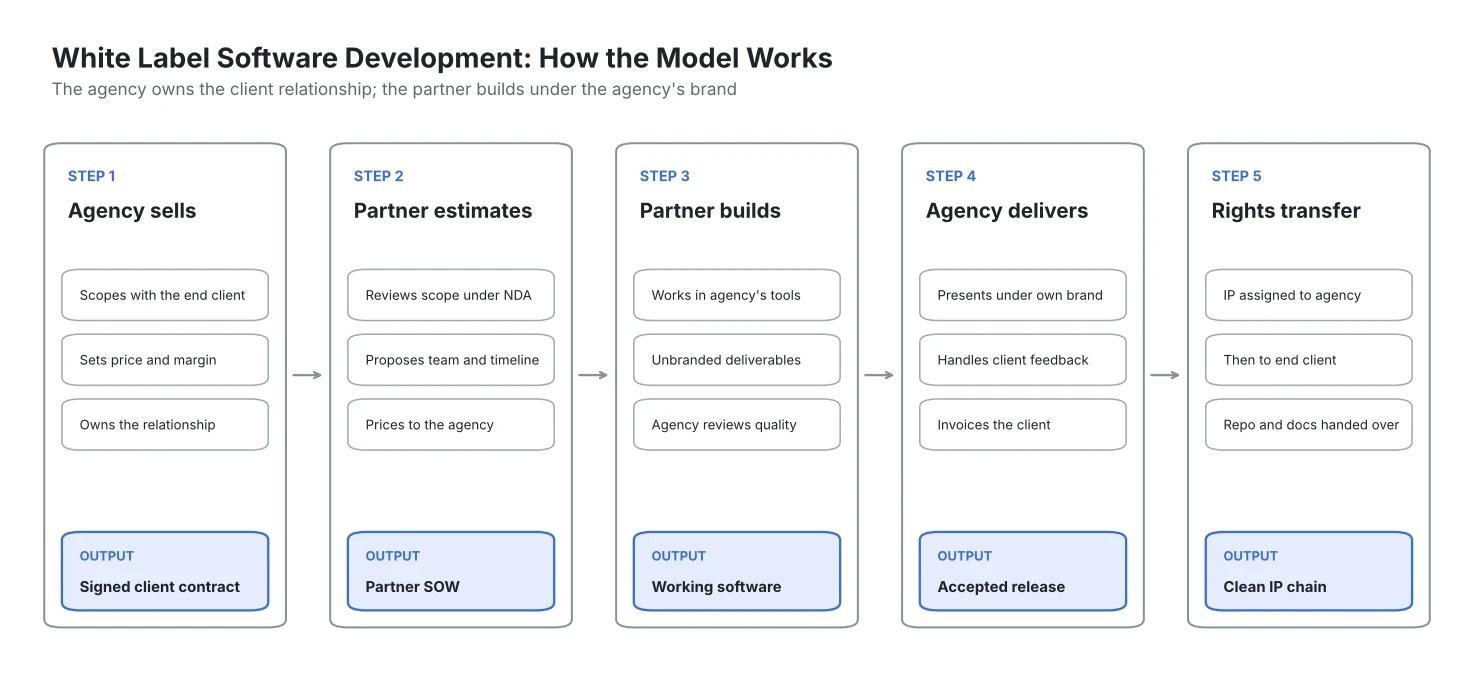
The agency sells and scopes the work, the partner estimates and builds it unbranded, the agency reviews and delivers it, and the rights pass from the partner to the agency and on to the end client.
- The agency sells and scopes: It agrees on requirements, price, and timeline with its client and owns the relationship.
- The partner estimates under NDA: It reviews the scope, proposes a team and timeline, and quotes a price to the agency.
- The partner builds in the agency’s systems: Work happens in repositories, project tools, and communication channels the agency controls, with unbranded deliverables.
- The agency reviews and delivers: The agency tests the work, presents it under its brand and manages client feedback.
- Rights and assets transfer: IP is assigned to the agency, and from the agency to the client as their contract requires, with code, documentation, and credentials handed over.
Some agencies let the partner join client calls as part of the agency’s team. Agree in writing on how the partner introduces itself and who can make commitments to the client.
White Label Engagement and Pricing Models
| Model | How it is priced | Best for | Watch for |
|---|---|---|---|
| Fixed-scope project | One price per defined deliverable | Clear specifications and one-off builds | Change requests; quality pressure near fixed deadlines |
| Dedicated white label team | Monthly fee per engineer | A steady pipeline of client work | Idle capacity if sales slow down |
| Hourly or block hours | Pay per hour, often in pre-bought blocks | Overflow, maintenance, and small tasks | Harder to quote clients a fixed price |
Most agencies start with fixed-scope projects to test a partner, then move to a dedicated team once the pipeline is predictable. AB Ark’s guide to dedicated teams vs staff augmentation explains the difference in control and cost between the two ongoing models, and its guide to fixed price vs time and materials covers how to structure project pricing.
How agencies earn a margin on white label work
The agency’s margin is the difference between what it charges its client and what the partner charges, minus its own project management, QA, and account costs. There is no reliable public benchmark for typical white label markups, so model it per project.
Illustrative calculation, not a benchmark: if a partner quotes $40,000 for a build and the agency spends $8,000 of its own time on management and QA, charging the client $64,000 leaves a $16,000 project margin, or 25% of revenue. If scope grows and the partner bills more without a matching change order to the client, that margin disappears first.
The Contract Terms That Matter Most
Intellectual property: assign it, do not rely on “work made for hire” alone
The US Copyright Office explains that a work created by an independent contractor is a work made for hire only if it is specially ordered or commissioned, falls within one of nine statutory categories, and both parties sign a written agreement saying so (Circular 30). Software usually does not fit those categories. Without an explicit written assignment, the contractor can remain the copyright owner even after being paid. The safer approach is a contract that designates the work as a work made for hire where possible and also assigns all rights in the work to the agency, effective on creation or payment.
| Clause | What it should say |
|---|---|
| IP assignment | All rights in deliverables are assigned to the agency, including code, designs, and documentation, with an obligation to sign any confirmatory documents |
| Pre-existing and open-source code | The partner lists any reusable components and licenses; the agency gets a perpetual license to anything not assigned |
| Confidentiality | Client identity, data, and business information stay confidential, including after the contract ends |
| Non-solicitation | The partner will not approach or contract directly with the agency’s clients for an agreed period |
| White label conduct | Unbranded deliverables; how the partner presents itself if it meets the client |
| Subcontracting | No further subcontracting without approval; the same terms flow down to any approved subcontractor |
| Data protection and security | Where client data is stored, who can access it, and breach notification duties |
| Warranty and support | Bug-fix period, response times, and post-launch support terms |
| Exit and handover | Repositories, credentials, and documentation handed over on termination |
AB Ark’s guide to software development contract questions covers ownership, change control, and support terms that apply to any outsourced build, white label or not.
How to Protect Quality and the Client Relationship
- Keep repositories and tools in your accounts: The partner works in your Git organization, project tracker, and cloud accounts, so you never lose access.
- Review every release before the client sees it: Run your own acceptance tests and code review, even if the partner has QA.
- Agree on a definition of done and quality standards: Set coding standards, test coverage, accessibility, and performance targets in writing.
- Name the people: Know who works on your projects and require notice before key people change.
- Control client communication: Decide whether the partner ever speaks to clients and who can approve scope changes.
How to Choose a White Label Software Development Partner
| Check | What good looks like |
|---|---|
| Relevant portfolio | Projects like your clients’ projects, with technologies you sell |
| White label experience | Existing agency partnerships and references from agency owners |
| Contract readiness | Accepts IP assignment, non-solicitation, and unbranded delivery as standard terms |
| Process visibility | Sprint demos, shared boards and access to the repository from day one |
| Team stability | Low turnover, named team, documented handover |
| Time zones and communication | Enough overlap for daily questions; clear written English |
| Security | Access control, an NDA for every engineer, and independent certifications where relevant |
Start with a small paid project before entrusting a partner with a client’s flagship build. AB Ark’s guide to software outsourcing services covers how to evaluate outsourcing partners in more depth, and its small business software development guide lists the contract questions to ask before signing.
Get a Custom Project Cost & Timeline Estimate ->
FAQs
What is white label software development?
White label software development is when a development partner builds custom software that an agency or consultancy delivers to its own clients under the agency’s brand. The agency owns the client relationship and pricing; the partner provides engineering and transfers the intellectual property.
Is white label development the same as outsourcing?
It is a form of outsourcing. The difference is branding and relationship: in white label development the end client deals with the agency, and the partner works unbranded behind it. In ordinary outsourcing, the client usually contracts with the development company directly.
Who owns the code in a white label arrangement?
Ownership depends on what the contracts specify. It should pass from the partner to the agency through an explicit written IP assignment, and from the agency to the end client under the client contract. A work-made-for-hire clause alone may not transfer copyright in software created by a contractor.
How do white label partners price their work?
Common models are a fixed price per project, a monthly fee per engineer for a dedicated team, or hourly billing, often in pre-bought blocks. The agency then sets its own client price to cover the partner’s cost, its management and QA time, and its margin.
How do I stop a white label partner from taking my clients?
Use confidentiality and non-solicitation clauses, keep client communication and repositories under your control, require unbranded deliverables, and choose partners that have agency references and whose business depends on agency relationships.
The Rule for White Label Software Development
Own the client, the repositories and the IP; let the partner own the engineering. Start with one small project, put assignment, confidentiality, and non-solicitation in writing, review every release yourself, and scale to a dedicated team only when your pipeline justifies it.
In white label work, the partner writes the code, but your brand signs it. Choose a partner you would be happy to put your name on.
Schedule a Free Consultation Call ->
CTO & Co-founder At AB Ark Solutions