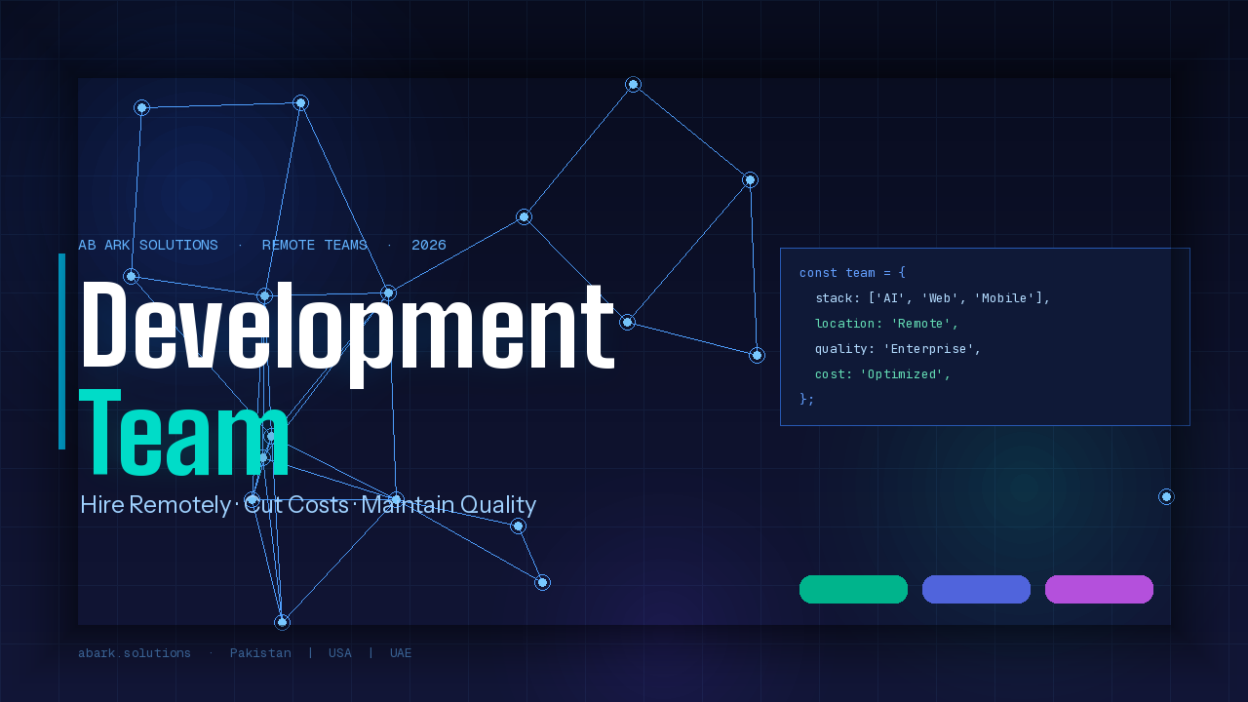
Hiring a development team remotely costs 40–65% less than building an equivalent local team in the US, UK, or UAE without reducing technical quality. Businesses hire remote development teams for cost efficiency, access to specialized global talent, faster onboarding (1–2 weeks vs. 6–12 weeks locally), and flexible scalability. The key to maintaining quality is choosing a partner with a structured sprint process, transparent communication, and IP protection built into the contract.
What Does It Mean to Hire a Development Team Remotely?
Hiring a development team remotely means engaging a group of full-time professionals developers, designers, QA engineers, and project managers who work exclusively on your project from a different geographic location, typically through a trusted IT services partner.
How remote development teams differ from other hiring models:
| Model | Dedication | Ownership | Typical Use Case |
| Remote Development Team | Full-time, one client | High – product-embedded | Long-term builds, SaaS, AI products |
| Staff Augmentation | Part-time, fills gaps | Medium – task-based | Short-term skill gaps |
| Freelancer | Part-time, multiple clients | Low – deliverable-based | One-off features or fixes |
| Project Outsourcing | Fixed scope only | Low – hands-off | Defined, time-bound projects |
A remote development team is not a vendor you hand a brief to. It functions as a full extension of your internal product team.
The Real Cost of Building a Development Team Locally
Hiring a senior developer locally in the US costs between $160,000 and $220,000 per year when salaries, benefits, office costs, and recruitment are factored in. For a team of five, that is $800,000 to $1,000,000+ annually before a single line of code ships.
Full cost breakdown – US-based in-house team:
| Cost Factor | US-Based Team (Annual) |
| Senior Developer Salary | $120,000 – $160,000 |
| Benefits and Overheads | +25–30% of salary |
| Office and Infrastructure | $15,000 – $30,000 |
| Recruitment and On-boarding | $10,000 – $20,000 |
| Total Per Developer | $160,000 – $220,000+ |
For startups, scale-ups, and mid-market businesses with defined budgets, this model is simply not viable for moving fast.
Why Businesses Hire Development Teams Remotely in 2026
Businesses hire development team remotely in 2026 primarily because remote teams in regions like Pakistan, Eastern Europe, and Southeast Asia deliver equivalent technical output at 40–65% lower cost, with faster onboarding and greater flexibility to scale.
The four core reasons:
- Cost efficiency: Remote teams cost 40–65% less than local equivalents, with no hidden overhead for office, benefits, or equipment.
- Speed to hire: A structured remote team can be on-boarded in 1–2 weeks, compared to 6–12 weeks for local recruitment.
- Specialized talent access: Remote hiring removes geographic limits, making it possible to source AI/ML engineers, game developers, and UX specialists that are scarce locally.
- Elastic scalability: Teams expand for intensive sprints and contract during maintenance phases, matching spend to actual output.
The quality concern most businesses raise is almost always a partnership selection problem, not a remote work problem.
What Quality Actually Looks Like in a Remote Development Team
Quality in a remote development team is defined by communication discipline, code standards, and accountability to product outcomes not just technical skill. A high-quality remote team operates with the same rigor as an in-house team.
Indicators of a high-quality remote development team:
- Participates in daily stand-ups and sprint retrospectives
- Flags blockers and risks proactively before deadlines are missed
- Writes clean, documented, and maintainable code
- Delivers within agreed sprint timelines with transparent progress tracking
- Asks product-level questions, not just technical ones
- Treats the product roadmap as shared, not as external instructions
The critical distinction: A vendor completes tasks. A development team owns outcomes. When you hire development team remotely, you should be getting the latter.
How to Hire Development Team Remotely: 5-Step Framework
To hire development team remotely, define your scope and stack first, evaluate portfolios specifically, run structured technical interviews, start with a paid discovery sprint, and lock in the process and communication structure before full engagement begins.
Step 1: Define Scope, Stack, and Budget Before Outreach
Document your tech requirements, project phases, expected team size, and budget range. Vague briefs return vague proposals and mismatched teams.
Step 2: Evaluate Portfolios Against Your Specific Problem
Look for case studies in your domain. A team that has built AI/ML platforms approaches architecture differently from one that has only delivered e-commerce sites. Relevance matters more than volume.
Step 3: Run a Structured Technical Interview
Test real skills through scenario-based questions. Ask how they handle system design, manage technical debt, structure QA, and respond to shifting requirements. Depth surfaces quickly.
Step 4: Start with a Paid Discovery Sprint
Run a 2–4 week paid sprint with a defined, measurable deliverable before committing to a full engagement. This validates communication, delivery speed, and code quality with real stakes but low risk.
Step 5: Agree on Process Before Price
Lock in sprint structure, reporting cadence, code review protocols, escalation paths, and communication tools before work begins. Process alignment prevents the majority of remote team failures.
Green Flags vs. Red Flags When Evaluating a Remote Development Partner
| Green Flags | Red Flags |
| Transparent, itemized pricing model | Vague pricing with no benchmarks |
| Portfolio with measurable, specific outcomes | Generic case studies with no detail |
| Defined sprint and reporting structure | No mention of standups or sprint reviews |
| NDA and IP protection as standard in contracts | No clarity on code and IP ownership |
| References from clients in similar industries | No verifiable client history |
| Cross-disciplinary expertise | Single-dimensional skill offering |
Which Project Types Are Best Suited for Remote Development Teams?
Remote development teams are best suited for SaaS products, AI/ML platforms, mobile applications, game development projects, UI/UX redesigns, and digital transformation initiatives particularly where long-term engagement, specialized skills, and iterative development are required.
Project fit summary:
| Project Type | Remote Team Fit | Reason |
| SaaS Products | ✅ Excellent | Iterative builds, evolving requirements |
| AI / ML Platforms | ✅ Excellent | Niche skills scarce locally |
| Mobile Apps | ✅ Excellent | Flutter, React Native, Swift specialists available |
| Game Development | ✅ Excellent | Unity and Unreal expertise accessible remotely |
| UI/UX Redesigns | ✅ Strong | Senior design talent at lower cost |
| Digital Transformation | ✅ Strong | Cloud, DevOps, and legacy modernization expertise |
| On-site hardware projects | ❌ Not suitable | Requires physical presence |
Summary
AB Ark Solutions builds dedicated remote development teams for businesses in Pakistan, the USA, and UAE. Services span software development, AI/ML engineering, game development, UI/UX design, and digital transformation consulting.
Every engagement includes:
- A team dedicated exclusively to your project no shared resources
- Sprint-based delivery with weekly progress reports
- NDA and IP ownership clauses standard in all contracts
- Fully transparent pricing with no hidden fees
- A technical lead responsible for quality assurance on your behalf
At-a-Glance Summary
| Factor | Remote Development Team | Local In-House Team |
| Cost | 40–65% lower | High-salary, benefits, overhead |
| Time to Hire | 1–2 weeks | 6–12 weeks |
| Talent Access | Global specialists | Geographically limited |
| Scalability | Flexible per phase | Fixed headcount |
| Quality (with right partner) | Equivalent to in-house | Dependent on local market |
| IP Protection | Contractually defined | Standard employment law |
Frequently Asked Questions
Q: What is the role of a development team?
The role of a development team is to design, build, test, and maintain software or applications, ensuring they meet functional requirements, performance standards, and business objectives.
Q: Who is in the development team?
A development team typically includes software developers, front end and back end engineers, UI/UX designers, quality assurance testers, project managers, and sometimes business analysts or DevOps specialists.
Q: What are the 7 stages of team development?
The seven stages of team development are forming, storming, norming, performing, adjourning, transforming, and sustaining.
Q: What are the 5 main roles in a team?
The five main roles in a team are leader, facilitator, communicator, implementer, and evaluator.
Ready to Hire Development Team That Delivers?
If your product is waiting on the right team stop waiting.
AB Ark helps businesses across Pakistan, the USA, and UAE hire development teams that are structured, accountable, and built around your product goals not just your ticket queue.
📩 Contact us for a free team structure consultation. Get a tailored recommendation within 48 hours with no commitment required.

Syed Ahmad Ali is a tech writer at AB Ark with a knack for turning complex ideas into easy reads. He writes across a range of topics, but AI, software development, and the business of tech sit right at the top of his list.