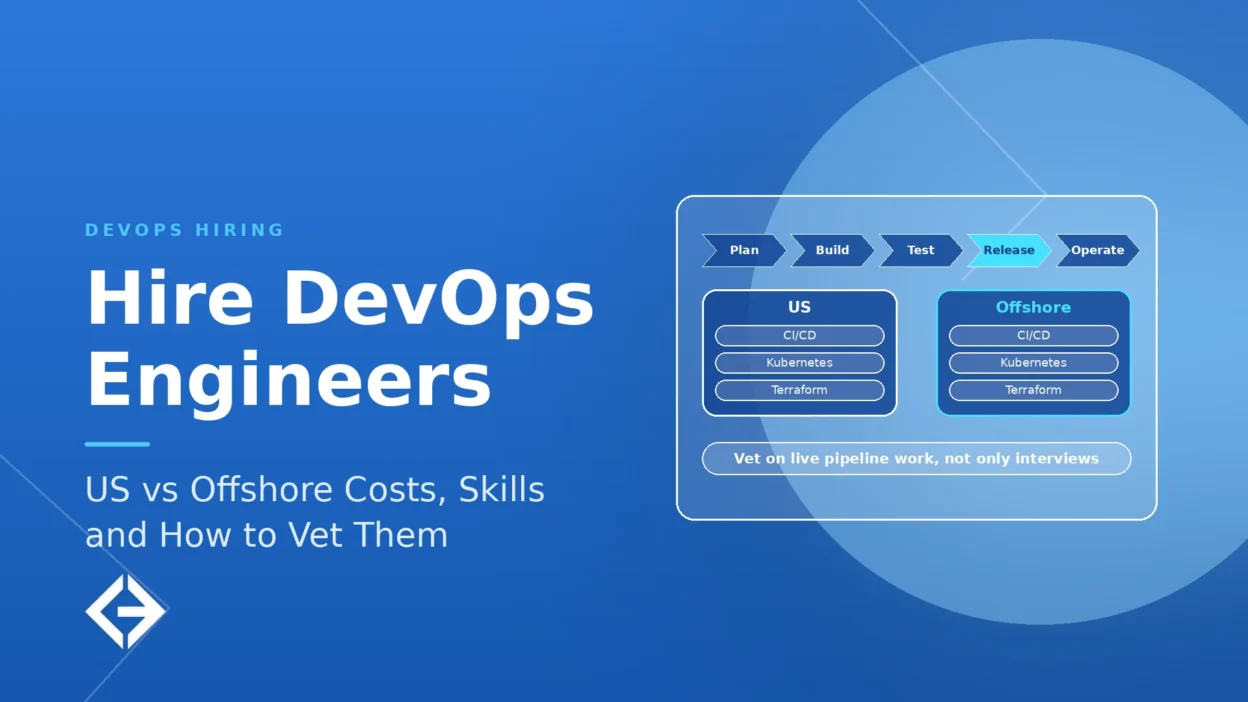

 To hire DevOps engineers well, decide the engagement model first, budget from real rates, then vet with a practical, scored process. A full-time US DevOps hire costs roughly $16,000 a month in salary and benefits at the closest federal benchmark; a US contractor at about $100 an hour costs a similar amount for full-time hours; offshore DevOps engineers through augmentation typically cost $4,000 to $9,600 a month. Skills and access controls matter more than location.
This guide is for CTOs, engineering managers and founders hiring one or more DevOps engineers into an existing team. It covers what DevOps engineers do and how the role differs from SRE and platform engineering, US vs offshore costs with the assumptions shown, the skills to test by seniority, a five-stage vetting process with a scorecard, and how to give offshore engineers production access safely. If you want a vendor to run your infrastructure end to end instead, AB Ark’s guide to managed DevOps services covers that model.
Key Takeaways
- There is no federal wage series for DevOps engineers; the closest BLS benchmark, software developers, had a median wage of $135,980 in May 2025, or about $194,000 a year once benefits are added.
- US contract DevOps engineers average about $100 an hour in YunoJuno’s booking data, so a full-time contractor costs about the same per month as a loaded US employee.
- Offshore augmentation cuts the monthly cost by roughly 40% to 75% against US benchmarks, but only works with strict access controls and a clear on-call model.
- Vet DevOps engineers with real work: a broken pipeline, a Terraform review and a live incident drill reveal far more than tool-name interviews.
- Measure the hire after 90 days with delivery metrics such as deployment frequency, lead time, change failure rate and time to restore service.
Talk to Our Team About Your Project ->
What Does a DevOps Engineer Do?
A DevOps engineer builds and runs the systems that move code from a developer’s laptop to production safely and repeatably. The core work is continuous integration and delivery (CI/CD) pipelines, infrastructure as code, container orchestration, cloud environments, monitoring and alerting, secrets and access management, and incident response. Good DevOps engineers also reduce cloud spend and make releases boring.
The title overlaps with several others. Hiring the wrong one is a common, expensive mistake:
| Role | Primary focus | Typical outputs | Hire when |
|---|---|---|---|
| DevOps engineer | Delivery pipeline and infrastructure automation | CI/CD, infrastructure as code, environments, deployments | Releases are slow, manual or risky |
| Site reliability engineer (SRE) | Reliability of production services | SLOs, error budgets, incident process, capacity planning | Uptime and incident volume are the main problem |
| Platform engineer | Internal developer platform | Golden paths, self-service environments, shared tooling | Many teams need the same infrastructure, repeatedly |
| Cloud engineer | Cloud architecture and accounts | Networking, IAM, landing zones, cost controls | You are migrating to, or restructuring, a cloud estate |
| DevSecOps engineer | Security inside the delivery pipeline | Scanning, policy as code, secrets, supply-chain controls | Audits, enterprise customers or regulation demand evidence |
Small teams usually need one generalist who covers DevOps and cloud, with SRE practices added as traffic grows. Write the job description around the problem you need solved, not a list of every tool you have heard of.
How Much Does It Cost to Hire DevOps Engineers? US vs Offshore
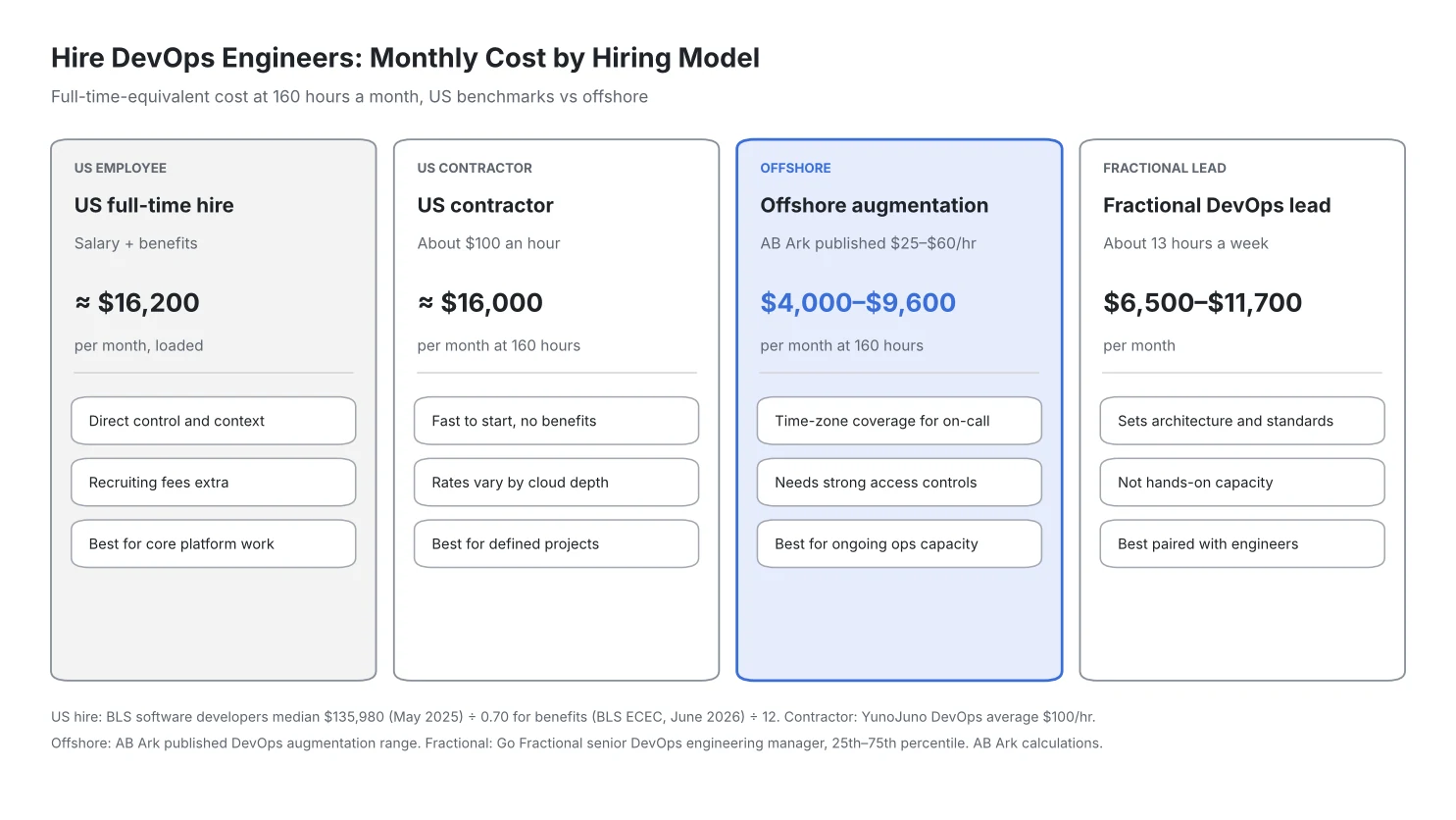
A full-time DevOps engineer costs about $16,000 a month in the USA, whether hired as an employee at the benchmark wage or as a contractor at market rates. Offshore engineers through staff augmentation cost roughly $4,000 to $9,600 a month for full-time hours. The table shows each figure and where it comes from.
The federal Bureau of Labor Statistics does not publish a DevOps occupation. The nearest benchmark is software developers, with a median annual wage of $135,980 in May 2025. Employers also pay benefits: in June 2026, wages and salaries made up 70.0% of private-industry employer compensation costs. Dividing the median by 0.70 gives a loaded cost of about $194,300 a year, or $16,200 a month. Experienced DevOps engineers in major US metros often earn above this median, so treat it as a floor.
For contractors, YunoJuno’s booking data shows a DevOps engineer average of about $100 an hour, with rates rising for AWS, Kubernetes, Terraform and DevSecOps depth. Offshore rates are softening: Accelerance reports Latin American software development rates fell 7.1% in 2025 in its survey of development firms. AB Ark publishes its own offshore DevOps augmentation range as $25 to $60 an hour.
| Model | Rate basis | Monthly cost (160 hours) | Source |
|---|---|---|---|
| US full-time employee | $135,980 median wage ÷ 0.70 for benefits | ≈ $16,200 | BLS OEWS May 2025; BLS ECEC June 2026 |
| US contractor | About $100 an hour | ≈ $16,000 | YunoJuno DevOps booking data |
| Offshore augmentation | $25–$60 an hour | $4,000–$9,600 | AB Ark published range |
| Fractional DevOps lead | $125–$225 an hour, about 13 hours a week | $6,500–$11,700 | Go Fractional, 25th–75th percentile |
Two costs hide outside the rate. Recruiting a full-time US hire through a search firm can add a fee: retained firms are typically paid about one-third of estimated first-year compensation for executive roles, and contingency recruiters for engineers commonly charge a percentage of salary too. And every month a DevOps seat stays empty, releases slow and incidents last longer, which rarely appears in the budget but shows up in delivery.
When US engineers are worth the premium
- 1. Regulated or restricted workloads: Some contracts and regulations, such as certain government work or export-controlled data, limit who may access systems. Check before hiring outside the USA.
- 2. Deep on-site or vendor work: Data-center hardware, on-premises networks and regular in-person vendor coordination favor local engineers.
- 3. You need a senior owner for the whole platform: A first, senior DevOps hire who will set the architecture for years often belongs in the core team, wherever they live.
When offshore DevOps engineers are the better fit
- 1. Ongoing operational capacity: Pipeline maintenance, environment management, monitoring and routine changes are well defined and suit a stable augmented engineer.
- 2. Follow-the-sun on-call: An engineer several time zones away can cover your night hours, which reduces burnout on a small US team.
- 3. Budget for two instead of one: For the cost of one US engineer, two offshore engineers can provide redundancy, so a single resignation does not stop deployments.
DevOps Engineer Skills to Test by Seniority
Test the skills the role will actually use in its first six months. A useful DevOps engineer is strong in fundamentals (Linux, networking, scripting) and proficient in at least one cloud, one infrastructure-as-code tool, one CI/CD system and containers. Tool names matter less than judgment about failure, cost and security.
| Skill area | Junior | Mid-level | Senior |
|---|---|---|---|
| Linux, networking, scripting | Navigates servers; writes Bash or Python scripts | Debugs DNS, TLS, load balancers; automates routine tasks | Diagnoses complex network and performance issues across systems |
| Cloud (AWS, Azure or GCP) | Uses core compute, storage and IAM | Designs environments, networking and IAM policies | Designs multi-account landing zones and cost controls |
| Infrastructure as code | Edits existing Terraform or similar | Writes reusable modules; manages state safely | Sets module standards, drift detection and review rules |
| CI/CD | Maintains pipelines | Builds pipelines with tests, caching and approvals | Designs release strategy: canary, blue-green, rollback |
| Containers and Kubernetes | Builds and runs containers | Deploys and troubleshoots workloads on Kubernetes | Designs clusters, autoscaling, upgrades and security |
| Observability and incidents | Reads dashboards; follows runbooks | Builds alerts and dashboards; leads minor incidents | Defines SLOs and incident process; runs postmortems |
| Security (DevSecOps) | Follows secrets handling rules | Adds scanning and least-privilege access | Owns supply-chain, policy-as-code and audit evidence |
How to Vet DevOps Engineers: A Five-Stage Process
Vet DevOps engineers with work samples and a live troubleshooting session, scored against the same rubric for every candidate. Certificates and tool lists show exposure; a broken pipeline shows ability.
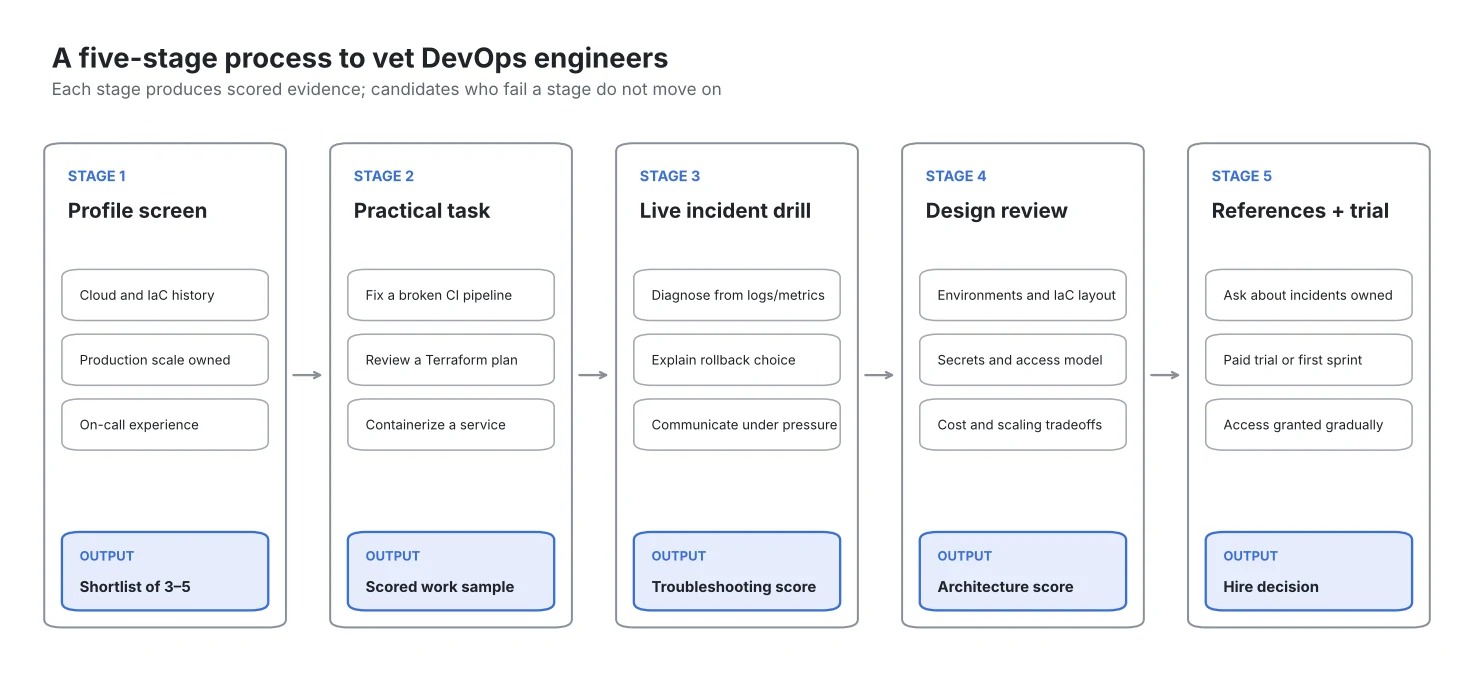
- 1. Profile screen: Look for production scale actually owned (number of services, traffic, environments), cloud accounts managed and on-call history. Ask what they automated, not which tools they used.
- 2. Practical task (2–3 hours, paid if longer): Give a small repository with a failing CI pipeline, a Terraform plan with a risky change, or a service to containerize. Score correctness, safety and the explanation.
- 3. Live incident drill: Share logs and metrics from a simulated outage and ask the candidate to talk through diagnosis, mitigation and rollback. This reveals judgment under pressure.
- 4. Design review: Ask how they would structure environments, infrastructure as code, secrets and access for your stack, and what it would cost to run.
- 5. References and a trial: Ask references about incidents the candidate owned. Start with a first sprint or a paid trial with limited access, then widen permissions as trust builds.
The AB Ark DevOps Vetting Scorecard
Score each area from 1 to 5, multiply by the weight, and compare candidates on the total out of 100. The weights are an AB Ark editorial framework; adjust them to the role.
| Area | Weight | What a 5 looks like |
|---|---|---|
| Cloud and infrastructure as code | 25% | Safe, reusable modules; understands state, drift and blast radius |
| CI/CD and release strategy | 20% | Fast, tested pipelines with clear rollback and approvals |
| Observability and incident response | 20% | Finds root cause from signals; communicates clearly during an incident |
| Containers and orchestration | 15% | Deploys, scales and debugs workloads without guesswork |
| Security and access | 10% | Least privilege by default; secrets never in code or logs |
| Communication and documentation | 10% | Writes runbooks others can follow; explains tradeoffs to non-specialists |
Red flags: shared root or admin credentials in past roles, no experience restoring from backup, inability to explain a past incident in detail, and treating cost as someone else’s problem.
Get a Custom Project Cost & Timeline Estimate ->
How to Give Offshore DevOps Engineers Production Access Safely
Offshore DevOps works when access is designed, not granted by habit. The same controls protect you from any engineer leaving, wherever they are based.
| Control | What to implement |
|---|---|
| Identity | Single sign-on and MFA for every console, repository and pipeline; no shared accounts |
| Least privilege | Role-based access scoped to environments; production write access only where the role needs it |
| Just-in-time access | Time-limited elevation for production changes, with approval and automatic expiry |
| Changes through code | Infrastructure changes go through reviewed pull requests and pipelines, not manual console edits |
| Secrets | A secrets manager with rotation; nothing in code, tickets or chat |
| Audit | Central logs of who changed what, kept outside the engineer’s own permissions |
| Offboarding | One checklist that removes all access on the last day, tested before you need it |
Engagement Models: Which Way to Hire DevOps Engineers
| Model | You manage | Best for | Watch for |
|---|---|---|---|
| Full-time employee | Everything | Long-term platform ownership | Slow hiring; single point of failure |
| Freelance contractor | Daily work; contract | Defined projects and migrations | Availability and continuity |
| Staff augmentation | Daily work; provider handles employment | Ongoing capacity inside your team | You still need technical direction |
| Managed DevOps service | Outcomes and SLAs | Teams that want infrastructure run for them | Less control over day-to-day choices |
If you choose augmentation, AB Ark’s staff augmentation services place engineers inside your team under your direction, and its guide to engineering staff augmentation explains how specialist roles such as DevOps fit that model. For a fully managed service, see DevOps service providers; for a one-off pipeline build, see DevOps development and CI/CD setup.
How to Measure a DevOps Hire After 90 Days
Judge a DevOps engineer by delivery results, not activity. The DORA metrics are a widely used set: deployment frequency, lead time for changes, change failure rate and time to restore service. Add cloud cost per environment or per customer, and the number of manual steps left in a release. Take a baseline in week one so progress is visible.
FAQs
How much does it cost to hire a DevOps engineer in the USA?
A full-time US DevOps engineer costs about $194,000 a year, or $16,200 a month, in salary and benefits at the BLS median for software developers ($135,980 in May 2025) plus a 30% benefits load. Senior engineers in major metros cost more. A US contractor at about $100 an hour costs roughly $16,000 a month for full-time hours.
How much do offshore DevOps engineers cost?
Offshore DevOps engineers through staff augmentation typically cost $25 to $60 an hour in AB Ark’s published range, or about $4,000 to $9,600 a month at 160 hours. Rates depend on seniority, cloud specialization, region and how much on-call coverage is included.
What skills should a DevOps engineer have?
A DevOps engineer should be strong in Linux, networking and scripting, and proficient in one major cloud, an infrastructure-as-code tool such as Terraform, a CI/CD system, containers and Kubernetes, monitoring, and secure secrets and access management. Senior engineers also design release strategy, SLOs and incident processes.
How do I test a DevOps engineer in an interview?
Use a short practical task, such as fixing a failing pipeline or reviewing a risky Terraform plan, followed by a live incident drill with logs and metrics. Score every candidate on the same rubric covering cloud and infrastructure as code, CI/CD, observability, containers, security and communication.
Should my first DevOps hire be in-house or offshore?
If the first hire will define your platform architecture for years, or your workloads restrict who may access them, hire a senior engineer into the core team. If you already have technical direction and need ongoing operational capacity or night-time on-call coverage, offshore augmentation is usually better value.
The Rule for Hiring DevOps Engineers
Hire for the problem, not the title: pipelines and automation need a DevOps engineer, uptime needs SRE practices, and shared tooling needs a platform engineer. Budget about $16,000 a month for full-time US capacity and $4,000 to $9,600 offshore, vet with real work, and design access before day one.
The best DevOps engineer is the one whose releases you stop noticing.
Schedule a Free Consultation Call ->
Engineering Manager At AB Ark Solutions