

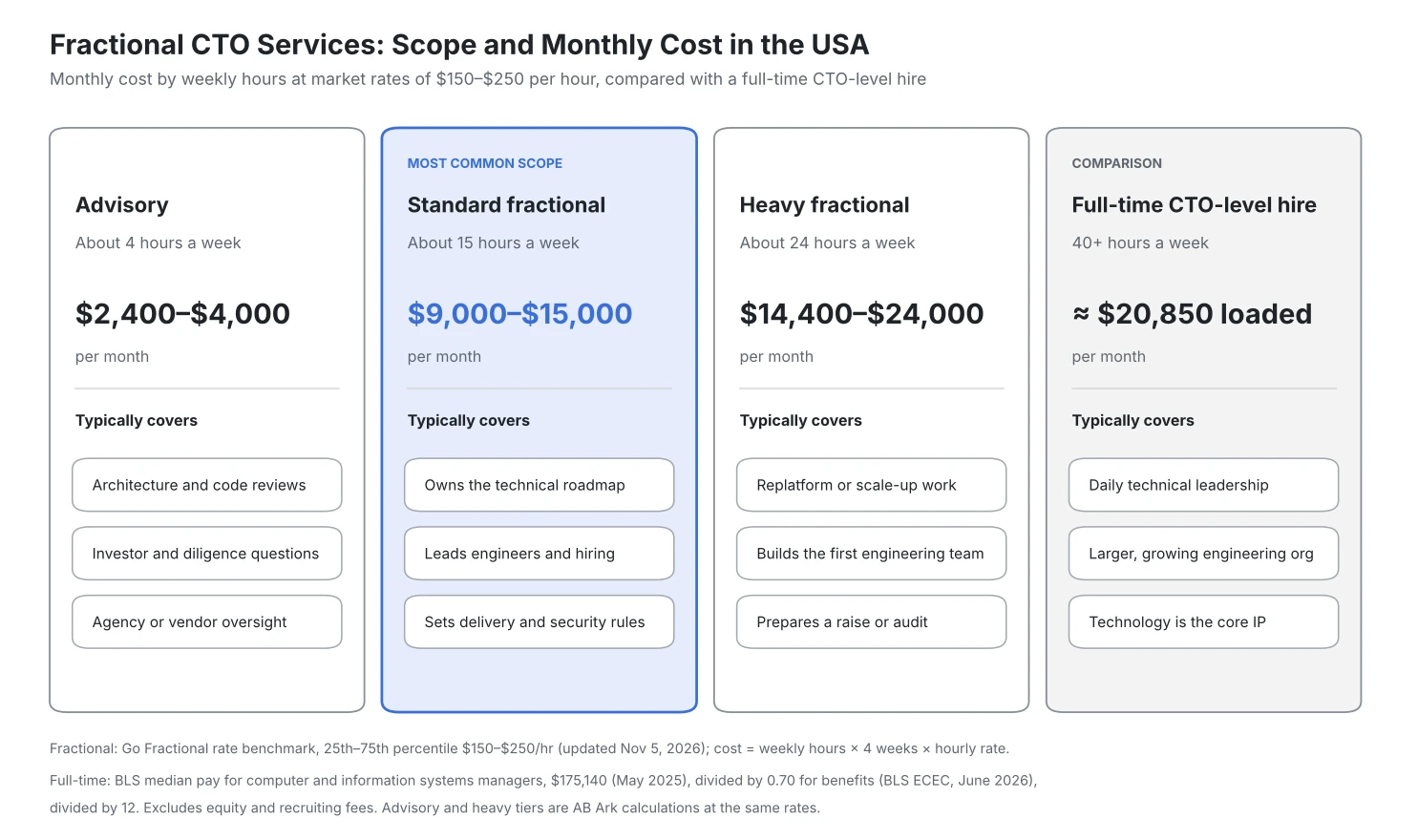
 Fractional CTO services give a startup a senior technology executive for part of the week, usually on a monthly retainer. In the USA, the middle of the market charges $150 to $250 an hour, or about $9,000 to $15,000 a month for 15 hours a week, according to Go Fractional’s November 2026 rate data. A startup needs one when technical decisions carry real business risk but there is not yet enough work, or budget, for a full-time CTO.
This guide is for founders and CEOs of US startups, usually from pre-seed to Series A, who are deciding how to cover technical leadership. It explains what a fractional CTO does, what fractional CTO services cost and how that compares with a full-time hire, the signals that you need one and the signals that you do not, a scorecard for the decision, and what the first 90 days should produce. All figures are US-focused and were checked in November 2026.
Key Takeaways
- A fractional CTO in the USA typically charges $150 to $250 an hour; at a typical 15 hours a week, that is about $9,000 to $15,000 a month.
- A full-time CTO-level hire costs roughly $250,000 a year in salary and benefits at the national median for the occupation, before equity and recruiting fees.
- At the $203 average rate, fractional time costs about the same as a full-time hire once it passes roughly 24 to 26 hours a week. Beyond that point, a full-time CTO is usually better value.
- Hire a fractional CTO when high-stakes technical decisions are frequent but do not yet add up to a full-time role: overseeing an agency, preparing for a raise, or hiring a first engineering team.
- Judge the engagement by what it leaves behind: a written assessment, a roadmap and an operating rhythm the team can run without the fractional CTO.
Talk to Our Team About Your Project ->
What Are Fractional CTO Services?
Fractional CTO services are part-time, executive-level technology leadership from an experienced CTO who works with more than one company. The fractional CTO owns technical decisions for an agreed share of the week: technology strategy and roadmap, architecture, engineering hiring and management, vendor oversight, security posture and the technical side of investor conversations.
The difference from a consultant is accountability. A consultant advises and leaves; a fractional CTO holds the role, joins leadership meetings and answers for outcomes. Fractional CTO services usually do not include writing most of the code. If the main need is more engineering capacity, a senior engineer or a development team is the cheaper fit.
Several titles overlap. The table separates them by commitment and decision rights:
| Model | Commitment | Owns technical decisions? | Best for |
|---|---|---|---|
| Fractional CTO | Part-time and ongoing, often 1 to 3 days a week | Yes, within an agreed scope | Startups that need executive judgment but not a full week of it |
| Interim CTO | Near full-time for a fixed period | Yes, temporarily | Covering a sudden vacancy or leading a turnaround until a permanent hire starts |
| Technical advisor | A few hours a month | No; advises the founders | Sounding board, advisory board seat, occasional reviews |
| CTO-as-a-service from a development agency | Bundled with software delivery | Shared with the agency | Founders buying a build who want technical oversight in the same contract |
| Full-time CTO | Full-time and permanent, usually with equity | Yes, fully | Companies where technology is the core product and decisions are daily |
CTO-as-a-service is often used as a synonym for fractional CTO. When the service is sold by a company that also builds the software, ask how the CTO stays independent of that company’s commercial interest. The vetting section below covers what to put in the contract.
How Much Do Fractional CTO Services Cost in the USA?
Most US fractional CTOs charge $150 to $250 an hour and bill a monthly retainer. Go Fractional, a fractional talent marketplace, puts the average fractional CTO rate at $203 an hour and the median at $200, based on 18 job posts and 1,282 candidate profiles from the 90 days to November 5, 2026. At its typical scope of 15 hours a week, that is $9,000 to $15,000 a month.
Treat these as market rates, not a price list. The same dataset shows a gap between buyers and sellers: employers posting fractional CTO jobs offered an average of $136 an hour, while candidates asked for an average of $204. Go Fractional sells fractional hiring, so its benchmark is a marketplace view. It is used here because it publishes its sample size, time window and method, which most published fractional CTO price ranges do not.
Fractional CTO pricing models
| Model | How it works | Best for | Watch for |
|---|---|---|---|
| Hourly | Billed per hour used, often with a minimum block | Architecture reviews, diligence questions, one-off decisions | Costs climb during onboarding; little continuity |
| Monthly retainer | Fixed fee for set hours or days and a named scope | Ongoing leadership: roadmap, team, hiring, vendors | Vague scope; insist on named responsibilities and deliverables |
| Project or fixed fee | One price for one defined outcome | Technical due diligence preparation, a technology assessment, vendor selection | Ownership ends at the deliverable |
| Retainer plus equity | Lower cash fee plus an equity grant | Cash-constrained startups expecting a long engagement | Treat equity as pay: document vesting, cliff and what happens at early exit |
What fractional CTO services cost by scope
The table turns market rates into monthly and annual budgets. Hourly rates are Go Fractional’s 25th to 75th percentile and average; the advisory and heavy scopes are AB Ark calculations at the same rates. Monthly figures use a four-week month to match Go Fractional’s method, and annual figures assume 48 billed weeks.
| Scope | Weekly hours | Monthly cost at $150–$250/hr | Monthly at $203/hr average | Annual cost (48 weeks) |
|---|---|---|---|---|
| Advisory | About 4 | $2,400–$4,000 | $3,248 | $28,800–$48,000 |
| Standard fractional | About 15 | $9,000–$15,000 | $12,180 | $108,000–$180,000 |
| Heavy fractional | About 24 | $14,400–$24,000 | $19,488 | $172,800–$288,000 |
What moves the price
- 1. Scope of ownership: Leading a team, owning the roadmap and representing technology to the board cost more than reviewing an architecture. Go Fractional names scope, stage and urgency, location and specialization as the main drivers of fractional CTO rates.
- 2. Stage and urgency: A fundraising deadline, a failing platform or a departed CTO raises the price because the work cannot wait.
- 3. Specialization: Regulated domains and AI or data platforms need narrower experience. In Go Fractional’s industry breakdown, average rates for fractional CTOs with industry experience range from $183 an hour in telecommunications to $214 an hour in fintech.
- 4. On-site expectations: Go Fractional’s data shows 39% of fractional CTO jobs are fully remote, 39% hybrid and 22% on-site. Requiring time in the office narrows the pool.
Fractional CTO vs Full-Time CTO: The Real Cost Comparison
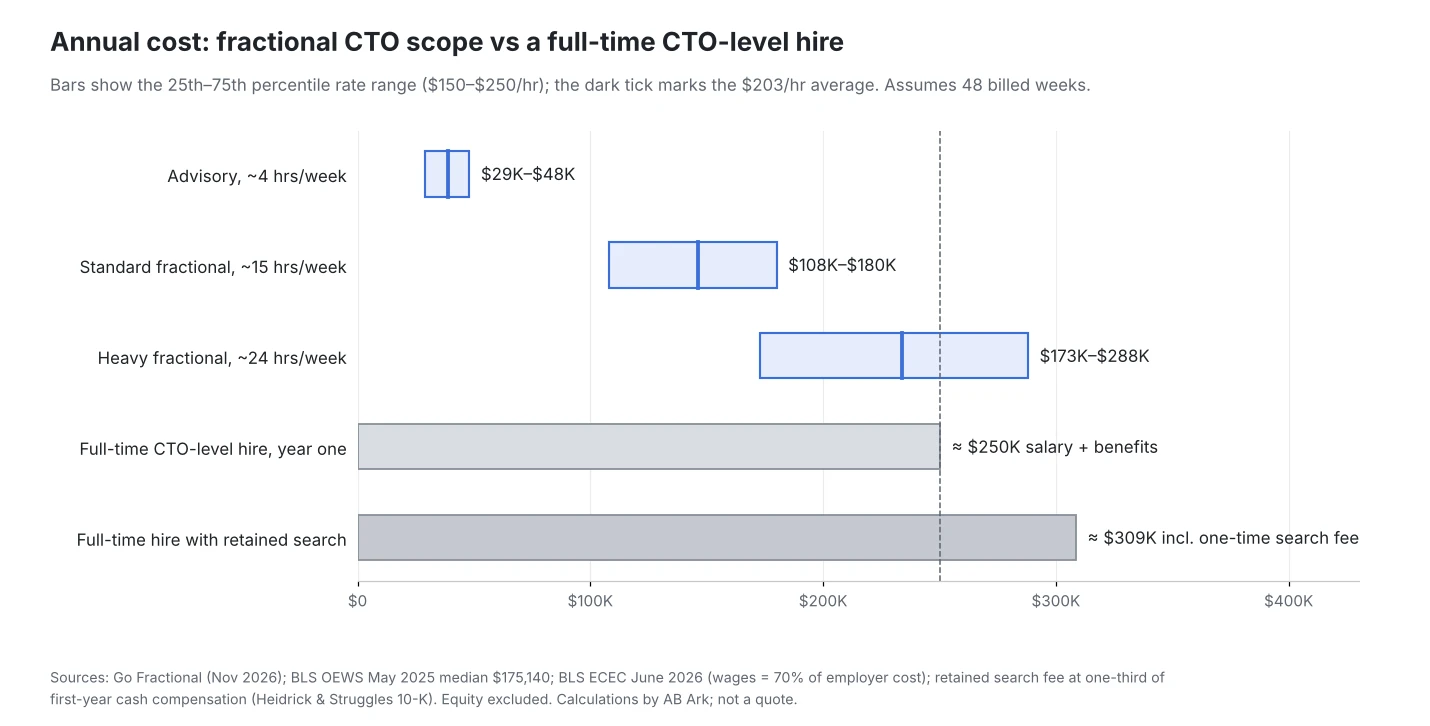
A full-time CTO-level hire in the USA costs roughly $250,000 a year in salary and benefits at the national median, before equity and recruiting fees. A standard fractional engagement costs $108,000 to $180,000 a year. The fractional model stays cheaper as long as the company needs less than about three days a week.
There is no official US wage series for startup CTOs. The closest federal benchmark is the Bureau of Labor Statistics occupation that lists CTO among its job titles, computer and information systems managers, which had a median annual wage of $175,140 in May 2025. Employers also pay benefits: in June 2026, wages and salaries made up 70.0% of private-industry employer compensation costs. Dividing the median wage by 0.70 gives an estimated loaded cost of about $250,200 a year. Venture-backed CTOs often earn more in cash and also receive equity, so treat this figure as a floor, not a typical startup offer.
Hiring has a one-time cost too. Heidrick & Struggles, a listed executive search firm, states in its SEC filing that it is typically paid a retainer of about one-third of the estimated first-year compensation for the role. On the median wage, one-third is about $58,400, which takes year-one cost to roughly $309,000 before equity.
The break-even point
At the $203 average hourly rate, fractional time costs the same as a $250,200 loaded salary at about 24 to 26 hours a week; the range depends on whether the CTO bills 52 or 48 weeks a year. Below that, a fractional CTO is cheaper. Above it, a full-time hire usually gives more value for similar money, because the company also gets full availability, deeper context and a leader who will build the team for the long term.
| Factor | Fractional CTO | Full-time CTO |
|---|---|---|
| Annual cash cost | $108,000–$180,000 at about 15 hours a week | About $250,000 loaded at the BLS median, plus equity |
| Start time | Fast; no executive search | Slower: search, notice period and onboarding |
| Equity | Optional and usually small | Usually expected |
| Availability | Agreed hours, shared with other clients | Full-time and single-focus |
| Context | Built part-time; risk of shallow knowledge | Deep and continuous |
| Breadth | Has seen many stacks, teams and stages | Depth in one company |
| Exit | Notice period in the contract | Severance, equity and rehiring |
| Best when | Technical decisions are high-stakes but intermittent | Technical decisions are daily and the team is growing |
When Does Your Startup Need a Fractional CTO?
A startup needs a fractional CTO when it is making technical decisions that are expensive to reverse, has no one senior enough to make them, and has less than a full-time job’s worth of that work.
That describes most early-stage companies. At seed stage, the median startup on Carta has just four employees (Carta, State of Startup Compensation H2 2025), so a full-time executive whose job is mainly leadership rarely makes sense. Senior judgment applied at the moments that matter does.
Signals you need a fractional CTO now
- 1. You pay an agency or offshore team and cannot judge their work: No one in-house can review estimates, code quality, architecture or security, so you rely on the vendor’s own word.
- 2. You are about to raise and investors will ask technical questions: Technical due diligence typically covers architecture, scalability, security, IP ownership and the team. A fractional CTO can prepare answers and close gaps before they affect the terms.
- 3. Your MVP works but will not scale: Outages, slowing releases, rising cloud bills or a codebase built quickly with AI coding tools. AB Ark’s vibe coding audit guide covers what to check in an AI-built application.
- 4. Your technical co-founder left or is overloaded: Fractional or interim cover keeps decisions moving while you decide on a permanent hire.
- 5. You are hiring your first engineers: Someone has to define roles, run technical interviews and set standards before the team grows.
- 6. Customers or regulators want security answers: HIPAA obligations, SOC 2 questionnaires and enterprise security reviews need an accountable technical owner.
Acting early matters because technical debt is cheap to create and expensive to carry. In a McKinsey survey of 50 CIOs at financial-services and technology companies with revenue above $1 billion, respondents said 10 to 20 percent of the technology budget meant for new products was diverted to resolving tech debt (McKinsey, 2020). Those were large companies, not startups, but the mechanism is the same: architecture choices made without senior review become a recurring tax on every later feature.
When it is too early
A fractional CTO is usually premature if you are still validating demand with a landing page, no-code tool or clickable prototype; if the build is a fixed-scope MVP on a standard stack with a clear specification; or if you cannot yet afford both leadership and the engineers it would lead. In those cases, a few hours of advisory review or a well-run fixed-scope build is better value.
When to move to a full-time CTO
Plan the transition when technical decisions become daily, when the engineering team grows beyond what one part-time leader can manage, when the product’s main value is proprietary technology such as an AI or data platform, or when your fractional hours approach the break-even range above. A good fractional CTO helps write the full-time job description and interviews the candidates.
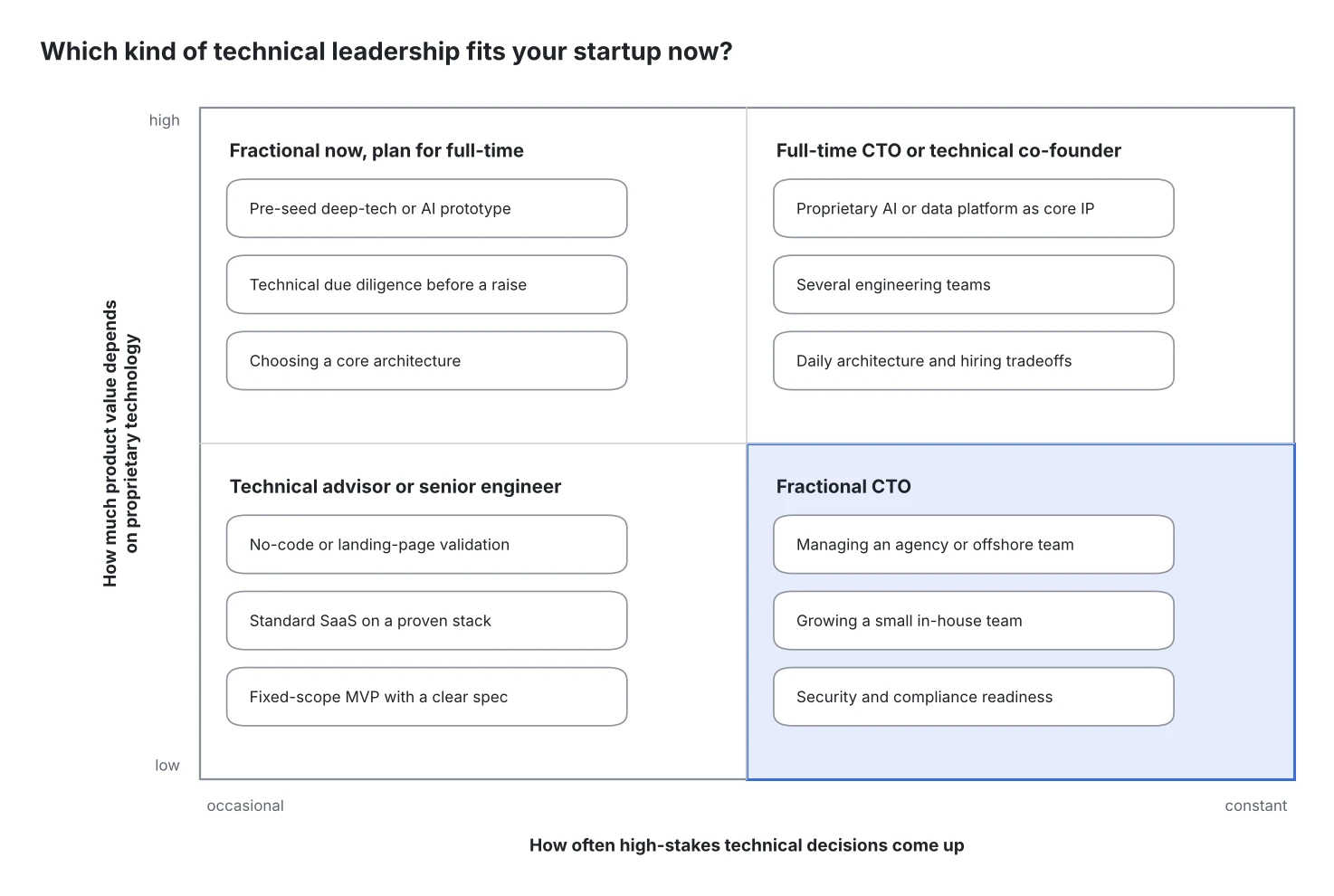 The quadrants are AB Ark editorial guidance, not measured data. Place your own startup by asking two questions: how often do high-stakes technical decisions come up, and how much of the product’s value depends on proprietary technology?
The CTO Decision Load Scorecard
Score each of the six questions from 0 to 2 and add them up. The total suggests which kind of technical leadership your startup needs now. The CTO Decision Load Scorecard is an AB Ark editorial framework for structuring the decision; it is not a validated assessment.
| Question | 0 points | 1 point | 2 points |
|---|---|---|---|
| 1. How often do you face technical decisions that are costly to reverse? | Rarely | About monthly | Weekly or more |
| 2. Who builds the product? | No build yet, or a no-code tool | An agency, freelancers or a small team | A growing in-house team |
| 3. How much of your value is proprietary technology? | Little; standard SaaS | Some; integrations or workflow logic | Core; AI, data or platform IP |
| 4. Is a fundraise, audit or enterprise deal due in the next six months? | No | Possibly | Yes, with technical scrutiny |
| 5. Who reviews architecture, security and vendor work today? | Not needed yet | Founders without deep expertise | No one, and gaps are showing |
| 6. Are you hiring engineers in the next six months? | No | One or two | A team |
| Total score | What it suggests |
|---|---|
| 0–4 | A technical advisor or a few advisory hours a month is enough for now. |
| 5–8 | A fractional CTO, typically around 15 hours a week, with named 90-day deliverables. |
| 9–12 | Heavy fractional cover now, plus a plan and budget for a full-time CTO. |
| Override | If questions 1 and 3 both score 2, start the full-time CTO search regardless of the total. |
Get a Custom Project Cost & Timeline Estimate ->
What a Fractional CTO Should Deliver in the First 90 Days
A fractional CTO engagement should produce written outputs the company keeps: an assessment, a roadmap and an operating rhythm. If the first 90 days produce only meetings and opinions, the engagement is not working.
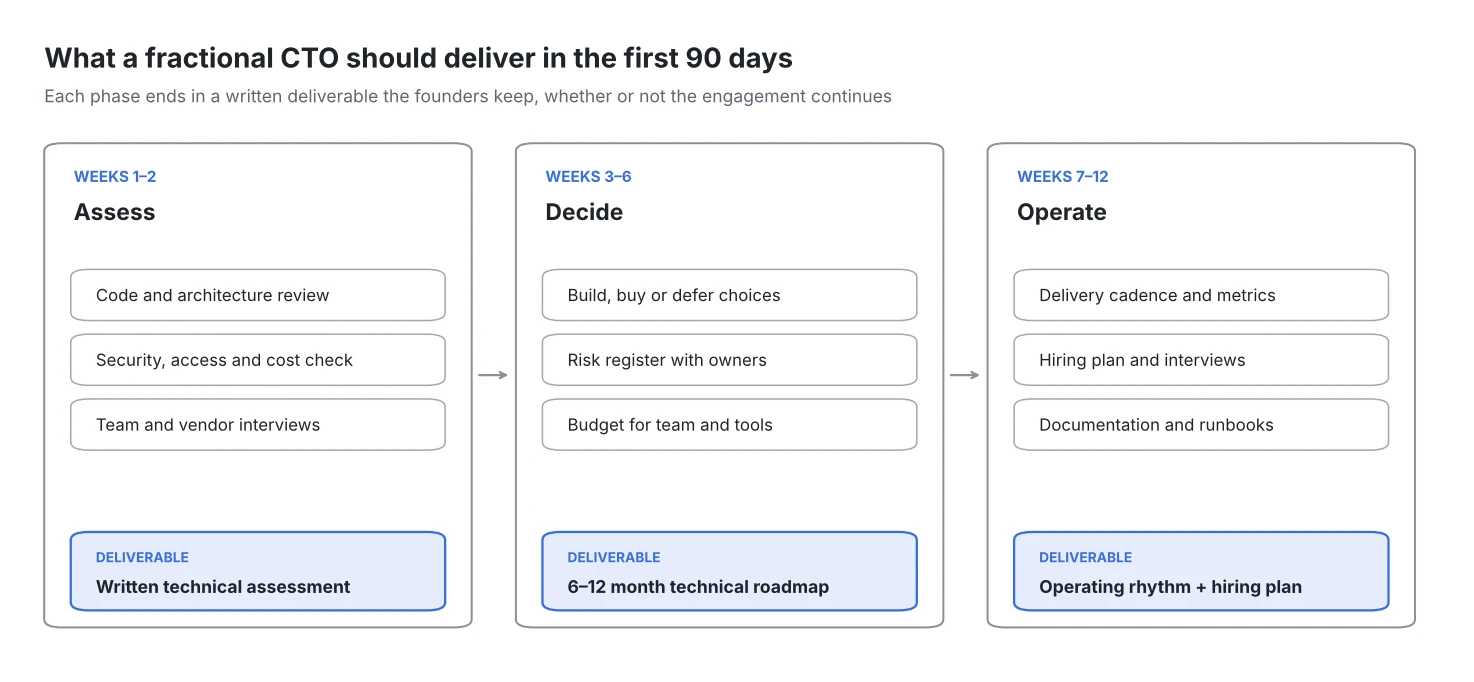
| Phase | What happens | Deliverable |
|---|---|---|
| Weeks 1–2: Assess | Review code, architecture, infrastructure, access and cloud spend; interview the team and vendors | Written assessment of risks, technical debt and quick wins |
| Weeks 3–6: Decide | Make build, buy or defer decisions; agree priorities with founders; set a budget for team and tools | A 6–12 month technical roadmap and a risk register with owners |
| Weeks 7–12: Operate | Set delivery cadence and metrics; run hiring; document systems and access | Operating rhythm, hiring plan and runbooks |
Metrics that show whether the engagement is working
| Metric | What it tells you |
|---|---|
| Deployment frequency and lead time from commit to production | Whether delivery is speeding up |
| Change failure rate and time to restore service | Whether quality and stability are improving |
| Technical decisions closed per month vs decisions waiting | Whether the bottleneck has moved off the founders |
| Cloud and tooling cost per active customer | Whether spend scales with the business |
| Open critical security findings | Whether risk is going down |
| Time to fill engineering roles and new-hire ramp-up | Whether the hiring plan is working |
How to Choose a Fractional CTO
Choose a fractional CTO on evidence that they have done your specific job before, a clear written scope, and independence from the vendors they will oversee.
- 1. Match the stage: Ask for examples at your stage and with your problem, such as taking an MVP to scale, preparing for technical due diligence or building a first team. Experience running a 500-person engineering organization does not always transfer to a four-person startup.
- 2. Check hands-on depth in your stack: A fractional CTO does not need to write most of the code, but should be able to read yours, review a pull request and challenge an estimate.
- 3. Put named deliverables in the contract: Write down the hours, responsibilities, 90-day deliverables, meeting cadence and response time for production incidents.
- 4. Check independence: A fractional CTO supplied by a development agency, or one who receives referral fees, may favor that vendor. Ask for disclosure and for the authority to recommend other vendors. AB Ark builds software for clients, so this applies to development partners like us too: the scope should say who reviews the partner’s work.
- 5. Protect IP and access: Make sure work product and code are assigned to the company, credentials live in company-owned accounts, and access is removed when the engagement ends.
- 6. Plan the exit from day one: A good engagement ends with documentation, a hired successor or a team that no longer needs the fractional CTO. Ask how they hand over.
- 7. Take references from founders: Ask previous clients what changed in delivery, hiring and investor conversations, not only whether they enjoyed working together.
An AB Ark Implementation Lens
AB Ark is a software development company, not a fractional CTO marketplace. Its product development services include development consulting on product architecture, tech stack selection and scalability planning, alongside discovery, prototyping, POC development and full builds. For founders working with an outside development team, the useful split is between who builds and who checks: a fractional CTO or in-house technical owner should review architecture, estimates and code, whoever writes them.
For the commercial side of working with a development partner, AB Ark’s guide to fixed price vs time and materials for AI MVPs explains when each pricing model fits and which risks each one moves between client and vendor.
FAQs
How much does a fractional CTO cost per month?
In the USA, a fractional CTO working about 15 hours a week typically costs $9,000 to $15,000 a month, based on Go Fractional’s November 2026 data showing a middle range of $150 to $250 an hour. Lighter advisory work of about four hours a week costs roughly $2,400 to $4,000 a month at the same rates, and near-full-time engagements cost more.
Is a fractional CTO worth it for an early-stage startup?
A fractional CTO is worth it when the startup is making technical decisions that are expensive to reverse: choosing an architecture, hiring engineers, managing an outsourced team or preparing for technical due diligence. It is usually not worth it before product validation, when a fixed-scope build or a few advisory hours cover the need.
What is the difference between a fractional CTO and a technical co-founder?
A technical co-founder is a founder with significant equity and a long-term, full-time commitment. A fractional CTO is a paid, part-time executive, usually on a retainer with a notice period. Some startups use a fractional CTO to cover technical leadership while they search for a technical co-founder or a first full-time CTO.
Does a fractional CTO write code?
Usually not much. A fractional CTO’s hours are better spent on architecture, reviews, hiring, vendor oversight and planning. Some build prototypes or critical components early on, but if the main need is engineering output, a senior engineer or development team gives more capacity for the money.
How long does a fractional CTO engagement last?
Engagement length depends on the goal. An assessment or due diligence project can take a few weeks, while ongoing leadership often runs until the company hires a full-time CTO or no longer needs one. Agree an initial term with defined 90-day deliverables, then renew based on results.
Should a fractional CTO get equity?
Equity is optional. It can lower the cash fee for a cash-constrained startup and align incentives on a long engagement, but treat it as compensation: agree the amount, vesting, cliff and what happens if the engagement ends early, and take legal and tax advice before granting it.
The Rule for Fractional CTO Services
Buy fractional CTO time when technical decisions are high-stakes and the volume is part-time. Define the engagement in hours and deliverables, not titles. Move to a full-time CTO when the hours, the team or the technology itself outgrow the model. Budget about $9,000 to $15,000 a month for a standard US engagement, and expect a written assessment, a roadmap and an operating rhythm within 90 days.
The best fractional CTO is not the one you keep forever. It is the one who leaves your company able to make good technical decisions without them.
Schedule a Free Consultation Call ->
CTO & Co-founder At AB Ark Solutions