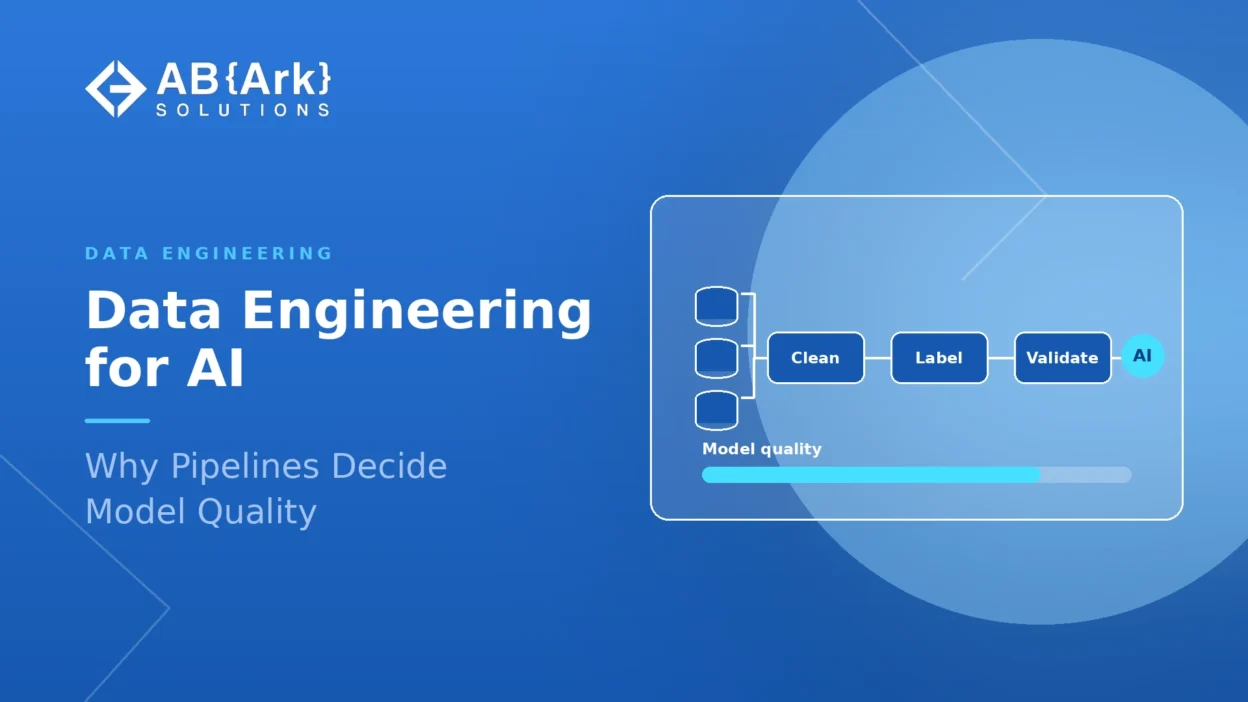

Data engineering for AI is the work of collecting, validating, transforming and serving the data that models are trained on and retrieve from. It decides model quality because a model can only be as accurate, current and consistent as the pipeline feeding it. Gartner predicted in February 2025 that through 2026, organizations would abandon 60% of AI projects unsupported by AI-ready data. Data engineering services close that gap by turning scattered, unreliable data into tested, traceable, production-grade pipelines.
Key Takeaways
- Most AI failures trace back to data, not models: RAND identified missing or inadequate data as one of the five leading root causes of AI project failure.
- AI-ready data differs from BI-ready data. It must be representative of the use case, continuously validated and traceable to its source.
- Pipeline defects such as schema drift, leakage, stale embeddings and training-serving skew degrade model quality silently, often weeks before anyone notices.
- Data engineering services for AI should be judged on validation, observability, lineage and governance, not just on how many sources they connect.
- Fixing the pipeline is often cheaper and faster than swapping the model, but only if teams can trace a bad output back to its data.
What Is Data Engineering for AI?
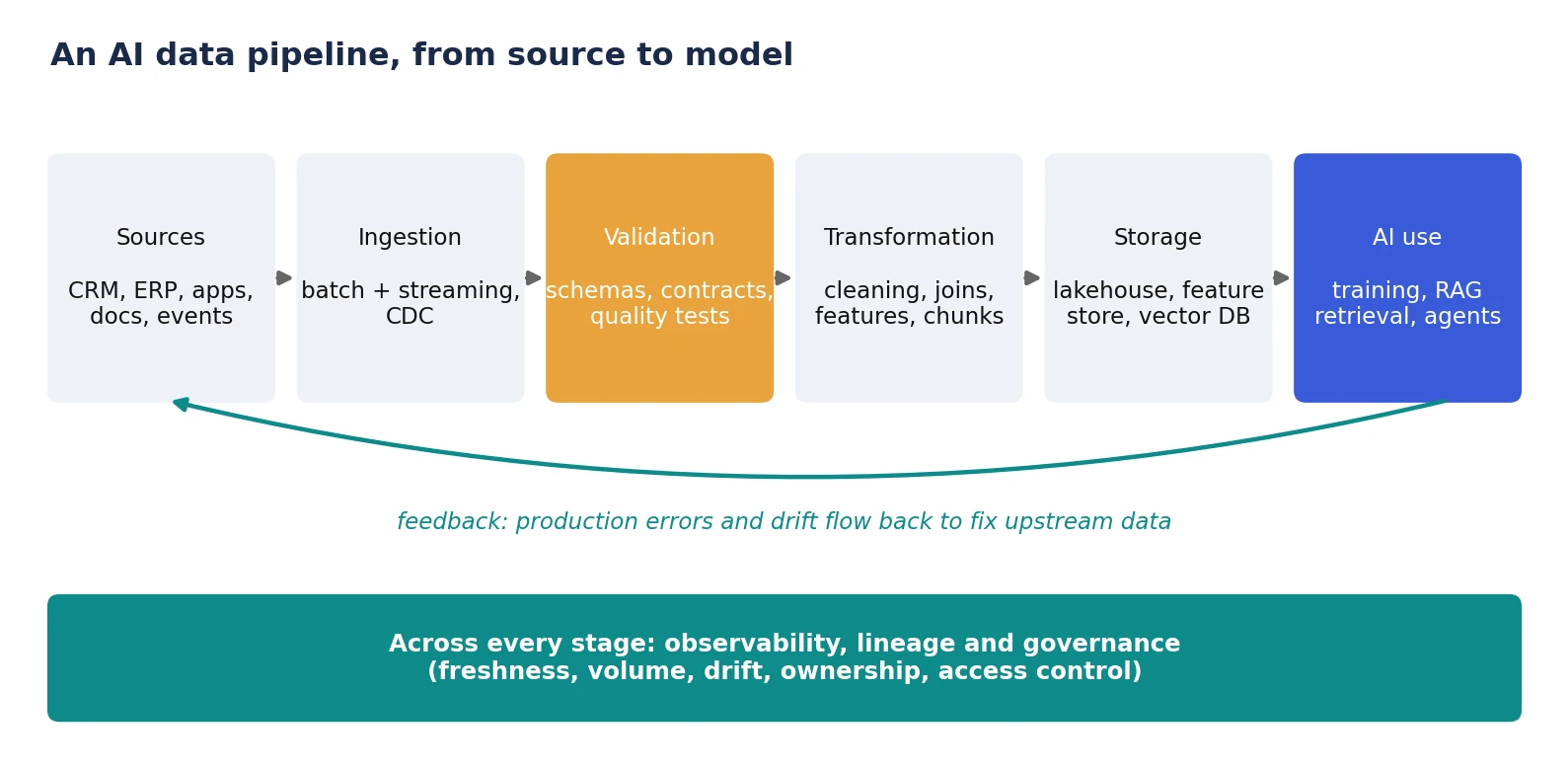
Data engineering for AI is the discipline of building and operating the pipelines that move data from source systems into a form models can learn from or retrieve at runtime. It covers ingestion, validation, transformation, storage, serving and monitoring, applied to two kinds of AI workloads: training and fine-tuning datasets, and live data feeds such as retrieval-augmented generation (RAG) indexes, feature stores and agent tool data.
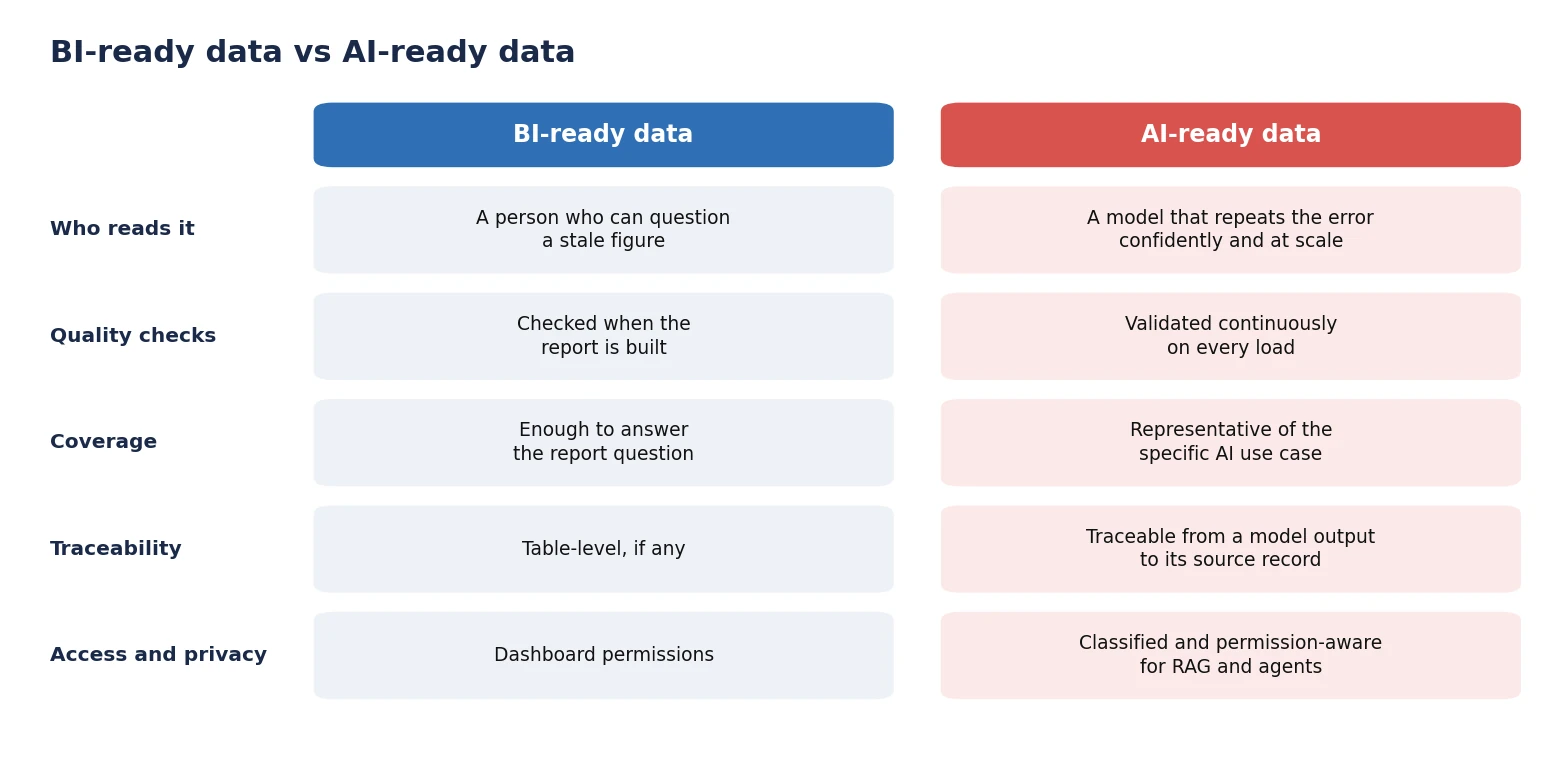
It differs from traditional analytics engineering in its tolerance for error. A dashboard with a stale figure misleads a person who can question it; a model trained or grounded on the same stale figure repeats the error confidently and at scale. Gartner’s guidance on AI-ready data makes the same distinction: AI-ready data must be representative of the specific use case and proven ready through metadata, governance and quality practices, and if the data has issues, it is not ready for AI.
Why Do Pipelines Decide Model Quality?
Pipelines decide model quality because every model behavior is downstream of a data decision. Which records were included, how labels were joined, when embeddings were refreshed and whether production features match training features all shape what the model learns and what it returns.
The evidence: AI projects fail on data
RAND’s 2024 study of AI project failure interviewed 65 experienced data scientists and engineers and identified five leading root causes. Two are data engineering problems: organizations lacking the data needed to train an effective model, and organizations lacking adequate infrastructure to manage data and deploy models. One interviewee in the RAND report summarized the work bluntly: 80% of AI is the dirty work of data engineering.
Gartner’s survey of data management leaders found that 63% of organizations either do not have or are unsure whether they have the right data management practices for AI. Its recommended steps include preparing data pipelines for both training datasets and live production feeds, and assuring data quality through DataOps and data observability.
The mechanism: data cascades
Google researchers call the compounding effect a data cascade. In their study of AI practitioners, based on interviews with 53 practitioners working on high-stakes AI, 92% of practitioners reported experiencing at least one data cascade. The cascades were described as pervasive, invisible, delayed and often avoidable. Google’s summary notes that cascades force costly system-level changes late in development and erode user trust through model mis-predictions.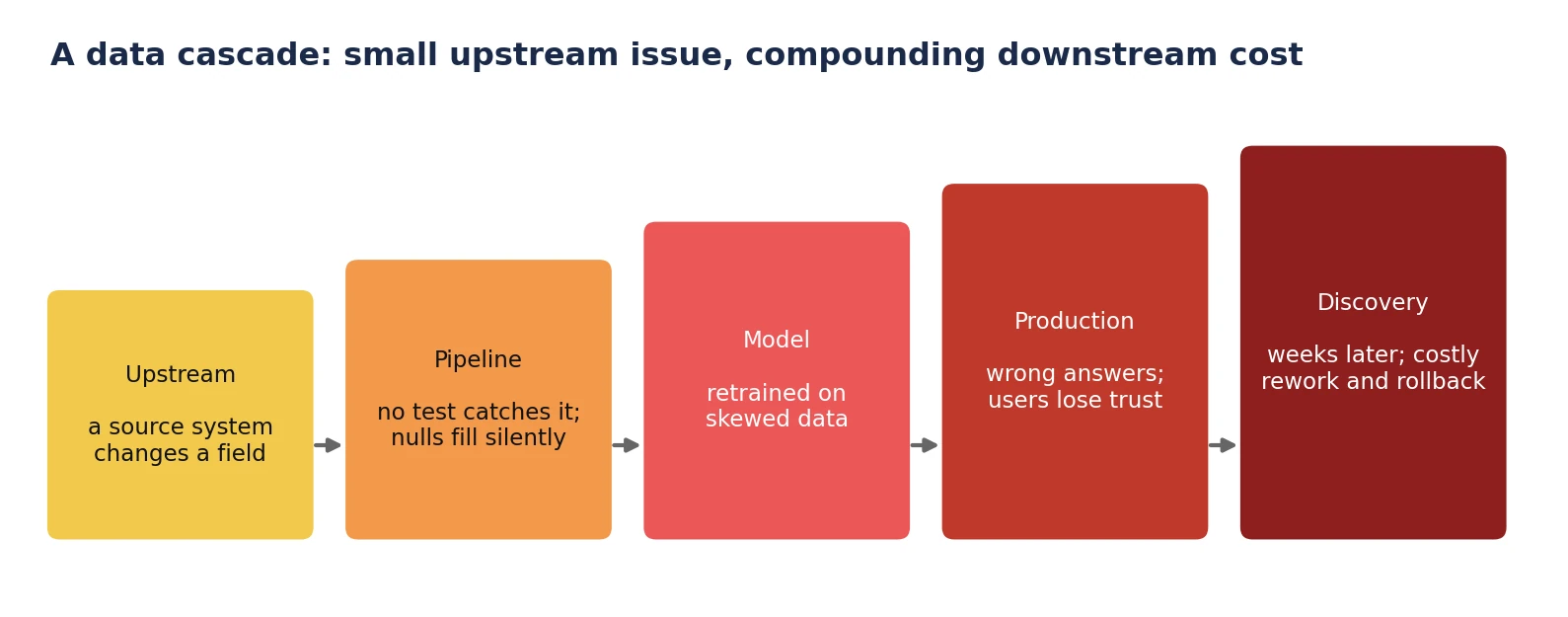
Where Do Data Pipelines Break Model Quality?
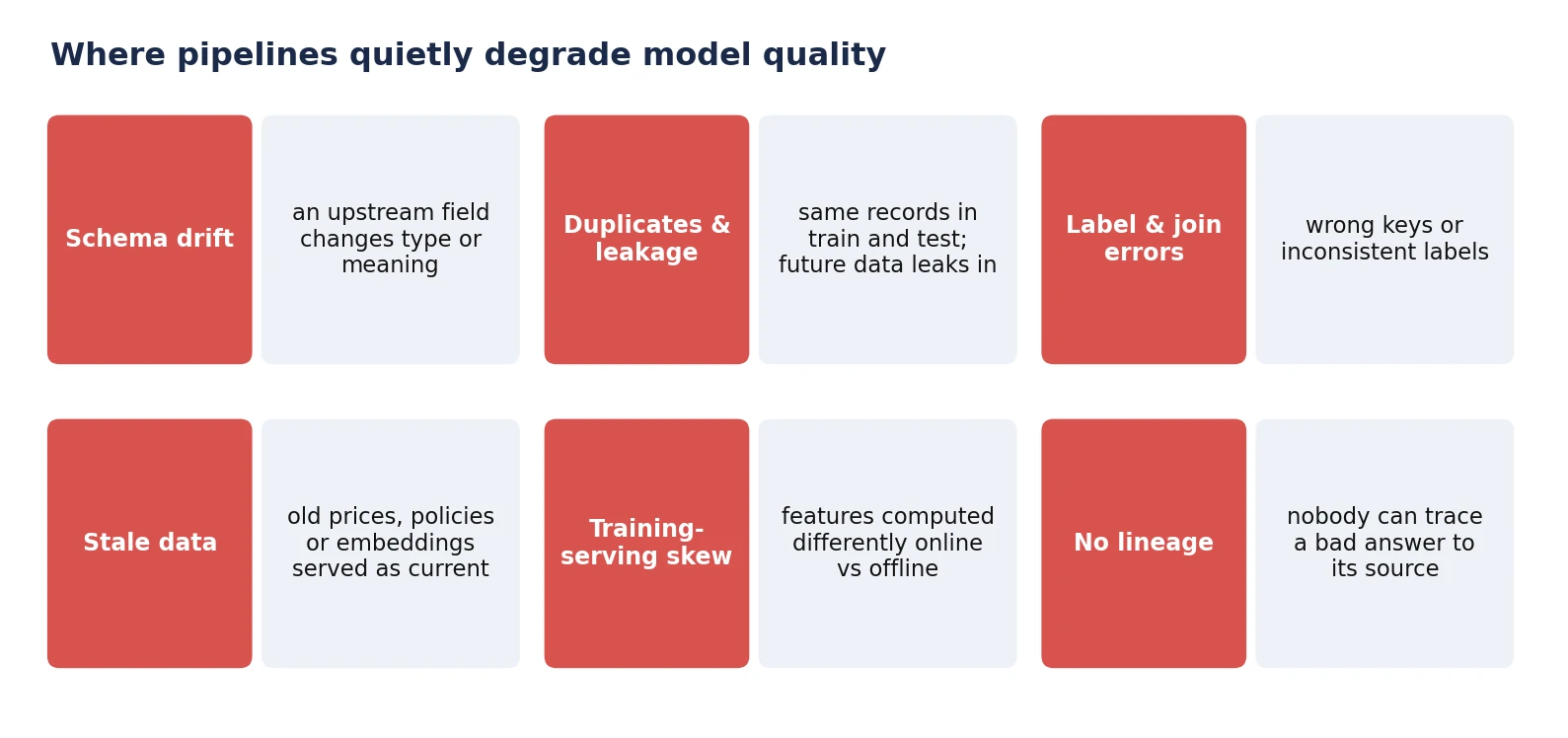
Data pipelines usually break model quality in six recurring ways. None of them raises an error by default, which is why they reach production.
| Pipeline defect | What happens to the model | Engineering control |
| Schema drift | Features silently become null or change meaning; predictions shift without code changes | Data contracts and schema validation at ingestion |
| Duplicates and leakage | Evaluation scores look excellent, then collapse in production | Deduplication, time-based splits, leakage checks |
| Label and join errors | The model learns the wrong relationships | Referential tests, label audits, reconciliation reports |
| Stale data and embeddings | RAG or agents answer with outdated facts | Freshness SLAs, incremental re-indexing, source timestamps |
| Training-serving skew | Accuracy in testing does not match accuracy in production | Shared feature definitions, a feature store, parity tests |
| Missing lineage | Bad outputs cannot be traced or fixed at the source | Column-level lineage and dataset versioning |
For RAG and agent systems, the same defects appear as retrieval problems: duplicate or outdated documents outrank current ones, chunks lose the context that made them meaningful, and permission metadata is dropped so the system retrieves content a user should not see. AB Ark covers the retrieval side of this in why RAG systems fail in production.
Talk to Our Team About Your Project ->
What Do Data Engineering Services for AI Include?
Data engineering services for AI should cover the full path from source to model, plus the controls that keep it trustworthy. A complete engagement typically includes:
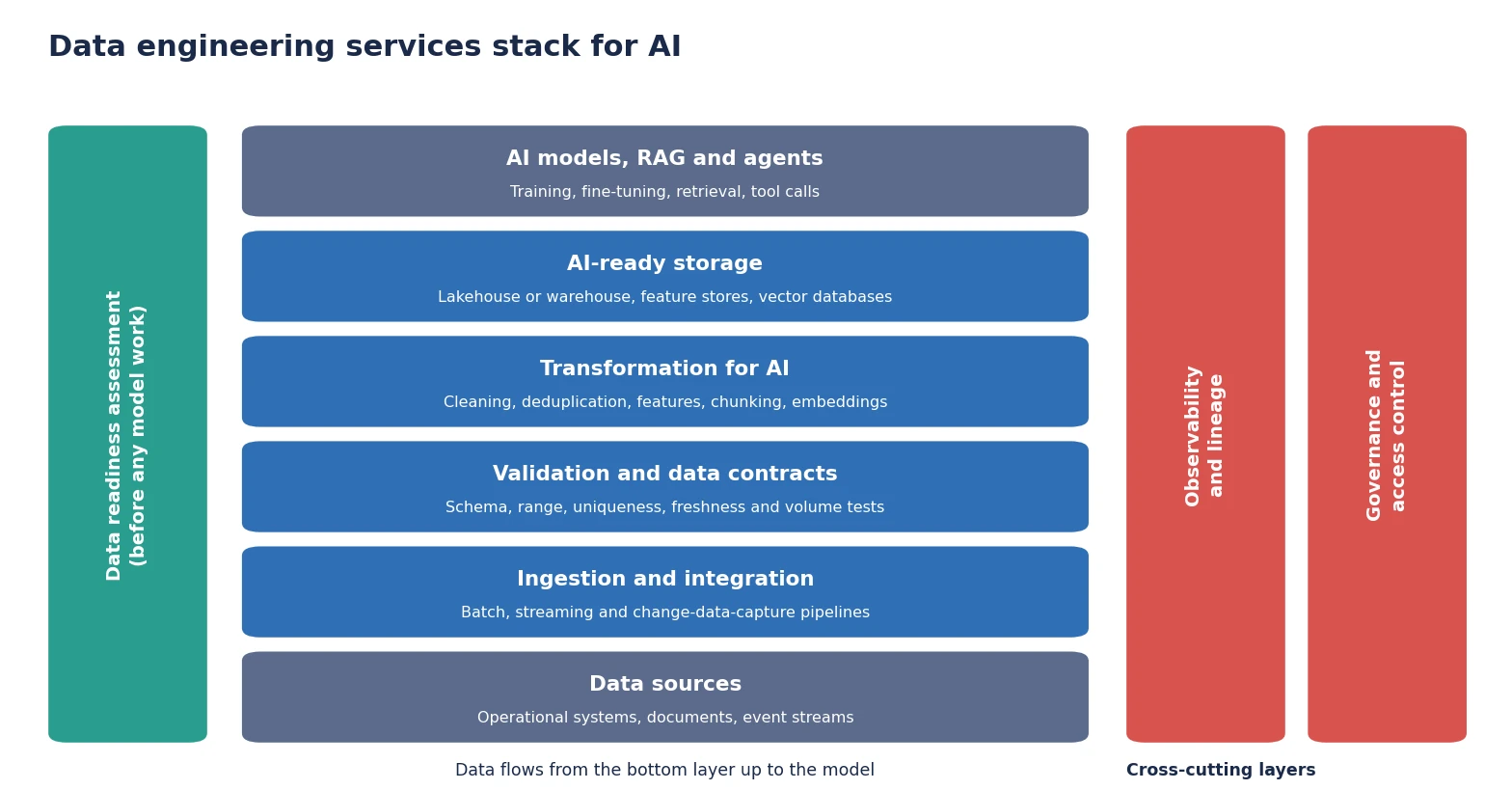 Data readiness assessment: mapping sources to the AI use case, profiling quality, and identifying gaps in coverage, labels and permissions before any model work begins.
Ingestion and integration: batch, streaming and change-data-capture pipelines from operational systems, documents and event streams.
Validation and data contracts: automated tests for schema, ranges, uniqueness, freshness and volume, with agreed ownership between producing and consuming teams.
Transformation for AI: cleaning, deduplication, feature engineering, document chunking and embedding generation, with versioned outputs.
AI-ready storage: lakehouse or warehouse layers, feature stores and vector databases designed around how models read data.
Observability and lineage: monitoring of freshness, drift and anomalies, plus lineage that links a model output back to its source records.
Governance and access control: classification of sensitive data, retention rules and permission-aware retrieval for RAG and agents.
Get a Custom Project Cost & Timeline Estimate ->
How Do You Know Your Data Is Not AI-Ready?
Your data is not AI-ready if your team cannot answer basic questions about it quickly. Use this quick self-assessment and count how many of the following apply to your team:
No one can say when a dataset or index was last refreshed, or which source a specific record came from.
Model accuracy in evaluation is consistently higher than accuracy reported by users.
Data scientists spend most of their time cleaning and re-joining data for each new project.
Schema or field changes in a source system have broken a model or report without warning.
Sensitive or permission-restricted data has no reliable tags, so it cannot be safely used for RAG or agents.
Three or more “yes” answers suggest your data is not AI-ready. These are pipeline problems, not model problems, and replacing the model is unlikely to fix them.
How Should You Evaluate a Data Engineering Services Partner?
Evaluate a data engineering partner on how they protect model quality, not just on the tools they use. This AB Ark checklist is an editorial framework, not an industry standard:
| Criterion | What to ask | Red flag |
| AI use-case alignment | How will you map data sources to our specific model or RAG use case? | Starts with tool selection before understanding the use case |
| Validation | Which automated tests run on every load, and who is alerted? | Quality checked manually or only at project end |
| Observability and lineage | Can you trace a model output to its source records? | No lineage beyond table level |
| Training-serving parity | How do you keep offline and online features identical? | Separate code paths for training and production |
| Governance | How are sensitive fields classified and permissions enforced in retrieval? | Access control handled “later” |
| Handover | What documentation, runbooks and ownership do we get? | Pipelines only the vendor can operate |
A credible partner should also be able to show a before-and-after example from a past engagement, with the data issue, the fix and the measured effect on model or retrieval quality.
AB Ark publishes results from related data-centric work. The Data Annotation Platform centralized image labeling and quality review for computer vision training data, and reports 1M+ images annotated at 98% quality accuracy with annotation 60% faster. QURI.AI, an AI redaction platform for medical documents, reports 500K+ documents processed at 99% detection accuracy.
How Do You Make Data AI-Ready? A Practical Sequence
Making data AI-ready works best as a sequence tied to one use case at a time:
- Define the use case and its data: name the decision or answer the model must produce and the sources it depends on.
- Profile and score readiness: measure completeness, freshness, duplication, label quality and access restrictions.
- Add contracts and tests at the source: stop bad data entering rather than cleaning it downstream.
- Build versioned, reproducible pipelines: so every training run and index can be recreated and compared.
- Instrument observability and lineage: alert on drift and freshness, and trace outputs to records.
- Close the loop: route production errors and user feedback back into data fixes, not only model retraining.
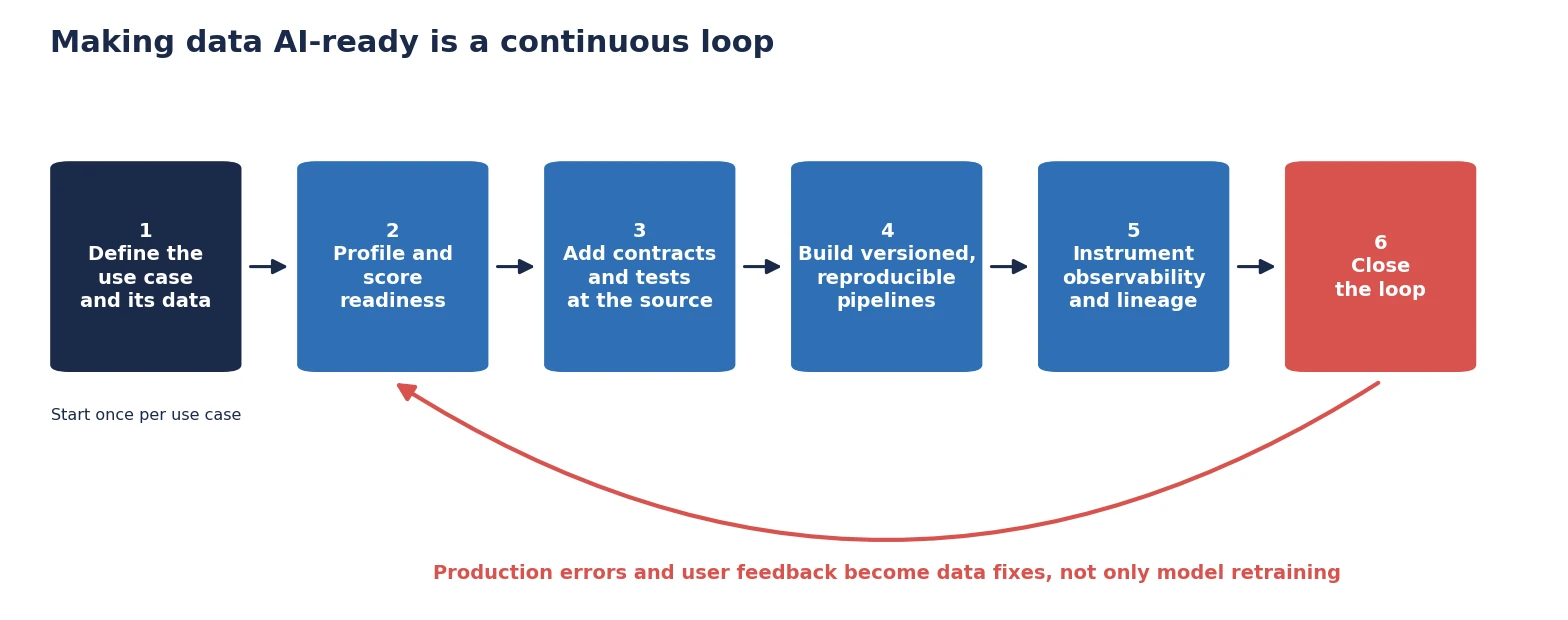
This mirrors Gartner’s own recommendations, which pair data pipelines for training and live feeds with continuous quality testing and observability. Teams building AI agents and automated workflows should apply the same sequence to the tools and data their agents can access.
FAQs
What are data engineering services?
Data engineering services design, build and operate the pipelines and platforms that collect, validate, transform, store and deliver data. For AI, they also cover feature stores, vector databases, embedding pipelines, observability and governance that keep model inputs accurate and current.
Why is data engineering important for AI?
Data engineering determines what a model learns and retrieves. Research from RAND and Google links AI project failures and downstream errors to data quality and infrastructure gaps, and Gartner predicted in February 2025 that 60% of AI projects lacking AI-ready data would be abandoned through 2026.
What is AI-ready data?
AI-ready data is representative of a specific AI use case, validated continuously, traceable to its source and governed for access and privacy. Data that works for dashboards is not automatically ready for training or retrieval.
What is the difference between a data engineer and a data scientist?
A data engineer builds and maintains the pipelines and platforms that supply data. A data scientist uses that data to build models and analyses. AI projects need both, and data engineering usually comes first.
How long does it take to make data AI-ready?
It depends on the number of sources, data quality and governance requirements. A focused readiness assessment for one use case is typically the first step, and the timeline for pipelines follows from what it finds.
Better models rarely rescue bad data. Better pipelines make ordinary models reliable. That is why data engineering, not model selection, often decides AI outcomes.
Schedule a Free Consultation Call ->
Engineering Manager At AB Ark Solutions