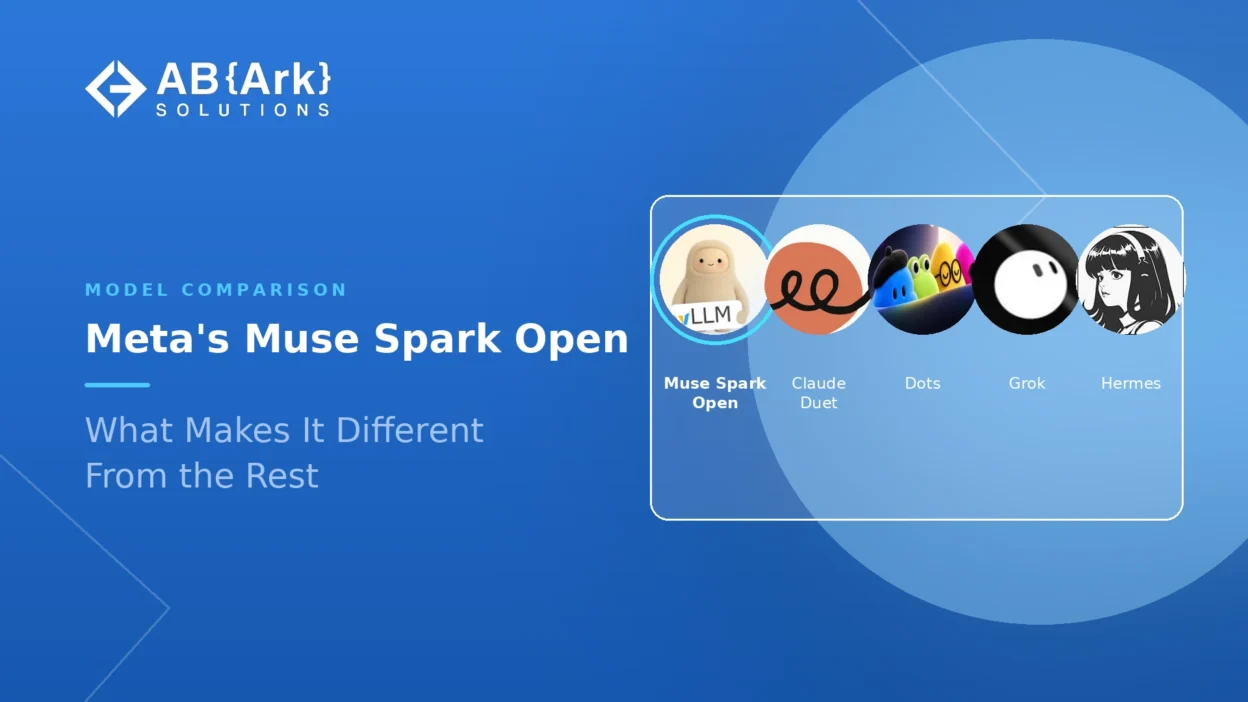

Muse Spark Open is an open-weight AI model; Anthropic’s Claude Duet, OpenAI’s dots, SpaceXAI’s Grok Bot and Nous Research’s Hermes Agent are always-on AI agents. That is the core difference. Meta released Muse Spark Open on October 15, 2026, as an 816B-parameter model (42B active) with a 1M-token context that anyone can download and build on. Claude Duet, dots and Grok Bot are managed agents locked to their vendors’ closed models, while Hermes Agent is an open-source agent that can run Muse Spark Open itself. For teams planning AI agent development, the real choice is whether to rent an agent or build one.
Key Takeaways
- Muse Spark Open is an engine, not a finished assistant. Claude Duet, dots, Grok Bot and Hermes Agent are agent products that plan, use apps and keep working in the background.
- Claude Duet, released as a research preview on October 21, 2026, runs on Claude Opus 5.5 for US Pro and Max subscribers; OpenAI dots run on GPT-6 Astra inside ChatGPT, Slack and Teams; Grok Bot runs on SpaceXAI’s Grok models through Cursor and SuperGrok plans. None of the three lets you swap in your own model.
- Hermes Agent is MIT-licensed, self-hosted and model-agnostic, so Hermes Agent plus Muse Spark Open is a fully open alternative to the managed agents.
- Muse Spark Open ships under Meta’s custom Muse Model License: free for most commercial use, with attribution and a separate agreement for large Model-as-a-Service providers.
- Self-hosting Muse Spark Open needs at least 700 GB of GPU memory or two Mac Studio M5 Ultra machines; hosted access costs about $1.25 / $4.25 per million tokens.
Talk to Our Team About Your Project ->
What Is Muse Spark Open?
Muse Spark Open is the open-weight version of Meta’s Muse Spark model, published by Meta Superintelligence Labs. Meta describes it as the most capable open-weight model from a US lab to date, built for coding, agentic work, long-horizon tasks and multi-step reasoning. Meta’s developer page explains that it derives from the Muse Spark model released in August, with extra safety post-training so it is more robust against misuse when deployed without system-level guardrails.
| Specification | Muse Spark Open |
| Architecture | Mixture-of-Experts transformer with a 1.8B-parameter Perception Encoder |
| Parameters | 816B total, 42B active per token (256 experts, 8 active) |
| Context window | 1M tokens at inference |
| Inputs / output | Text, image, video and audio in; text out |
| Languages | Trained on data from more than 100 languages |
| Weights | BF16 and NVFP4 on Hugging Face |
| Reasoning effort | low, medium, high, xhigh (default xhigh) |
| License | Muse Model License (custom) |
Source: Muse Spark Open model card. Meta also highlights a separate commentary channel that lets the model state its intent before acting, which helps developers audit what an agent built on it is about to do.
Why Is Meta Releasing Muse Spark Open, and How Does It Benefit Meta?
Muse Spark Open caps a year of strategy changes. Meta Superintelligence Labs launched the original Muse Spark on April 8, 2026 as a closed, proprietary model powering Meta AI, which many developers read as a retreat from the Llama-era open-weights strategy. In August, Meta reversed course, releasing the smaller Muse Glimmer under Apache 2.0 and promising open weights for its flagship. Muse Spark Open, released on October 15, 2026, delivers on that promise.
Meta does not sell model access as its core business, so giving away weights costs it relatively little. The likely benefits, based on Meta’s statements and industry analysis, are:
A two-track strategy: Meta keeps its most advanced proprietary models for its own apps, such as WhatsApp, Instagram, Facebook and Ray-Ban Meta glasses, while open weights win over developers. Analysts describe this hybrid as Meta positioning itself as a counterweight to Anthropic and OpenAI, which focus more on enterprise and government sales.
Developer distribution without a cloud business: Meta has no developer cloud comparable to AWS, Azure or Google Cloud. Open weights act as a distribution channel that puts Meta’s architecture into thousands of products, frameworks and hosting catalogs, including the seven API providers listed later in this article.
Free ecosystem work and talent: Every team that fine-tunes, quantizes or builds tools for Muse Spark Open improves the ecosystem around Meta’s models at no cost to Meta, and makes it easier to hire engineers who already know the stack.
Brand and commercial leverage through the license: The required “Built with Muse Spark Open” attribution spreads Meta’s brand through other companies’ products, and the separate agreement required for large Model-as-a-Service providers gives Meta leverage over the biggest commercial hosts.
Policy and geopolitical positioning: The open-weight frontier has been led by Chinese models such as GLM and Kimi, which appear in the benchmark table below. Zuckerberg has tied Meta’s releases to a US policy debate about keeping American developers competitive with foreign alternatives, and the strongest US open-weight model strengthens Meta’s voice in that debate.
Groundwork for on-device agents: Meta is building its own agent layer, such as the on-device Muse Code tests described below. A strong open model that runs on two Mac Studios supports Meta’s push for private, on-device AI across its hardware and apps.
For businesses, the benefit is the mirror image: a frontier-class model they can run, fine-tune and keep private without per-token fees to a closed vendor.
Why Compare a Model With Claude Duet, Dots, Grok Bot and Hermes?
Because all four are being sold as answers to the same question: how do I get AI to do real work, not just chat? They answer it at different layers of the stack. Claude Duet, dots, Grok Bot and Hermes Agent are agent layers that hold memory, connect to apps, run on a computer and decide what to do next. Muse Spark Open sits in the model layer underneath, supplying the reasoning that an agent uses.
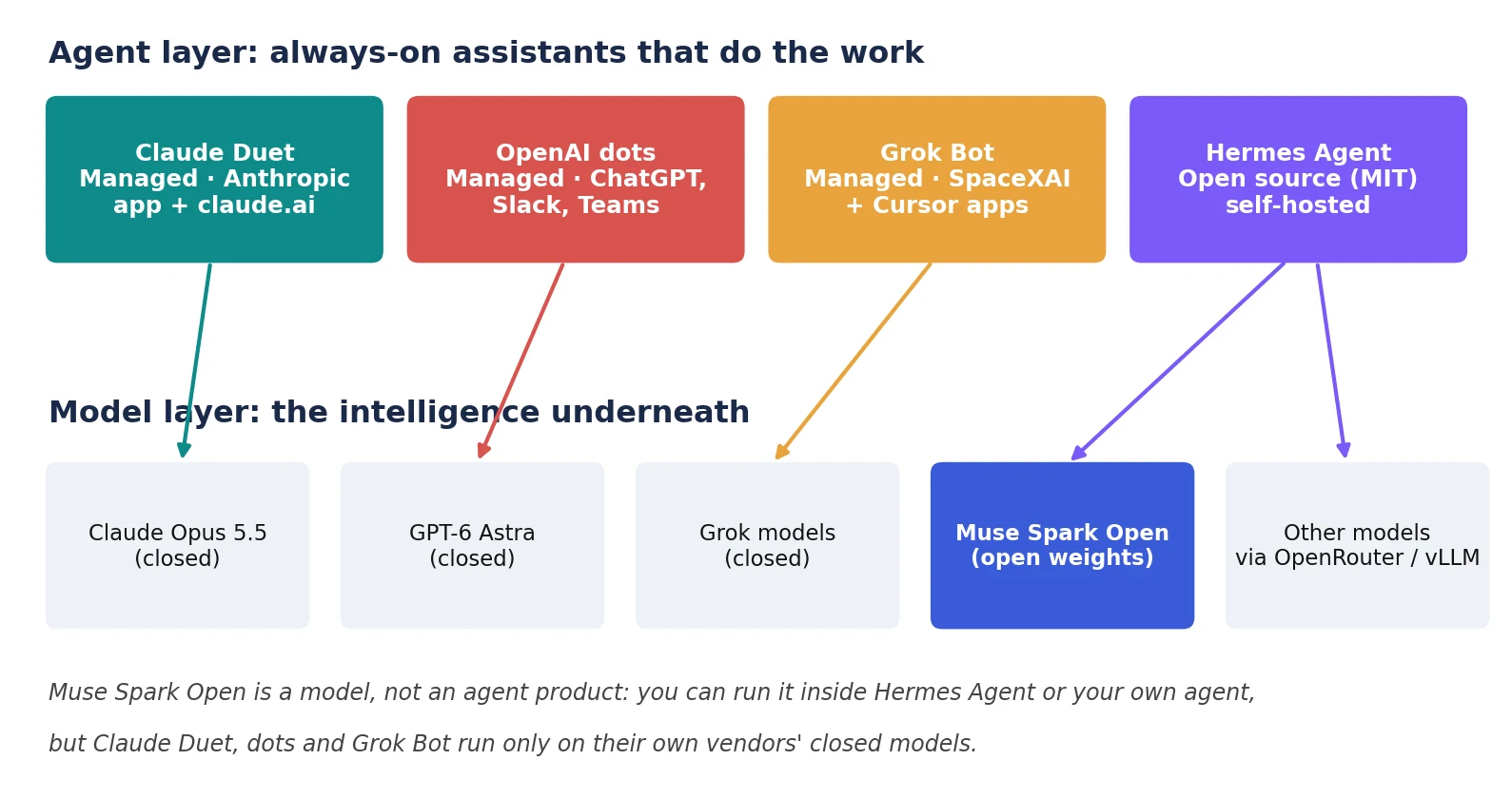
Meta has its own agent layer too: Meta reports testing Muse Code powered by Muse Spark Open entirely on-device, shipping real iOS changes to an open-source Mastodon client and driving DaVinci Resolve end to end.
Why Are These Companies Competing for the Agent Layer?
Chat assistants answer questions; agents finish work. Whoever owns the agent a person or team relies on every day controls where that work happens, which apps it touches and which model gets paid to do it. That is why five very different organisations are converging on the same market.
Recurring revenue: Background agents keep consuming tokens and justify higher-priced plans. Claude Duet, dots and Grok Bot are all bundled into premium tiers such as Claude Max, ChatGPT Pro and Cursor Ultra, turning agents into a reason to upgrade.
Lock-in through memory and connectors: An agent that holds your memory, preferences, learned routines and thousands of app connections is hard to replace. Switching means retraining a new assistant from scratch, so the first agent a company adopts tends to stay.
Better models from real-world use: Agents that act inside real apps generate feedback on what works and what fails, which helps vendors improve their next models and safety systems.
Different starting points: Each company competes from a different strength. Anthropic builds on Claude’s reputation for careful, permissioned work with professionals; OpenAI leverages ChatGPT’s user base and Slack and Teams distribution; SpaceXAI pairs Grok with Cursor’s developer audience; Nous Research wins users who want an open, self-hosted agent; and Meta supplies the open model layer that independent agents, including Hermes, can run on.
For buyers, this competition means rapid feature releases and bundled pricing, but also a real risk of lock-in. That makes the rent-or-build decision covered in this article a strategic one, not just a technical one.
How Do Muse Spark Open, Claude Duet, Dots, Grok Bot and Hermes Agent Compare?
Before the side-by-side table, here is what each option is and the work it is built to do.
Muse Spark Open (Meta): Meta’s open-weight model, not an agent. Teams download or rent it to power their own products: coding assistants, document and video analysis across a 1M-token context, multilingual chatbots and custom agents that run privately on their own hardware.
Claude Duet (Anthropic): A proactive assistant app for professionals and small business owners, running on Claude Opus 5.5. It sends a morning brief, monitors email, calendar and connected business apps every few hours, drafts replies, books meetings, researches and fills forms in its own browser, and asks for approval before sending, paying, signing or deleting.
OpenAI dots: Always-on agents inside ChatGPT, Slack and Teams, powered by GPT-6 Astra. Each dot has its own cloud computer and works across 4,000+ apps: preparing reports, tracking projects, following up on tasks and doing background research, within Custom Rules set by the team.
Grok Bot (SpaceXAI): Agent teammates built with Cursor that sign in to your tools like a person would. Bots run in parallel 24/7, hand work to each other and learn a workflow after watching you do it once, which suits repetitive operations, data entry and developer tasks.
Hermes Agent (Nous Research): An open-source, self-hosted agent framework. It runs on your server or laptop, remembers context, writes its own reusable skills, schedules jobs and controls a browser, and you talk to it through Telegram, Slack, WhatsApp, Discord, Signal or a terminal. It can use any model, including Muse Spark Open.
| Attribute | Muse Spark Open | Claude Duet | OpenAI dots | Grok Bot | Hermes Agent |
| What it is | Open-weight model | Proactive agent app (research preview) | Managed always-on agent | Managed agent teammates | Open-source agent framework |
| Publisher | Meta | Anthropic | OpenAI | SpaceXAI with Cursor | Nous Research |
| Model underneath | Itself | Claude Opus 5.5 | GPT-6 Astra | SpaceXAI Grok models | Any: Nous Portal, OpenRouter, vLLM, custom |
| Where it runs | Your hardware or 7 API hosts | Virtual machine with its own browser | OpenAI cloud computer | SpaceXAI cloud computer | Your server, laptop, Docker or SSH |
| Access and price | Free weights; ~$1.25 / $4.25 per 1M tokens hosted | Included in Pro and Max (US, waitlist); shares plan limits | ChatGPT Pro, Business Premium; Enterprise beta | Cursor Ultra $200/mo; Premium Teams $120/seat; SuperGrok Heavy | Free, MIT; you pay for the model |
| Where you talk to it | API | iOS, Android, claude.ai; text or voice | ChatGPT, Slack, Teams, voice | Desktop and iOS apps | Telegram, Discord, Slack, WhatsApp, Signal, CLI |
| Apps it can use | Whatever you build | 6,000+ connectors and plugins | 4,000+ apps via plugins | Signs into your apps and sites | Browser control, 40+ built-in skills |
| Memory and learning | None built in | Carries over Claude memory and skills | Learns preferences | Learns routines by watching | Persistent memory; writes own skills |
| Data location | Wherever you deploy it | Anthropic cloud | OpenAI cloud | SpaceXAI cloud | Local, in ~/.hermes |
Sources: Muse Spark Open model card, Anthropic’s Claude Duet announcement, OpenAI’s dots announcement, SpaceXAI’s Grok Bot page and Hermes Agent, checked October 22, 2026.
Muse Spark Open vs Claude Duet
Anthropic opened a research preview of Claude Duet on October 21, 2026, describing it as an app where Claude works as a proactive agent for professionals and small business owners. It is built around Claude Opus 5.5, sends a morning brief on what matters across connected apps, checks those accounts every few hours, and messages only when something needs attention. It runs on a virtual machine with its own browser, so work continues when your laptop is closed, and it carries over the memory, skills and connected apps from an existing Claude account.
Claude Duet’s distinguishing feature is how strictly it gates actions. Before it sends a message, makes a payment, signs a document or deletes anything, it shows exactly what it will do and waits for approval; some actions, such as trading securities or moving money between accounts, are blocked even with approval. Anthropic says Duet never directly sees passwords or sign-in tokens, and a dedicated classifier blocks sharing of the most sensitive data, such as card numbers and government IDs. Purchases go through Stripe’s Link wallet with a virtual card.
The limits are those of an early preview: Anthropic notes it may misread a thread or misjudge urgency, cannot yet show its browser, lives in a separate app, and is available only by waitlist to US Pro and Max subscribers. Background checks also count toward plan usage limits. Like dots and Grok Bot, it runs only on its vendor’s models, which is the point of contrast with Muse Spark Open.
Muse Spark Open vs OpenAI dots
OpenAI launched dots on September 29, 2026 as always-on agents powered by GPT-6 Astra. Each dot has its own cloud computer and browser, connects to more than 4,000 apps through plugins, and can be messaged or called in ChatGPT, Slack and Teams. Dots learn a user’s preferences over time and do “proactive research” in the background using read-only tools.
The strength of dots is control built for non-developers: Custom Rules decide what a dot may do alone, an auto-review step checks risky actions against instructions, and sensitive tasks such as password changes always stay with the user. OpenAI says it does not train on Business, Enterprise or Edu workspace content by default. The trade-off is lock-in. Dots run only on OpenAI’s models, inside OpenAI’s cloud, on eligible paid plans.
Muse Spark Open gives a development team the opposite: no agent, no memory and no app connectors out of the box, but full control over where the model runs, how it is fine-tuned and what data it ever sees.
Muse Spark Open vs Grok Bot
Grok Bot is SpaceXAI’s agent product, built with Cursor and launched in early beta on August 11, 2026. Bots sign in to your tools and use them as a person would, run in parallel 24/7, pass work between each other, and can learn a workflow by watching you complete it once. Access currently comes through Cursor Ultra at $200 a month, Cursor Premium Teams at $120 per seat, or SuperGrok Heavy, with apps for macOS, Windows, Linux and iOS.
Grok Bot is tied to SpaceXAI’s Grok models and its cloud. One review of the setup documentation notes that Bots share a cloud computer rather than each having a separate machine, and that reliability, authentication and audit details are still thinly documented. SpaceXAI advises users to review approvals, security and privacy settings before connecting sensitive systems. Muse Spark Open, by contrast, lets you decide the security model yourself because you operate the whole stack.
Muse Spark Open vs Hermes Agent
Hermes Agent is the closest relative in philosophy. Nous Research’s project is an MIT-licensed, self-hosted agent with persistent memory, automatically created skills, a scheduler, parallel sub-agents, browser control and a messaging gateway for Telegram, Discord, Slack, WhatsApp and Signal. All memory stays in a local folder and there is no telemetry. TechCrunch reported about 214,000 GitHub stars by July 2026.
Hermes Agent and Muse Spark Open are complementary rather than competing. Hermes Agent supports any OpenAI-compatible endpoint and local vLLM, and Muse Spark Open serves through vLLM and SGLang with an OpenAI-compatible API. Together they form a fully open stack: an open agent framework running on an open-weight model, which is the realistic self-hosted alternative to Claude Duet, dots and Grok Bot.
How Good Is Muse Spark Open on Benchmarks?
Meta reports strong agentic and multimodal results, but compares Muse Spark Open only with other open-weight models. The agent products in this article do not publish comparable benchmarks for themselves. On Meta’s model card, at xhigh reasoning effort, Muse Spark Open leads its comparison set on JobBench (61.8), MCP-Atlas (89.2), HLE-Diamond without tools (26.1) and ZeroBench with tools (50.0), but trails GLM 5.3 and Kimi K3 on the Artificial Analysis Intelligence Index and Terminal-Bench 2.1.
| Benchmark (Meta-reported) | Muse Spark Open | GLM 5.3 (max) | Kimi K3 (max) |
| AA Intelligence Index | 39 | 45 | 44 |
| JobBench | 61.8 | 61.4 | 54.3 |
| MCP-Atlas (tool use) | 89.2 | 84.2 | 82.3 |
| Terminal-Bench 2.1 | 76.4 | 83.9 | 85.0 |
| DeepSWE 1.1 | 60 | 67 | 68 |
| OSWorld Verified (computer use) | 80.4 | not reported | 84.8 |
MCP-Atlas and OSWorld matter most here, because tool calling and computer use are exactly what agents like Claude Duet, dots and Grok Bot do. Independent results are more mixed: OpenRouter’s listing shows Vals AI scores of 76.2% on Vibe Code Bench v1.1 and 60.7% on Finance Agent v2.1, but only 6.6% on the harder, newer Terminal-Bench 4.0. Harnesses differ, so treat that gap as a reason to test on your own tasks.
Where Can You Run Muse Spark Open?
Muse Spark Open can run through hosted APIs, cloud model catalogs, your own GPU cluster or a pair of desktop computers.
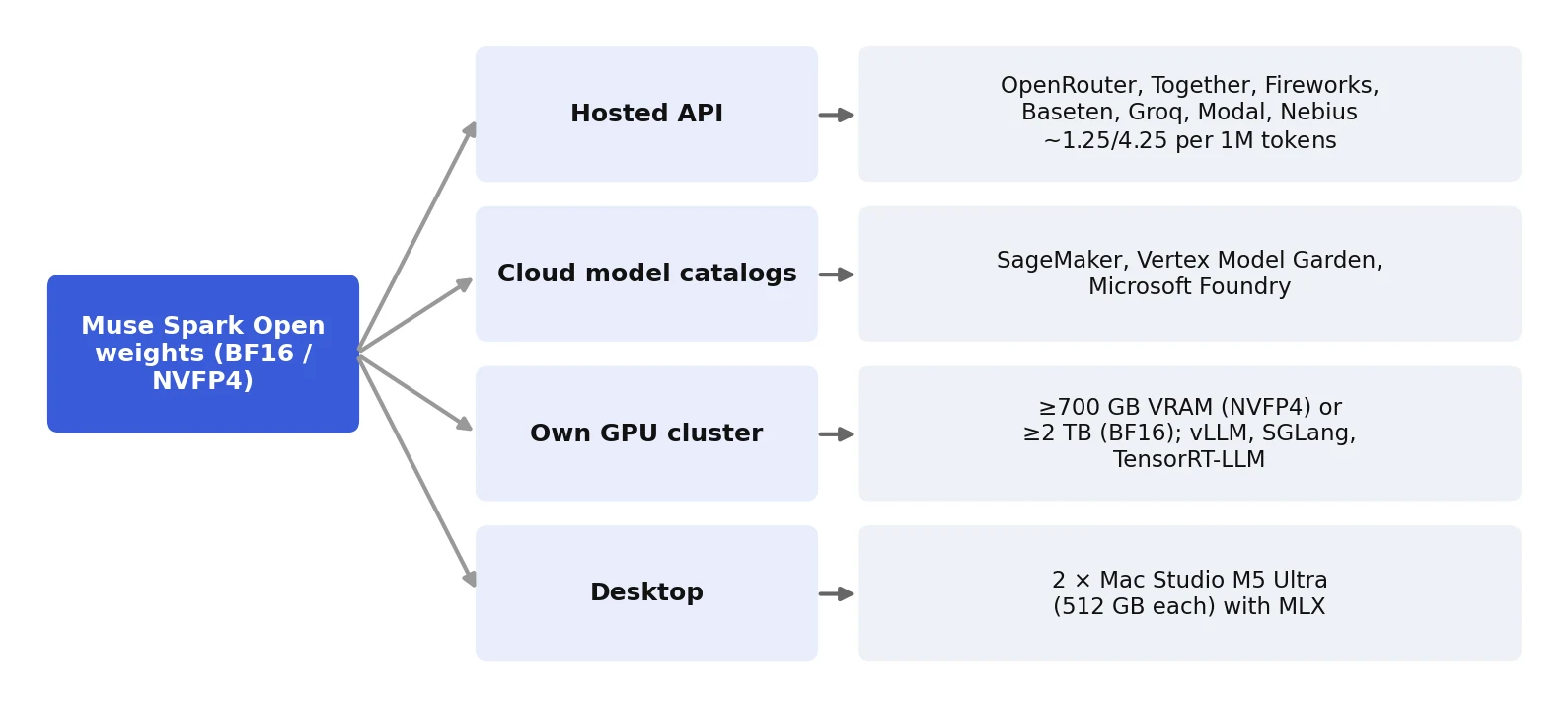
Hosted APIs: Meta lists Baseten, Fireworks AI, Groq, Modal, Nebius, OpenRouter and Together AI. On OpenRouter, providers charge $1.25 input, $4.25 output and $0.15 cached input per million tokens, with the fastest showing about 180 tokens per second. OpenRouter notes the model is not available through its EU in-region routing.
Own GPUs: The model card states a minimum of 700 GB of GPU memory for NVFP4 weights and about 2 TB for BF16, using SGLang, vLLM, TensorRT-LLM, Transformers, Unsloth or llama.cpp.
Desktop: Meta optimised the model for two Mac Studio M5 Ultra machines running MLX, each with up to 512 GB of unified memory. That makes a private, on-premise agent feasible for development work, something none of the managed agents can offer.
LM Studio also hosts a cloud version with text and vision input; its listing notes that audio and video are not exposed there.
What Does the Muse Model License Allow?
The Muse Model License is permissive for most businesses but is not open source in the Apache or MIT sense. Under the license text, anyone may use, modify, fine-tune, distill and sell the model, subject to these conditions:
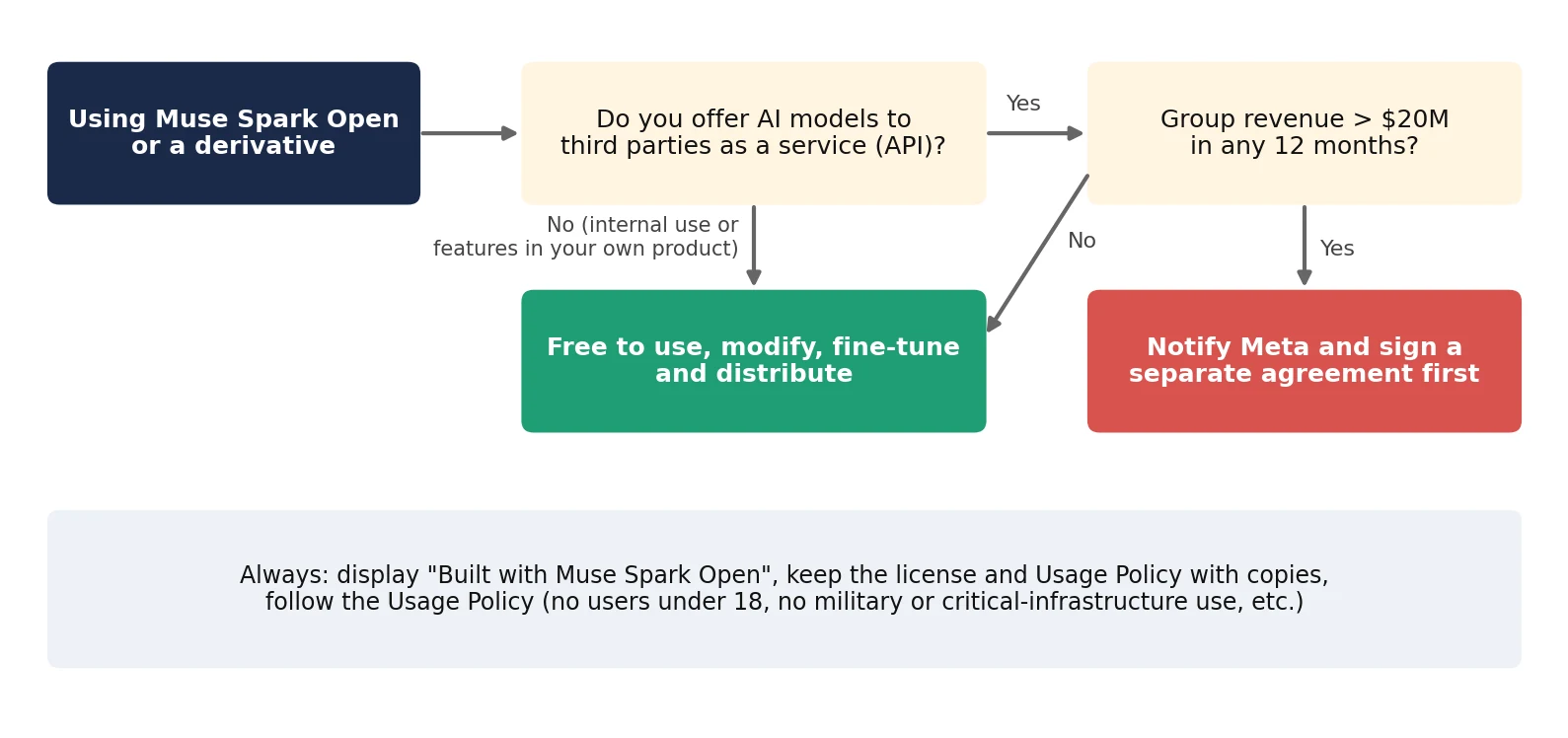
Attribution: products using the model or a derivative must display “Built with Muse Spark Open”.
Model-as-a-Service threshold: a company with group revenue above $20M in any 12 months must notify Meta and sign a separate agreement before offering the model to third parties as a service. Internal use and features inside your own product are exempt.
Broad derivatives: models trained on Muse Spark Open’s outputs count as derivatives.
Usage policy: prohibits uses such as military and critical-infrastructure applications; the model is not intended for users under 18.
A company building its own always-on agent on Muse Spark Open for internal teams is generally on the simple side of this license; a company reselling a hosted Muse-based agent at scale is not. Hermes Agent’s MIT license adds no such conditions, while Claude Duet, dots and Grok Bot are governed by their vendors’ subscription terms.
How Safe Is Muse Spark Open for Agent Use?
Meta reports strong refusal results for an open-weight model. On the model card, Muse Spark Open scores 0.5 on StrongREJECT v2 (lower is better) against 62.9 to 86.4 for other open models, refused 99.2% of jailbreaks on Meta’s internal cyber benchmark, and showed a 0% misbehaviour rate on the Agentic Misalignment benchmark. These are Meta’s own evaluations.
The difference from the managed agents is who builds the guardrails. Claude Duet requires approval before sending, paying, signing or deleting and blocks some actions outright; dots ship with auto-review, Custom Rules and monitoring that can pause a dot; Grok Bot relies on approvals; Hermes Agent offers container hardening and local data. With Muse Spark Open, Meta recommends that developers add their own: use-case guardrails, human confirmation for irreversible actions, protection of internal messages from manipulation, and not exposing raw chain-of-thought. Meta’s data also shows a higher over-refusal rate than peers on FORTRESS (17.4), so expect some legitimate requests to be declined.
Which Should You Choose?
Choose by who should own the agent and the data. This AB Ark selection guide is an editorial framework, not an industry standard.
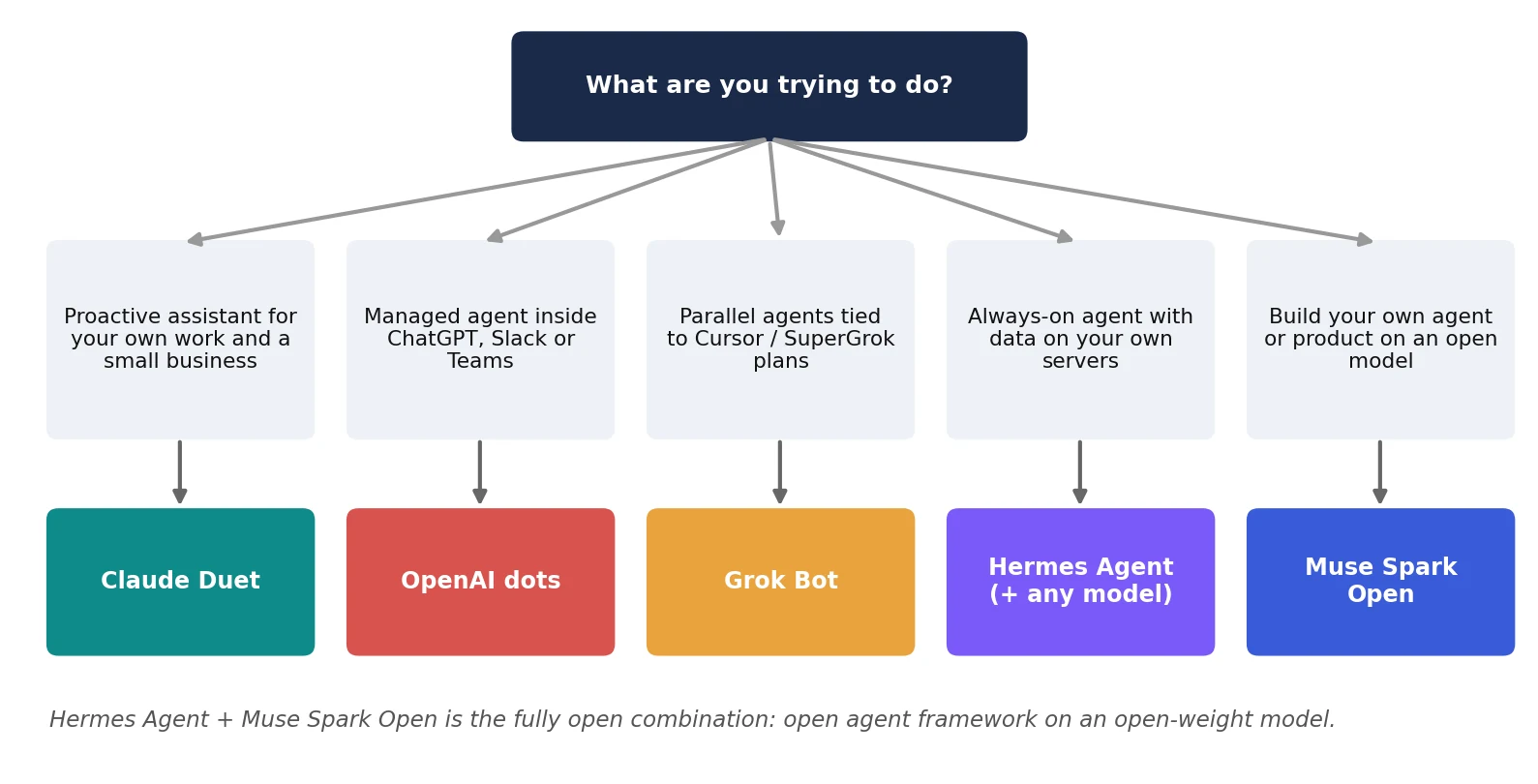
Figure 4. Choosing between Claude Duet, OpenAI dots, Grok Bot, Hermes Agent and Muse Spark Open. AB Ark diagram.
Choose Claude Duet when you are a professional or small business owner in the US who already uses Claude and wants a proactive assistant with strict approval gates, and can wait for the research preview.
Choose OpenAI dots when your team already lives in ChatGPT, Slack or Teams and wants a managed agent with mature approval controls.
Choose Grok Bot when your team already pays for Cursor Ultra or SuperGrok Heavy and wants parallel agents that learn routines by demonstration.
Choose Hermes Agent when you want an always-on agent you host yourself, with your data on your own machines and freedom to switch models.
Choose Muse Spark Open when you are building your own agent or AI product and need an open, self-hostable model with a 1M-token context and native multimodal input, and can meet its license terms.
Many teams will combine layers: Hermes Agent or a custom agent on Muse Spark Open for sensitive internal workflows, and a managed agent for everyday productivity. Whatever you shortlist, test it on 50 to 100 real tasks with your own approval rules; the agent scaffolding changes results as much as the model, a point AB Ark covers in its guide to why RAG systems fail in production.
Get a Custom Project Cost & Timeline Estimate ->
FAQs
Is Muse Spark Open an AI agent like Claude Duet, OpenAI dots or Grok Bot?
No. Muse Spark Open is an open-weight model. Claude Duet, dots and Grok Bot are agent products with memory, app connections and their own cloud computers. You can build an agent on Muse Spark Open, or run it inside an agent framework such as Hermes Agent.
Can Hermes Agent run Muse Spark Open?
In principle, yes. Hermes Agent supports any OpenAI-compatible endpoint and local vLLM, and Muse Spark Open is served through vLLM, SGLang and hosted APIs with OpenAI-compatible interfaces. Test tool-calling behaviour before relying on the combination.
Is Muse Spark Open open source?
It is open-weight, not open source in the OSI sense. The weights can be downloaded, modified and sold, but the Muse Model License adds attribution, a Model-as-a-Service revenue threshold and a usage policy.
How much does Muse Spark Open cost compared with Claude Duet, dots and Grok Bot?
Muse Spark Open’s weights are free, and hosted access costs about $1.25 per million input tokens and $4.25 per million output tokens on OpenRouter. Claude Duet is included in Claude Pro and Max plans during its US research preview; dots are included in eligible ChatGPT Pro and Business Premium plans; Grok Bot comes with Cursor Ultra at $200 a month or SuperGrok Heavy.
Can I run Muse Spark Open locally?
Yes, with large hardware: at least 700 GB of GPU memory for NVFP4 weights, or two Mac Studio M5 Ultra machines using MLX.
Claude Duet, dots and Grok Bot sell you a finished AI teammate. Hermes Agent gives you the open framework to run one. Muse Spark Open gives you the open model to power it. The right choice depends on how much of the stack you want to own.
Schedule a Free Consultation Call ->
CEO At AB Ark Solutions