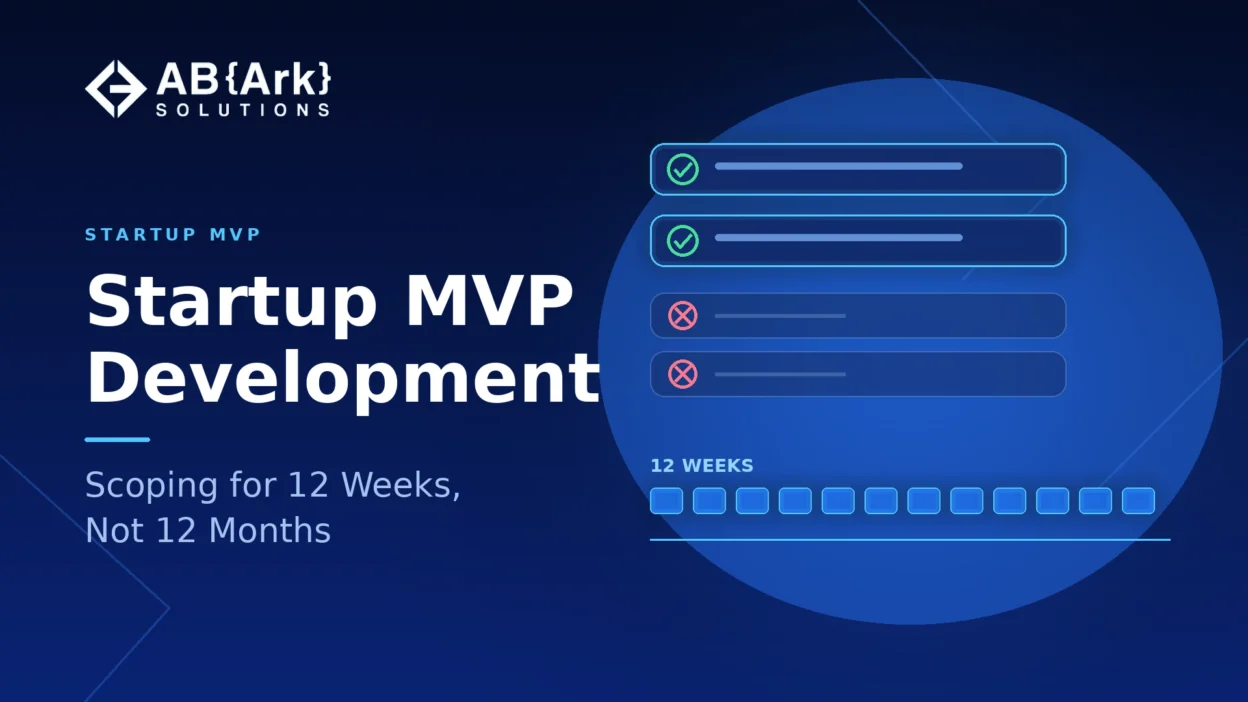
In startup MVP development, a product fits into 12 weeks when the scope is built around one target user, one core job and one success metric, with everything else cut, faked manually or bought off the shelf. MVPs drift to 12 months when founders scope features instead of the riskiest assumption they need to test. Fix the time box first, then let the scope flex to fit it, not the other way round.
Key Takeaways
- An MVP exists to test a business assumption with real users, not to launch a smaller version of the full product.
- Lock the time box (12 weeks) and the budget, and treat scope as the only variable.
- Write the scope as one user, one job and one metric; any feature that does not serve that sentence waits for version 2.
- Use manual workarounds, no-code tools and third-party services for everything that is not your core differentiator.
- Agree before week 1 what result at week 12 would mean continue, change direction or stop.
Talk to Our Team About Your Project ->
Why Startup MVPs Drift From 12 Weeks to 12 Months
MVPs rarely start as 12-month projects. They become 12-month projects one reasonable-sounding feature at a time: a second user type, an admin panel, payments, notifications, integrations, a mobile app alongside the web app. Each addition delays the moment real users test the core idea, which is the only reason the MVP exists.
The cost of that delay is measured in runway. CB Insights’ March 2026 analysis of 431 venture-backed startups that shut down since 2023 found that running out of capital was cited in 70% of cases, but usually as the final cause rather than the root problem. Among the 385 companies whose reasons could be identified, poor product-market fit was cited by 43%, bad timing by 29% and unsustainable unit economics by 19%. The same analysis found a median of 22 months between a company’s last fundraise and its shutdown.
Read together, those numbers make the case for a short MVP. A 12-month build uses more than half of that 22-month median before the market has answered the most common reason startups fail. A 12-week build leaves time to learn, adjust and try again.
Common drift patterns, and what each delays:
| Drift pattern | Why it feels necessary | What it actually delays |
|---|---|---|
| Building for every user type | “Buyers and sellers both need to use it” | Learning whether either side wants the core value |
| Full admin and back office | “We need to manage it properly” | Work a founder could do manually for the first users |
| Polished design system | “First impressions matter” | Testing whether the product solves the problem at all |
| Native mobile plus web | “Users expect both” | Two front ends to build and test before any validation |
| Integrations with every tool | “Customers won’t switch otherwise” | Proof that customers want it enough to try |
| Scaling infrastructure | “What if it goes viral?” | Effort spent on a problem you would be happy to have |
How to Scope a Startup MVP for 12 Weeks: The One-Sentence Scope
A 12-week startup MVP starts with a single sentence that names one user, one job and one metric. If the team cannot agree on that sentence, the scope is not ready, no matter how detailed the feature list is. This is the AB Ark one-sentence scope, an editorial framework drawn from MVP practice rather than a published standard:
Every proposed feature is then tested against that sentence. If it does not help that user complete that job, or help you measure that metric, it waits for version 2.
Find the riskiest assumption first
Behind every MVP is an assumption that, if wrong, makes the rest of the plan irrelevant. Usually it is one of three: users have this problem badly enough to change behaviour; they will use this solution to solve it; or they will pay enough for it to build a business. Scope the MVP to test the riskiest of the three first. A feature that tests a less risky assumption is a feature you can defer.
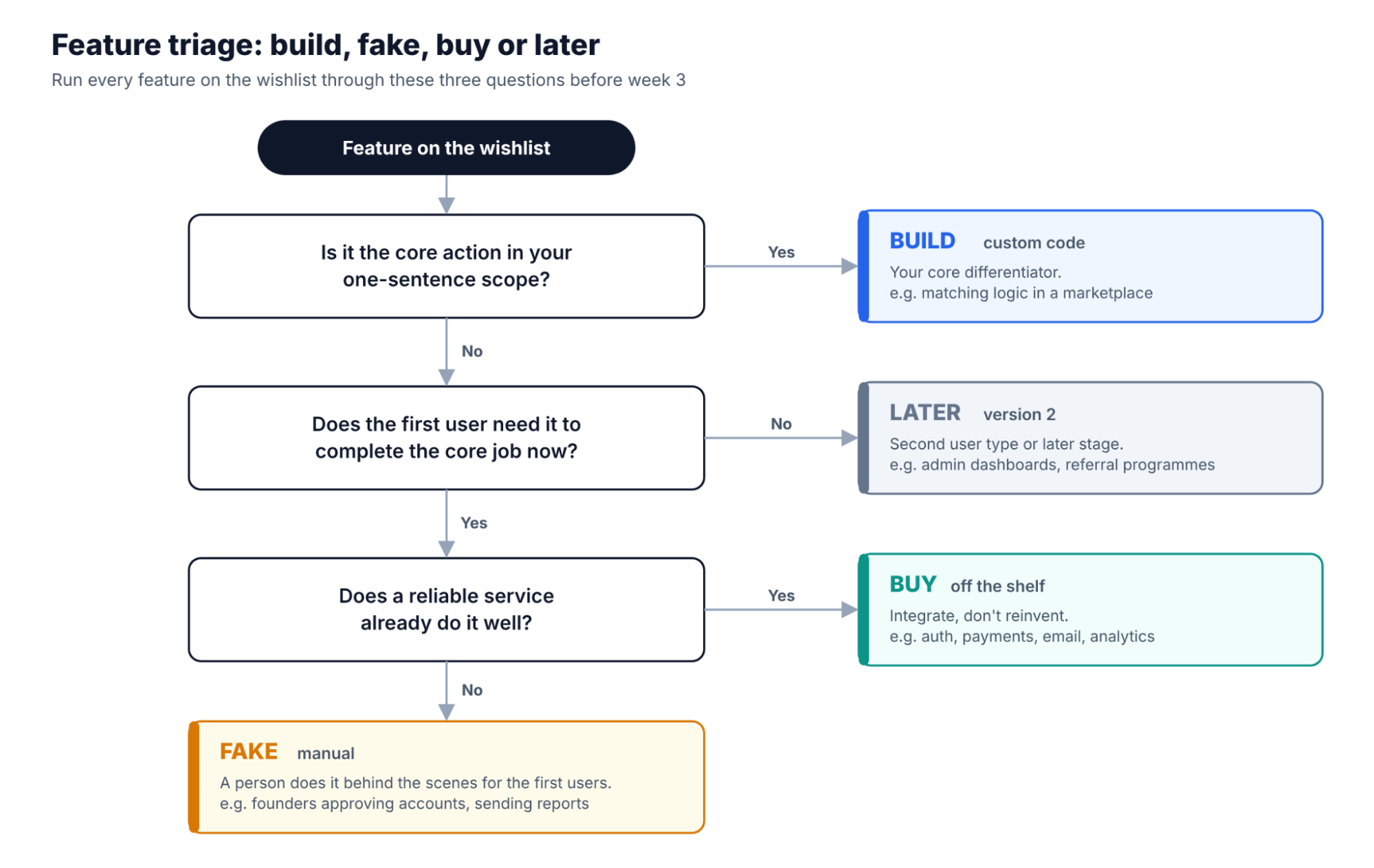
Triage every feature into build, fake, buy or later
| Decision | Use it when | Example |
|---|---|---|
| Build | The feature is the core action in your scope sentence, or your differentiator | The matching logic in a marketplace; the analysis in a reporting tool |
| Fake (manual) | The feature can be done by a person behind the scenes for the first users | Founders approving accounts, sending reports by email, onboarding by video call |
| Buy (off the shelf) | A reliable service already does it well | Authentication, payments, email delivery, analytics, customer support chat |
| Later | The feature serves a second user type, a later stage or an edge case | Admin dashboards, referral programmes, multiple languages, native apps |
Worked example (illustrative)
A founder planning a booking platform for independent physiotherapists starts with a 40-feature list covering patients, therapists, clinics and insurers. The one-sentence scope becomes: “For independent physiotherapists who struggle to fill last-minute cancellations, our MVP lets them publish open slots to past patients in one click, and we will know it works if 30% of published slots are rebooked by week 12.” That sentence removes clinics and insurers entirely, turns patient accounts into simple booking links, and makes payments a later decision. The build shrinks to the slot-publishing flow, a booking page and the metric dashboard.
A 12-Week Startup MVP Plan, Phase by Phase
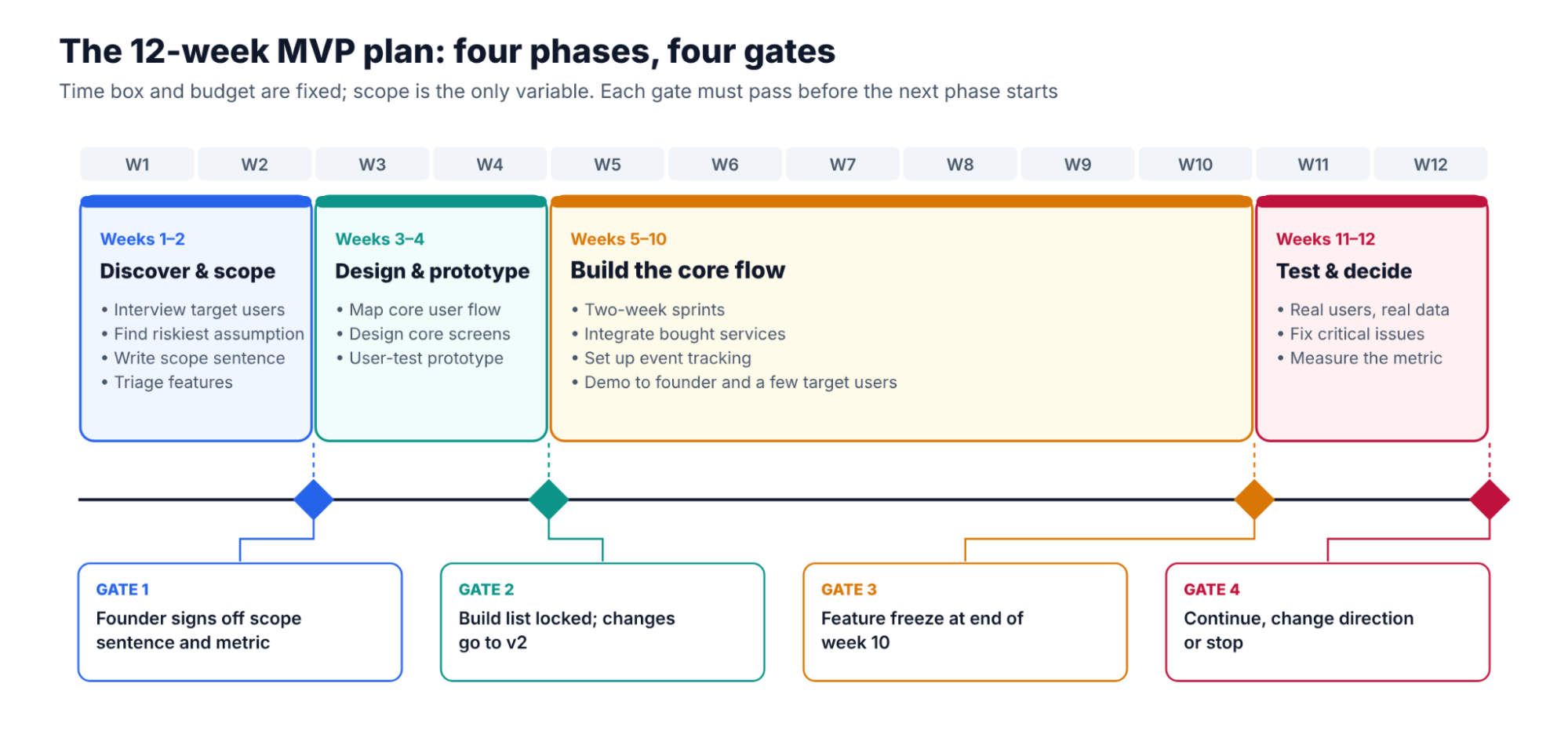
A 12-week MVP plan has four phases, each ending at a gate where the founder confirms or cuts scope. The most important gate is the second: once the prototype has been tested with target users, the build list is locked and anything new waits for version 2.
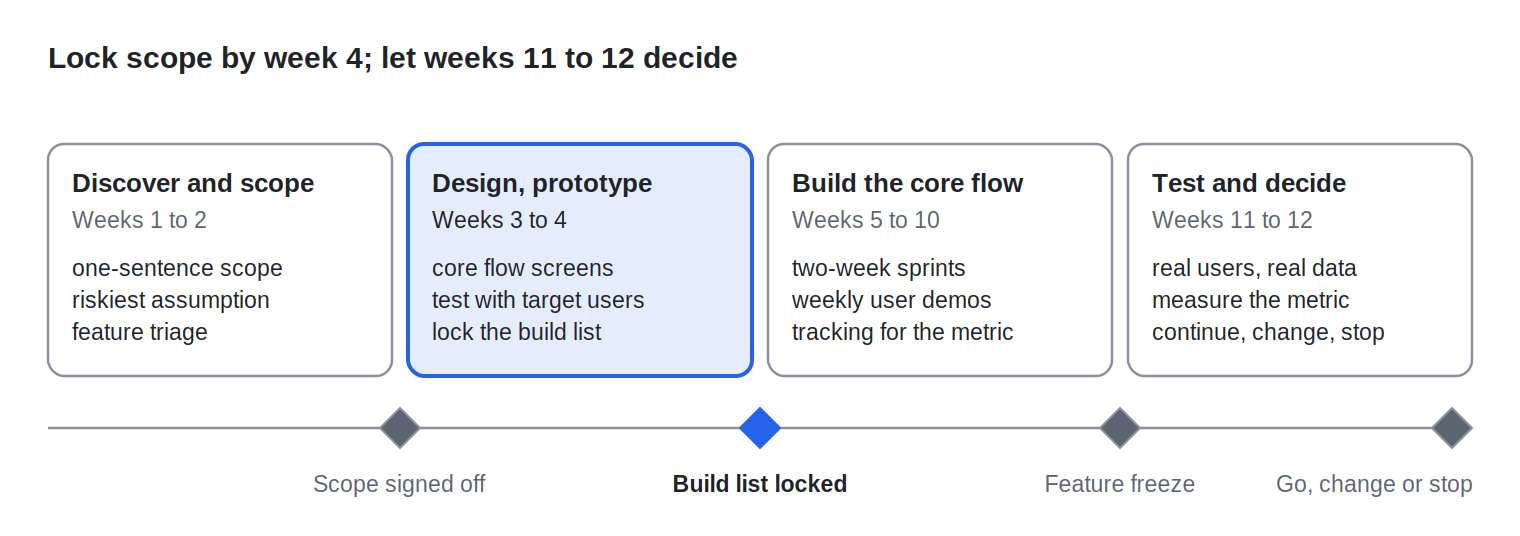
The weeks for each phase are a starting point; a product with heavy design needs can trade a week of build for a week of prototyping, but the total stays at 12.
| Weeks | Phase | Key activities | Gate at the end |
|---|---|---|---|
| 1 to 2 | Discover and scope | Interview target users, write the one-sentence scope, identify the riskiest assumption, triage features into build, fake, buy or later | Founder signs off the scope sentence and metric |
| 3 to 4 | Design and prototype | Map the core user flow, design the screens for the core action, test a clickable prototype with target users | Build list locked; changes after this go to version 2 |
| 5 to 10 | Build the core flow | Two-week sprints, integrate bought services, set up event tracking, demo to the founder and a few target users each week | Feature freeze at the end of week 10 |
| 11 to 12 | Test and decide | Put the MVP in front of real users with real data, fix critical issues, measure the success metric against the target | Continue, change direction or stop, using criteria agreed in week 1 |
Get a Custom Project Cost & Timeline Estimate ->
What to Cut, Fake or Buy, and What Never to Cut
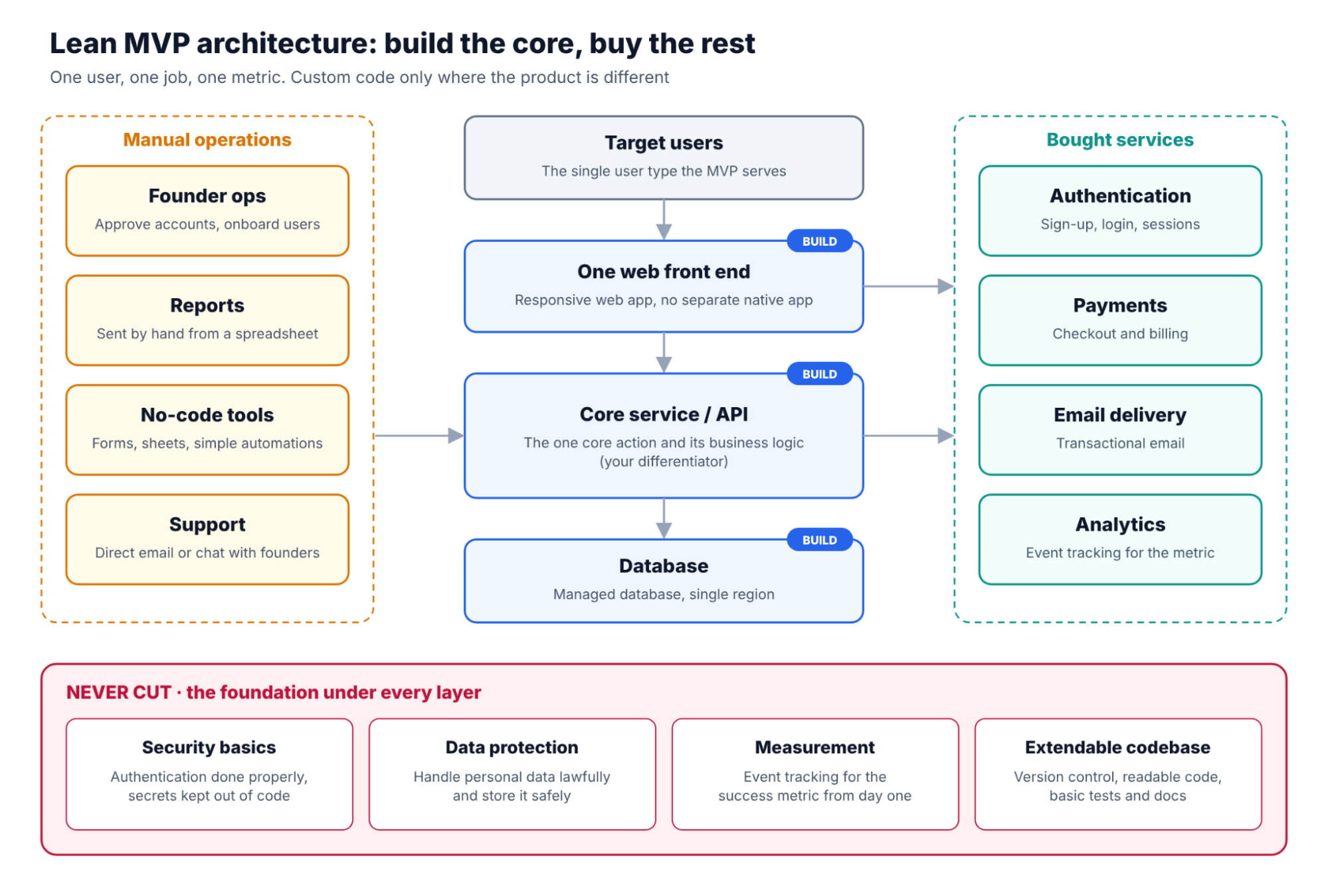
The fastest way to protect a 12-week MVP is to decide in advance which shortcuts are acceptable. Cutting features, faking back-office work and buying commodity services all save weeks. Cutting security, data protection or the ability to measure the success metric does not save time; it moves the cost to a worse moment.
Usually safe to cut or defer: secondary user roles, admin dashboards beyond the minimum, notifications beyond email, referral and social features, multiple languages, native mobile apps when a responsive web app will do, advanced search and filtering, and integrations that only some early users need.
Usually safe to fake manually for the first users: onboarding, account approval, matching or recommendations done by a founder, reporting sent by email, customer support, and billing by invoice instead of automated subscriptions.
Usually better to buy than build: authentication and sign-in, payments, transactional email, analytics and event tracking, file storage, maps, and customer support chat. These are mature services; building them in an MVP spends weeks on a solved problem.
Never cut:
- Security basics: Authentication done properly, secrets kept out of code, data encrypted in transit, and access limited to what each user should see.
- Data protection: If you collect personal data, follow the privacy rules of your users’ countries from day one; retrofitting consent and deletion is expensive.
- Measurement: Event tracking for the metric in your scope sentence. An MVP that cannot measure its own success metric cannot answer the question it was built for.
- A codebase someone else can extend: Version control, a readable structure and basic automated tests on the core flow. Throwaway code is acceptable for experiments, not for a product you hope to grow.
If you are deciding whether to validate even earlier with a proof of concept, AB Ark’s guide to custom MVP development services explains where a PoC fits before the MVP.
Budget, Team and Success Criteria for a 12-Week MVP
A 12-week startup MVP needs a small, stable team, a fixed budget and decision criteria agreed before work starts. The time box only works if all three are fixed; when the team or budget changes mid-build, scope expands to fill the gap.
Budget: AB Ark’s guide to custom MVP development services puts most startup MVPs at $15,000 to $80,000, with simple web apps at the low end and AI-powered or marketplace products at the high end. That is AB Ark’s own estimate from its delivery work, not an industry benchmark. Whatever the figure, set it before scoping, and treat it, like the 12 weeks, as fixed.
Team. A typical 12-week MVP team is small enough to make decisions daily:
| Role | Commitment | Responsibility |
|---|---|---|
| Founder or product owner | Daily | Owns the scope sentence, makes trade-off calls, recruits test users |
| Product designer | Heavy in weeks 1 to 4, lighter after | User flows, clickable prototype, interface for the core action |
| Full-stack engineers (usually 2) | Full time | Builds the core flow, integrates bought services, sets up tracking |
| QA or engineer-led testing | Ongoing, heavier in weeks 9 to 11 | Tests the core flow on real devices and data |
Success criteria. Write down, before week 1, what result at week 12 means you continue, change direction or stop:
| Week-12 result against the scope metric | Decision |
|---|---|
| Target met or exceeded | Continue: plan version 2 around what users did most |
| Clear partial signal (users engage but below target) | Change direction: adjust the user, the job or the core action, and run another short cycle |
| Little or no engagement despite reaching the right users | Stop or rethink the problem before spending more |
The hardest part is honouring the decision. The natural temptation at week 12 without a signal is to ask for “just a few more features”; the scope sentence and the agreed criteria are what make that conversation short.
If you are choosing a partner to build the MVP, AB Ark’s guide to MVP development agencies for startups compares the main types of provider and what each typically costs.
An AB Ark Implementation Lens
AB Ark’s QS Learning case study shows what scoping around one core job looks like. QS Learning was running as a traditional tutoring centre, and AB Ark built it a smart online academy centred on a single outcome: letting parents and students find, book and attend classes at any time. The build focused on the pieces that outcome needed: automated scheduling, an integrated classroom and an SEO-optimised website, rather than a wider feature list. The case study summary does not describe the project as a 12-week MVP or publish its timeline.
FAQs
How long should startup MVP development take?
For most software startups, a focused MVP can be built in about 8 to 16 weeks when the scope is limited to one user, one core job and one success metric. Twelve weeks is a practical target that leaves time for discovery, a build, real-user testing and a decision. Timelines grow mainly through added scope, not through slower engineering.
What is the difference between an MVP, a prototype and a proof of concept?
A proof of concept tests whether something is technically possible. A prototype shows how the product will look and work, often without real functionality. An MVP is a working product that real users can use, built to test whether they want it. Many startups move from prototype to MVP in the same 12-week plan.
What features should a startup MVP include?
Only the features needed for one target user to complete the core job, plus sign-in, basic security and tracking for the success metric. Secondary user types, admin dashboards, native mobile apps and most integrations can wait, be handled manually, or use off-the-shelf services.
Can a startup MVP be built with no-code tools?
Yes, for many ideas, especially internal workflows, marketplaces at small scale and content products. No-code is fastest when the core action is standard. Custom code is the better choice when the core action is your differentiator, needs complex logic or data processing, or would be hard to migrate later.
What happens after the 12 weeks?
Compare the success metric with the target you agreed before starting, then decide to continue, change direction or stop. If you continue, plan version 2 around what users actually did, not the original feature list. If you change direction, run another short, time-boxed cycle rather than extending the first one.
The Rule for a 12-Week MVP
Fix the time and the budget, then scope to fit them: one user, one job, one metric, and a build that covers only the core action. Fake what a person can do, buy what already exists, defer everything else, and never cut security, data protection or measurement. At week 12, let the agreed criteria decide what happens next.
A good MVP is not the smallest version of your product. It is the fastest honest answer to the question your business depends on.
Schedule a Free Consultation Call ->

Head Of Engineering Department