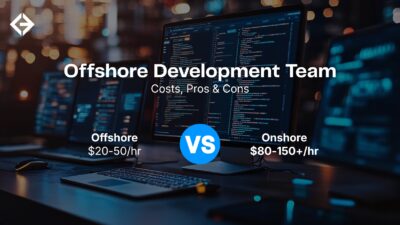

Offshore Python developers are remote engineers hired from countries outside your market typically India, Pakistan, Ukraine, Poland, or Vietnam to build backends, APIs, data pipelines, and AI systems using Python. Their hourly rates range from $12/hr for junior talent in South Asia to $70/hr for senior engineers in Eastern Europe, compared to $75–$150+/hr for equivalent onshore talent in the US or UK. For teams that need to scale Python engineering capacity without the cost or timeline of local hiring, hiring offshore Python developers has shifted from a budget tactic to a standard operating model.
That said, the rate is only one variable. The country you hire from, the Python complexity tier your project sits in, and the engagement model you choose all determine whether an offshore hire saves you money or costs you more in rework. This guide breaks down all three.
What Are Offshore Python Developers?
Offshore Python developers are skilled engineers hired from countries outside your home market to build web platforms, REST APIs, machine learning pipelines, automation scripts, and data-intensive applications using the Python ecosystem. They typically operate at 30–70% lower cost than equivalent onshore talent while drawing from mature talent pools in South Asia, Eastern Europe, and Latin America.
Key Takeaways:
- Offshore Python developer rates range from $15/hr (South Asia, junior) to $70/hr (Eastern Europe, senior) versus $75–$150+/hr onshore in the US or UK.
- India, Pakistan, Ukraine, Poland, and Vietnam consistently rank as the top five countries for quality-to-cost ratio.
- Senior Python developers specializing in AI/ML, Django, or FastAPI typically command a 15–30% premium over general backend rates.
- The engagement model (dedicated team vs. fixed-price vs. time-and-material) affects your total cost of ownership more than the headline hourly rate.
- Time-zone overlap, English proficiency, and documented code review culture are the three most underweighted factors when sourcing offshore Python talent.
📊 Request a Free Tech Stack & Architecture Review

Why Python Dominates Offshore Hiring in 2026
Python’s ecosystem has expanded well beyond Django CRUD apps. Today’s offshore Python engagement is likely to involve FastAPI microservices, Celery task queues, LangChain orchestration, Pandas/Polars data pipelines, or PyTorch fine-tuning workflows. The language’s dominance across backend, AI, and data engineering means a single strong Python team can cover what previously required three separate specialty hires.
That scope expansion is precisely why global demand has outrun domestic supply. According to current market data, the offshore IT services market was projected to reach $151.9 billion in 2026, with Python and AI/ML engineering accounting for a disproportionate share of that growth. For companies operating at scale, the question is no longer whether to go offshore, it’s where and how to structure the engagement.
Top Countries for Hiring Offshore Python Developers
Choosing a country is a multivariable optimization problem, not a lowest-bid auction. Below is an honest breakdown of the major regions, including rate data updated as of mid-2026.
| Country / Region | Junior Rate ($/hr) | Senior Rate ($/hr) | AI/ML Premium | Key Strengths |
| India | $15–$25 | $30–$45 | +20–30% | Largest talent pool; strong in Django, ML, enterprise stacks |
| Pakistan | $12–$22 | $28–$40 | +15–25% | Fast-growing ecosystem; excellent English; competitive rates |
| Vietnam | $15–$25 | $28–$45 | +15–20% | Strong CS fundamentals; growing AI talent cluster |
| Ukraine / Poland | $25–$40 | $50–$70 | +20–30% | Top code quality; EU time-zone; strong documentation culture |
| Romania | $20–$35 | $45–$65 | +15–25% | Rapid growth market; rates up ~20% YoY but still strong value |
| Argentina / Mexico | $20–$35 | $45–$65 | +15–25% | US time-zone overlap; fluent English; growing Python community |
| US / Western Europe | $75–$120 | $120–$200+ | +25–40% | Highest innovation capacity; best for regulated, high-stakes projects |
The real cost levers aren’t just geography. A senior AI engineer in Lahore or Pune billing at $38/hr who writes clean, documented FastAPI services with full test coverage will outperform a $55/hr developer in Warsaw whose onboarding takes four weeks. Total cost of ownership including rework cycles, handoff documentation, and async communication overhead consistently matters more than the sticker hourly rate.
How Python Complexity Shapes Your Offshore Rate
Not all Python work is priced the same, and conflating a Django CRUD project with an NLP pipeline or a RAG-based chatbot will blow your budget estimate before the first sprint ends. The complexity tiers that most offshore teams price against look like this:
Tier 1 – Standard Backend / Web ($15–$35/hr offshore): REST APIs, Django/Flask applications, PostgreSQL integrations, basic ETL scripts. This is the highest-volume tier with the deepest talent availability.
Tier 2 – Data Engineering / Automation ($25–$50/hr offshore): Airflow DAGs, Spark jobs, Pandas pipelines, Celery workers, third-party API integrations at scale. Requires mid-to-senior level engineers.
Tier 3 – AI / ML / LLM Engineering ($35–$70/hr offshore): PyTorch/TensorFlow model training, LangChain agents, FastAPI + vector database service architecture, computer vision pipelines. The talent pool is tighter and commands a meaningful premium.
Understanding which tier your project lives in before you open a sourcing pipeline saves weeks of misaligned candidate reviews. To see exactly how this scope-to-rate mapping works in practice, read our complete guide to hiring a Python developer in 24 hours to map out your hiring workflow before your next sprint planning.
Proof in Production: How AB Ark Engineered a Python-Powered NLP Ecosystem
When Ebanah needed to build an AI-Powered Arabic Proofreading Ecosystem capable of delivering real-time corrections at 95% accuracy across web, mobile, desktop, and Chrome environments, they partnered with AB Ark. The engineering challenge required a deeply specialized Python backend: custom NLP models trained on Arabic morphological rules, low-latency API layers capable of processing text at scale, and a cross-platform architecture that kept inference fast regardless of the client surface. AB Ark’s Python-first engineering team designed and deployed the full stack, delivering a system that now serves EdTech institutions across the Arabic-speaking world. Read the full Ebanah case study to see the technical architecture breakdown.
This is one of 300+ client projects AB Ark has delivered across a team of 80+ professionals, maintaining a 99% job success rate across 15,000+ working hours logged on platforms including Upwork and Clutch.
What to Validate Before Signing an Offshore Python Contract
Hourly rates are visible before you hire. These factors are not and they’re the ones that determine whether an offshore engagement ships or stalls.
- Framework fluency: Ask for code samples in the specific framework your project uses. Django experience does not automatically transfer to FastAPI async architecture.
- Test coverage culture: Request a recent project’s test suite. Offshore teams that don’t write tests create technical debt that costs more than the hourly savings.
- Version control discipline: Review a sample PR history. Clear commit messages, branch naming conventions, and documented review cycles signal a team that can work asynchronously without daily standups.
- Security posture: Python projects handling user data need developers who understand OWASP Top 10, secrets management, and dependency vulnerability scanning not just application logic.
- Communication cadence: Time-zone overlap of even 3–4 hours makes a meaningful difference. For US-based teams, South Asian developers at GMT+5 can hit morning standups; for European teams, Eastern European timezone alignment is nearly seamless.

Frequently Asked Questions
Which country is best for Python developers?
The best countries for Python developers include the United States, Canada, Germany, India, and Pakistan due to strong demand, growing tech industries, and abundant career opportunities.
How much does it cost to hire an offshore Python developers in 2026?
Offshore Python developers rates range from $12–$70/hr depending on region and seniority. South Asian markets (India, Pakistan, Vietnam) average $15–$45/hr for mid-to-senior engineers, while Eastern European developers run $35–$70/hr. Developers with AI/ML or LangChain specialization typically add a 15–30% premium on top of baseline regional rates.
Which country pays the highest salary to a Python developer?
The United States generally pays the highest salaries for Python developers, followed by Switzerland, Canada, Germany, and Australia.
What are the top 10 countries for outsourcing?
The top countries for IT outsourcing include India, Pakistan, Philippines, Vietnam, Poland, Ukraine, Romania, Mexico, Brazil, and Argentina.
👉 Book a Strategy Call to Scale Your Engineering Velocity

Syed Ahmad Ali is a tech writer at AB Ark with a knack for turning complex ideas into easy reads. He writes across a range of topics, but AI, software development, and the business of tech sit right at the top of his list.