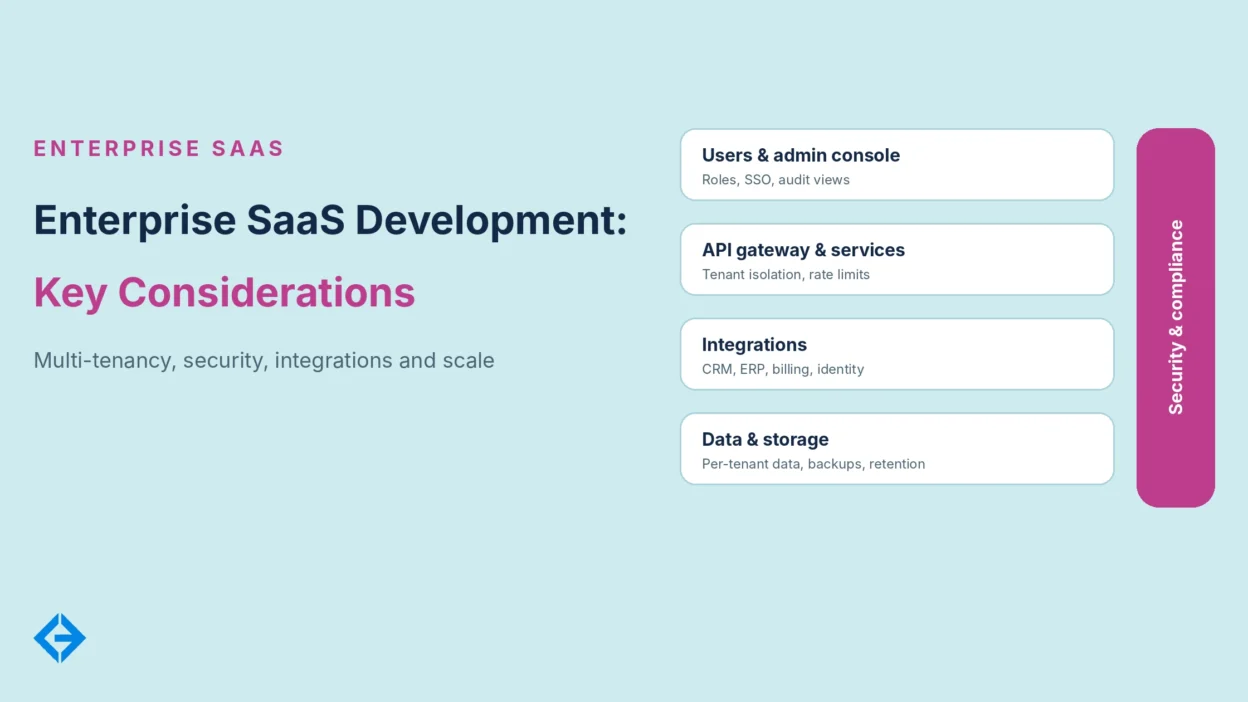

In enterprise SaaS development, the product is judged on more than features. Enterprise buyers check how tenant data is isolated, whether users sign in through their identity provider, what security evidence exists (usually a SOC 2 report), how the API integrates with their stack, and what uptime and data-handling commitments are in writing. Decide tenancy, identity and security before the first enterprise pilot; they are the costliest to retrofit.
Key Takeaways
- Enterprise SaaS development differs from SMB SaaS mainly in isolation, identity, compliance evidence and contractual commitments, not in core features.
- Choose a tenancy model deliberately: silo, pool or a bridge of both, based on data sensitivity and cost per tenant.
- SSO, SCIM provisioning, audit logs and a SOC 2 Type 2 report are common procurement requirements; plan them into the roadmap rather than reacting to each deal.
- Readiness can be staged. The AB Ark Enterprise SaaS Readiness Ladder sequences controls from pilot-ready to regulated-ready.
Talk to Our Team About Your SaaS Platform →
What Is Enterprise SaaS Development?
Enterprise SaaS development is the design and engineering of multi-tenant cloud software that large organizations can buy, secure, integrate and govern. It includes the product itself plus the platform capabilities enterprises require: tenant isolation, single sign-on, role-based permissions, audit trails, compliance evidence, integration APIs, service-level commitments and administrative controls.
It is not simply “SaaS for big companies.” A product used by 50 seats at a startup and one used by 20,000 employees inside a bank may share the same core features, but the bank will require identity federation, contractual uptime, data-retention controls and third-party audit reports before it signs.
| Area | SMB SaaS (typical) | Enterprise SaaS (typical) |
|---|---|---|
| Sign-in | Email and password, social login | SSO via SAML or OIDC; automated provisioning |
| Permissions | A few fixed roles | Custom roles, group mapping, fine-grained access |
| Security evidence | Security page, basic policies | SOC 2 Type 2 report, questionnaires, pen-test summaries |
| Tenancy | Shared (pool) by default | Pool, silo or bridge depending on customer tier |
| Contracts | Click-through terms | Negotiated MSA, DPA and uptime SLA |
| Integrations | Prebuilt connectors | Versioned public API, webhooks, bulk data export |
The 7 Key Considerations in Enterprise SaaS Development
Seven decisions shape whether an enterprise SaaS platform passes procurement and scales after it does. The first three are architectural and hardest to change later.
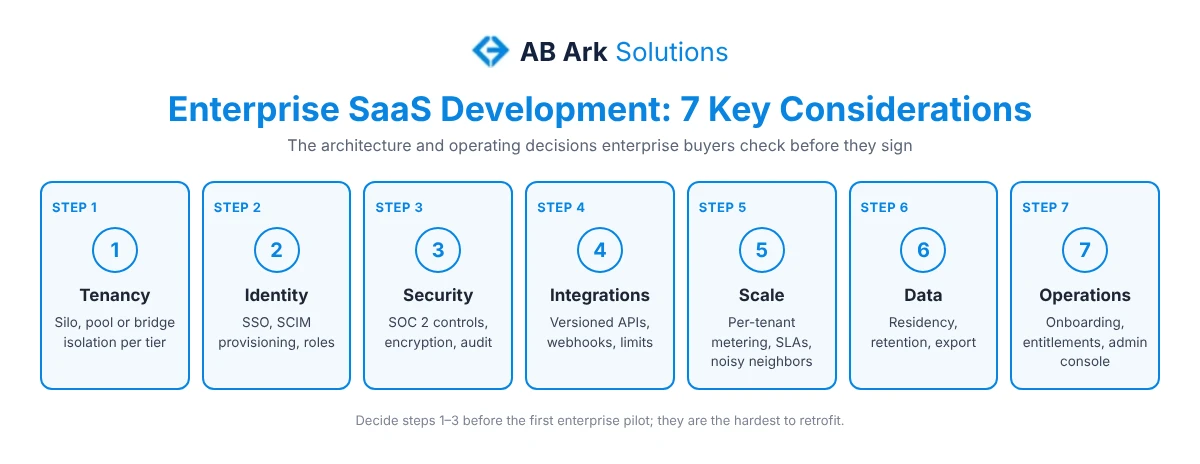
1. Multi-tenancy and tenant isolation
Tenant isolation is the guarantee that one customer cannot access another customer’s data or resources. AWS describes it as foundational to SaaS design and notes that crossing that boundary could be an unrecoverable event for a SaaS business. AWS groups approaches into silo (dedicated resources per tenant), pool (shared resources) and a bridge model that mixes both across services.
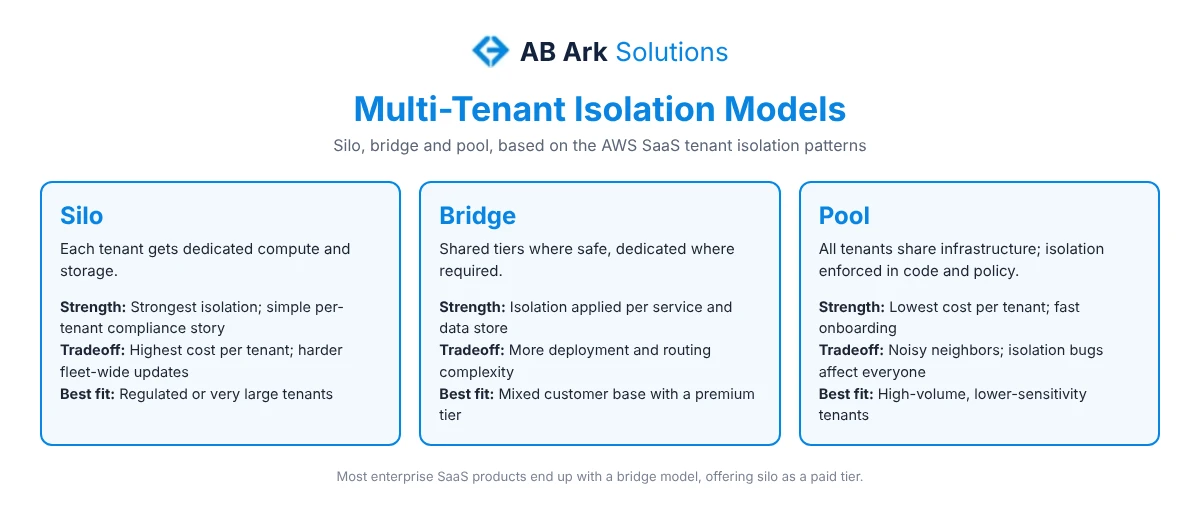 The pool model is usually cheapest per tenant, but AWS points out that shared compute needs broader access scopes, so isolation must be enforced by the application itself. In practice that means tenant context on every request, tenant-scoped database queries or row-level security, and automated tests that try to read across tenants. A common enterprise pattern is pooled infrastructure by default with a dedicated (silo) tier priced for regulated or very large customers.
2. Identity, SSO and access control
Enterprise customers expect employees to sign in through the company identity provider using SAML or OpenID Connect, and to be added or removed automatically. The IETF’s SCIM standard (RFC 7644) defines an HTTP-based protocol for provisioning and managing identity data between enterprises and cloud service providers. Without SCIM, a departing employee may keep access to your product until someone removes them by hand.
Access control should support custom roles and mapping of identity-provider groups to roles. Many enterprise products start with role-based access control (RBAC) and add attribute-based rules for cases such as region- or department-scoped data.
3. Security and compliance evidence
Enterprise security reviews look for independent evidence, not claims. For US buyers, the most common artifact is a SOC 2 report, an AICPA framework that evaluates controls against trust services criteria for security, availability, processing integrity, confidentiality and privacy. A Type 2 report covers how controls operated over a period, so the controls need to be running months before the report is issued.
The stakes are concrete. IBM’s 2026 Cost of a Data Breach report puts the global average breach cost at $4.99 million, and the US average at $11.5 million. Build encryption in transit and at rest, secrets management, least-privilege infrastructure access, dependency scanning and immutable audit logs into the platform from the start. Sector rules such as HIPAA for health data add requirements on top.
4. Integrations and APIs
Enterprise SaaS rarely runs alone. Plan a documented, versioned public API, webhooks for events, bulk import and export, and per-tenant rate limits. Treat API versions as contracts: enterprise customers build internal workflows on them and cannot absorb breaking changes on short notice.
5. Scalability, reliability and SLAs
An uptime SLA turns reliability into a contractual obligation with credits attached. Design for it with redundancy across availability zones, tested backups and restore drills, and tenant-aware monitoring so you can see when one large tenant (a “noisy neighbor”) degrades service for others. Per-tenant metering also supports usage-based pricing and capacity planning. AB Ark’s cloud and DevOps work covers this layer.
6. Data governance, residency and portability
Enterprise contracts often specify where data is stored, how long it is kept, how it is deleted and how customers can export it. Build configurable retention, verifiable deletion, regional hosting options and complete data export into the data model early. Retrofitting regional storage into a single-region schema is one of the more expensive late changes.
7. Tenant operations and administration
Enterprise customers expect an admin console to manage users, roles, SSO settings, audit-log access and billing. Internally, you need automated tenant onboarding, an entitlements system that switches features by plan, and support tooling that respects tenant boundaries. These are often missing from MVPs and become a sales bottleneck once enterprise deals start closing.
Get a Custom Project Cost & Timeline Estimate →
AB Ark Enterprise SaaS Readiness Ladder
The AB Ark Enterprise SaaS Readiness Ladder sequences enterprise capabilities into four levels so teams build what their next buyers need, rather than everything at once. Each level assumes the controls of the level below it.
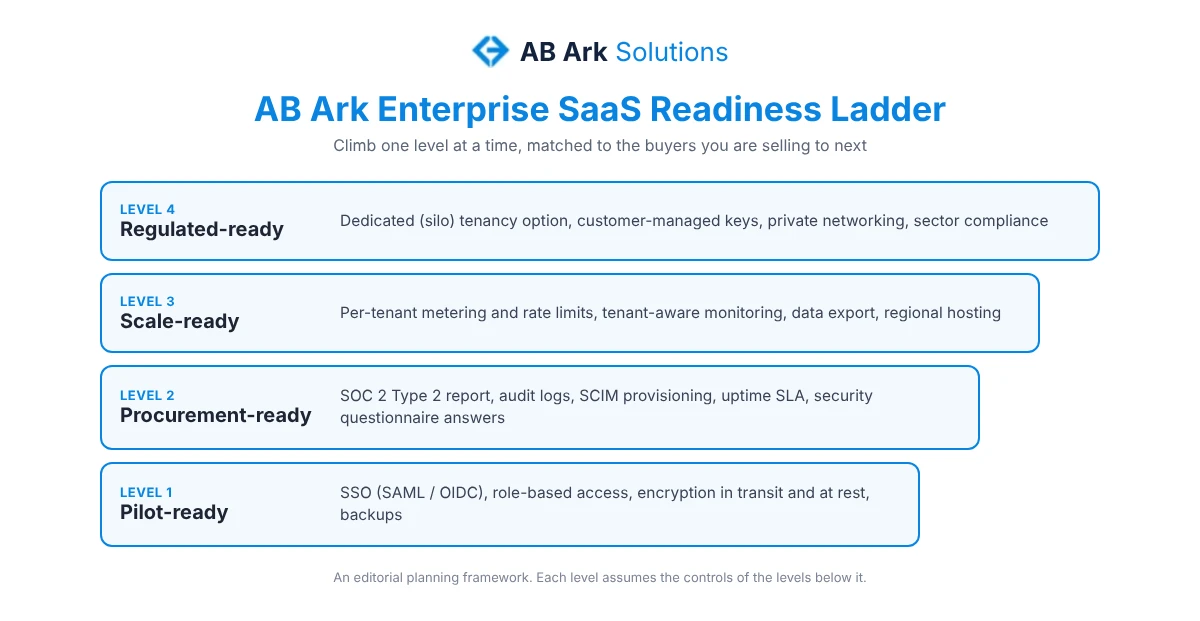
| Level | Core capabilities | Typical trigger |
|---|---|---|
| 1. Pilot-ready | SSO (SAML/OIDC), role-based access, encryption, backups | First enterprise pilot or design partner |
| 2. Procurement-ready | SOC 2 Type 2, audit logs, SCIM, uptime SLA, security questionnaire responses | First enterprise contract through formal procurement |
| 3. Scale-ready | Per-tenant metering and rate limits, tenant-aware monitoring, data export, regional hosting | Several large tenants or usage-based pricing |
| 4. Regulated-ready | Dedicated tenancy option, customer-managed keys, private networking, sector compliance | Healthcare, finance or public-sector buyers |
Use the ladder to answer a practical question: which level do the next three deals in the pipeline require? Building Level 4 controls for a market that only needs Level 2 delays revenue; selling into Level 3 buyers with Level 1 controls stalls deals in security review.
How to Sequence Enterprise SaaS Development
- Validate the core workflow first. An MVP can run on a pooled architecture, but carry tenant IDs through every table and request from day one.
- Add Level 1 controls before the first enterprise pilot, especially SSO and roles, because pilot users will test them immediately.
- Start SOC 2 preparation early. Controls must operate over an observation period before a Type 2 report exists.
- Build the admin console and entitlements before sales needs to hand-configure each new account.
- Introduce a dedicated tier only when a customer segment requires it and is willing to pay for it.
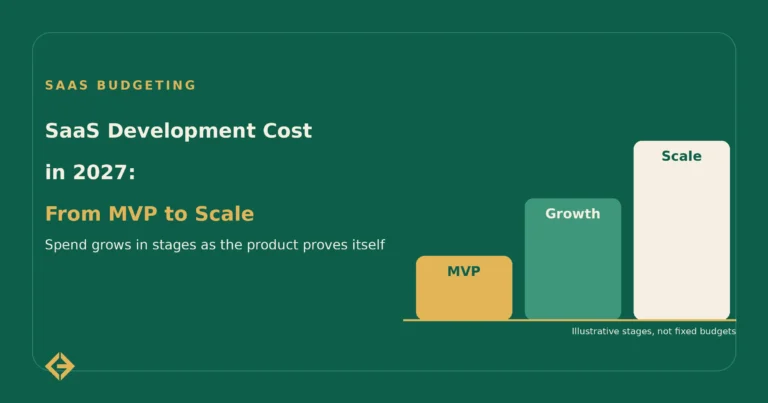
Budget follows these stages. AB Ark’s SaaS development cost guide breaks down costs from MVP to scale. Teams that need extra capacity for enterprise features can also hire dedicated SaaS developers, while independent quality assurance is worth adding for cross-tenant and permission testing.
Common Enterprise SaaS Development Mistakes
- Treating tenancy as a later problem. Adding tenant scoping after launch touches nearly every query and API.
- Building SSO per customer. One-off integrations multiply maintenance; use a standards-based implementation that supports multiple identity providers.
- Relying on the UI for authorization. Enforce permissions in the API and data layers, where enterprise integrations also connect.
- Promising an SLA without measuring it. Instrument uptime and latency per tenant before the SLA is signed.
- Skipping cross-tenant tests. Automated tests that attempt to read another tenant’s data catch the most damaging class of bug.
FAQs
What makes SaaS “enterprise-grade”?
Enterprise-grade SaaS combines reliable core features with tenant isolation, SSO and automated provisioning, granular permissions, audit logs, independent security evidence such as a SOC 2 report, a documented API, and contractual uptime and data-handling commitments.
Should enterprise SaaS be single-tenant or multi-tenant?
Most enterprise SaaS is multi-tenant for cost and update speed, with isolation enforced in the application and data layers. A dedicated single-tenant (silo) option is common as a premium tier for regulated or very large customers.
Do I need SOC 2 to sell to US enterprises?
SOC 2 is not legally required, but many US enterprise security reviews ask for a SOC 2 Type 2 report. Without one, expect longer questionnaires and slower deals. Preparation should start months ahead because Type 2 reports cover controls operating over time.
When should a startup add enterprise features?
Add them when the pipeline demands them. Carry tenant IDs from day one, add SSO and roles before the first enterprise pilot, and start SOC 2 work once enterprise deals are a near-term revenue priority.
Enterprise SaaS is won in architecture reviews as much as in demos. The platforms that close large deals are the ones that can prove isolation, identity control and accountability before the customer asks.
Schedule a Free Consultation Call →
Head Of Engineering Department