

To hire Next.js developers, test for the skills the current framework demands: the App Router, React Server Components, caching and rendering choices, data fetching, and production performance. A full-time US developer costs roughly $194,000 a year fully loaded at the national median wage. Freelancers suit short tasks. A dedicated developer suits ongoing product work at a lower monthly cost.
If you want to skip sourcing, AB Ark offers vetted Next.js developers for hire on dedicated or staff augmentation terms. The rest of this guide explains how to evaluate any candidate or vendor yourself.
Key takeaways
- The US median wage for software developers was $135,980 in May 2025, according to the Bureau of Labor Statistics. Benefits add about 30% for private employers.
- Next.js 16, released in October 2025, introduced Cache Components and replaced middleware with proxy.ts. Experience limited to the older Pages Router is no longer enough for new projects.
- Caching and rendering decisions affect cost, speed and correctness more than component code does. Test them directly.
- A short paid task on an existing codebase reveals more than a whiteboard interview.
Talk to Our Team About Your Next.js Project →
What does a Next.js developer do?
A Next.js developer builds web applications with Next.js, the open-source React framework maintained by Vercel. Next.js adds routing, server rendering, static generation, API routes and build tooling on top of React, so one team can ship a fast, search-friendly front end and much of the server logic behind it.
In practice, a Next.js developer decides which pages render on the server, which are static and which run in the browser. They connect the app to APIs and databases, handle authentication, tune performance metrics such as load time, and deploy to platforms such as Vercel, AWS or a self-hosted Node.js server.
Why the Next.js version matters
Next.js has changed significantly in recent releases. Next.js 16, released on October 21, 2025, introduced Cache Components for a new caching model, made Turbopack the stable bundler, and replaced middleware with proxy.ts. Next.js 16.3, released in August 2026, added opt-in instant navigations and large memory reductions for the dev server.
A developer who has only worked with the older Pages Router and earlier caching behavior will need ramp-up time on a current codebase. Ask candidates which Next.js versions they have shipped to production.
Next.js developer vs React developer
Every Next.js developer is a React developer, but not every React developer knows Next.js well. The differences are in server rendering, caching, routing and deployment. Next.js is also SEO-friendly: it can render pages on the server, so search engines can read your content and pages load quickly. If your app is a client-side dashboard behind a login, a strong React developer may be enough. If search visibility, page speed or server-side logic matter, hire for Next.js specifically. AB Ark also offers React JS developers for client-side projects.
How much does it cost to hire a Next.js developer?
A full-time Next.js developer in the US at the national median costs about $194,000 a year, or about $16,200 a month, once benefits are included. This is an estimate built from two official sources, so you can rerun it with your own salary data.
The Bureau of Labor Statistics does not publish a Next.js-specific wage. The closest official figure is software developers, whose median annual wage was $135,980 in May 2025. The lowest 10% earned under $82,460 and the highest 10% over $214,670. In June 2026, wages made up 70.0% of private-industry employer compensation costs, with benefits making up the rest.
| Cost basis (US, full-time) | Annual | Monthly | Source |
|---|---|---|---|
| Base salary, 10th percentile | $82,460 | $6,872 | BLS, May 2025 |
| Base salary, median | $135,980 | $11,332 | BLS, May 2025 |
| Base salary, 90th percentile | $214,670 | $17,889 | BLS, May 2025 |
| Fully loaded cost, median | ~$194,260 | ~$16,190 | Median ÷ 0.70 (AB Ark estimate) |
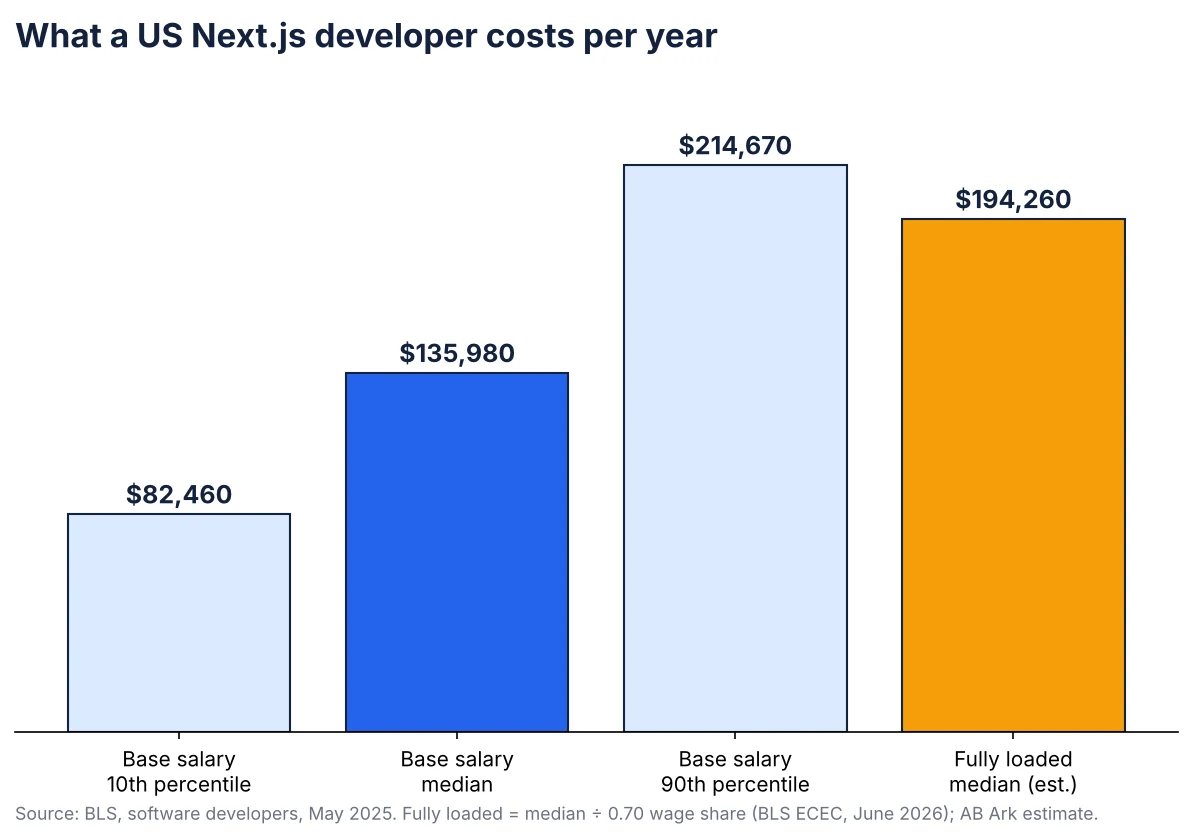
The fully loaded figure excludes recruiting fees, equipment and management time, so treat it as a floor for in-house cost.
What changes a Next.js developer’s rate
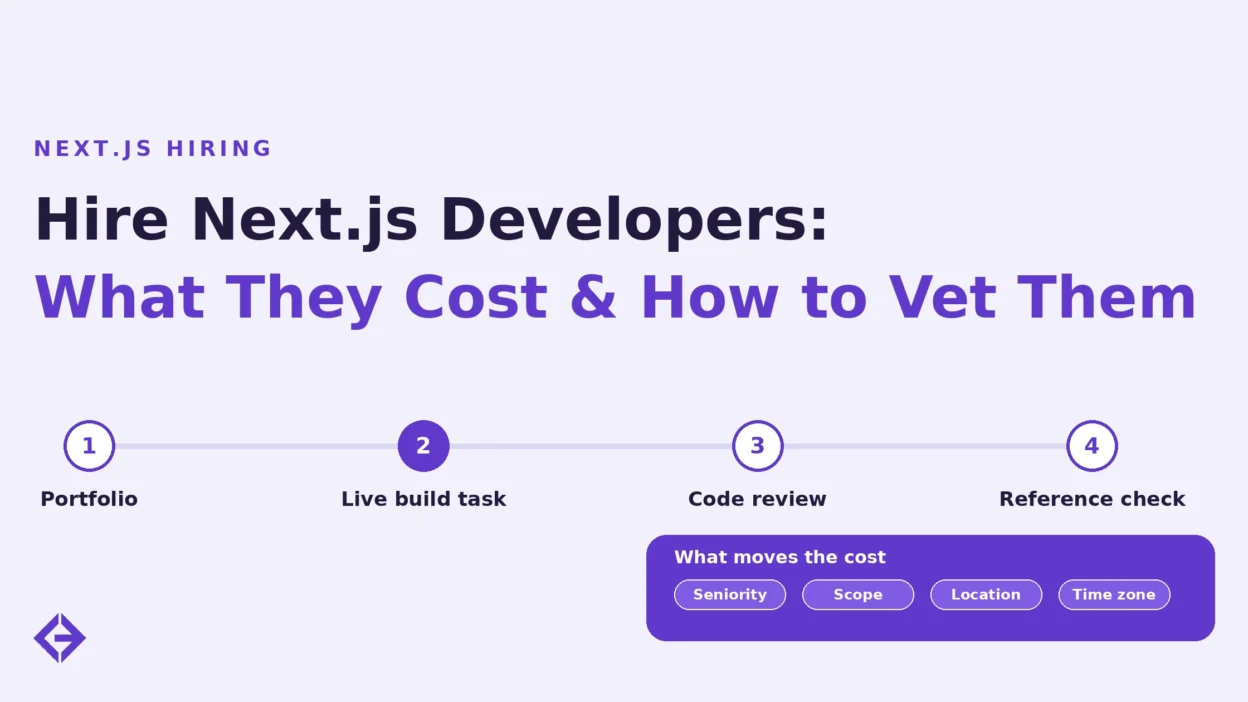
Seniority moves the price most, because a senior Next.js developer can own architecture, caching strategy and deployment alone. Location sets the base rate. The engagement model decides whether you pay benefits, management and replacement risk. Breadth matters too: developers who also handle the backend, databases and cloud infrastructure cost more than front-end-only developers.
Offshore and freelance rates vary too widely to quote one honest range. Ask each provider for a written rate card by seniority, and compare it with the fully loaded US figure rather than US base salary.
How to vet Next.js developers: a six-area scorecard
Vet Next.js developers on the decisions that break production apps, not on React trivia. Score each area from 1 to 4 using evidence from past work and a short paid task. A score of 1 in any area is a reason to stop.
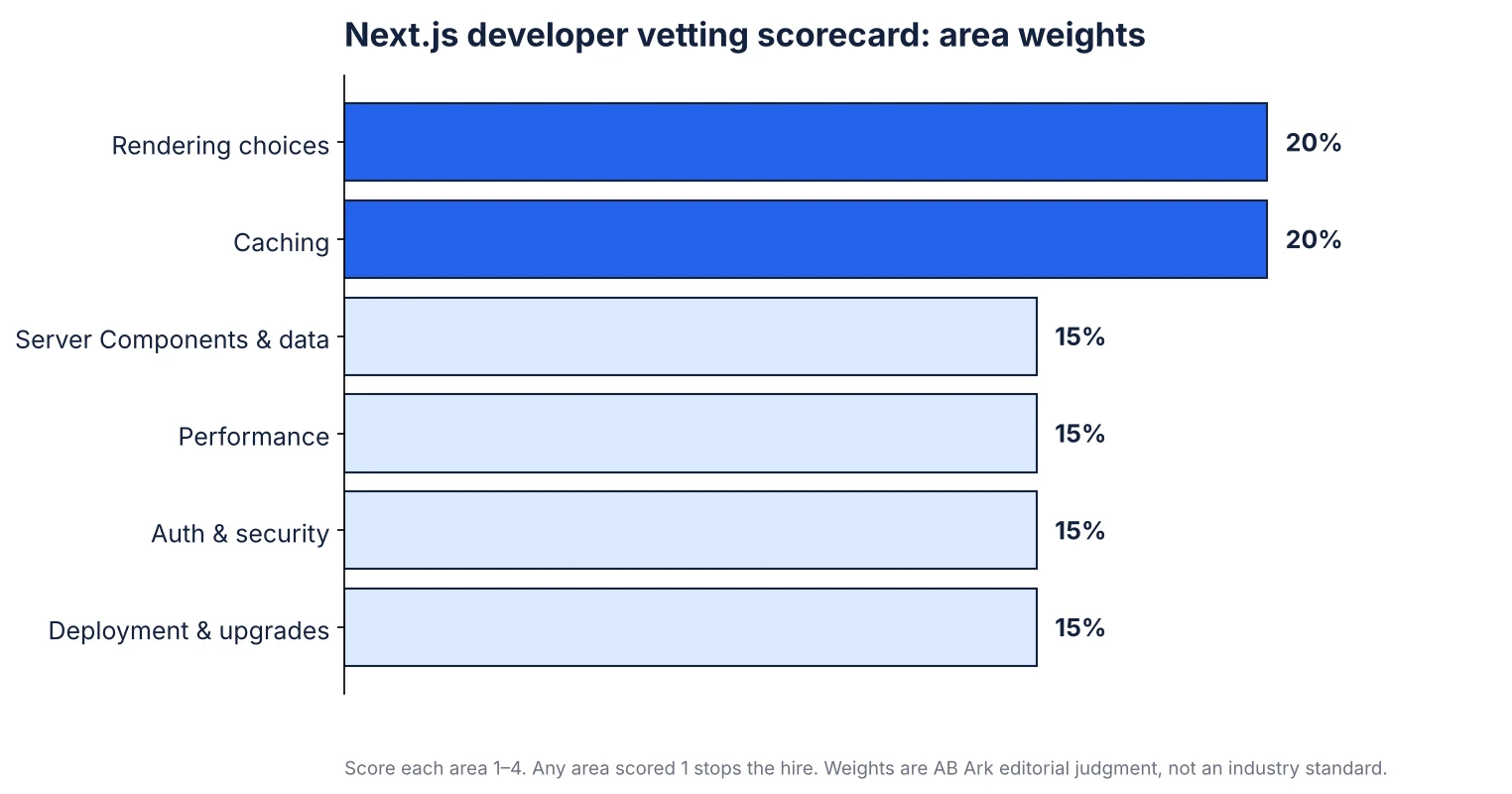
| Skill area | What to ask or test | Strong evidence (4) | Weight |
|---|---|---|---|
| Rendering choices | Which pages should be static, server-rendered or client-rendered, and why? | Explains the tradeoff for each page in terms of speed, freshness and cost | 20% |
| Caching | A product page shows stale prices after an update. How do you fix it? | Understands Cache Components, revalidation and when not to cache | 20% |
| Server Components and data fetching | Move this client-side data fetch to the server | Clean split between server and client components, no secrets sent to the browser | 15% |
| Performance | Why does this page load slowly on mobile? | Measures with real tools, reduces JavaScript sent to the browser, optimizes images | 15% |
| Auth and security | How do you protect a route and a server action? | Checks authorization on the server, validates input, handles sessions safely | 15% |
| Deployment and upgrades | How did you upgrade an app across Next.js major versions? | Concrete upgrade story, CI checks, knowledge of hosting options beyond one platform | 15% |
The weights are AB Ark’s editorial judgment, not an industry standard. Raise the security weight for apps that handle payments or personal data.
A paid task that shows real skill
Give a 3–4 hour paid task on a small existing Next.js app. Include one page with a stale-data caching bug, one slow page and one unprotected server action. Ask the candidate to explain the order of their fixes.
Red flags
- They mark every component “use client” to avoid thinking about the server.
- They cannot explain why a page shows stale data.
- They put API keys or secrets in client-side code.
- Their only Next.js experience is a template or tutorial project.
Freelancer, in-house or dedicated Next.js developer?
Pick the engagement model by how stable your scope is and who will own technical decisions.
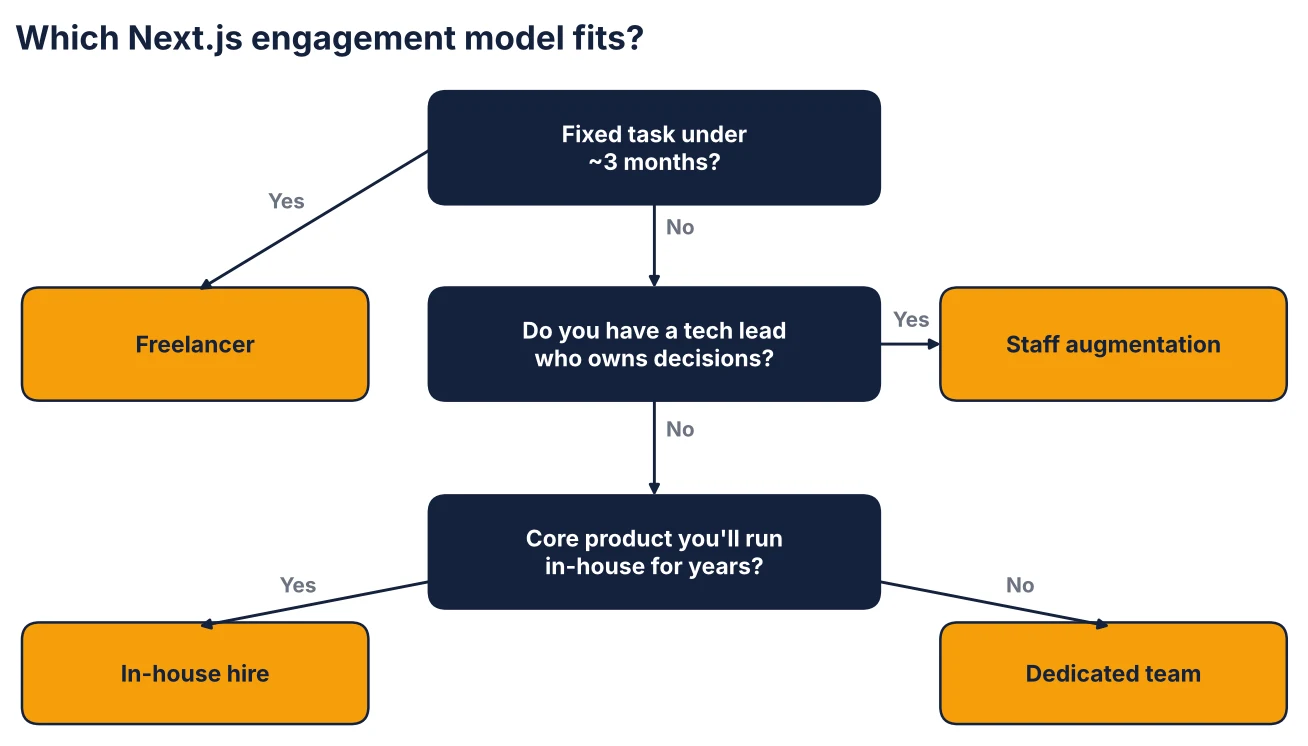
| Model | Best fit | Who owns decisions | Main risk |
|---|---|---|---|
| Freelancer | A landing page, feature or upgrade under about 3 months | You | Continuity after the task ends |
| In-house hire | A core web product you will run for years | You | Highest cost and slowest to start |
| Staff augmentation | Adding developers to a team with a tech lead | Your lead | Added developers follow your process, good or bad |
| Dedicated team | A full web app or rebuild with no internal team | Shared: you own product, the team owns delivery | Needs a product decision-maker on your side |
If you are comparing the last two models, see our guide to dedicated development teams vs staff augmentation. If you would rather hire a whole agency, our list of React and Next.js development companies compares firms.
Case study: a tutoring platform with scheduling and payments
AB Ark’s Spanish Tutor case study shows the kind of web application where server logic and front-end experience meet. An independent tutor was losing hours every week to booking emails, Zoom links and chasing payments.
AB Ark built a self-service portal with a subscription credit system, live calendar syncing, automatic Zoom links and a 48-hour cancellation rule, with payments handled through Stripe subscriptions. The case study reports 100% upfront payments, about 8 hours of admin time saved each week and no more last-minute no-shows.
The lesson for hiring: an app like this needs a developer who can handle payments, scheduling logic, authentication and a fast front end together, which is exactly what the scorecard tests.
Get a Custom Quote for Your Next.js Team →
How to hire a Next.js developer, step by step
Define the role before you look for candidates. Without a clear scope, you cannot tell a strong Next.js developer from a weak one.
- Write the scope. New app, rebuild, version upgrade or ongoing feature work. Note your Next.js version, hosting platform, backend and data sources.
- Choose the engagement model from the table above.
- Set the seniority. If nobody on your team can review Next.js code, hire senior.
- Screen against the scorecard. Ask for live production sites and code samples before interviews.
- Run the paid task on a small existing Next.js app.
- Agree on ownership in writing. The code repository, hosting account, domain and IP assignment should belong to your company. Our checklist of software development contract questions covers what to include.
- Measure the first 30 days. Track merged pull requests, page performance on key routes and production errors, not hours logged.
Frequently asked questions
Can a React developer work on a Next.js project?
A React developer can write Next.js components quickly, because Next.js is built on React. The gaps are server rendering, caching, routing conventions and deployment. For a production Next.js app, pair a React developer with someone experienced in Next.js, or budget ramp-up time for those areas.
Do I need a full-stack developer or a front-end Next.js developer?
Hire a full-stack Next.js developer if the app’s server logic, database and APIs live inside the Next.js project. Hire a front-end Next.js developer if a separate backend team already provides the APIs. Many small products only need one full-stack developer at first.
Is Next.js only for apps hosted on Vercel?
No. Vercel maintains Next.js and offers the most direct hosting, but Next.js apps also run on AWS, other cloud platforms and self-hosted Node.js servers. Ask candidates which hosting setups they have deployed to, because some features behave differently across platforms.
How long does it take to hire a Next.js developer?
Hiring time depends on the engagement model. Freelancers and staff augmentation providers can often start within days or weeks. A full-time US hire involves sourcing, several interview rounds and a notice period, so it usually takes longer. Ask any provider for its actual time-to-start in writing.
Choosing the right Next.js hire
The right Next.js hire matches your engagement model to your scope and proves skill where Next.js apps actually fail: rendering choices, caching, server-side security and deployment. Use the US fully loaded cost of about $16,200 a month as your benchmark, run a paid task before committing, and keep code and hosting accounts under your company’s ownership.
AB Ark provides vetted Next.js developers, full-stack developers and dedicated web teams for new builds, rebuilds and upgrades.
Schedule a Free Consultation Call →
Engineering Manager At AB Ark Solutions