
To hire React Native developers, first decide the engagement model, then test for the skills that current React Native development actually demands. A US in-house hire costs roughly $194,000 a year fully loaded at the national median wage. Freelancers suit short, well-scoped work. A dedicated offshore developer suits ongoing product work at a lower monthly cost. Vet candidates on the New Architecture, native module work, app store releases and performance debugging, not on React trivia.
Key takeaways
- The US median wage for software developers was $135,980 in May 2025, per the Bureau of Labor Statistics. Benefits make up about 30% of total compensation for private employers, which adds roughly 43% on top of base salary.
- React Native 0.76 made the New Architecture the default in October 2024. A candidate who has only shipped on the old bridge needs extra ramp-up time.
- React web experience does not transfer fully. Mobile releases, native modules and device performance are separate skills.
- The right engagement model depends on scope stability and who owns product decisions, not only on hourly rate.
Talk to Our Team About Your React Native Project →
What does a React Native developer do?
A React Native developer builds iOS and Android apps from one JavaScript or TypeScript codebase using Meta’s open-source React Native framework. The role covers the shared UI and app logic, plus the native edges: device APIs, push notifications, payments, build configuration and app store releases.
That native edge is where React Native hiring goes wrong. A strong React web developer can write React Native screens quickly. The same developer may still struggle with an Xcode build failure, an Android memory leak or a rejected App Store submission.
The framework has also changed under the hood. React Native 0.76 enabled the New Architecture by default in October 2024. Later releases went further: React Native 0.84 made Hermes V1 the default JavaScript engine and continued removing the Legacy Architecture. A developer hired today should be fluent in this current stack.
When hiring a React Native developer makes sense
React Native fits when you need one team to ship on both iOS and Android, your web team already uses React and TypeScript, and the app is mostly product UI, forms, feeds and API calls.
It fits less well when the app depends heavily on custom graphics, low-level Bluetooth or camera pipelines, or platform features that ship on iOS long before cross-platform libraries catch up. If you are still choosing the framework, read our comparison of Flutter vs React Native before you hire.
How much does it cost to hire React Native developers in the US?
A full-time US React Native developer at the national median costs about $194,000 a year, or about $16,200 a month, once benefits are included. That figure is an estimate built from two official sources, shown below so you can rerun it with your own salary data.
The Bureau of Labor Statistics does not publish a React Native-specific wage. The closest official figure is software developers (SOC 15-1252). The median annual wage for software developers was $135,980 in May 2025. The lowest 10% earned under $82,460 and the highest 10% over $214,670.
Salary is not the full cost. In June 2026, wages and salaries made up 70.0% of private-industry employer compensation costs, with benefits making up the rest.
| Cost basis (US, full-time) | Annual | Monthly | Basis |
|---|---|---|---|
| Base salary, 10th percentile | $82,460 | $6,872 | BLS OEWS, May 2025 |
| Base salary, median | $135,980 | $11,332 | BLS OEWS, May 2025 |
| Base salary, 90th percentile | $214,670 | $17,889 | BLS OEWS, May 2025 |
| Fully loaded cost, median | ~$194,260 | ~$16,190 | Median ÷ 0.70 (AB Ark estimate) |
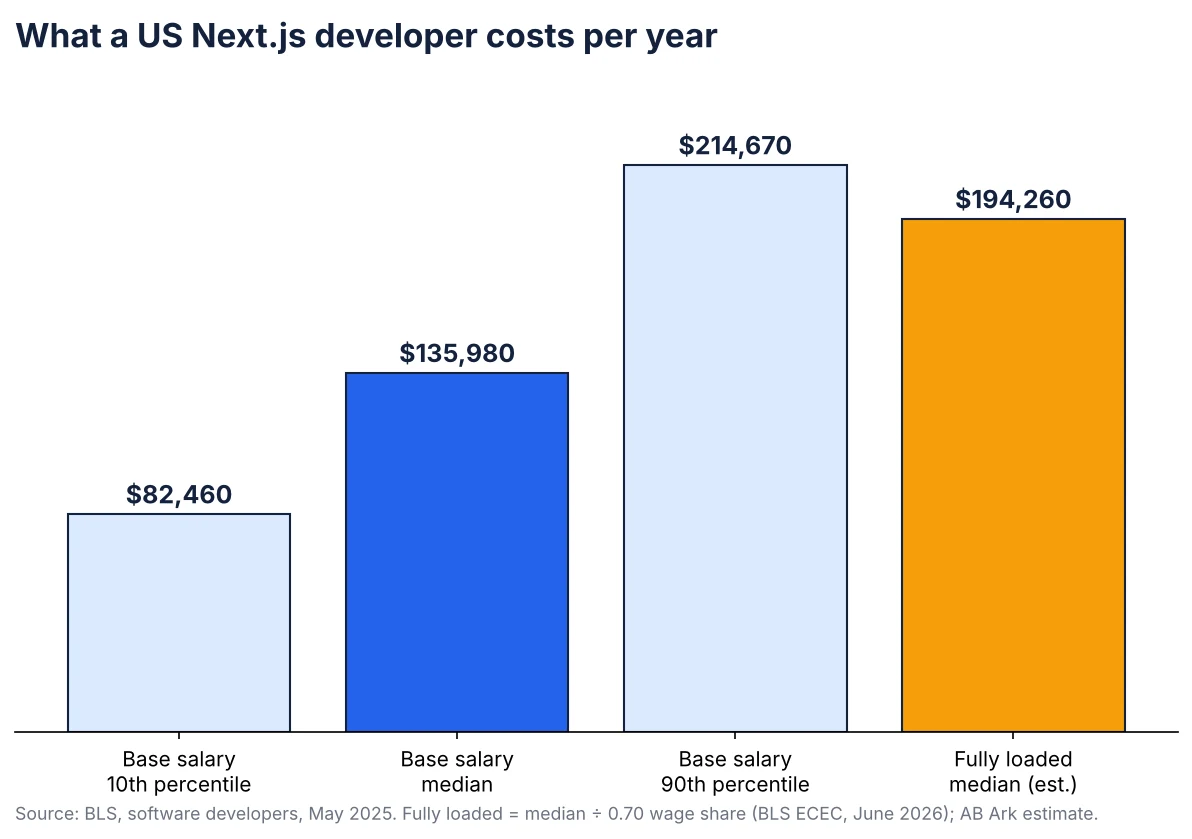
The fully loaded row is our calculation: median salary divided by the 70% wage share from BLS’s Employer Costs for Employee Compensation. It excludes recruiting fees, equipment, software licenses and the time a vacant seat stays unfilled. Treat it as a floor for in-house cost, not a quote.
What changes the price
Four factors affect a React Native rate more than any others. Seniority matters most, because a senior developer can own releases and native modules alone. Location sets the base, since rates in the US, Latin America, Eastern Europe and South Asia differ widely. The engagement model adds or removes overhead such as benefits, management and replacement risk. Native depth matters too: a developer who writes Swift and Kotlin modules commands a higher rate than one who only works in JavaScript.
Offshore and marketplace rates vary too much by vendor to quote one honest range. Ask every provider for a written rate card by seniority, and compare it against the fully loaded US figure above, not against US base salary.
Engagement models: freelance, in-house, staff augmentation or dedicated team
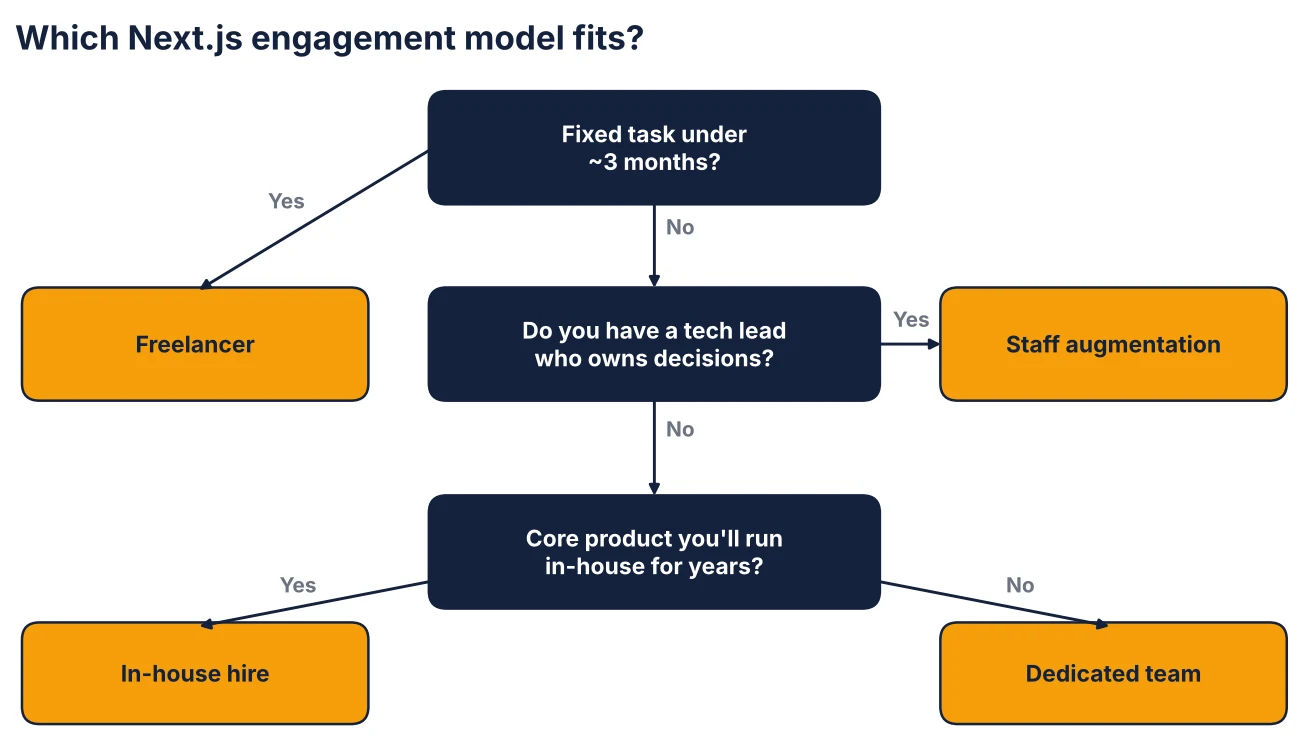
The right model depends on two questions: how stable is the scope, and who will own product and technical decisions? Hourly rate comes third.
| Model | Best fit | Who owns decisions | Main risk |
|---|---|---|---|
| Freelancer | A fixed task under about 3 months: a feature, an upgrade, an audit | You | Availability and continuity after the task ends |
| In-house hire | A core mobile product you will run for years | You | Highest cost and slowest to start |
| Staff augmentation | Adding 1–2 developers to a team that already has a mobile lead | Your lead | The added developer is only as effective as your process |
| Dedicated team | A full app or major rebuild with no internal mobile team | Shared: you own product, the team owns delivery | Needs clear product ownership on your side |
A common failure is hiring one freelance React Native developer for a full app build with no technical owner on the client side. Nobody reviews architecture choices until problems surface in production.
If you are weighing the last two models, our guide to dedicated development teams vs staff augmentation covers the trade-offs in more depth.
For an example of how AB Ark scopes and delivers a full product build with a dedicated team, see our All-in-One platform case study.
Get a Custom Quote for Your React Native Team →
How to vet React Native developers: a six-area scorecard
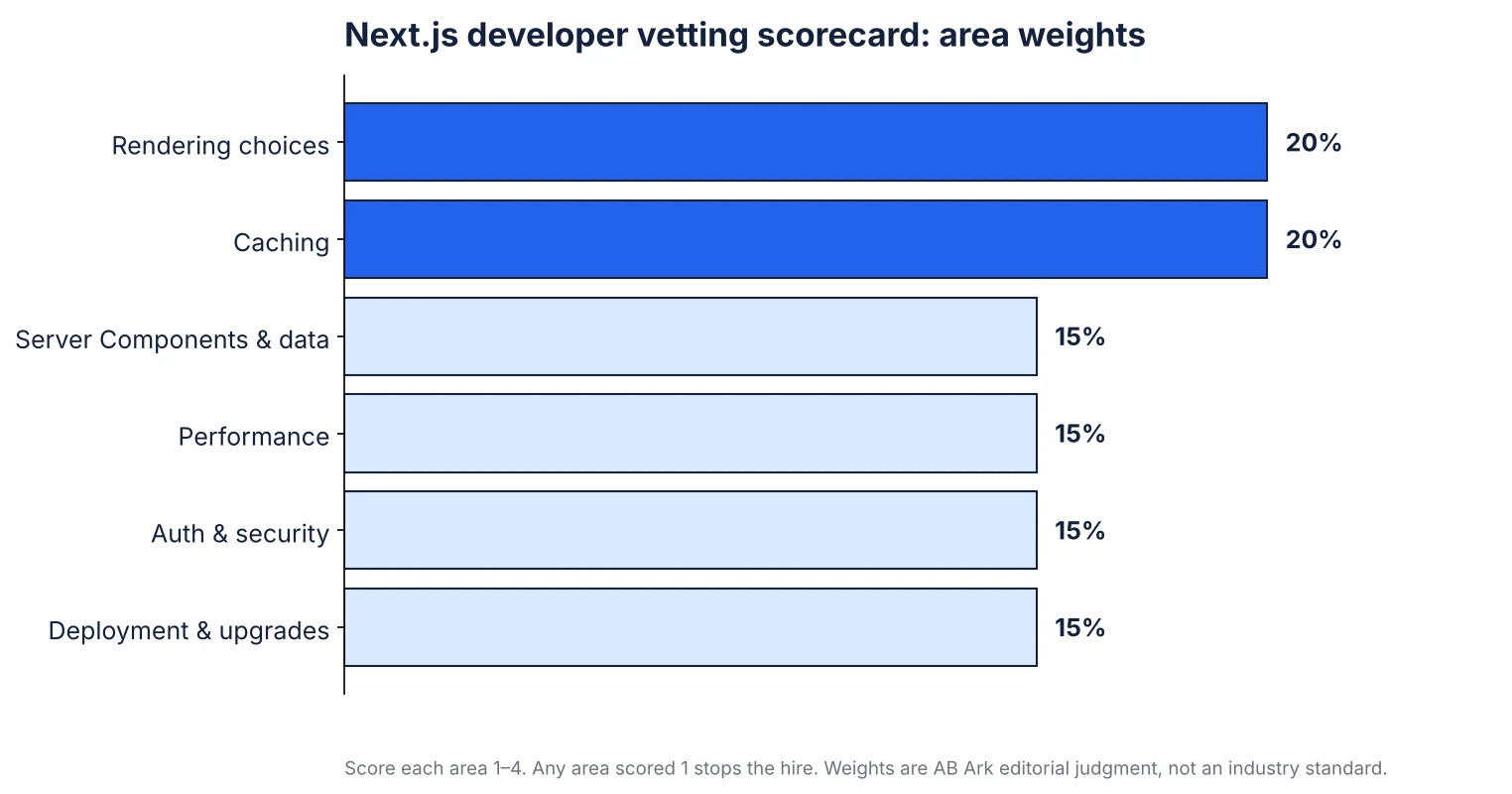
Vet React Native developers on what breaks in production, not on what React Native is. Score each area from 1 to 4 using evidence from the candidate’s past work and a short paid task. Any area scored 1 is a reason to stop.
| Area | What to ask or test | Strong evidence (4) | Weight |
|---|---|---|---|
| Shipping history | Which apps did you release, and what was your role in the release? | Live App Store and Google Play listings they can walk through, including a rejected build they fixed | 20% |
| Current architecture | How did you move an app to the New Architecture? Which libraries blocked you? | Concrete migration story: Fabric, TurboModules, Codegen, library replacements | 20% |
| Native depth | Show a native module or a native bug you fixed | Swift/Objective-C or Kotlin/Java code they wrote and can explain | 15% |
| Performance | How do you find why a list scrolls slowly or the app starts late? | Uses profiling tools and measured before-and-after numbers | 15% |
| State, data and offline | How do you handle a flaky network and cached data? | Clear choices for server state, local storage and conflict handling | 15% |
| Release and quality | How do builds, tests and updates reach users? | CI builds, automated tests, staged rollouts, crash reporting | 15% |
The weights are AB Ark’s editorial judgment, not an industry standard. Shift weight toward native depth for hardware-heavy apps, or toward release and quality for regulated apps.
A paid task that reveals more than an interview
Give a 3–4-hour paid task on a small existing app, not a blank project. Include one real bug, one slow screen and one missing feature. Ask the candidate to explain what they fixed first and why. The order of their fixes tells you more about judgment than the code itself.
Red flags
- Every app in their portfolio was built with a template and never released.
- They cannot explain what changed in the New Architecture.
- They avoid native code entirely: “there’s always a library for that.”
- No experience with app store review, signing certificates or release builds.
How to hire a React Native developer, step by step
Define the job before you source anyone. With a vague role, you cannot tell a strong candidate from a weak one.
- Write the scope in one paragraph: State whether it is a new app, a rebuild, a New Architecture migration or ongoing feature work. Name the platforms, the backend and any native features such as payments, maps or Bluetooth.
- Pick the engagement model: from the table above, based on scope stability and decision ownership.
- Set the seniority: If nobody on your team can review React Native code, hire senior. A mid-level developer needs a reviewer.
- Screen against the scorecard: Ask for live app store links before any interview.
- Run the paid task: on a small existing codebase.
- Agree on ownership in writing: Code repository, Apple and Google developer accounts, signing keys and IP assignment should sit with your company from day one. Our checklist of software development contract questions covers what to put in the agreement.
- Measure the first 30 days: Track merged pull requests, time to first release build and crash-free session rate, not hours logged.
Frequently asked questions
Can a React web developer build React Native apps?
A React web developer can build React Native screens quickly, because components, hooks and state management carry over. The gaps are mobile-specific: native modules, device performance, build signing and app store releases. For a production app, pair a React web developer with someone who has shipped React Native apps, or budget time for those skills.
Should I hire a React Native or a Flutter developer?
Hire React Native developers if your team already uses React and TypeScript, or if you want to share logic with a React web app. Flutter uses Dart and its own rendering engine, which suits highly custom UI. The framework decision should come before the hire, not after it.
How long does it take to hire a React Native developer?
Hiring time depends mostly on the engagement model. A freelancer or a staff augmentation provider can often start within days or weeks. A full-time US hire involves sourcing, several interview rounds and a notice period, so it usually takes longer. Ask any provider for their actual time-to-start in writing.
Do I need separate iOS and Android developers if I use React Native?
Most React Native apps do not need separate iOS and Android developers. One React Native team can cover both platforms. You may still need native specialist time for platform-heavy features such as widgets, background processing or custom camera work.
Choosing the right React Native hire
The best React Native hire is the one whose engagement model matches your scope and whose proven work matches your app’s riskiest part. Use the US fully loaded cost of about $16,200 a month as the benchmark, score every candidate on the six-area scorecard, and keep code, accounts and signing keys under your company’s ownership.
If you want a shortlist of vetted React Native developers or a dedicated mobile team, AB Ark can share profiles matched to your scope.
Schedule a Free Consultation Call →
Engineering Manager At AB Ark Solutions