
Disclosure: AB Ark Solutions publishes this list and is included in it. AB Ark has a US office in Delaware and offices in the UAE and Pakistan. Every company was assessed on the same criteria; the list is ordered alphabetically, with each company’s best fit noted; it is not a ranking. Facts checked November 6, 2026.
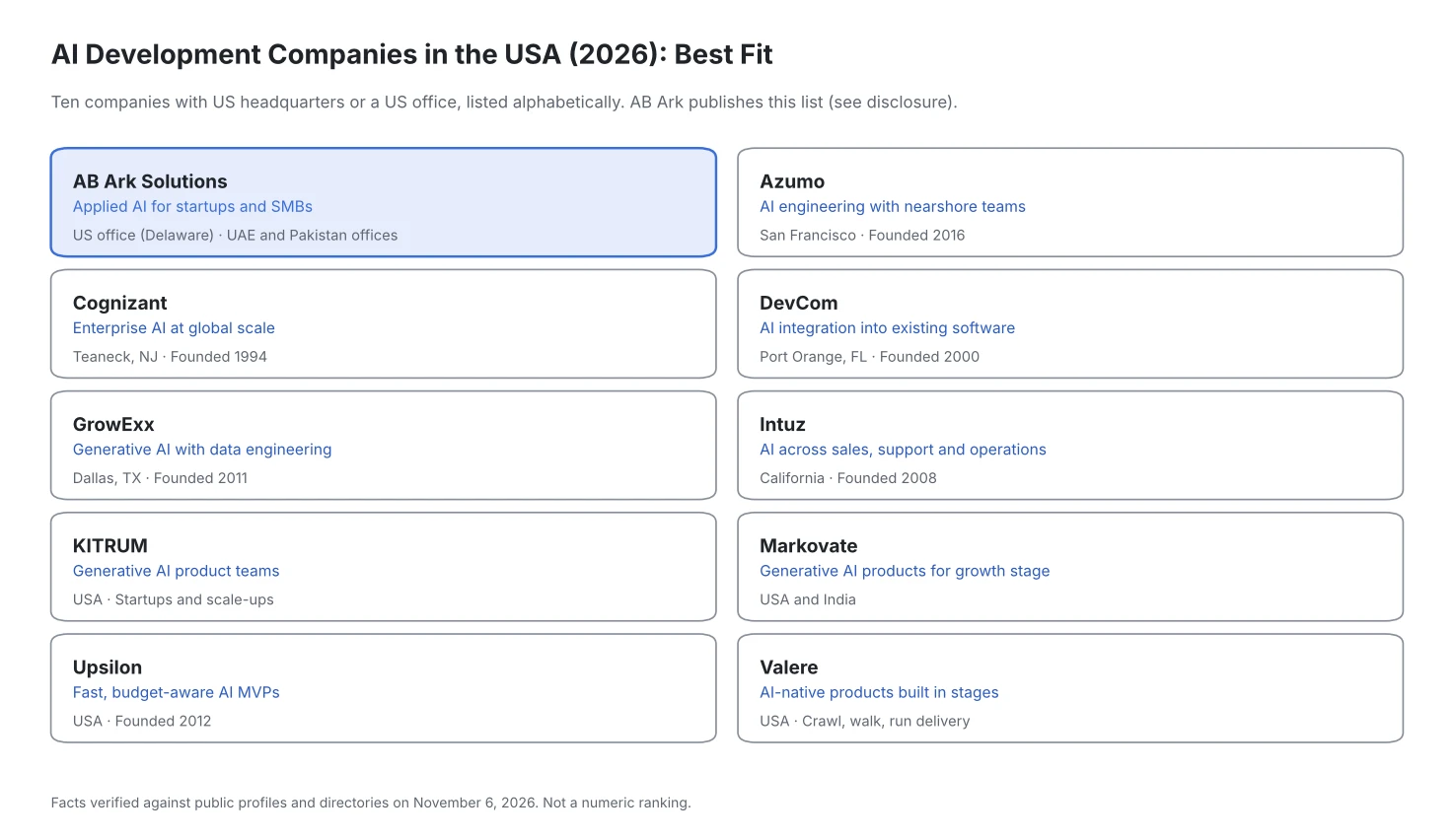 The top AI development companies in the USA in 2026 include AB Ark Solutions, Azumo, Cognizant, DevCom, GrowExx, Intuz, KITRUM, Markovate, Upsilon and Valere. They range from a global enterprise integrator to small product teams for startups. The right choice depends on whether you need AI added to existing software, a new AI product, or enterprise-scale data and governance. Check where the engineers are based, as well as where the company is registered.
This list is for US companies choosing a partner to build machine learning, generative AI, computer vision or AI-enabled software. It explains what counts as a “US” AI development company, how the companies were selected, each company’s best fit, what drives cost, and how to evaluate a partner. For companies focused specifically on AI agents that take actions, see AB Ark’s separate comparison of AI agent development companies.
Key Takeaways
- “AI development company in the USA” can mean US headquarters, a US legal entity, or US-based engineers; ask which, because it affects contracts, time zones and data handling.
- Match the partner to the job: AI integration into existing software, a new AI product, data and MLOps foundations, or enterprise transformation.
- Ask every vendor how they evaluate models, monitor them in production and control run costs; these decide whether an AI project survives its first year.
- Smaller US firms and US-registered companies with offshore engineering usually cost less than large integrators but need clearer specifications from you.
- Own your code, prompts, training data and evaluation sets in the contract.
Talk to Our Team About Your Project ->
What Counts as an AI Development Company in the USA?
For this list, a company qualifies if it is headquartered in the USA or has a US office and legal entity, and builds custom AI software for clients. Many US-headquartered firms deliver with distributed engineering teams, and some international firms contract through US entities. Both can be good choices; what matters is that you know who does the work, where data is processed, and which law governs the contract.
| Model | What it means | Consider when |
|---|---|---|
| US headquarters, US engineers | Company and team in the USA | Restricted data, heavy on-site work, highest budgets |
| US headquarters, distributed engineers | US company with nearshore or offshore teams | You want US contracting with lower blended rates |
| US entity, international headquarters | Registered in the USA, delivery mostly abroad | Cost matters most and the scope is clear |
How We Selected These Companies
Each company was assessed on public AI case studies (30%), breadth of AI engineering across ML, generative AI, data and MLOps (20%), independent reviews or recognition (20%), US presence (15%) and post-launch support (15%). Evidence came from company websites and published comparisons linked in the table below. The list is ordered alphabetically, with each company’s best fit noted, rather than ranked, because the evidence is qualitative.
| Company | Best fit | US presence | Source for profile |
|---|---|---|---|
| AB Ark Solutions (publisher) | Applied AI products for startups and SMBs | Office in Lewes, Delaware | AB Ark website |
| Azumo | AI engineering with nearshore teams | San Francisco; founded 2016 | Entrans |
| Cognizant | Enterprise AI at global scale | Teaneck, New Jersey; founded 1994 | DevCom |
| DevCom | AI integration into existing software | Port Orange, Florida; founded 2000 | DevCom |
| GrowExx | Generative AI with data engineering and analytics | Dallas, Texas and Bengaluru, India; founded 2011 | DevCom |
| Intuz | AI across sales, support and operations systems | San Ramon, California; founded 2008 | Entrans |
| KITRUM | Generative AI product teams for startups | Tampa, Florida; founded 2014 | Technource |
| Markovate | Generative AI products for growth-stage companies | San Francisco, California; founded 2015 | Technource |
| Upsilon | Fast, budget-aware AI MVPs | Sheridan, Wyoming; founded 2012 | Master of Code |
| Valere | AI-native products built in stages | Marlborough, Massachusetts; founded 2019 | Technource |
Company Profiles
AB Ark Solutions (publisher, disclosed)
AB Ark, founded in 2023, is an AI-native software development company with a US office in Lewes, Delaware, plus offices in the UAE and Pakistan. It reports a team of 60+ professionals and 500+ clients served. Its published AI development work spans language, vision and voice: an AI-powered Arabic proofreading platform, an AI-powered solid-waste detection app using computer vision, and AI4Real, which automates real estate video creation. Verified Clutch reviews also describe an AI educational platform and a multi-tenant learning-management system with AI-powered tools. Best for: startups and SMBs that want applied AI products built by one team, or AI engineers added to an existing team.
Azumo
Azumo, a San Francisco company founded in 2016, delivers AI engineering through nearshore teams based largely in Argentina. It is noted for multi-agent systems, LLM-agnostic architecture and strong MLOps. Its Clutch profile shows 50 to 249 staff, a $10,000 minimum project size and rates of $25 to $49 an hour, with reviewed projects ranging from about $4,200 to over $70,000. Some reviewers mention team turnover during projects, so ask how backfills are handled. Best for: US companies that want nearshore AI engineers working in US time zones.
Cognizant
Cognizant, headquartered in Teaneck, New Jersey, and founded in 1994, provides enterprise AI platforms with governance and monitoring for banking, insurance and healthcare. It is by far the largest company on this list: its 2025 annual report shows $21.1 billion in revenue and about 350,000 employees. Its AI offering centers on the Neuro AI and Flowsource platforms, and its AI Lab reports 62 US patents. In 2025 it also announced a collaboration with Anthropic on agentic AI tooling. Best for: large enterprises running AI across many business units.
DevCom
DevCom, based in Port Orange, Florida, and founded in 2000, focuses on custom software and AI integrations into complex business environments. Its Clutch profile shows 24 verified reviews averaging 4.9 stars, 50 to 249 staff, a $25,000 minimum project size and rates of $25 to $49 an hour; the most common reviewed project size is $200,000 to $999,999. Reviewed work includes custom CRMs for construction and HVAC companies, SharePoint and .NET integrations, and long-running outsourced development. Note that DevCom also published the comparison used as the source for three profiles in this list, including its own. Best for: companies adding AI to existing software.
GrowExx
GrowExx, founded in 2011, combines generative AI development with data engineering and analytics. Clutch lists its location as Bengaluru, India, while the DevCom comparison reports a Dallas, Texas base, so confirm where the engineers sit. Clutch also shows 50 to 249 staff, a $10,000 minimum project size and rates of $25 to $49 an hour. Reviewed work includes an AI document-processing platform with data extraction and classification, Tableau analytics for a chemical manufacturer, and a healthcare mobile app. Best for: mid-market companies whose AI depends on getting data foundations right.
Intuz
Intuz, founded in 2008, has offices in San Ramon and San Francisco, California, and Ahmedabad, India, and builds AI solutions integrated with business systems across sales, support and operations. Its Clutch profile shows 50 to 249 staff, a $10,000 minimum project size, rates of $25 to $49 an hour and a most common reviewed project size of $10,000 to $49,999. Recent reviewed AI work includes AI agents for a home health agency ($50,000 to $199,999) and an AI speech-to-text and text-to-speech mobile app for an ERP developer’s client. Best for: companies automating workflows across several existing tools.
KITRUM
KITRUM is a Tampa, Florida company founded in 2014, focused on generative AI MVPs for lean startup teams. Its Clutch profile shows 250 to 999 staff, a $25,000 minimum project size, rates of $50 to $99 an hour and a second office in Warsaw, Poland. Reviewed work includes stabilizing a transportation management system while cutting AWS costs and integrating HubSpot CRM, and building a healthcare management platform from pre-built modules. Best for: startups that need a generative AI product team quickly.
Markovate
Markovate, founded in 2015 in San Francisco, California, with operations in the US and India, builds generative AI products for growth-stage startups. Its services span generative AI and LLM development, AI agents, computer vision, and machine learning with MLOps, and its company description cites 50+ certified AI engineers. One directory lists it as ISO-certified and mainly serving mid-market clients. Published hourly rate estimates differ ($25 to $49 in one directory, $50 to $100 in another), so request a written estimate. Best for: growth-stage companies adding generative AI features to a product.
Upsilon
Upsilon, founded in 2012, specializes in generative AI and fast MVP development for startups. Clutch lists offices in Sheridan, Wyoming, Tallinn, Estonia and Warsaw, Poland, and a team of 10 to 49, while Upsilon’s own site cites 60+ people and rates of $25 to $49 an hour. FeaturedCustomers lists Christie’s, ThoughtSpot and Spotnana among its clients. With offices in Poland and Estonia, confirm where the engineers sit. Best for: founders who need a lean first AI release.
Valere
Valere is a Marlborough, Massachusetts company founded in 2019 that builds AI-native products in “crawl, walk, run” stages. Its method moves clients through building, learning and scaling, and its Clutch profile cites 225+ experts across three countries and AWS Advanced Tier Partner status. Clutch lists 50 to 249 staff and rates of $50 to $99 an hour. One reviewed project turned a client’s early AI prototype into a scalable SaaS product for managing construction submittals and RFIs. Best for: companies that want to phase AI investment against measured results.
What Drives the Cost of AI Development
AI development cost depends mostly on data readiness, how much of the system is custom versus built on existing models, the number of integrations, and the evaluation and monitoring the use case requires. Run costs continue after launch. Gartner’s prediction that over 40% of agentic AI projects will be canceled by the end of 2027, citing costs, unclear value and weak risk controls, is a useful reminder to agree on value and cost targets before building.
| Driver | Lower cost | Higher cost |
|---|---|---|
| Data | Clean, accessible, labeled | Scattered, unlabeled, sensitive |
| Model approach | Existing model APIs with retrieval | Custom training or fine-tuning |
| Integrations | One system with a good API | Many systems, including legacy |
| Risk and compliance | Internal productivity tool | Regulated decisions or customer-facing actions |
| Operations | Basic logging | Full MLOps: monitoring, retraining, drift detection |
AB Ark’s guide to MLOps explains what it takes to run models reliably after launch, the stage where many budgets fall short.
Get a Custom Project Cost & Timeline Estimate ->
How to Choose an AI Development Company in the USA
- Confirm who does the work and where: Names, roles and locations of the engineers, and where your data will be processed.
- Ask for a production case like yours: Same type of AI, similar data, measurable result, and a reference you can call.
- Ask how models are evaluated and monitored: Test sets from your data, accuracy and safety thresholds, and alerts when performance drifts.
- Ask about governance: Who approves changes to models and prompts, what is logged, and how humans review high-impact outputs. AB Ark’s AI agent governance guide lists controls to expect.
- Get run-cost estimates: Model, hosting and monitoring costs per user or per transaction.
- Secure ownership: Code, prompts, fine-tuned weights, training data and evaluation sets should belong to you.
FAQs
What are the top AI development companies in the USA?
Companies with US headquarters or offices that build custom AI include Cognizant for large enterprises, DevCom and Intuz for integrating AI into existing systems, GrowExx for data-heavy generative AI, Azumo for nearshore AI engineering, and KITRUM, Markovate, Upsilon, Valere and AB Ark for startup and growth-stage AI products.
Is a US AI development company better than an offshore one?
Not automatically. US-based teams help with time zones, restricted data and in-person work; offshore or nearshore teams usually cost less per hour. Many US-registered companies combine both. Choose based on relevant experience, evaluation practice and contract terms, and confirm where engineers and data are located.
How long does an AI development project take?
A focused AI feature or MVP often takes two to four months, while enterprise AI programs run much longer. Data preparation, integration and evaluation usually take more time than model work, so ask vendors to break the timeline down by phase.
What should be in an AI development contract?
It should include clear scope and acceptance criteria; ownership of code, prompts, models and data; data-processing and security terms; evaluation targets; post-launch support and run-cost responsibilities; and a handover plan if the engagement ends.
The Rule for Choosing a US AI Development Partner
Decide what “US” must mean for your project, then choose the partner whose production work matches your use case and who can show how it evaluates, monitors and controls the cost of AI after launch.
The best AI partner is not the one with the most impressive demo. It is the one whose AI is still working a year after launch.
Schedule a Free Consultation Call ->
CEO At AB Ark Solutions