

Revolut says it cut its AI coding inference costs by about 90% in under a year by making self-hosted, open-weight models its default for roughly 2,000 engineers. The savings came from three things: running a large open model on its own GPUs, tuning that setup hard, and routing only the work that needs a frontier model to one. The figure is Revolut’s own, reported from a conference talk, so the useful lesson is the method, not the headline number.
Key Takeaways
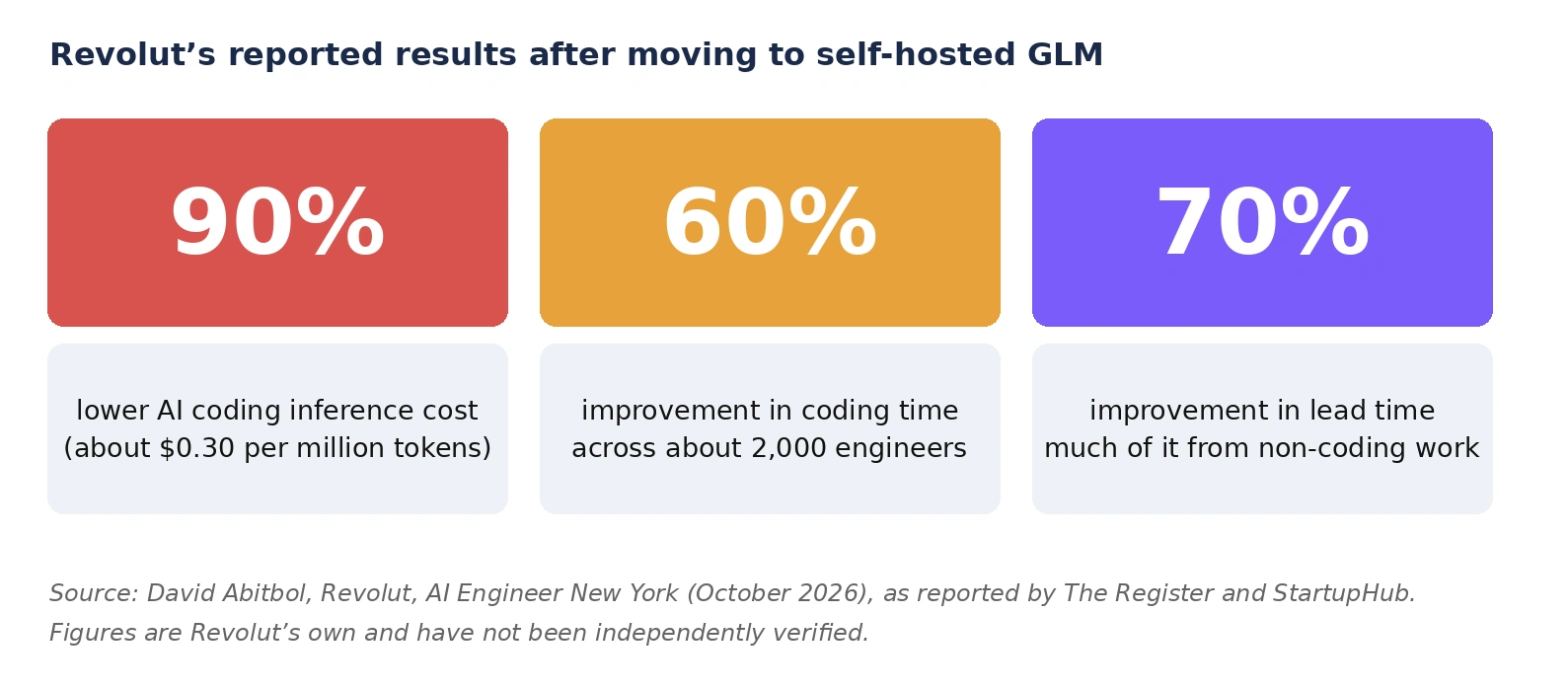
- Revolut reports a 90% lower AI coding bill, at about $0.30 per million tokens, after moving from metered APIs to self-hosted GLM models.
- Strict budget limits on metered tools kept costs down but also kept engineers from using AI on the tasks where it helps most.
- Tuning, not extra hardware, delivered most of the gain: quantization, parallelism, disaggregated serving and a 256,000-token context cap.
- Revolut reports 60% faster coding time and 70% shorter lead time, with much of the lead-time gain coming from work outside pure coding.
- Self-hosting is not a drop-in saving. The result depends on steady high volume, 56 Nvidia B200 GPUs and a team that can run them.
Talk to Our Team About Your Project →
Why Was Revolut’s AI Coding Bill a Problem?
Revolut’s AI coding spend was high and hard to justify. David Abitbol, Revolut’s ops and infrastructure lead, told the AI Engineer conference in New York in October 2026 that the company deployed Gemini in early 2025 and Claude Code in early 2026. The Register reports he described individual engineers spending $1,000 or even $10,000 a month with little visible return.
Revolut responded with strict budget limits. That created a second problem. With tokens rationed, engineers saved them for hard tasks, and StartupHub’s account of the talk says early Claude Code use under budget caps showed little impact. Metered pricing made the tools expensive and underused at the same time.
What Did Revolut Change?
Revolut made a self-hosted GLM model, from the Chinese lab Z.ai, its default coding model. The Register reports it started on GLM-5.1 and moved to GLM-5.3; StartupHub’s write-up names GLM-4.5, so the exact version differs between reports. The 754 billion-parameter figure below fits the GLM-5.x reports better: GLM-4.5 is a smaller model, at roughly 355 billion total and 32 billion active parameters. The setup described in the talk:
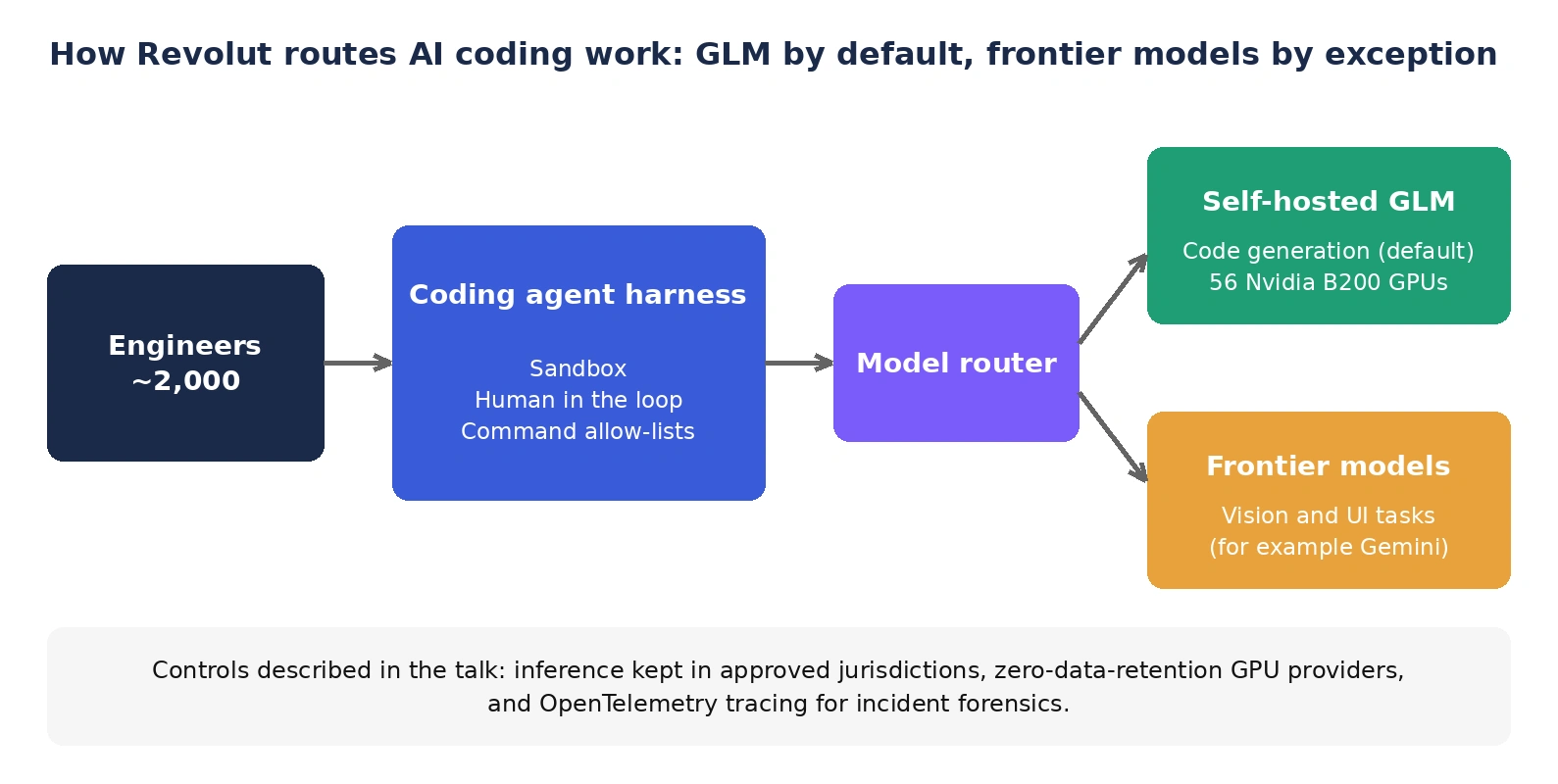
- Hardware: 56 Nvidia B200 GPUs, equal to seven eight-GPU DGX B200 systems.
- Model size: about 754 billion total parameters, with roughly 40 billion active per token. The weights alone need around 380 GB of GPU memory at 4-bit (NVFP4) precision.
- Price: about $0.30 per million tokens, roughly a tenth of what Revolut previously paid Anthropic and OpenAI.
- Integration: an OpenAI-compatible endpoint used through coding tools such as OpenCode and Codex.
How Did Revolut Make Self-Hosting Work?
Revolut made self-hosting work through tuning, not by adding GPUs. Abitbol said out-of-the-box inference was poor. StartupHub reports the team improved performance by 88% and served 76% more demand without adding GPUs, though it does not say which metrics those figures measure. The levers he described:
- Quantization: NVFP4 on Blackwell GPUs, which he said cut GPU footprint by about 40% versus FP8 with no measurable accuracy loss for this workload.
- Parallelism: GLM needed eight-way tensor parallelism, not four-way, to fit its KV cache.
- Disaggregated serving: separating the prefill and decode phases of inference.
- Context limits: a cap of 256,000 tokens even though the model can serve a million. Abitbol’s verdict: “Long context is a scam.”
He also set targets around how engineers work. The goal was a first token in under three seconds, because complaints start once waits pass five. About 200 tokens per second was enough, since engineers now run tasks in parallel and check back when they finish. After 5 p.m., when load drops, speeds reach about 800 tokens per second. StartupHub reports time to first token fell from over 10 seconds to 1.6 seconds while requests per second rose from 3 to over 7.
What Did Cheaper Tokens Change for Engineers?
Cheaper tokens changed behavior, not just cost. Revolut reports 60% faster coding time and 70% shorter lead time across about 2,000 engineers. Abitbol attributed the larger lead-time gain to work outside pure coding, such as debugging, Jira and Confluence tickets, and inbox triage. When tokens are not rationed, engineers hand those jobs to the model instead of saving tokens for the hardest task.
Billing is also flat. There is no end-of-month bill shock, which changes how freely people use the tools.
What Still Runs on Frontier Models?
Vision tasks, such as screenshots and UI mockups, still run on frontier models. GLM is text-only, so Revolut uses a model router that sends vision tasks to Gemini or similar models while code generation stays on GLM. The frontier models remain in the mix as the exception, not the default.
Is a Chinese Open-Weight Model Safe for a Bank?
Revolut’s position is that the risk lies in where the model runs, not in who trained it. Abitbol framed the threat as local: the coding-agent harness employees use, not customer banking systems. Agents run in a sandbox with a human in the loop and allowlists, so a safe command such as git add is permitted while destructive ones (for example, git push –force or rm -rf) are blocked. Inference stays in jurisdictions covered by data adequacy decisions, GPU providers apply zero data retention by default, and OpenTelemetry supports incident forensics.
On the concern about Chinese models, he said the real exposure is calling an API hosted in China. Running the weights on-premises or on regional cloud capacity addresses it. Regulators and security teams may still want evidence that human-in-the-loop controls are more than a configuration flag.
Metered APIs or Self-Hosted Models: How Do They Compare?
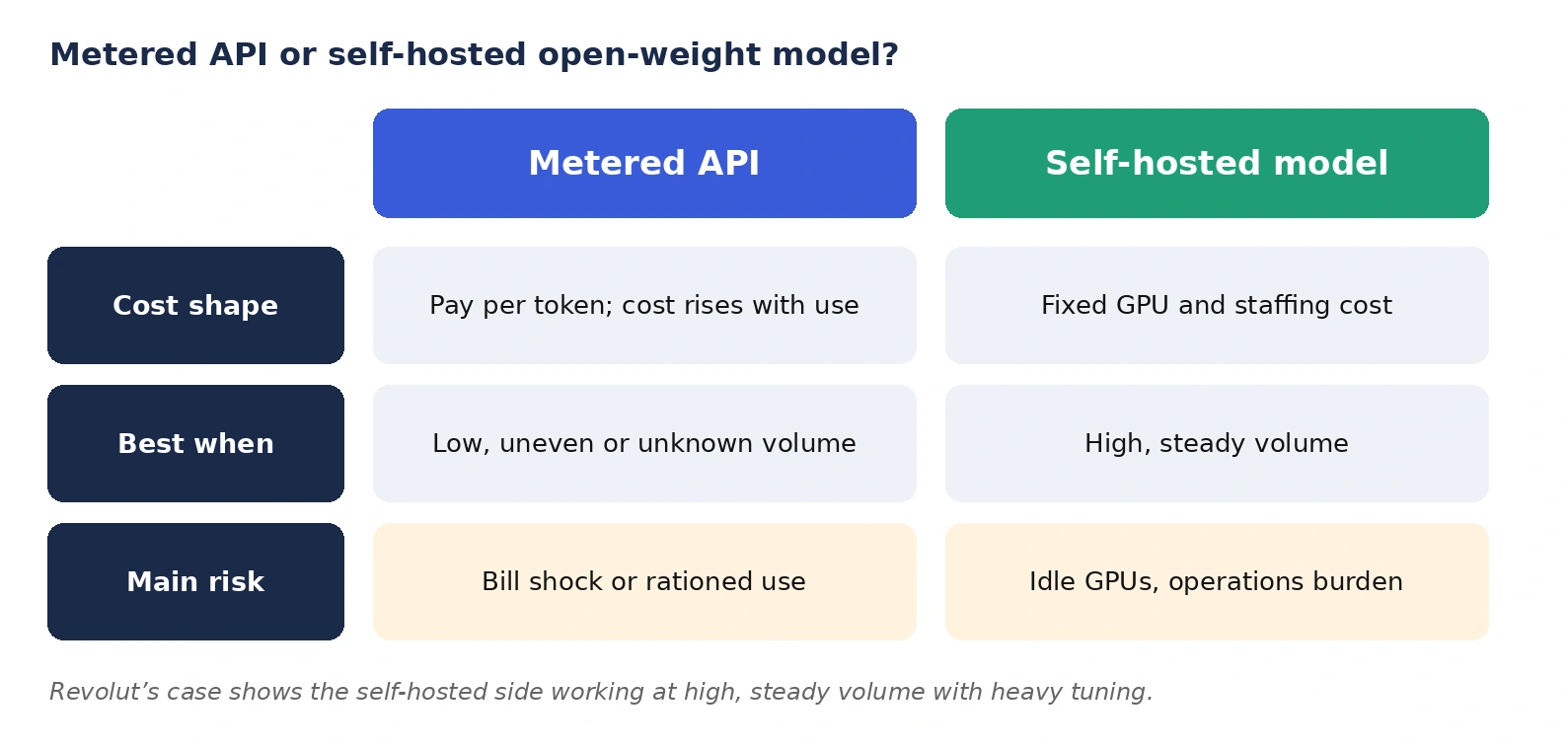
The two options trade a variable bill for a fixed one. Revolut’s case shows the self-hosted side works at high, steady volume. The table below sets out the trade-offs for a team deciding between them.
| Factor | Metered API | Self-hosted open-weight model |
|---|---|---|
| Cost shape | Pay per token, so cost rises with use | Fixed GPU and staffing cost, so cost per token falls with use |
| Best when | Volume is low, uneven or unknown | Volume is high and steady |
| Cost control | Budget caps, which can ration useful work | Utilization and tuning |
| Who tunes performance | The vendor | Your team |
| Model choice | Latest frontier models, including vision | Open-weight models that may trail on some tasks and may be text-only |
| Main risk | Bill shock or underuse | Idle GPUs, slow first tokens, operations burden |
What Should You Ask Before Copying Revolut’s Approach?
- How many tokens do your engineers use a month, and how steady is that load?
- What does that usage cost today, and how much of it is rationed or blocked by caps?
- Do you have people who can run and tune GPU inference, or a partner who can?
- Which tasks need a frontier or vision model, and can a router send only those?
- Where can inference run, given your data and regulatory rules?
- Does the cost estimate include hosting, staffing and observability, not just GPUs?
- How will you measure whether coding time and lead time actually improve?
Can Every Team Expect a 90% Saving?
No. The 90% is Revolut’s self-reported result, and four things limit how far it travels:
- It is self-reported. It comes from a conference talk, not an audit.
- The $0.30 figure excludes key costs. StartupHub notes the talk did not cover hosting, staffing or observability in that token math.
- Scale matters. The result assumes 56 B200 GPUs, continuous tuning, and a company that can shape load through sandbox rules and working patterns. Smaller teams may see slow first tokens or idle GPUs instead of savings.
- It is not a full replacement. Revolut still routes some work to frontier models, so open-weight models are not yet a drop-in answer for every task.
How AB Ark Approaches AI Coding Costs
AB Ark Solutions builds custom software and AI solutions and helps teams adopt AI tooling with cost and risk in view. For teams weighing metered APIs against self-hosting, a sensible start is to measure current usage, test a routed or self-hosted setup with one team, and compare cost and delivery metrics before committing. AB Ark’s case studies show the range of software it has delivered, and teams planning AI work can start with the AI agent development service.
Get a Custom Project Cost & Timeline Estimate →
FAQs
How did Revolut cut its AI coding costs by 90%?
It moved about 2,000 engineers from metered frontier APIs to self-hosted open-weight GLM models on 56 Nvidia B200 GPUs, then tuned the setup with quantization, parallelism, disaggregated serving and a 256,000-token context cap. It reports a cost of about $0.30 per million tokens.
Which model does Revolut use for AI coding?
A GLM model from the Chinese lab Z.ai. The Register reports GLM-5.1 and then GLM-5.3, while StartupHub names GLM-4.5. The model is text-only, so vision tasks go to other models through a router.
How much hardware does a self-hosted coding model need?
Revolut serves about 2,000 engineers on 56 Nvidia B200 GPUs. The model’s weights alone need around 380 GB of GPU memory at 4-bit (NVFP4) precision, plus extra memory for each user’s context.
Has Revolut’s 90% saving been independently verified?
No. It comes from Revolut’s own account at a conference, reported by several outlets. The talk did not include hosting, staffing or observability costs in the $0.30 token figure.
Can a smaller team copy this approach?
Possibly, but the savings depend on steady high volume and the ability to tune GPU inference. Smaller teams should compare their current spend, usage and operations capacity before moving.
Is it safe to run a Chinese open-weight model?
Revolut says the main risk is calling an API hosted in China, and that running the weights on-premises or on regional cloud capacity addresses it. It also uses a sandbox, human review and zero-data-retention GPU providers. Your own security team should assess it against your requirements.
Measure your AI coding spend, test a routed self-hosted setup with one team, and keep frontier models for the work that needs them.
Schedule a Free Consultation Call →
CEO At AB Ark Solutions