In AI software development and everyday AI use, AI governance for a mid-size company is a lightweight set of owners, rules and controls that decides which AI tools and systems the business may use, for what, with which data, and who checks them. A workable framework has five parts: named accountability, an inventory of AI use, risk tiers that set the level of review, technical controls owned by engineering, and ongoing monitoring. It should fit existing security and privacy processes rather than create a separate bureaucracy.
Key Takeaways
- AI governance is not a compliance document; it is a decision system for which AI uses are allowed, who approves them and how they are checked.
- Start with an inventory. You cannot govern AI tools and features you do not know exist, including those employees adopt on their own.
- Use risk tiers so most AI use gets a light-touch check and only high-impact systems get full review.
- Many controls are engineering work: data access, logging, evaluation, human approval steps and vendor settings. Assign them to named engineers, not to a policy.
- Align with an established framework, such as the NIST AI Risk Management Framework, so the program scales and can be explained to customers and auditors.
Talk to Our Team About Your Project ->
What Is AI Governance?
AI governance is the set of decisions, roles and controls that determine how an organization develops, buys and uses AI responsibly. It answers four practical questions: which AI uses are allowed, who approves them, what data they can access, and how they are checked once they are running. Good AI governance is a decision system, not a policy document that sits in a folder.
Three references come up most often when companies set up AI governance: the NIST AI Risk Management Framework, ISO/IEC 42001 and the EU AI Act. They do different jobs. NIST gives you a working method, ISO/IEC 42001 gives you a standard you can be certified against, and the EU AI Act is law that can apply to you whether you choose it or not.
NIST AI Risk Management Framework (AI RMF): A voluntary framework from the US National Institute of Standards and Technology for incorporating trustworthiness into the design, development, use and evaluation of AI systems. It organizes the work into four functions: Govern (accountability and policy), Map (context and risks of each AI use), Measure (testing and monitoring) and Manage (acting on the risks). NIST has also published a Generative AI Profile, released in July 2024, that applies the same structure to generative AI risks. Mid-size companies typically use it as the day-to-day playbook for building their governance program.
ISO/IEC 42001: The international standard for an AI management system, published in December 2023. It specifies requirements for establishing, implementing, maintaining and continually improving an AI management system, and applies to any organization, regardless of size, that provides or uses AI-based products or services. Unlike NIST, an organization can be audited and certified against it, so companies typically adopt it when customers or partners ask for formal proof of responsible AI practices, often alongside ISO/IEC 27001 for information security.
EU AI Act: European Union law that regulates AI by risk level. It applies to companies that place AI systems on the EU market or whose AI output is used in the EU, including companies based outside Europe. Some AI practices are banned outright, transparency duties apply to systems such as chatbots and AI-generated content, and the strictest obligations apply to high-risk uses such as hiring, credit and education, which now apply from 2 December 2027. A company does not choose to follow the EU AI Act; it needs to check whether the Act applies to its products and customers.
| NIST AI RMF | ISO/IEC 42001 | EU AI Act | |
| What it is | Voluntary risk management framework | International management system standard | EU regulation (law) |
| Mandatory? | No | No, unless a customer or contract requires it | Yes, where it applies |
| Can you be certified? | No | Yes, through an accredited audit | No certification; conformity duties for high-risk systems |
| Best used for | Running the governance program day to day | Proving responsible AI practice to customers and auditors | Meeting legal obligations for AI used in the EU |
In practice, many mid-size companies use NIST as the working model, map their program to ISO/IEC 42001 if customers start asking for certification, and check the EU AI Act whenever they sell to or serve EU users. The framework in this article is aligned to NIST and designed so it can grow into either of the other two.
What Does AI Governance Mean for Me?
For a mid-size company, typically a few hundred employees with a small legal team and no dedicated AI ethics function, AI governance has to be proportionate: strong enough to protect customers, data and the business, and light enough that teams keep using approved tools rather than working around them. What it means day to day depends on your role:
| If you are… | AI governance means you… |
|---|---|
| CEO, founder or executive sponsor | Decide how much AI risk the company accepts, name a governance lead and sign off the highest-risk uses |
| CTO or engineering lead | Own the technical controls: approved tools, data access, logging, evaluation, human approval steps and vendor settings |
| Legal, privacy or security lead | Run the inventory and approvals, review vendor terms and track obligations such as the EU AI Act |
| Team lead or manager | Know which AI tools your team uses, request approval for new ones and make sure staff follow the acceptable-use policy |
| Employee | Use approved AI tools with company accounts, keep confidential and customer data out of unapproved tools, and report problems |
| A supplier to larger companies | Have clear answers when customers ask how you govern AI in security questionnaires and contracts |
In practice, the first 90 days are mostly about visibility and ownership: knowing what AI is in use, who owns it and which few systems need real controls. The rollout plan later in this article sets out that sequence.
Why Is AI Governance Needed?
AI governance is needed because AI now touches company data, customer decisions and business systems, often without anyone deciding it should. Five risks make it necessary for mid-size companies in particular:
- Data leaving the company. Employees paste confidential or customer data into AI tools whose retention and training terms nobody has checked.
- Wrong or unfair outputs. AI that drafts customer messages, scores leads or screens candidates can be inaccurate or biased, and the company remains responsible for the result.
- AI that takes actions. Agents connected to email, payments or records can cause real damage if their permissions are too broad or their output is manipulated.
- Customer and supplier expectations. AI questions now appear in enterprise security questionnaires and supplier contracts, so mid-size suppliers need answers they can stand behind.
- Regulation becoming concrete. Rules on transparency, high-risk uses and human oversight now have dates attached.
Weak controls also cost projects. Gartner predicts that over 40% of agentic AI projects will be canceled by the end of 2027, citing escalating costs, unclear business value or inadequate risk controls (press release, June 2025).
In the EU, the Digital Omnibus on AI, now in force, delayed most high-risk AI obligations to 2 December 2027 and created a new “small mid-cap” category of companies. According to Orrick’s summary, these are enterprises that are not SMEs, employ fewer than 750 people and have turnover up to €150 million or a balance sheet up to €129 million, and they gain access to simplified technical documentation, more proportionate quality management expectations and tailored penalty caps. Many mid-size companies fall into this category; the obligations are lighter, not absent.
The Framework at a Glance
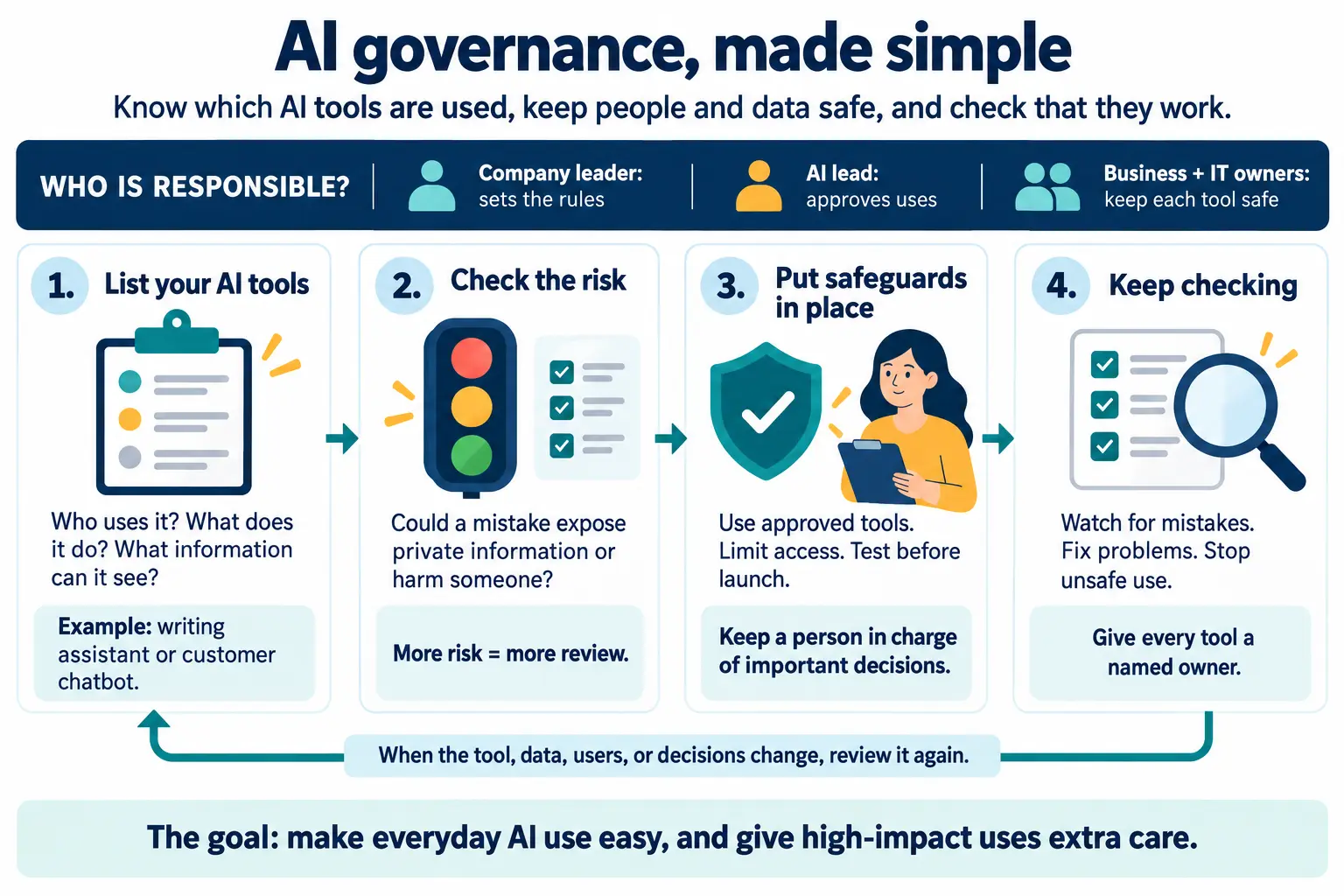
The AB Ark mid-size AI governance framework has two layers: accountability at the top, and four operating components underneath that run continuously. The executive sponsor sets how much AI risk the company accepts; the governance lead and a small review group run approvals and policy; and the inventory, risk tiers, engineering controls and monitoring do the day-to-day work.
The loop matters as much as the boxes. When an AI system’s data, users or decision-making changes, it goes back through the inventory and is re-tiered; governance is a cycle, not a one-off approval. The NIST labels show which function of the AI Risk Management Framework each component mainly serves, with Govern running across all of them.
Step 1: Build the AI Inventory
An AI inventory is a register of every AI tool, model and AI-powered feature the company uses or builds, with an owner and a risk tier for each. It is the foundation of governance: every later decision, from approvals to vendor reviews to incident response, depends on knowing what exists.
Record, for each entry: the name and vendor or model; the business owner and the technical owner; what it is used for and by whom; what data it can access or receive, especially personal, confidential or customer data; whether it makes or influences decisions about people; where it runs and where data is stored; and its risk tier.
Three sources together give a good first picture: a short survey of team leads, a review of SaaS subscriptions and expense claims for AI tools, and a check by engineering of network traffic, browser extensions and API keys for AI providers. Expect to find tools nobody approved; the goal of the first inventory is visibility, not punishment.
Step 2: Assign a Risk Tier to Every AI Use
Risk tiers decide how much review each AI use needs, so that governance effort goes where the potential for harm is greatest. The four tiers below are the AB Ark mid-size tiering model, an editorial framework aligned to NIST’s “Map” function; it is not a legal classification and does not replace an EU AI Act assessment where that applies.
| Tier | Typical examples | Review required before use | Ongoing checks |
|---|---|---|---|
| Tier 1: Low | Writing assistants with no confidential data, summarizing public information, internal brainstorming | Approved-tool list and acceptable-use policy only | Annual inventory update |
| Tier 2: Moderate | Coding assistants on company code, AI features inside approved SaaS tools, internal knowledge search over company documents | Security and data review of the vendor or tool; engineering confirms data settings | Quarterly access and usage review |
| Tier 3: High | Customer-facing chatbots and voice agents, AI that drafts customer communications, AI that processes personal data at scale | Full review: data protection impact check, testing, human oversight design, sign-off by the governance lead | Monitoring, sampling of outputs, incident process |
| Tier 4: Restricted | AI that makes or materially influences decisions about hiring, credit, pricing for individuals, health, safety or legal rights; agents that can move money or change records | Executive sign-off, legal review, documented human oversight; check EU AI Act high-risk status | Continuous monitoring, regular audits, documented re-approval on change |
Two rules keep tiering honest: the tier follows the use, not the tool, so the same model can be Tier 1 for brainstorming and Tier 3 in a customer chatbot; and any change in data, users or decision-making triggers a re-tier.
Get a Custom Project Cost & Timeline Estimate ->
Step 3: Technical Controls Engineering Must Own
A governance policy only works if it is enforced in systems, and most of that enforcement is engineering work. The controls below turn the risk tiers into something that actually happens; each needs a named engineering owner, not just a line in a policy. They are AB Ark’s recommended baseline for mid-size companies; scale them to your tiers and stack.
| Control | What it does | Applies from | Engineering owner’s task |
|---|---|---|---|
| Approved AI tools and access via SSO | Limits AI use to vetted tools with company accounts, so data settings and offboarding are controlled | Tier 1 | Provision enterprise or team plans, enforce single sign-on, remove personal-account use for work data |
| Secrets and API key management | Keeps AI provider keys out of code and limits what each key can do | Tier 1 | Store keys in a secrets manager, scope and rotate them, monitor usage and spend |
| Vendor data settings | Prevents company data being retained or used for model training by AI vendors | Tier 2 | Confirm and document training opt-out, retention period and data region for each vendor; re-check on contract renewal |
| Data classification gates | Stops confidential or personal data reaching tools not approved for it | Tier 2 | Map data classes to approved tools; add data-loss-prevention or redaction where needed |
| Least-privilege tools for AI agents | Limits what an AI system can do if its output is wrong or manipulated | Tier 3 | Give agents narrow, typed tools; no write access beyond the task; validate parameters in code |
| Human approval for high-impact actions | Ensures a person approves actions that move money, change records or affect customers | Tier 3 | Build approval steps into the workflow; approvals expire rather than auto-execute |
| Pre-release evaluation | Tests accuracy, safety and failure behaviour before launch | Tier 3 | Maintain an evaluation set of real and adversarial cases; re-run on every model, prompt or data change |
| Logging and audit trail | Records inputs, outputs, tool calls and approvals for investigation | Tier 3 | Log to a store the AI cannot edit; set retention in line with privacy rules |
| Monitoring and incident response | Detects failures, abuse and drift in production | Tier 3 | Alerts on error rates, unusual usage and policy violations; a runbook to disable the AI feature quickly |
The agent controls follow security community guidance. The OWASP Top 10 for LLM Applications names Excessive Agency (LLM06:2025) as the risk that an AI system takes damaging actions in response to unexpected, ambiguous or manipulated outputs, and traces it to excessive functionality, permissions and autonomy. Narrow tools, least privilege and human approval for high-impact actions address all three. For a worked example of approval controls, see AB Ark’s AI agent approval workflow for refunds.
The practical test for every Tier 3 or Tier 4 system is simple: if the AI produced the worst plausible output, would a control in code stop the harm, or only a sentence in a policy?
Step 4: Escalate Risks to the Right Owner
Anyone can raise an AI risk through a single channel, such as a form or a dedicated Slack channel. Each report is logged against the system’s inventory entry, and the technical owner triages it within one business day.
| Tier | Notified | Decides | Response |
| Tier 1: Low | Technical owner | Technical owner | Next weekly review |
| Tier 2: Moderate | Technical owner, business owner | Business owner | Within 5 business days |
| Tier 3: High | Business owner, governance lead | Governance lead | Within 2 business days. Pause the feature if customers are affected. |
| Tier 4: Restricted | Governance lead, executive sponsor, legal | Executive sponsor | Same day. Disable first, investigate second. |
These rules keep it working:
Escalate by impact, not by tier. A Tier 2 tool that leaks customer data is treated as Tier 3 or higher immediately.
When unsure, escalate one level up:
Stopping doesn’t need approval. The technical owner can disable a Tier 3 or 4 feature without waiting for sign-off.
Close the loop. Every report ends with a recorded decision (fix, accept or retire), the reporter is told the outcome, the system is re-tiered if needed, and open items go to the quarterly review.
This maps to NIST MANAGE 4.3, which covers communicating incidents to the people who need to act.
Rolling Out AI Governance in 90 Days
A mid-size company can stand up a working AI governance program in about 90 days by doing the minimum that matters first and improving from there. The aim of the first quarter is not a perfect framework; it is a known inventory, clear owners, approved tools and real controls on the highest-risk systems.
| Days | Focus | Deliverables |
| 1 to 30 | Ownership and visibility | Executive sponsor and governance lead named; first AI inventory; acceptable-use policy; approved-tool list with company accounts. Day 30 checkpoint: Sponsor and governance lead confirm the inventory is complete enough to tier and flag likely Tier 3 and Tier 4 systems for priority review. |
| 31 to 60 | Risk and controls | Every inventory entry is tiered; vendor data settings confirmed for all tools; Tier 3 and Tier 4 systems reviewed or scheduled for review, with gaps assigned to engineering owners. Day 60 checkpoint: Governance lead confirms owners and dates for every open gap. |
| 61 to 90 | Process and habits | Intake form for new AI uses; risk escalation channel; short training for staff and managers; monitoring and incident runbook for Tier 3 and Tier 4 systems; first quarterly review held. |
Roles for a mid-size company. Most mid-size companies do not need a dedicated AI ethics team. A workable model is an executive sponsor who owns the risk appetite; a governance lead, often from security, privacy or legal, who runs the inventory and approvals; a small review group with legal, security, engineering and a business representative that meets monthly or when a Tier 3 or Tier 4 request arrives; and named business and technical owners for every AI system in the inventory.
Keep it proportionate. Tier 1 requests should be approved in days, not weeks, or employees will route around the process. Spend review time on the few systems that touch customers, personal data or decisions about people.
Align with a standard as you mature. Once the basics run, map the program to the NIST AI RMF functions so it can be explained to customers and auditors, and consider ISO/IEC 42001, the international standard for AI management systems, if customers start asking for certification.
An AB Ark Implementation Lens
AB Ark’s Grey Mind AI case study is the kind of system this framework is designed for: an AI-powered mental health platform that helps individuals and organizations track emotional wellbeing, with emotion analysis and personalized insights.
AI working on sensitive wellbeing data would sit in the High or Restricted tier of the model above, needing data protection review, documented human oversight and monitoring. The case study describes the product, not its governance program, so it should not be read as evidence of the specific controls in this article. If you are building AI features and want these controls designed in from the start, AB Ark’s custom software development team can review your AI systems against the tiers and controls above.
FAQs
Is AI governance only for companies that build AI?
No. Most mid-size companies need AI governance mainly for the AI they use: assistants employees adopt, AI features switched on inside existing SaaS tools, and vendor products that process company data. Building AI adds testing and oversight duties, but using AI already creates data, accuracy and accountability risks that need owners.
Does a mid-size company need an AI governance framework?
If employees use AI tools with company data, or the company offers AI features to customers, yes, in proportion to the risk. A lightweight framework protects customer data, answers supplier security questionnaires, and prepares the company for regulation such as the EU AI Act, where the new small mid-cap category reduces, but does not remove, obligations.
Who should own AI governance in a mid-size company?
An executive sponsor should own the risk appetite, and a named governance lead, often from security, privacy or legal, should run the day-to-day process. Engineering should own the technical controls, and every AI system should have a named business owner and technical owner.
What is the difference between the NIST AI RMF and ISO/IEC 42001?
The NIST AI Risk Management Framework is voluntary US guidance organized around four functions: Govern, Map, Measure and Manage. ISO/IEC 42001 is an international standard for AI management systems that organizations can be certified against. Many companies use NIST as the working model and consider ISO 42001 when customers ask for certification.
How do you stop employees using unapproved AI tools?
Blocking alone rarely works. Offer approved tools with company accounts that are as easy to use as the unapproved ones, publish a short acceptable-use policy, make approval for low-risk tools fast, and use engineering controls to keep confidential data out of tools not approved for it.
The Framework in One Line
For a mid-size company, AI governance means knowing every AI use, tiering it by risk, putting real engineering controls on the systems that touch customers, personal data or decisions about people, and naming an owner for each. Start in 90 days with the minimum that matters, keep low-risk approvals fast, and align with NIST as the program matures.
Good AI governance does not slow teams down. It makes the safe uses fast and puts real controls on the few that could cause harm.
Schedule a Free Consultation Call ->

Head Of Product