
Outsourcing AI development can give an enterprise access to specialist engineering capability without building an entire team internally. But outsourcing the work does not automatically outsource accountability for the business process, the data or the decisions the system influences.
This guide is for technology leaders, security teams and procurement owners who need to understand the risks before signing a contract, not after a project has become difficult to recover. Most of these risks are manageable. The challenge is making them visible, assigning ownership and establishing controls while the buyer still has leverage.
What Changes When AI Development Is Outsourced
An AI project can involve more organizations than the company on the proposal: a development partner, subcontractors, a cloud provider, a foundation model provider and other processing or integration services. Each may have different access, retention rules and service obligations.
Start by mapping the delivery chain. Identify who can access source data, where it is stored, who deploys the application, who approves model changes and who responds to incidents. Record the same details for any subcontractors or external APIs.
The risk profile differs by delivery model. In staff augmentation, the client may retain architecture and operational control. In managed development, the vendor may take responsibility for delivery milestones. In a hosted AI service, the provider may operate infrastructure and update models. In all three, the buyer still needs to understand its own obligations and what the contract actually delegates.
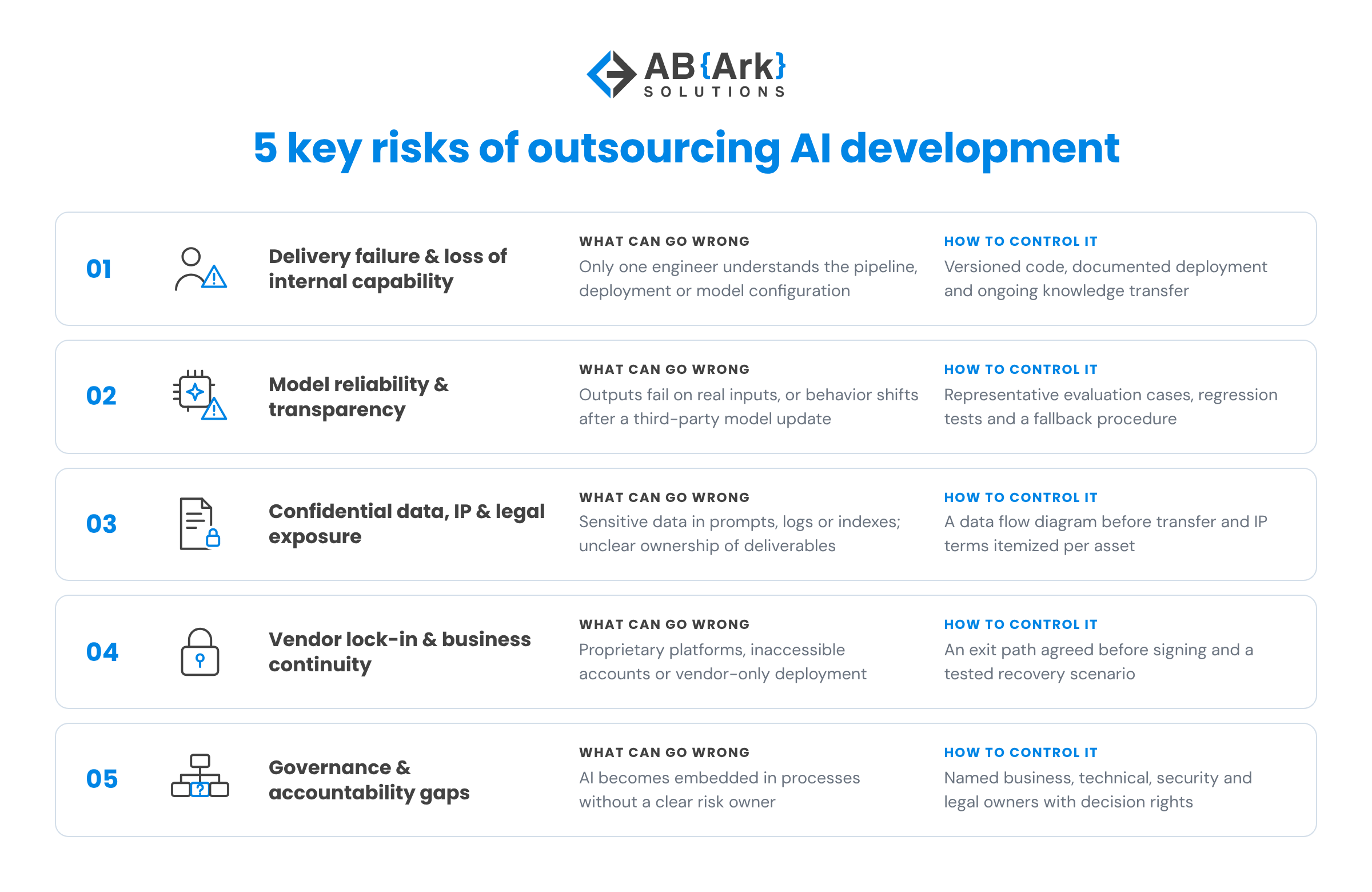
Risk 1: Delivery Failure and Loss of Internal Capability
A project can be delivered on time and still create a long-term dependency if the internal team cannot operate it. Key-person risk appears when one engineer understands the retrieval pipeline, deployment scripts or model configuration and nobody else can maintain them.
How to reduce operational dependency
Require version-controlled source code, architecture diagrams, deployment instructions, test suites and a record of decisions. Schedule knowledge-transfer sessions throughout the engagement rather than concentrating them in the final week. Assign an internal technical owner even when the vendor leads development.
For a critical workflow, ask the partner to demonstrate recovery and handover using a team member who was not the original author. If deployment depends on undocumented steps or personal credentials, resolve that before accepting the system.
Risk 2: Model Reliability and Lack of Transparency
AI outputs can be incorrect, incomplete or inconsistent even when the software runs without errors. A model may work on a curated demonstration but fail on unusual documents, unfamiliar terminology or changing input patterns. Third-party model updates can also alter system behavior.
What the buyer should require
Define representative evaluation cases and measurable acceptance criteria. A customer service assistant might be assessed on correct policy retrieval, escalation of ambiguous requests and absence of unauthorized disclosures. A predictive model may need validation on recent or separately held-out data.
Ask for model versions, evaluation methods, known limitations and the response to a model or API outage. Require regression tests before material changes and establish rollback or fallback procedures. A fallback may mean routing a task to a human, not necessarily switching to another model automatically.
Transparency does not always mean access to a proprietary model’s internal weights. It does mean understanding the dependencies, available evidence, limitations and decisions that affect the buyer’s use case.
Risk 3: Confidential Data, Intellectual Property and Legal Exposure
When an AI application processes internal records, source code, customer information or proprietary documents, the data path matters as much as the application itself. Confidential information may appear in prompts, retrieved passages, model responses, vector indexes, logs or backups.
Clarify data processing before any transfer
Request a data flow diagram and identify storage locations, retention periods, subprocessors, model-provider usage terms and deletion procedures. Determine whether data can be used for provider training and whether the selected configuration changes those terms. Restrict access to the smallest set of people and systems required.
Legal and privacy teams should assess relevant data protection requirements, cross-border transfers and sector obligations. A vendor’s general assurance that its service is compliant does not establish that your particular deployment meets every applicable requirement.
Clarify what you own at the end of the project
The contract should distinguish newly developed code, pre-existing vendor components, third-party libraries, prompts, evaluation assets, datasets and outputs. Confirm which items are assigned, licensed or excluded and whether the rights allow another team to maintain the application.
Do not assume that paying for a project gives unrestricted rights to a third-party model or library. Review license terms and identify any dependency that could limit future use, distribution or migration. Have counsel assess the relevant IP and contractual issues.
Risk 4: Vendor Lock-In and Business Continuity
Lock-in is not limited to the model. It can occur through a proprietary orchestration platform, inaccessible cloud accounts, undocumented data pipelines or a deployment process that only the vendor controls.
Some dependencies are commercially reasonable. A managed model API may reduce infrastructure complexity substantially. The question is whether your business understands what replacing it would involve and whether that cost is acceptable.
Design an exit path before signing
Agree on access to repositories, data export formats, deployment configuration, documentation and credentials under appropriate client control. Identify which components can be replaced independently and which would require redevelopment. Set out transition assistance, termination terms and secure return or deletion of data.
Test recovery against a defined scenario: the supplier becomes unavailable, a model provider changes its service or the client needs to move hosting. For critical systems, define recovery objectives and verify that the recovery approach meets them. A migration plan that has never been exercised is an assumption, not proven resilience.
Risk 5: Governance and Accountability Gaps
An external development team can build an approval interface, but the client must still decide who is authorized to approve a consequential business action. If those decisions are not documented, an AI application can become embedded in processes without a clear risk owner.
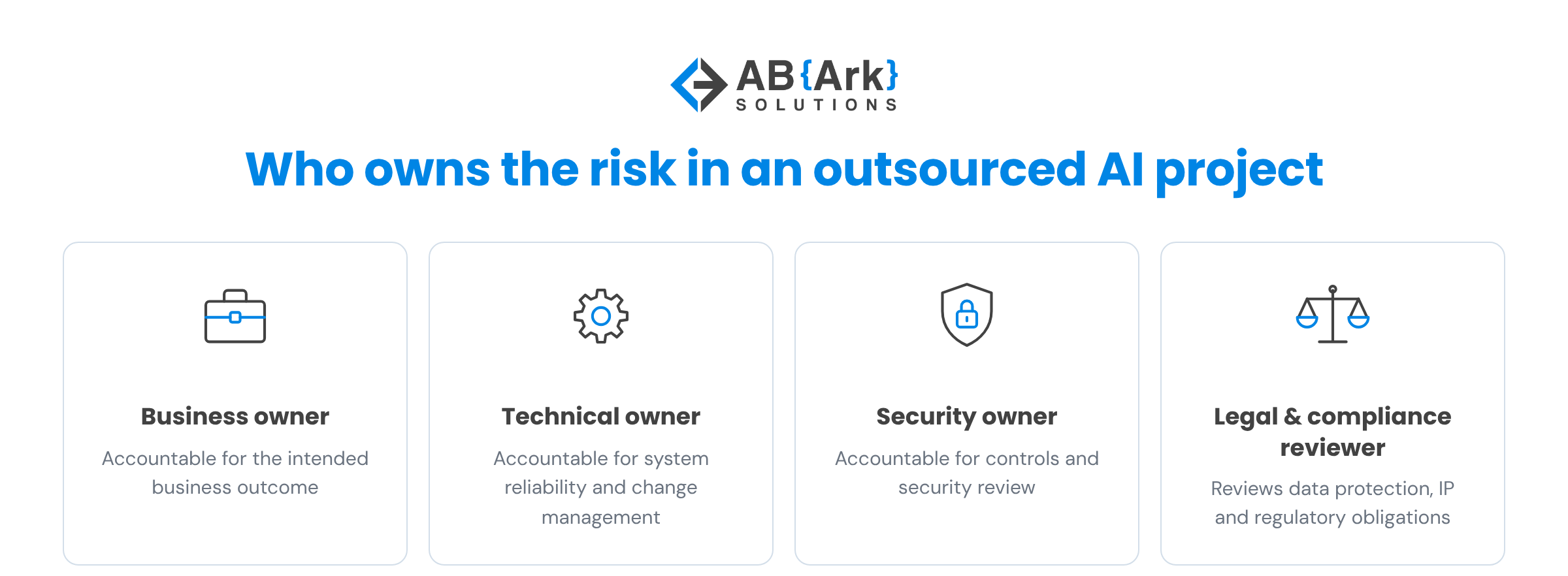
Assign a business owner for the intended outcome, a technical owner for system reliability, a security owner for controls and an appropriate legal or compliance reviewer. Define who can approve deployment, accept remaining risk, investigate an incident and authorize a return to service.
Human oversight should be meaningful. For example, if an AI tool proposes a financial adjustment, the reviewer needs the information and authority to reject it. A nominal approval button is insufficient if the reviewer cannot evaluate the proposed action.
How to Assess AI Vendor Risk Before Signing
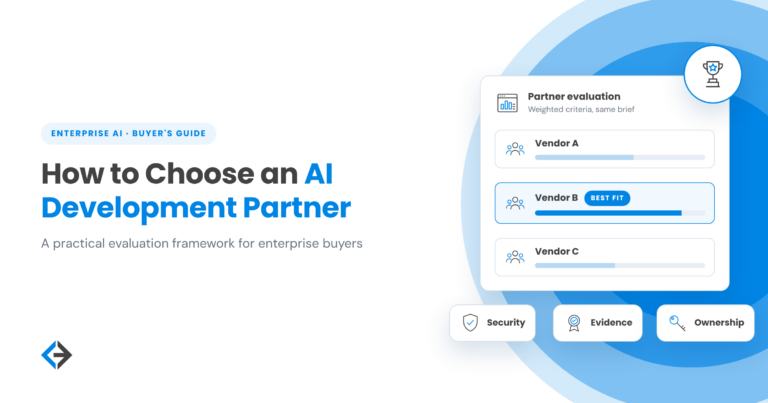
Request evidence rather than relying on yes-or-no questionnaires. Useful evidence includes architecture diagrams, data inventories, access provisioning processes, evaluation reports, incident response procedures, relevant security assessment results and a sample handover package. Scope any audit or certification evidence to the specific service and deployment.
A practical risk register
Use a register with a scenario, likelihood, impact, owner, mitigation, evidence and remaining risk. Here are three illustrative entries:
- Unauthorized document retrieval: potentially high impact; security owner; require document-level authorization and negative-access tests; do not release until critical failures are resolved.
- Model API outage: likelihood assessed using dependency information; technical owner; require timeout handling, manual fallback and recovery tests; accept remaining downtime only against business requirements.
- Departure of a key engineer: delivery owner; require shared repositories, documented deployment and cross-training; validate by independent handover rehearsal.
Likelihood should be assessed for your actual environment rather than copied from a generic template. Revisit the register when scope, data sources or model providers change.
What to Put in the Contract and Operating Plan
A practical agreement should cover deliverables and acceptance, data processing and confidentiality, IP and licensing, approved subprocessors, security responsibilities, notification and escalation procedures, service commitments, change control and exit assistance. Specific obligations should be reviewed by qualified counsel.
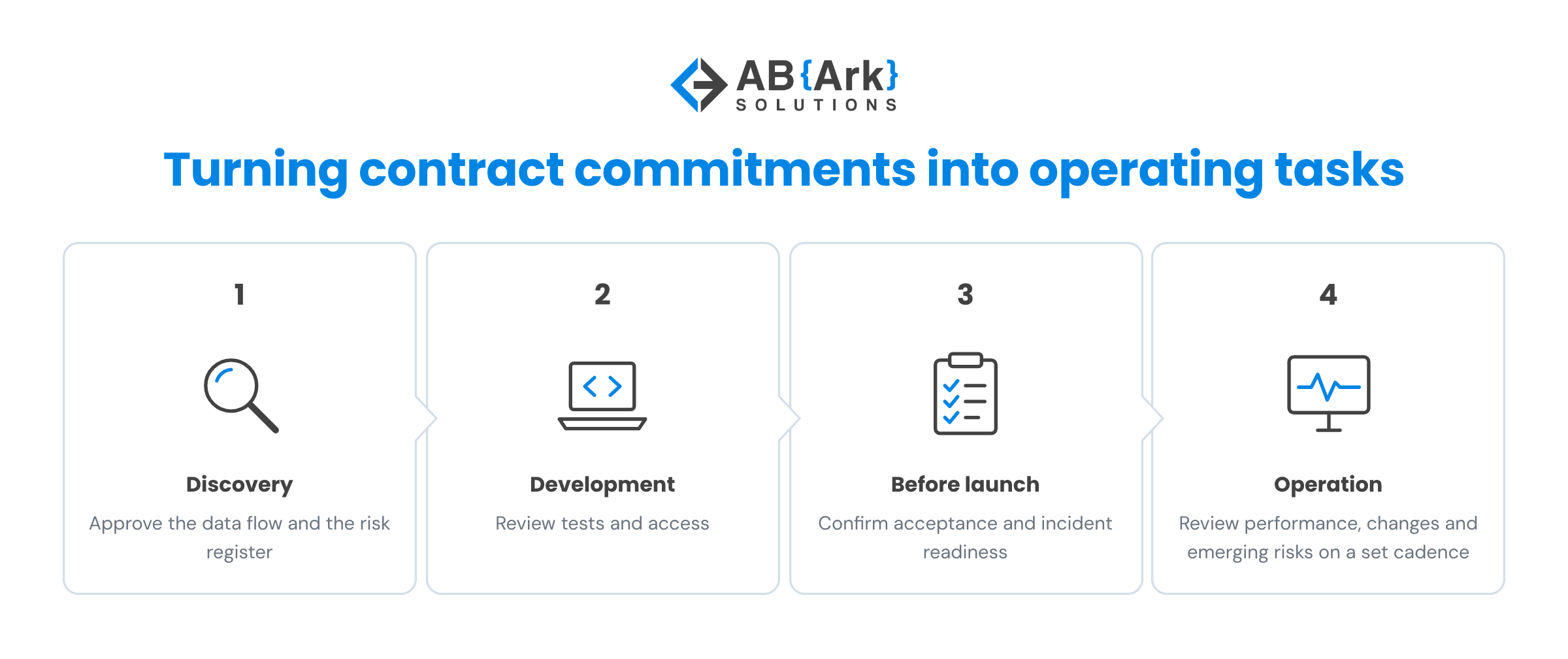
After signing, convert those commitments into operating tasks. During discovery, approve the data flow and risk register. During development, review tests and access. Before launch, confirm acceptance and incident readiness. During operation, review performance, changes and emerging risks at an appropriate cadence.
The NIST AI Risk Management Framework provides a useful lifecycle structure for organizing these activities. It is not a substitute for legal review or proof that a particular control works.
Frequently Asked Questions
What are the biggest risks of outsourcing AI development?
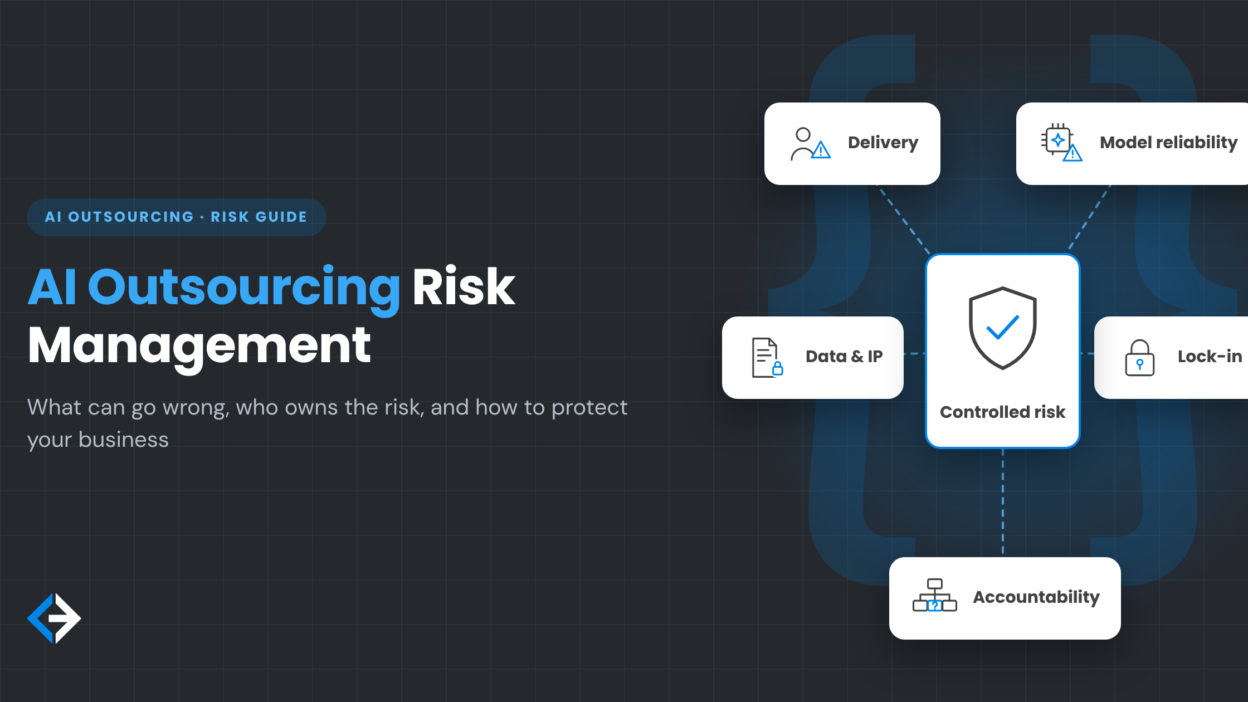
The principal risks are unreliable outputs, confidential data exposure, unclear intellectual property rights, delivery dependency, vendor lock-in and gaps in operational accountability. Their relative importance depends on the data, system and business consequences involved.
Does outsourcing transfer compliance responsibility to the vendor?
Not automatically. Responsibilities depend on applicable law, the parties’ roles and the agreement. The organization should assess its own obligations with counsel and ensure that the vendor’s commitments support them.
Who owns AI-generated outputs and source code?
Ownership and usage rights depend on applicable law, contracts and third-party terms. Clarify code, datasets, prompts, outputs and pre-existing components separately rather than assuming a single ownership clause covers everything.
How can I reduce AI vendor lock-in?
Use portable interfaces where practical, retain appropriate access to code and data, document dependencies and negotiate exit support. Evaluate migration cost before choosing proprietary components.
How do I monitor an outsourced AI system?
Define quality and reliability indicators, establish privacy-aware logging, review changes and incidents and assign accountable owners. The monitoring approach should reflect the harm a failure could cause, not just system uptime.
What should an AI outsourcing agreement include?
Include scoped deliverables, acceptance tests, data handling, confidentiality, IP, security responsibilities, subcontracting, incident notification, support, change management and exit terms. Obtain legal review for the actual engagement.
The Bottom Line
The objective of AI outsourcing risk management is not to eliminate every dependency. It is to make dependencies visible and manageable. A buyer that can explain who controls the data, how the system is evaluated, who responds to failure and how the solution can be handed over is in a much stronger position than one relying on a supplier’s assurances.
If you are considering an outsourced AI project, bring your security requirements, workflow and ownership expectations to a technical discovery discussion with AB Ark Solutions. Establish the delivery boundaries before committing to implementation.
CTO & Co-founder At AB Ark Solutions