
Choosing an AI development partner is not the same as choosing a software development agency. A conventional application can often be evaluated against a deterministic specification. An AI system must also be evaluated against the variability of its inputs, the reliability of its outputs, the security of its data flows and its ability to operate when underlying models change.
This guide is written for CTOs, CIOs, product leaders and procurement teams who need to shortlist a partner, defend the investment internally and avoid paying for a prototype that never becomes a dependable business system. The goal is not to identify the vendor with the most impressive demo. It is to identify the team that can deliver the outcome your organization actually needs.
What an AI Partner Actually Needs to Deliver
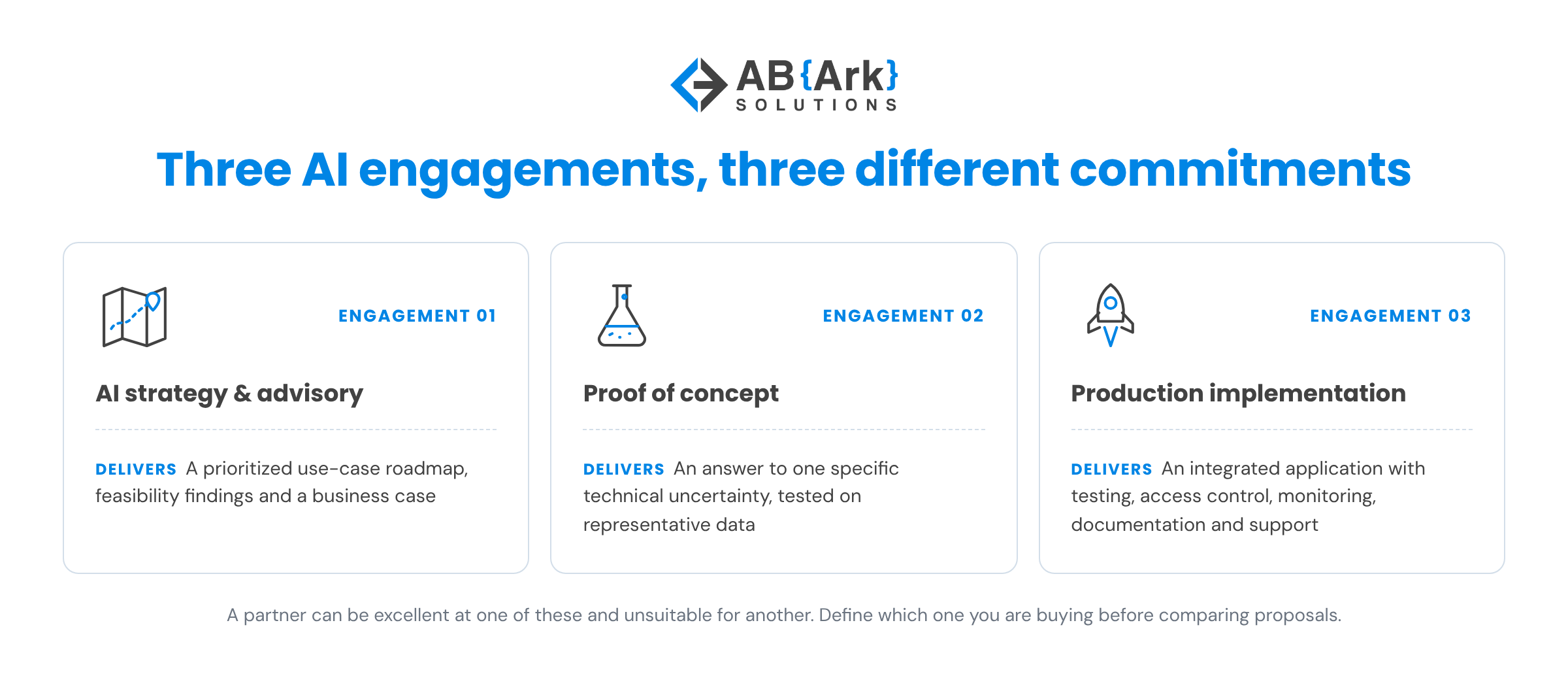
Before you compare vendors, establish what you are buying. An AI strategy engagement, a proof of concept and a production implementation are different commitments. A partner can be excellent at one and unsuitable for another.
Define the engagement before comparing proposals
An advisory engagement should produce a prioritized use-case roadmap, feasibility findings and a business case. A proof of concept should resolve a specific technical uncertainty using representative data. A production engagement should deliver an integrated application with testing, access control, monitoring, documentation and a support arrangement.
Write down the workflow you want to improve, the people who use it, the current cost or processing time, the available data and the outcome that would justify investment. For an internal knowledge assistant, for example, success might mean employees find approved policy answers faster without seeing documents they are not authorized to access. That is a much more useful specification than “build a chatbot.”
If your organization already has an architect, product owner and engineering management capability, dedicated engineers may be the right engagement. If those capabilities are missing, buying additional developer hours alone will not necessarily solve the delivery problem. You may need a partner responsible for architecture, product delivery and operational readiness.
Match technical capability to the actual use case
Retrieval-augmented generation (RAG) requires expertise in document ingestion, retrieval, permissions and grounded answers. Predictive machine learning requires representative historical data, validation and monitoring for changing patterns. Workflow automation requires reliable integrations and exception handling. An AI agent that can take actions requires carefully scoped permissions and approval mechanisms.
Ask vendors to explain how their experience maps to your workflow. A portfolio of conversational interfaces is not evidence that a team can integrate with a regulated enterprise’s identity system. An industry logo is not proof of experience with the same deployment constraints.
The Enterprise AI Vendor Evaluation Scorecard
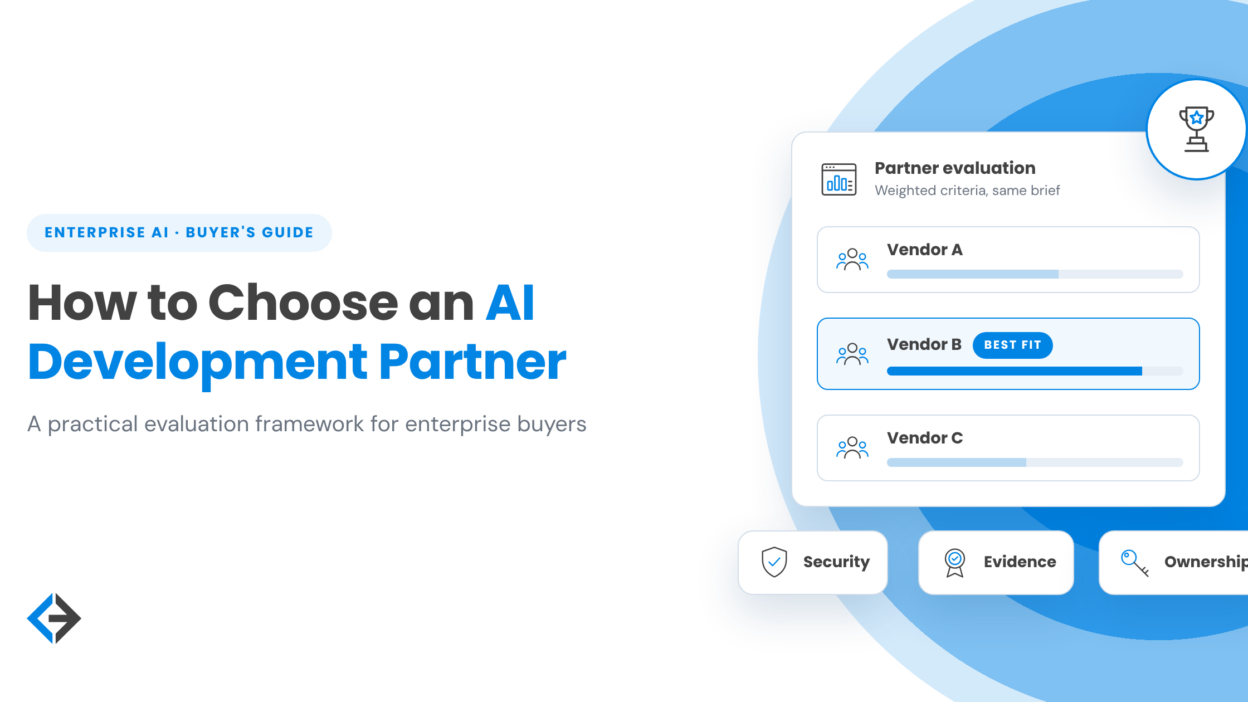
A scorecard makes proposals comparable and gives procurement a defensible record of the selection. The following weights are a suggested starting point, not an industry standard. Adjust them before reviewing proposals so that the evaluation does not favor a particular vendor after the fact.
- Technical and architecture capability (25%): relevant architecture, integration strategy, evaluation approach and production reliability.
- Relevant delivery evidence (20%): comparable deployments, measurable outcomes, references and clear attribution of the vendor’s role.
- Security and governance (20%): data flows, access controls, incident response and evidence of appropriate security practices.
- Delivery process and team (15%): named roles, seniority, availability, delivery cadence and quality assurance.
- Commercial transparency (10%): itemized costs, assumptions, exclusions and change control.
- Ownership and support (10%): code and documentation rights, handover, maintenance and exit arrangements.
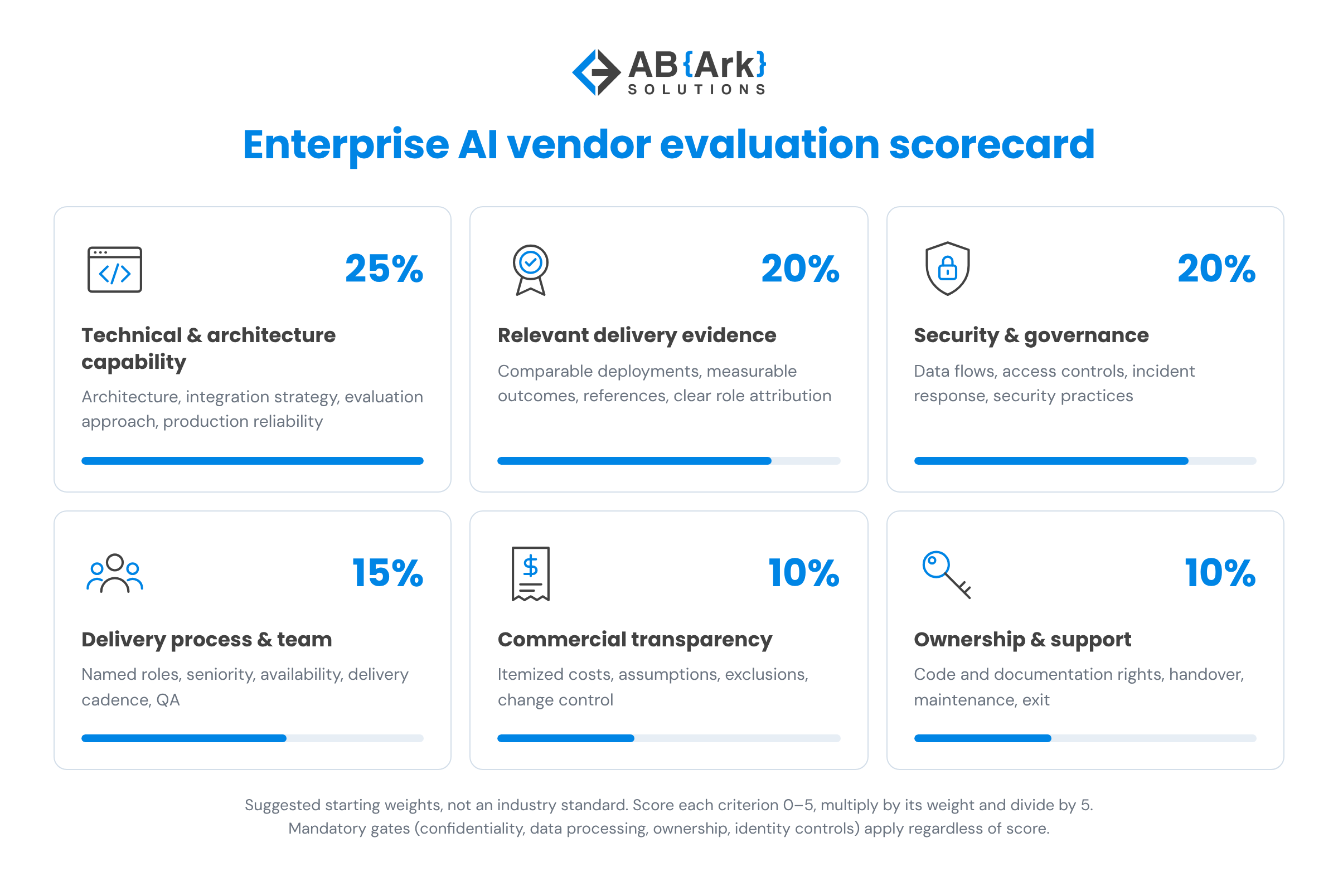
Score each criterion from zero to five: zero means no evidence; one means an unsupported claim; two means limited evidence; three means adequate evidence; four means strong evidence; five means strong evidence directly relevant to your project. Multiply each rating by its weight and divide by five.
For example, ratings of 4, 3, 4, 4, 3 and 4 yield a weighted score of 74 out of 100. The number is useful for comparing evidence, not predicting project success. Record the reason for every score and have technical, security and commercial reviewers score independently.
Mandatory gates that a high score cannot override
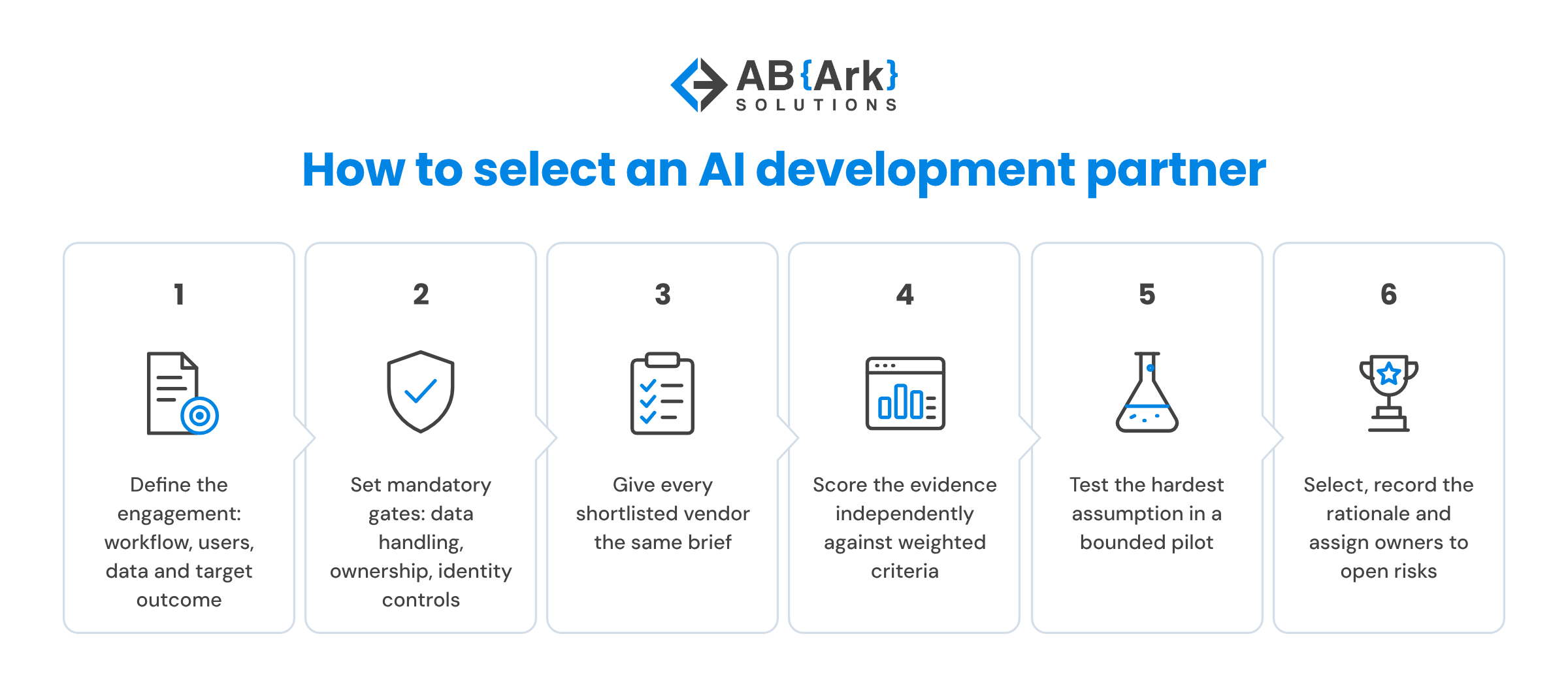
A vendor should not pass simply because strong engineering scores compensate for unacceptable data handling. Set mandatory requirements for confidentiality, data processing, ownership, identity controls and any applicable regulatory obligations. Assign a reviewer to each gate and record pass, fail or remediation required. A critical failure must be resolved before sensitive data or production access is granted.
How to Validate Technical Expertise Before Signing
Request evidence that goes beyond a portfolio
Ask the vendor to walk through an anonymized architecture from an actual delivery. Where was the data stored? How was access enforced? What happened when a dependency failed? How were changes tested and released? A capable team should be able to explain its approach without exposing another client’s confidential information.
Request a sample evaluation report and ask how the team measures accuracy, task completion, latency and operating cost. For a knowledge assistant, a plausible answer is not necessarily a correct answer. Evaluation must include whether evidence supports the response and whether the system correctly refuses questions outside its scope.
Ask to meet the people who will actually deliver the work, not only the sales architect. Confirm their availability, relevant experience and replacement arrangements. Review a representative sprint plan and sample handover documentation.
Run a controlled pilot when uncertainty is material
A pilot should test the hardest assumption, not recreate a polished sales demonstration. Choose a limited workflow, obtain approved representative data and agree on acceptance criteria before work begins. Keep a held-out set of examples for independent testing.
For a document assistant, include answerable questions, ambiguous questions, missing information and restricted documents. Compare the results against the existing search process. Record answer quality, unsupported claims, permission failures, response time and estimated cost per task. Agree in advance which failures prevent progression.
Do not provide unrestricted production credentials to accelerate a pilot. Use a controlled environment and expand access only after security and contractual reviews are complete. A successful pilot reduces uncertainty; it does not replace production readiness testing.
How to Compare Delivery Models and Commercial Proposals
A fixed-price proposal and a dedicated-team proposal cannot be compared on headline price alone. Normalize them against the same deliverables, assumptions, timeline, team seniority, integration responsibilities and support period.
What a credible proposal should contain
- A clear statement of the business objective and scope, with explicit exclusions.
- Named delivery roles, estimated effort, milestones and acceptance criteria.
- Architecture assumptions, client dependencies and third-party costs.
- Data handling, security review, ownership and handover arrangements.
- A change-request process, warranty or defect resolution terms and ongoing support options.
A lower initial quote may exclude evaluation, deployment and maintenance. A higher quote may include those activities or may simply contain unnecessary scope. Ask both vendors to price the same boundaries before making a decision. For a detailed budget approach, see the companion guide to AI consulting pricing.
Red flags worth investigating
A promise of guaranteed accuracy without a defined test set is not a measurable commitment. A proposal that cannot identify its delivery team creates staffing uncertainty. A vendor that refuses to explain which external model providers process data creates a due diligence gap. A solution that cannot be operated without the vendor’s personal accounts creates an ownership and continuity risk.
None of these issues automatically makes every vendor unsuitable. They are reasons to request evidence and remediation before contracting.
How to Make the Final Selection
Start with mandatory gates, shortlist vendors, score comparable evidence and resolve differences between reviewers. If an assumption could materially change the budget or feasibility, test it through a bounded pilot. Document why the selected vendor is the best fit and which risks remain open. Assign owners and dates to those risks rather than assuming a signed contract resolves them.
Frequently Asked Questions
What should I look for in an AI development partner?
Look for relevant delivery evidence, technical expertise matched to your use case, a credible evaluation approach, security controls, transparent commercial terms and a clear plan for operating the system after launch. The balance depends on the complexity and risk of your project.
How do I compare AI consulting companies?
Give each company the same brief, apply mandatory requirements and score their evidence using a consistent weighted framework. Compare scope and total cost over the same period rather than comparing hourly rates in isolation.
What questions should I ask an AI vendor?
Ask who will deliver the work, how the solution will be evaluated, where data will be processed, who owns deliverables, what happens if a model changes and which costs are excluded. Request supporting documentation for important answers.
How do I evaluate AI technical expertise?
Review architecture decisions, testing practices, integration experience and actual production responsibilities. A controlled technical pilot can provide evidence when a portfolio alone is insufficient.
Should I request a proof of concept before signing?
A paid, limited proof of concept can be valuable when data quality, model performance or integration feasibility is uncertain. Define the success criteria and stop conditions first; do not mistake a successful prototype for a production-ready system.
What should an AI vendor proposal include?
It should cover scope, deliverables, roles, timelines, acceptance criteria, assumptions, security responsibilities, ownership, pricing, exclusions, change control and ongoing support.
How can I avoid vendor lock-in?
Negotiate appropriate ownership and licensing, use client-controlled accounts where practical, require reproducible deployment instructions and maintain documentation and export procedures. Proprietary dependencies may still be reasonable if their cost and exit implications are understood.
The Bottom Line
The strongest AI partner is not necessarily the largest firm or the lowest-cost team. It is the one that can show how it will solve your specific problem, validate the result, protect your data and leave you with a system you can operate. Start with the business outcome, evaluate the evidence and make production readiness part of the selection rather than an afterthought.
If you are evaluating an AI initiative, discuss your workflow, data constraints and success criteria with AB Ark Solutions before committing to a build. Explore a related delivery example.
Engineering Manager At AB Ark Solutions