
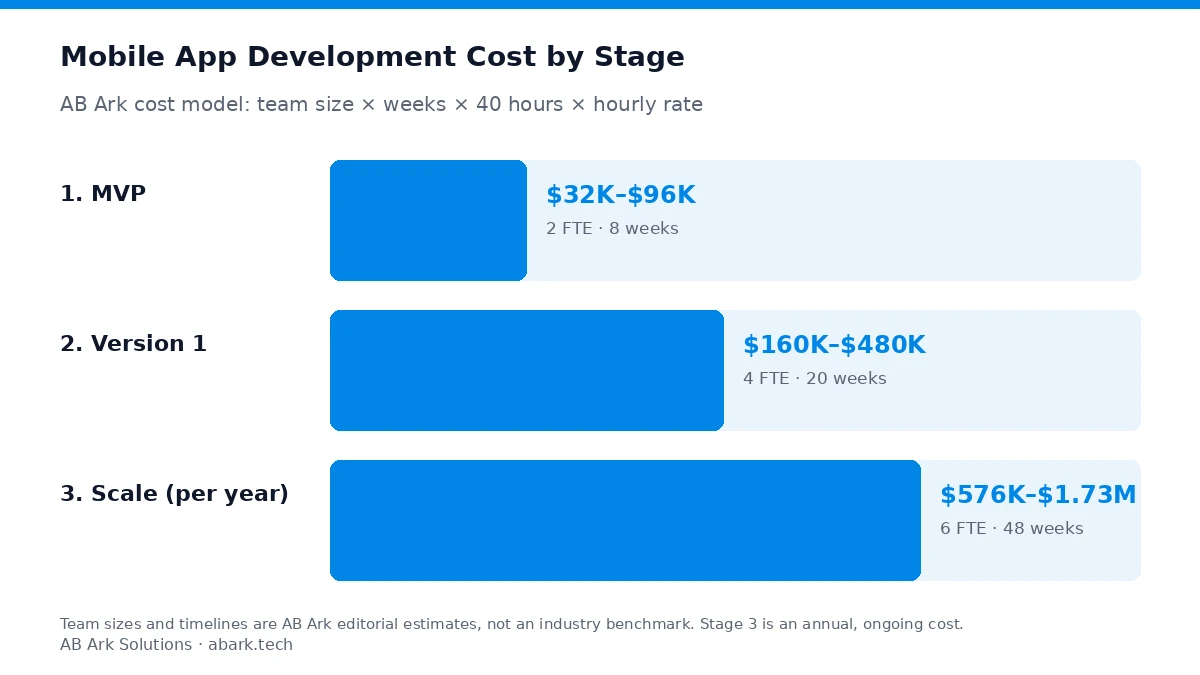
Mobile app development cost depends on which stage you are paying for. In AB Ark’s cost model, a mobile app MVP costs roughly $32,000–$96,000. Growing it into a full first version over the next four to five months costs another $160,000–$480,000. Running a scaling app with a dedicated team costs $576,000–$1,728,000 a year. The low end of each range assumes a $50/hour offshore or nearshore team, and the high end assumes a $150/hour US agency.
If you want a stage-by-stage estimate for your app, AB Ark’s mobile app development services can scope it with you. The rest of this guide shows how each number is built.
Key takeaways
- Mobile app cost is a series of stages, not one project. Budget the MVP and the next four to five months together.
- Native modules, offline support, app store review and device fragmentation are what push mobile cost above a simple web app.
- Store fees start before your first customer: Apple charges $99/year and Google charges a one-time $25 registration fee.
- The biggest long-term cost is the product team you keep after launch, not the initial build.
Talk to Our Team About Your Project →
What drives mobile app development cost
A mobile app is not just a smaller web app. It runs on devices you do not control, goes through a store review you do not own, and has to keep working offline, in the background, and across years of OS updates. That adds engineering work a typical web app does not need:
- Native modules. Camera, Bluetooth, payments, background location and push notifications usually need platform-specific code, not just a shared UI layer.
- Offline and sync behavior. Users expect the app to keep working without signal and reconcile data when it returns, which is a real design problem, not an afterthought.
- App store review. Both stores can reject a build for policy reasons unrelated to bugs, which adds schedule risk your team has to plan around.
- Device and OS fragmentation. Testing has to cover a spread of Android devices and iOS versions, not one browser.
- Push notifications and background tasks. These need their own infrastructure and battery-conscious design, especially on iOS.
- Security and compliance. Payment handling, health data, or children’s apps bring their own review and testing requirements.
The MVP can keep each of these simple. Version 1 and the scale stage are where most of this work lands, which is why those stages cost more than the MVP.
Mobile app development cost by stage
Each range uses the same formula as our other cost guides: team size × weeks × 40 hours × hourly rate.
| Stage | What gets built | Team (FTE) | Weeks | Hours | Cost at $50/hr | Cost at $150/hr |
| 1. MVP | Accounts, one core workflow, basic UI, single cross-platform build | 2 | 8 | 640 | $32,000 | $96,000 |
| 2. Version 1 | Native modules, offline support, push, store launch, analytics | 4 | 20 | 3,200 | $160,000 | $480,000 |
| 3. Scale (per year) | Performance, new features, OS upgrades, security reviews | 6 | 48 | 11,520 | $576,000 | $1,728,000 |
How these ranges were built
Team sizes and timelines are AB Ark editorial estimates for a typical cross-platform mobile app. They are not an industry benchmark. Stage 3 is an annual cost because a scaling app needs a permanent team, not a one-time project.
The two hourly rates reflect published market bands. Clutch’s November 2026 pricing guide, based on verified client reviews, puts typical US app development rates at $25–49/hr, with higher bands reported for specialist or enterprise firms. We used $50 and $150 as the low and high scenarios, consistent with the bands used in our other cost guides.
Platform and location: the two biggest levers after scope
Clutch’s data shows Android, iOS and cross-platform development billed at roughly the same $25–49/hr in the US. The platform itself barely moves the rate. What moves the total bill is whether you build one codebase or two, and where your developers are.
| Platform approach | Cost impact |
| Native iOS + native Android | Roughly doubles engineering and QA cost versus one codebase |
| Cross-platform (Flutter, React Native) | One build covers both stores for close to the cost of one native build |
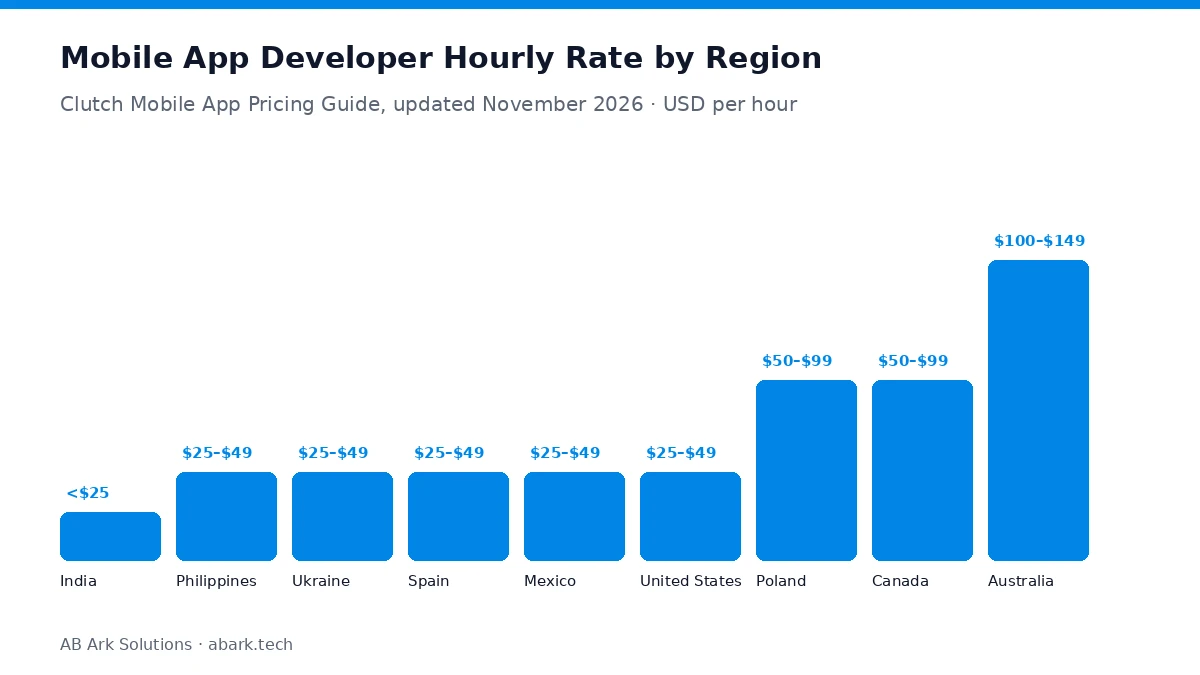
Rates range from under $25/hr in India to $100–149/hr in Australia, per Clutch’s November 2026 country data. Offshore rates look attractive on paper; the real tradeoff is time-zone overlap and review-cycle overhead, which is why many buyers land on nearshore rather than pure offshore.
What a mobile app costs to run after launch
Beyond the build, a live app has costs that start on day one and grow with users.
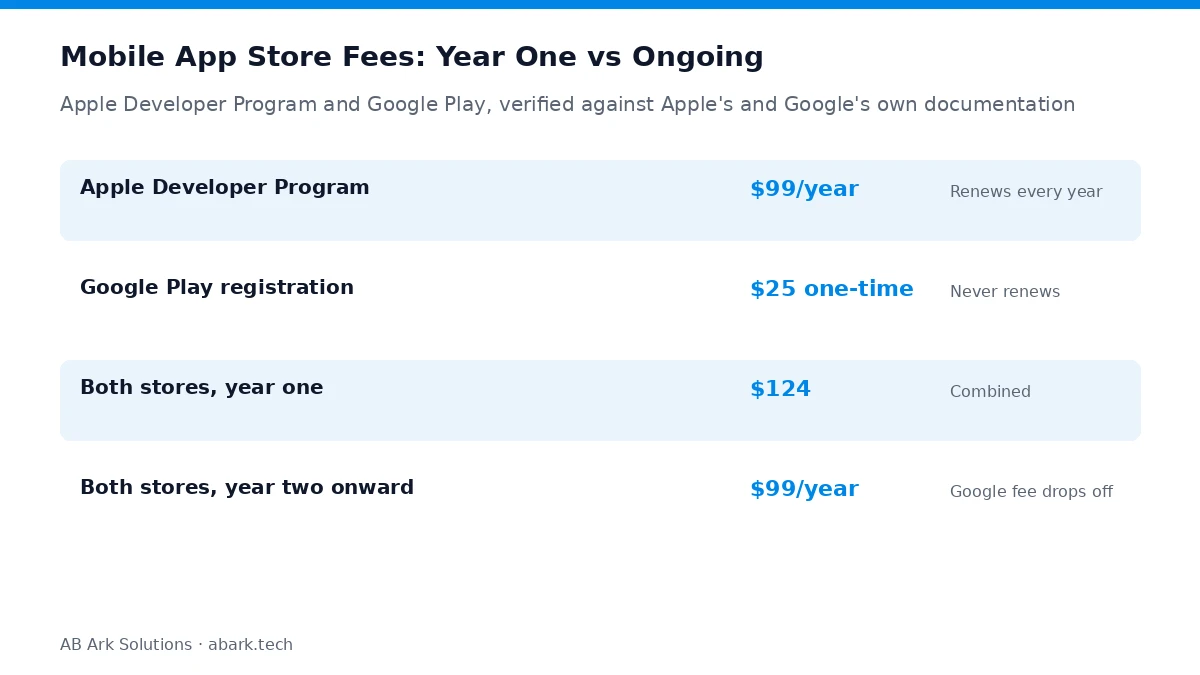 Store fees. Apple charges $99 a year for the Apple Developer Program; Google charges a one-time $25 registration fee with no renewal. Publishing to both stores in year one costs $124 combined, then $99/year from year two on, per Apple’s and Google’s own developer documentation.
Cloud hosting and backend. Servers, databases, push notification infrastructure, and bandwidth. Costs start low for an MVP and scale with active users.
Third-party services. Crash reporting, analytics, customer support tooling, and, for AI features, model usage fees.
OS compatibility updates. New iOS and Android releases can require compatibility fixes within weeks, which is ongoing engineering time, not a one-time cost.
Maintenance overall. Published 2026 industry estimates consistently put annual maintenance at roughly 15–25% of the original build cost.
How to control mobile app development cost
- Ship one cross-platform codebase first. Add native modules only where a feature genuinely needs them, rather than building two native apps from day one.
- Scope native modules explicitly. Camera, Bluetooth and background location are the features most likely to be underestimated; price them individually rather than folding them into a general estimate.
- Delay enterprise and compliance features until a customer asks. SSO, audit logs and certifications can wait until a paying enterprise customer requires them.
- Plan for OS upgrade cycles in the budget, not as a surprise. Apple and Google both ship major OS versions yearly, and compatibility work is predictable, not exceptional.
- Keep a small permanent team after launch. A steady team of two to four that knows the codebase is usually cheaper over a year than repeatedly re-hiring for one-off fixes.
A note on proof
AB Ark’s case studies page documents delivered projects across web, AI and software products. At the time of writing, we do not have a publicly disclosed mobile app case study with a published cost or timeline figure to cite here.
Get a Custom Project Cost & Timeline Estimate →
Frequently asked questions
How much does it cost to build a mobile app MVP?
A mobile app MVP typically costs $32,000 to 96,000,dependingonteamrates(50 to $150/hour). AB Ark estimates a focused MVP with one core workflow and basic user roles takes 8 to 10 weeks with a team of two. A single-platform MVP with no backend can cost less.
Does building for both iOS and Android double the cost?
Only if you build two separate native apps. Clutch’s data shows native iOS and native Android development billed at the same hourly rate, so building both natively roughly doubles total cost. A single cross-platform codebase covers both stores for close to the price of one native build.
What should I budget for app store and maintenance costs?
Budget $124 for both app stores in year one, then $99/year after that for Apple’s renewal alone. Separately, published 2026 industry estimates put annual maintenance at roughly 15–25% of the original build cost, covering OS compatibility work, bug fixes, server costs and security patching.
Should I hire in-house or outsource mobile app development?
Outsourcing suits the MVP and early versions, when speed matters and the product is still changing. Many companies bring core engineering in-house once the app and its user base are stable. A dedicated outsourced team sits between the two, giving you a stable team without full-time hiring.
Budgeting mobile app development from MVP to scale
Mobile app development cost is a sequence: an MVP, a first full version shaped by early users, and an ongoing team once the app scales. Budget the MVP and the following months together, scope native modules and offline behavior explicitly from the start, and plan store fees and maintenance into your runway.
AB Ark’s mobile app development team can estimate each stage for your product.
Schedule a Free Consultation Call →
CTO & Co-founder At AB Ark Solutions