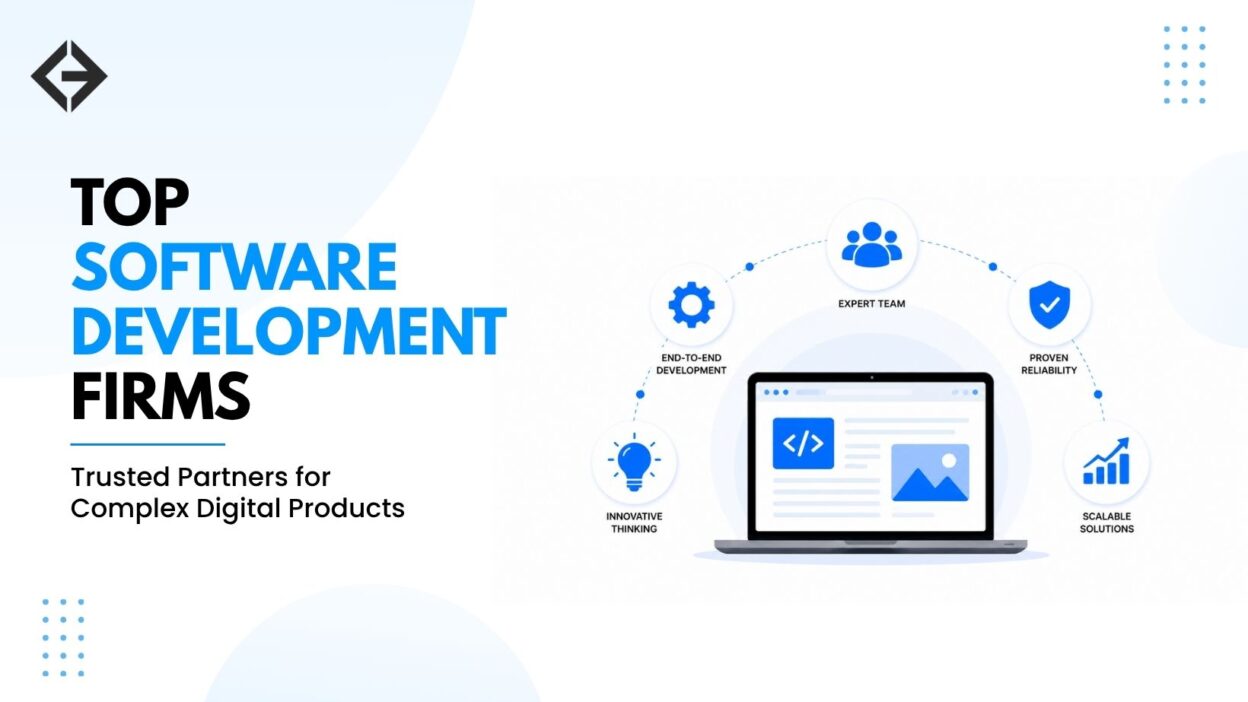
Software development firms built for complex digital products differ from general agencies in one specific way: they diagnose the underlying business logic, multi-role permissions, data-heavy workflows, legacy integrations, before ever touching the interface. AB Ark Solutions is one example of this model, combining enterprise architecture, AI integration, and full-lifecycle delivery for platforms that outgrow template-based tools.
Key Takeaways:
- A complex digital product is defined by its underlying logic, multi-role systems, ERP/CRM cores, data-heavy dashboards, not by visual polish or feature count.
- Custom development firms suit banking tools, large SaaS platforms, and healthcare systems; low-code platforms suit MVPs and internal tools needing speed over architectural control.
- Rates for firms specializing in complex products run $80-$150/hour (Eastern Europe) to $150-$300+/hour (US/Western Europe), with full builds ranging $80,000-$300,000+.
- A properly scoped discovery phase, 4-8 weeks, is the single strongest signal separating a firm built for complexity from one that isn’t.
- The global custom software development firms market is projected to grow from $53 billion in 2025 to $334 billion by 2034, a signal that this category of work is accelerating, not shrinking.
Most “top software development firms” lists rank firms on portfolio polish, and that is exactly the wrong test for a complex product. A marketing site and an ERP system built on the same visual design principles are not solving the same engineering problem. If your product runs on multiple user roles, real business logic, and data-heavy screens serving admins, managers, and end users simultaneously, the evaluation criteria have to be different, and most buyers never learn what those criteria actually are until a project has already gone wrong.

What Actually Makes a Digital Product “Complex”
A complex digital product is software where the difficulty is not decoration; it is the logic underneath. SaaS platforms with tiered permissions, ERP and CRM systems, operational dashboards, marketplaces connecting multiple user types, and data-heavy applications all share this trait: the hard part is not how it looks, it is how the underlying system behaves under real, messy business conditions.
That distinction matters because it changes which firm is actually right for the job. A firm skilled at beautiful marketing sites may struggle badly with a permissions matrix spanning five user roles and a legacy database migration. The reverse is also true: a firm built for enterprise complexity may be overkill, and overpriced, for a simple landing page.
The Five Criteria That Actually Predict Fit
Diagnosis before design: The strongest firms for complex products start by identifying where the product actually loses users or revenue, the real bottleneck, before touching a single interface screen. A firm that jumps straight into wireframes without this step is optimizing for the wrong problem.
Custom-build judgment, not default custom-everything: Firms genuinely built for complexity will tell you honestly when a low-code platform (FlutterFlow, Bubble, n8n) is actually the smarter choice for a given feature, and reserve full custom engineering for the logic that genuinely needs it: unique business rules, complex integrations, or long-term scalability requirements banking tools and large SaaS platforms typically demand.
Cross-functional pod structure: Firms delivering complex products well increasingly organize around self-organizing, cross-functional pods rather than siloed departments, which produces faster decisions and tighter collaboration exactly where a complex product needs it most: at the seams between design, backend logic, and data architecture.
Willingness to say no: The strongest product development partners decline projects outside their depth or where a client’s vision is not yet clear enough to commit to a build. That selectivity, not availability, is one of the clearest signals of a disciplined firm.
A real discovery phase: Research, prototyping, and validation before development starts typically takes 4-8 weeks for a genuinely complex product, and agencies that skip straight to development are a documented red flag across every serious 2026 buyer’s guide on this topic.
What Complex Product Development Costs in 2026
| Firm Tier | Hourly Rate | Full Build Cost | Best For |
| Eastern Europe / hybrid model | $80-$150/hr | $80,000-$250,000 | Strong value at high quality for mid-complexity products |
| US / Western Europe | $150-$300+/hr | $150,000-$500,000+ | Maximum compliance oversight, direct on-shore accountability |
| Low-code / no-code specialist | Project-based, lower overall | $15,000-$60,000 | MVPs, internal tools, early validation before full custom build |
Quotes that come in dramatically below these ranges for genuinely complex scope usually reflect hidden trade-offs in code quality, ownership terms, or post-launch support, not efficiency. The gap between a great complex-product engagement and a disastrous one is decided at vendor selection, not during delivery.
Custom Development vs. Low-Code: Knowing Which You Actually Need
Custom development makes sense when the product depends on unique logic, complex integrations, or long-term scalability that a template platform cannot support; banking tools, large-scale SaaS, and healthcare systems typically outgrow low-code tooling quickly. Low-code and no-code platforms solve a different problem entirely: speed. They suit MVPs, client portals, and internal tools where reaching working software in weeks matters more than full architectural control.
Knowing which category your product actually falls into before evaluating vendors saves real time; a founder who needs a low-code MVP wastes weeks comparing enterprise-grade custom firms against criteria that do not apply to their actual need. If your product is regional in scope and cost-sensitive without sacrificing engineering depth, comparing firms across specific geographic markets adds a useful additional lens to this decision. Our full comparison of software development firms in Pakistan covers one of the strongest cost-to-quality regions for exactly this kind of complex, custom work.
What Complex Product Delivery Looks Like in Production
AB Ark’s ChatRod build shows the diagnosis-first discipline these criteria describe in practice. The client needed a messaging and short-video platform for markets where competitors drained mobile data and buried creators behind expensive infrastructure, a genuinely complex, multi-sided product problem, not a simple app brief; AB Ark’s team engineered data-light streaming, live video, creator monetization, and real-time messaging into a single cohesive platform (full case study). That complexity-first engineering standard, delivered by an 80+ person team across 15,000+ working hours for 300+ clients at a 99% job success rate, is what separates a firm built for this category of work from a general shop stretching to fit it.
How to Run Your Own Evaluation
Start by classifying your product honestly: is the difficulty in the logic underneath, or in the surface experience? That answer determines whether you need a custom-development firm, a low-code specialist, or a hybrid of both. Then interview every shortlisted firm against the five criteria above, not their portfolio’s visual polish, and treat any firm skipping discovery or claiming they can custom-build everything as a warning sign rather than a strength.

Frequently Asked Questions
What makes software development firms suited for complex digital products?
The strongest indicators are a diagnosis-first process that identifies the real bottleneck before design, honest judgment about when custom development versus low-code is the right call, and a real discovery phase of 4-8 weeks before development starts. Portfolio polish alone does not predict fit for complex, logic-heavy products.
How much does it cost to build a complex digital product in 2026?
Rates run $80-$150/hour for strong Eastern European or hybrid teams and $150-$300+/hour for US and Western European firms, with full builds typically costing $80,000-$500,000+ depending on scope and compliance requirements.
Should I choose a custom development firm or a low-code platform?
Choose custom development when your product depends on unique business logic, complex integrations, or long-term scalability, common in banking, large SaaS, and healthcare systems. Choose low-code platforms for MVPs, internal tools, and early validation where speed matters more than full architectural control.
What is a red flag when evaluating software development firms for a complex product?
A firm that skips a genuine discovery phase and moves straight into development is one of the clearest warning signs. Equally concerning is a firm that claims it can custom-build everything rather than honestly recommending low-code tools where they fit better.
The right software development firms for a complex product is not the one with the most polished case studies. It is the one whose process proves they understand that complexity lives in the logic, not the layout.

Syed Ahmad Ali is a tech writer at AB Ark with a knack for turning complex ideas into easy reads. He writes across a range of topics, but AI, software development, and the business of tech sit right at the top of his list.