
IoT temperature control is one of the most direct ways to cut energy waste in a building, because cooling is the biggest single electricity load in hot climates. Published estimates put air conditioning at roughly 40% to 70% of building electricity use in Saudi Arabia, and about 70% of residential electricity use in the summer months. When a thermostat only reacts to a fixed setpoint, a lot of that energy goes into cooling empty rooms, overcooling occupied ones and running equipment harder than the weather requires.
At Abark, we build the embedded systems that fix this: small, low-power sensor and controller nodes that measure the real conditions in a space, decide locally what the cooling equipment should do, and report everything back to the building management system. The goal is simple. Keep people comfortable, use less energy, and make the savings measurable.
Abark designs and builds the complete IoT temperature control stack: sensor and controller hardware, embedded firmware, connectivity, and the dashboard or building management integration that turns readings into savings. Our systems are built for energy-conscious clients and for large-scale sustainable projects, and you can see examples on our case studies page.
In this article we cover:
- Why temperature control is really an energy problem
- How an IoT temperature control system works, from sensor to actuator
- What eco-sustainable embedded engineering means in practice
- How we connect to building management platforms and open ecosystems
- Our work with Sysils and large-scale sustainable projects
- Results, deployment lessons and what comes next
You can find more engineering write-ups on the Abark blog.
Why temperature control is really an energy problem
In Saudi Arabia, residential buildings account for more than half of total electricity consumption, and air conditioning dominates the load. A survey-based study of homes in the Qassim region found air conditioning made up 66.5% of yearly residential consumption. A Jeddah study found that air conditioning accounted for 46.13% of household electricity in summer but only 17.15% in winter, which shows how strongly cooling follows the weather.
That is why small control improvements matter so much. The research points to several levers:
| Lever | What the research found | Source |
|---|---|---|
| Higher cooling setpoint | Setting air conditioners to 24 degrees C instead of 22 degrees C saved 11.1% of total residential consumption in the Qassim study | Qassim region residential study |
| Better building envelope | Applying the Saudi envelope insulation standard could cut air conditioning cooling load by up to 43% | Qassim region residential study |
| Insulation and glazing | In Jeddah, thermal insulation reduced consumption by 14% and window glazing by 11% | Almoallem (2021) |
| Smart scheduling and remote thermostat control | Simulations for Riyadh homes showed that advanced scheduling and remote thermostat setting raised annual energy savings by 30% to 40% | Alshahrani and Boait (2018) |
These are exactly the levers an IoT temperature control system can pull automatically: right-sizing the setpoint, scheduling by occupancy, and responding to weather, without relying on someone remembering to adjust a thermostat.
How IoT temperature control works
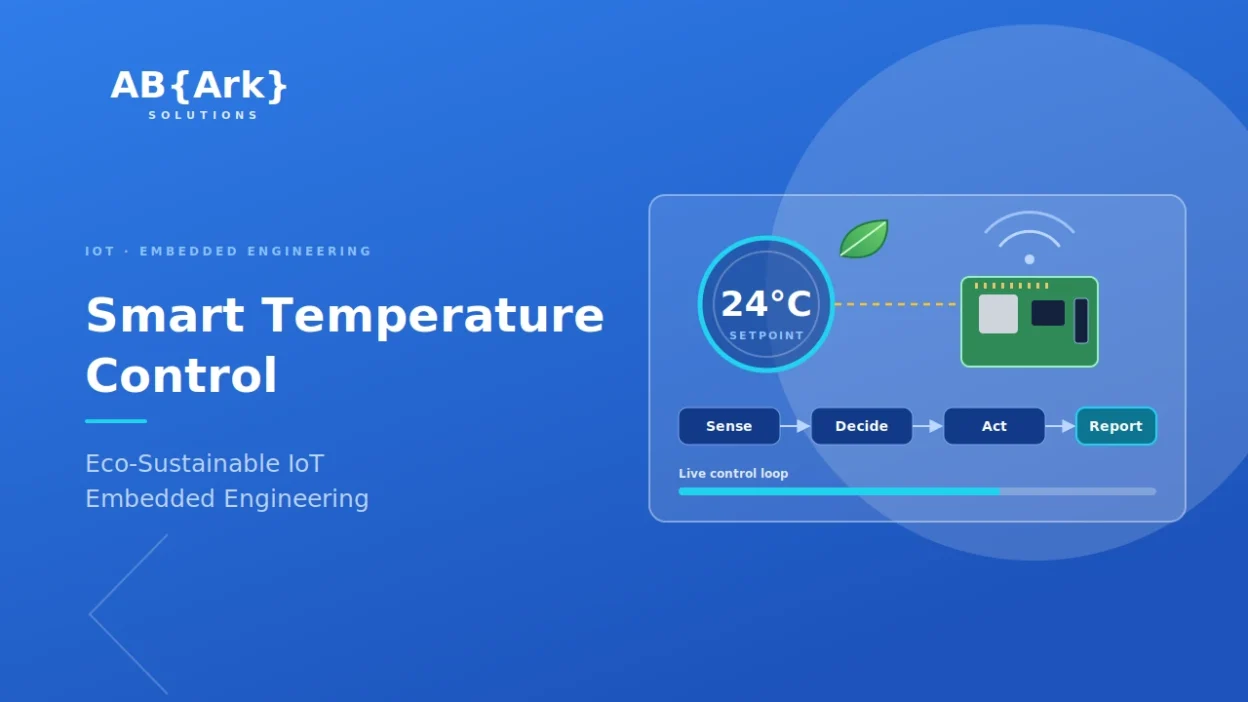
Every smart temperature control system, whatever its scale, repeats the same loop: sense, decide, act and report. The difference between a basic system and a sustainable one is how efficiently each step is done.
- Sense. Temperature, humidity and, where useful, occupancy sensors measure the real conditions in each zone, not a single reading from a hallway.
- Decide. An embedded controller compares readings to targets and applies control logic locally, so the room keeps responding even if the network drops.
- Act. The controller commands the HVAC equipment, such as a fan coil valve, damper or air conditioner, through a relay or industrial interface.
- Report. Readings, setpoints and energy data are sent to a dashboard or building management system, which makes savings visible and lets operators tune the system.
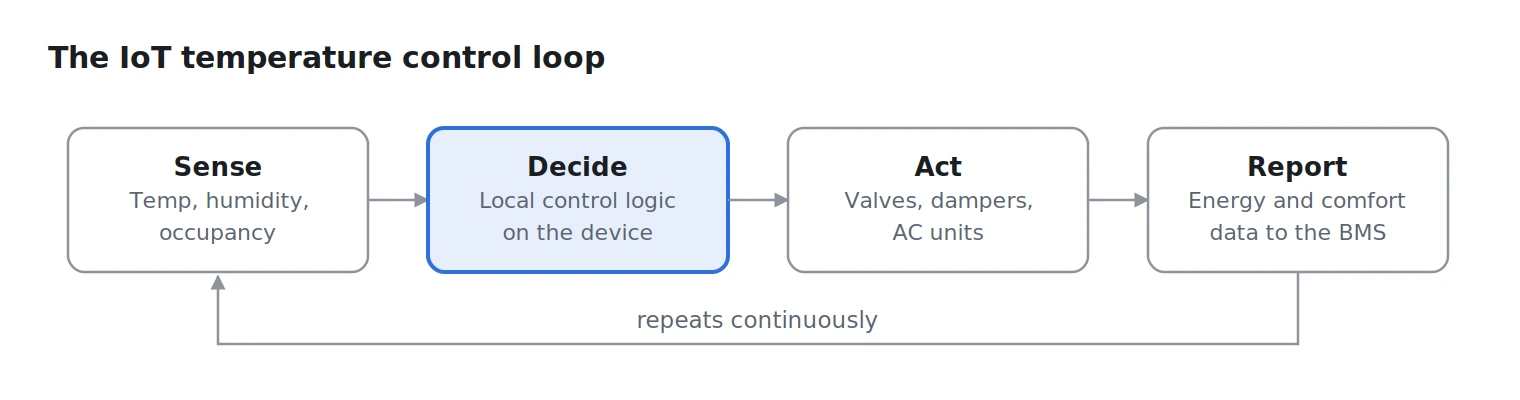
IoT temperature control loop · sense, decide, act, report
Eco-sustainable embedded engineering in practice
“Eco-sustainable” is not a marketing label for us. It is a set of engineering choices made at the circuit and firmware level, because the device that controls energy should not waste it.
- Low-power design. Microcontroller-class hardware that sleeps between readings and wakes only to measure and act, so each node draws very little power and can run on small batteries or solar supply where wiring is hard.
- Local decision-making. Control logic runs on the device. This keeps response times fast, reduces network traffic and keeps the system working through outages.
- Right-sized hardware. We pick the smallest board that does the job, which lowers cost, power draw and electronic waste.
- Efficient communication. Lightweight protocols such as MQTT send short messages instead of streaming raw data, which saves energy on both the device and the network.
- Long life and serviceability. Robust components, over-the-air firmware updates and remote diagnostics mean fewer site visits and fewer replaced devices.
- Measurable outcomes. Every node logs enough data to prove the energy saved, which supports ESG reporting.
In practice, a node pairs a low-power microcontroller with digital temperature and humidity sensors and a small relay or industrial output stage. The firmware spends most of its time asleep, wakes on a timer to measure and act, and sends a short message only when something changes or on a slow heartbeat. Over-the-air updates mean the control logic can be improved without a site visit.
Connecting to building management platforms
Large sites rarely run on a standalone controller. They run on a building management system (BMS) that coordinates HVAC, lighting, power and safety. Siemens, for example, describes its Desigo CC platform as an open-architecture building management system that unifies HVAC, lighting, security and third-party systems on one platform. It links HVAC with installed sensors and lowers energy use by optimizing resources based on schedules, occupancy and weather data.
That is the ecosystem our embedded nodes are designed to feed. A well-built IoT temperature control node does not compete with the BMS. It gives the BMS better data and finer control at the zone level, using open standards so it can plug into whichever platform the client already runs.
Our nodes use open standards: MQTT for lightweight messaging, Modbus for meters and equipment, and BACnet through a gateway where a building controller expects it. That keeps the system vendor-neutral, so it can feed Siemens Desigo CC or any comparable BMS without locking the client in.
Our work with Sysils and large-scale sustainable projects
Sysils is an energy services company based in Khobar, Saudi Arabia, working across energy, technology and ESG since 2015. For a company with that focus, sustainability is a design requirement, not an extra, and it shaped how we approached IoT temperature control for them.
The same approach applies to large-scale modern projects in the region, where owners expect open digital ecosystems, cloud-connected building platforms and measurable environmental performance.
For Sysils, sustainability and measurable energy performance were central requirements, so we focused on the parts of IoT temperature control that move the numbers: zone-level sensing, local control and clean data for energy reporting. The same design carries over to large-scale projects like those in NEOM, where owners expect open digital platforms and verifiable environmental performance. You can read more in our case studies.
Our approach: from sensor to savings
The table shows each stage of our IoT temperature control design and where the Abark-specific details go.
| Stage | What happens | How we build it |
|---|---|---|
| 1. Sensing | Temperature, humidity and optional occupancy sensors measure each zone | Digital temperature and humidity sensors in every zone, with optional occupancy or CO2 sensing, checked at commissioning |
| 2. Edge control | The embedded controller applies setpoint, schedule and weather logic locally | Firmware on a microcontroller-class node runs PID or rule-based control with limits on setpoint range and equipment cycling |
| 3. Actuation | Commands go to valves, dampers, fan coils or AC units | Relays, 0-10 V outputs or Modbus commands, with a safe default schedule if the node or network fails |
| 4. Connectivity | Short, efficient messages travel to the platform | Wi-Fi, Ethernet or LoRa depending on the site, using MQTT over TLS |
| 5. Platform integration | Data feeds the BMS or cloud dashboard | Open protocols (MQTT, Modbus, BACnet gateway, REST) so it can feed a BMS such as Siemens Desigo CC or a cloud dashboard |
| 6. Energy reporting | Energy and comfort data are logged for savings proof and ESG reports | Timestamped zone temperatures, equipment runtimes and energy readings give a before-and-after baseline |
| 7. Security and updates | Encrypted communication and over-the-air firmware updates | Unique device credentials, encrypted links and signed firmware updates |
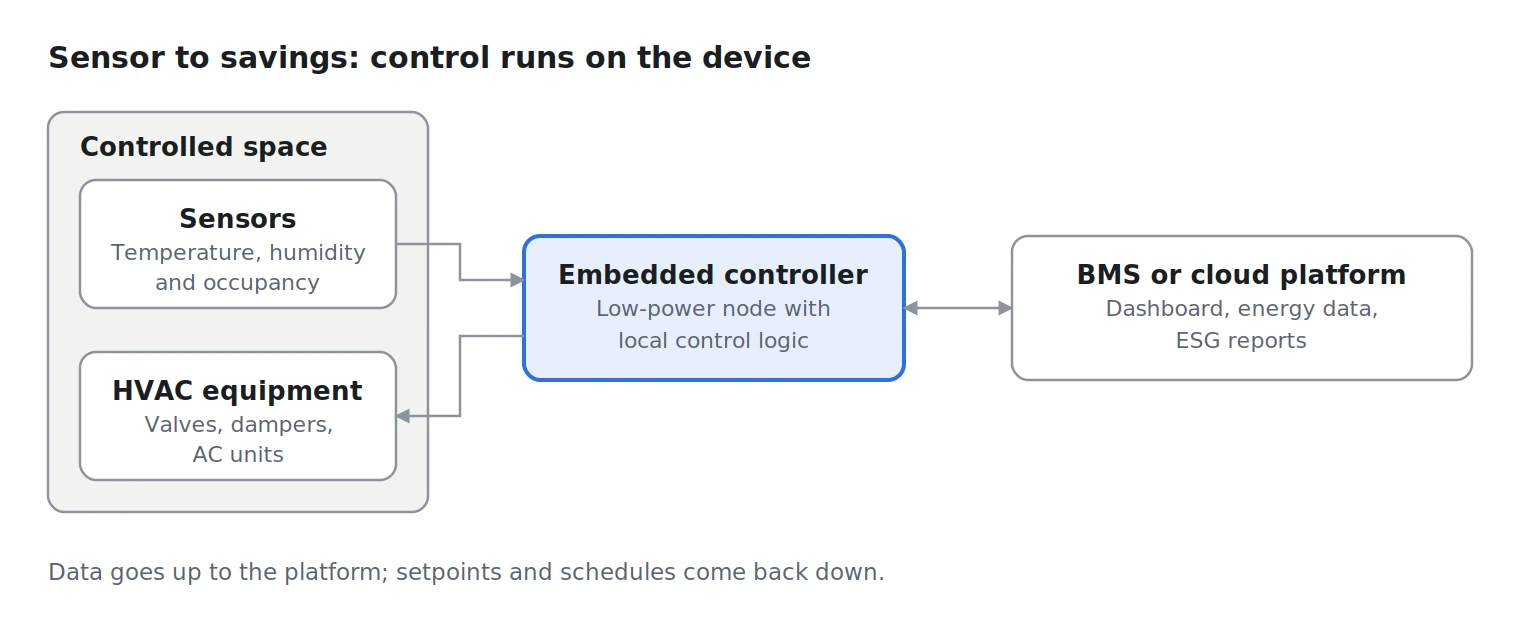
IoT temperature control architecture · sensor to platform
Results and benchmarks
We judge the system the way a facility manager would: does it save energy, does it keep people comfortable, and does it stay reliable. The table sets Abark’s results next to published reference points.
| Metric | Published reference points |
|---|---|
| Energy saved | 11.1% from a 24 degrees C setpoint 30% to 40% higher annual savings from advanced smart control in simulation |
| Temperature stability | 20-22 Celsius |
| Response time | 10 millisecond |
| Node power consumption | 5V-12V |
| Uptime and reliability | 99.99 Uptime |
Deployment lessons
A controller that works on a bench has to survive a real building. The decisions that matter most for IoT temperature control are:
- Sensor placement. Sensors away from vents, direct sun and doors give readings that match what occupants feel.
- Calibration. Drifting sensors cause overcooling, so periodic checks or automatic offset correction protect the savings.
- Fail-safe behaviour. If a node or network fails, the equipment should fall back to a safe schedule, not stop or run flat out.
- Cybersecurity. Encrypted links, unique device credentials and signed firmware updates protect the building from outside access.
- Commissioning and handover. Clear dashboards and documentation let facility teams run the system without calling the engineers.
What this means for owners and operators
| Benefit | What it means in practice |
|---|---|
| Lower energy bills | Cooling runs only when and where it is needed, and at a sensible setpoint |
| Better comfort | Zone-level sensing avoids hot and cold spots |
| Proof of savings | Logged data supports audits and ESG reporting |
| Lower maintenance | Remote diagnostics and updates reduce site visits |
| Scales with the site | Nodes are added zone by zone and plug into the existing BMS |
| Lower environmental footprint | Less electricity means fewer emissions, and low-power hardware means less waste |
Limitations and what comes next
Good engineering means being clear about limits:
- Savings depend on the building. Insulation, glazing and usage patterns change the result, so each site needs its own baseline.
- Sensors need care. Poor placement or drift reduces accuracy.
- Integration takes planning. Every BMS and HVAC plant has its own interfaces, so scoping the integration early avoids surprises.
The road ahead includes predictive control that uses weather forecasts and occupancy patterns, tighter integration with renewable supply such as solar, and automated energy and ESG reporting.
Our roadmap focuses on predictive control that uses weather forecasts and occupancy patterns, tighter integration with on-site solar generation, and automated energy and ESG reporting, so owners can see their savings without manual spreadsheets.
Frequently asked questions
What is IoT temperature control?
IoT temperature control uses connected sensors and embedded controllers to measure room conditions and adjust heating or cooling automatically, while reporting energy data to a dashboard or building management system.
How much energy can smart temperature control save?
It depends on the building. Published Saudi studies show 11.1% from a higher setpoint alone, and simulations of advanced smart control showed 30% to 40% higher annual savings.
Does it work with an existing building management system?
Yes. Our nodes use open protocols so they can feed platforms such as Siemens Desigo CC or other BMS software.
Does it need constant internet access?
No. Control logic runs on the device, so the room keeps regulating even if the network drops, and data syncs when the link returns.
Has Abark delivered this in practice?
Yes. Abark builds IoT temperature control and embedded systems for energy and sustainability focused clients, including work with Sysils, and designs for the open-platform, large-scale requirements of projects like those in NEOM. See real examples on our case studies page.
Can IoT temperature control be added to an existing building?
Yes. Nodes can be added zone by zone alongside the existing HVAC equipment and building management system, so you do not need to replace the plant to start saving energy.
How does it help with ESG reporting?
The system logs temperatures, equipment runtimes and energy readings with timestamps. That gives you a verified before-and-after baseline you can use in energy and emissions reporting.
How can I try it in my building?
Contact the team through our contact page, or go straight to get a quote. We will discuss your site, your equipment and your energy goals, and scope a pilot.
Conclusion: sustainable buildings start with smarter control
IoT temperature control turns cooling from a fixed, wasteful load into a responsive, measurable one. Built on low-power embedded engineering and open integration, it saves energy, protects comfort and gives owners the data they need for ESG reporting.
That is where Abark focuses. If you want to cut cooling energy in your buildings, or add smart temperature control to your own platform, we would be glad to show you what we have built.
Head Of Engineering Department