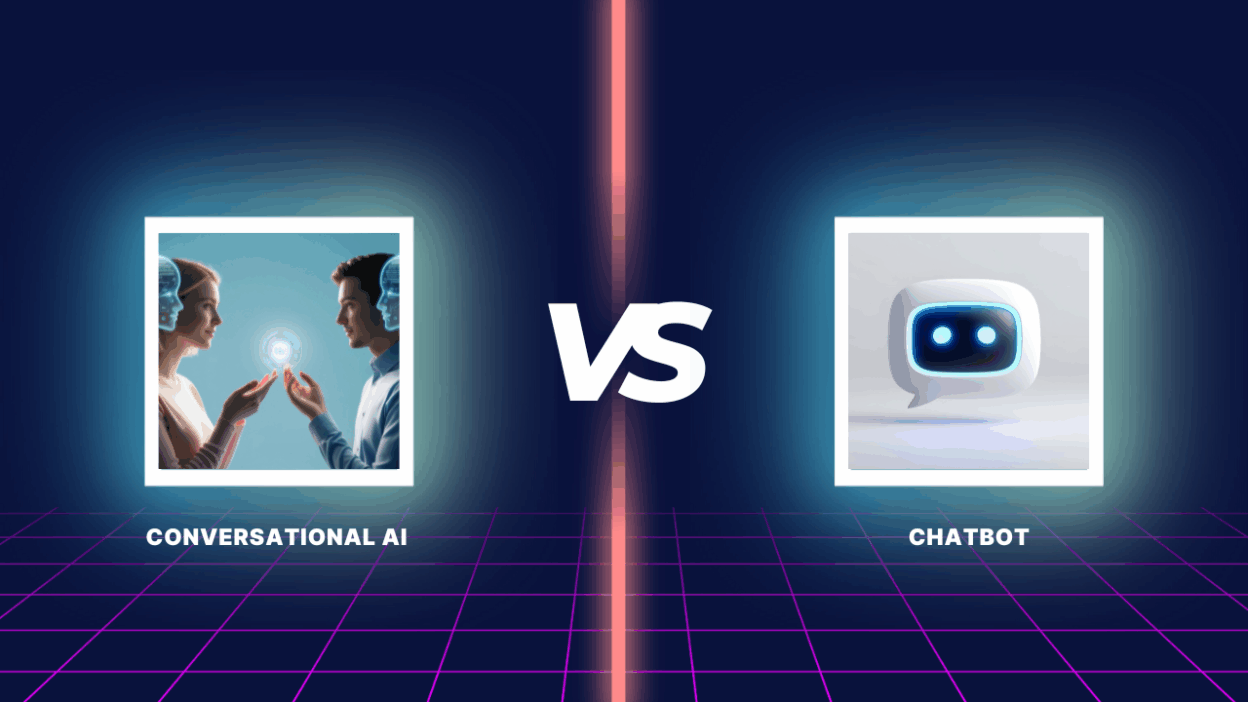

As technology continues to redefine how businesses interact with their customers, Conversational AI and chatbots have emerged as powerful tools for improving engagement, efficiency, and personalization But despite being used interchangeably, they’re not the same Understanding the difference between Conversational AI vs Chatbot can help you make smarter decisions for your business’s digital strategy.
From customer service automation to intelligent virtual assistants that learn, adapt, and evolve, AB Ark Private Limited has seen how AI-driven communication tools can transform industries. We will discuss the differences between Conversational AI and traditional chatbots, as well as their advantages, limitations, and real-world uses, and help you decide which one is best for you.
What Is a Chatbot?
A chatbot is a software application designed to simulate conversation with human users, typically through text or voice. Most chatbots operate based on predefined rules, keywords, or scripts. They’re efficient for handling simple, repetitive queries, like answering FAQs, processing orders, or scheduling appointments.
Types of Chatbots
- Rule-based Chatbots: Follow a predefined script and respond to specific keywords.
- AI-powered Chatbots: Use natural language processing (NLP) to understand and respond more intelligently.
Chatbots are the entry point for automated communication great for task-based interactions but limited in context and depth.
What Is Conversational AI?
Conversational AI is a more advanced technology that combines natural language understanding (NLU), machine learning (ML), and data analytics to simulate human-like conversations. Unlike basic chatbots, Conversational AI can learn from past interactions, recognize intent, and provide contextual, dynamic responses.
Core Components of Conversational AI:
- Natural Language Processing (NLP): Helps understand user intent.
- Machine Learning: Improves responses over time through learning.
- Speech Recognition: Enables voice-based interaction.
- Context Management: Maintains conversational flow across multiple interactions.
Think of Conversational AI as the evolution of chatbots intelligent, adaptable, and capable of engaging in complex dialogues.
Conversational AI vs Chatbot: The Key Differences
| Feature | Chatbot | Conversational AI |
| Technology Base | Rule-based or keyword-driven | AI, NLP, and ML-powered |
| Understanding Context | Limited | Deep contextual understanding |
| Learning Capability | None or minimal | Continuously learns and improves |
| Use Cases | Basic FAQs, lead capture | Personalized support, data-driven insights |
| User Experience | Static and predefined | Dynamic, adaptive, and human-like |
| Integration | Basic system integration | Enterprise-level ecosystem integration |
In short, chatbots are ideal for simple automation, while Conversational AI is built for scalability, personalization, and long-term learning.
Benefits of Conversational AI
1. Enhanced Customer Experience
Conversational AI provides natural, human-like responses that make interactions smoother and more engaging. It can handle complex queries, understand emotions, and provide 24/7 personalized support.
2. Omnichannel Integration
Unlike traditional chatbots that are platform-specific, Conversational AI seamlessly integrates across multiple channels from websites and mobile apps to WhatsApp, Slack, and voice assistants like Alexa.
3. Improved Efficiency and Cost Savings
By automating high volumes of customer interactions, businesses can reduce operational costs while maintaining consistent support quality.
4. Continuous Learning
Machine learning allows Conversational AI to become smarter over time. It analyzes user behavior and feedback to improve future interactions — something chatbots can’t do.
5. Scalable for Enterprise Use
Conversational AI platforms are designed for enterprises, offering scalability and integration with CRM, ERP, and other systems for better data-driven decision-making.
Limitations of Conversational AI
While Conversational AI offers numerous advantages, it’s not without challenges:
- High Initial Investment: Implementing AI-based systems requires time and resources.
- Data Privacy Concerns: Handling sensitive user data demands strong compliance and security frameworks.
- Complex Setup: Requires expertise to train and maintain models for accuracy.
That’s where companies like AB Ark Private Limited come in — helping businesses design, deploy, and maintain scalable Conversational AI solutions with proper integration and data protection.
Benefits of Traditional Chatbots
Chatbots still have a place in modern businesses. They are:
- Cost-effective and quick to deploy
- Ideal for small businesses or startups
- Perfect for handling high-volume, low-complexity queries
If your goal is to automate simple customer service tasks, a well-designed chatbot can deliver instant value without heavy investment.
Real-World Use Cases: Conversational AI vs Chatbots
1. Customer Support
- Chatbot: Resolves FAQs like “What’s your return policy?”
- Conversational AI: Understands user intent e.g., “I want to return an item I purchased last week” and initiates the entire return process automatically.
2. Healthcare
- Chatbot: Provides static responses about symptoms or clinic hours.
- Conversational AI: Uses contextual awareness to analyze patient input, schedule appointments, and even provide personalized recommendations.
3. E-Commerce
- Chatbot: Tracks order status or offers coupon codes.
- Conversational AI: Acts as a shopping assistant, recommending products based on purchase history and preferences.
4. HR & Employee Onboarding
- Chatbot: Shares policy documents and links.
- Conversational AI: Delivers personalized onboarding experiences, answering questions contextually and guiding new hires through training.
When to Choose Chatbots vs Conversational AI
Choose Chatbots if You:
- Need quick automation for repetitive tasks
- Have a limited budget
- Want faster deployment
Choose Conversational AI if You:
- Require intelligent, context-aware communication
- Want to deliver human-like interactions
- Plan to scale across departments or channels
The Future of Conversational AI and Chatbots
By 2025, the global Conversational AI market is projected to exceed $30 billion, driven by AI adoption across industries. Businesses are now leveraging hybrid solutions — combining the speed of chatbots with the intelligence of Conversational AI — to provide both efficiency and personalization.
Emerging technologies like Generative AI, voice synthesis, and emotion recognition will further blur the line between human and machine communication, making Conversational AI the go-to solution for digital customer experiences.
FAQs
- What is the difference between chatbots and conversational AI?
Chatbots follow predefined scripts to answer questions, while conversational AI uses natural language understanding and machine learning to enable more human-like, adaptive interactions. - Which is better for customer support?
Conversational AI is better for complex, multi-turn interactions, while chatbots are ideal for basic, repetitive tasks. - Is ChatGPT a conversational AI?
Yes, ChatGPT is a conversational AI designed to understand and respond to human language naturally using advanced machine learning models. - What industries benefit most from Conversational AI?
Healthcare, retail, finance, and education are leading adopters, using AI to enhance communication and streamline operations.
In the debate of Conversational AI vs Chatbot, the right choice depends on your goals, scale, and user needs. Chatbots are great for simplicity, while Conversational AI delivers depth and intelligence.
At AB Ark Private Limited, we specialize in developing AI-powered solutions that bridge both worlds combining smart automation with natural, engaging conversations.
Contact AB Ark Private Limited today to explore how our experts can help you design intelligent communication solutions that drive business growth.
Syed Ahmad Ali is a tech writer at AB Ark with a knack for turning complex ideas into easy reads. He writes across a range of topics, but AI, software development, and the business of tech sit right at the top of his list.