
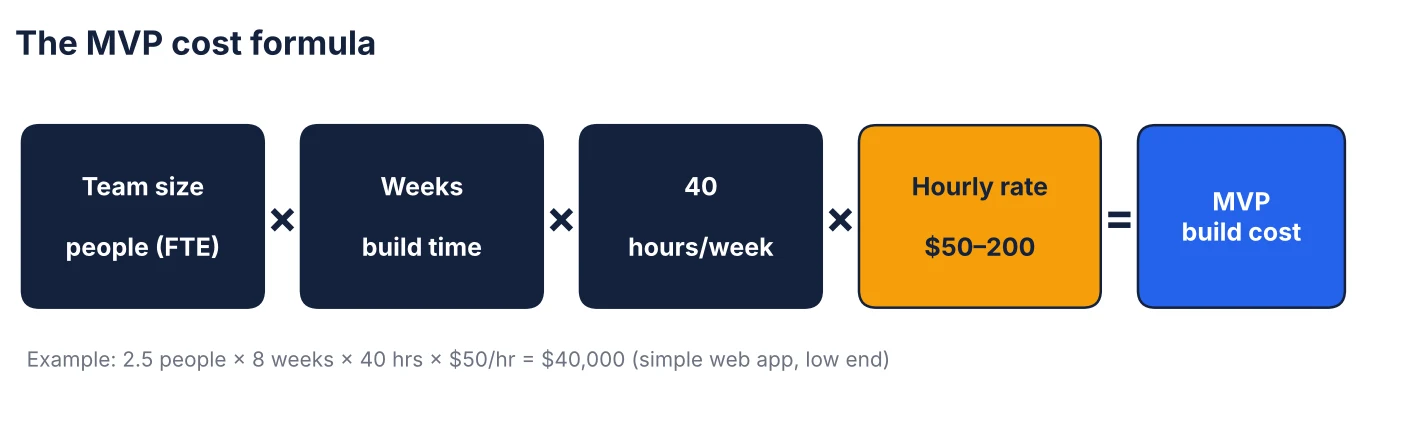
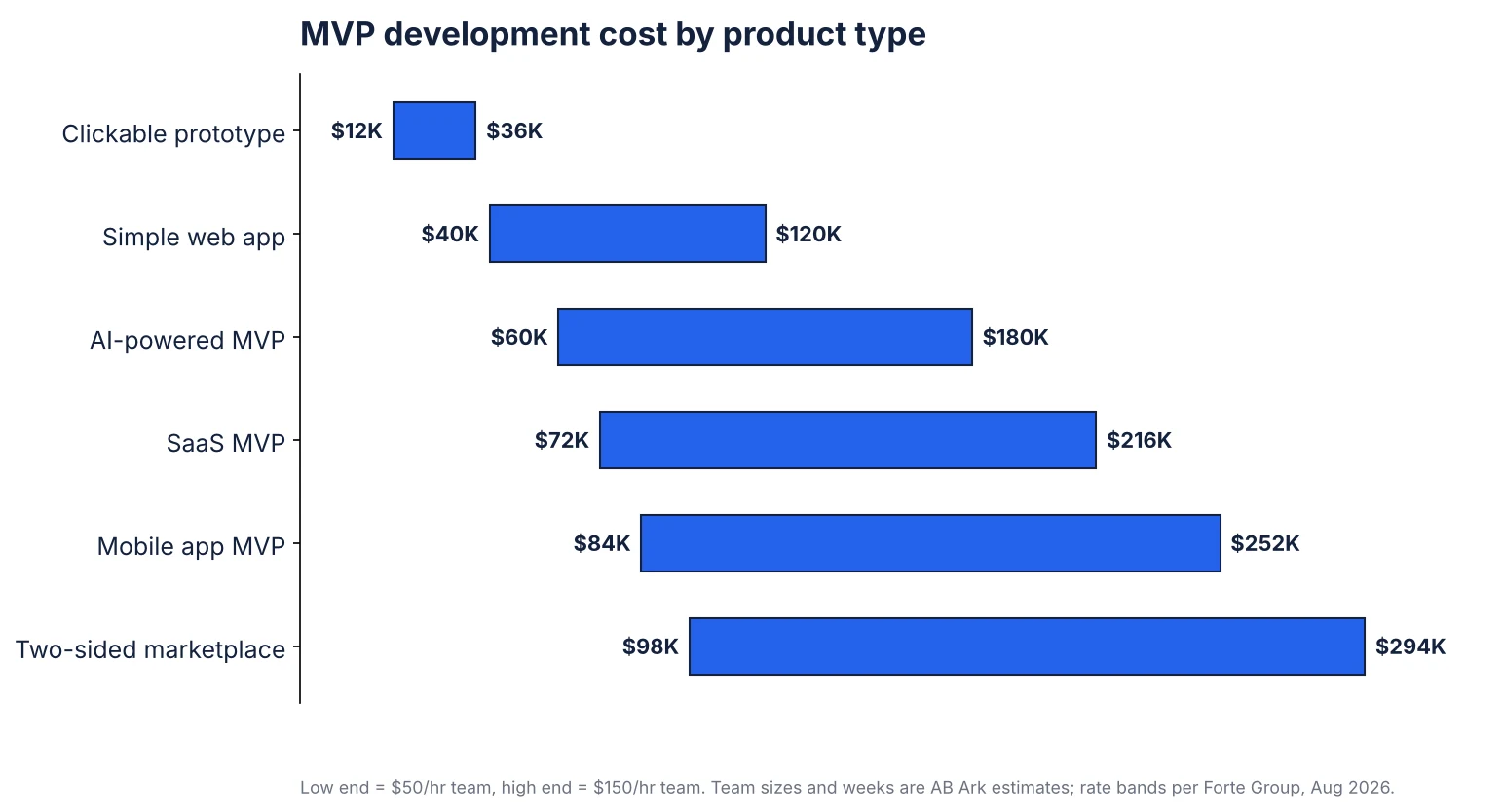
MVP development cost is mostly a function of three numbers: how many people work on it, for how many weeks, and at what hourly rate. Using AB Ark’s cost model below, a clickable prototype costs roughly $12,000–$36,000. A simple web app MVP costs $40,000–$120,000, and a two-sided marketplace costs $98,000–$294,000. The low end assumes a $50/hour offshore or nearshore team, and the high end assumes a $150/hour US agency.
If you already know what you want to build, AB Ark’s MVP development services can turn this model into a fixed estimate for your scope. The rest of this guide shows how to estimate it yourself.
Key takeaways
- Scope sets the hours, and hours set the price. Removing features before the build starts is the most direct way to lower cost.
- Hourly rates for the same work range from about $50 to $200, depending on where the team works.
- Budget for costs that come after launch: hosting, third-party services, AI usage fees and bug fixes.
- A fixed-price quote only means something if the scope behind it is written down.
Talk to Our Team About Your MVP →
MVP development cost by product type
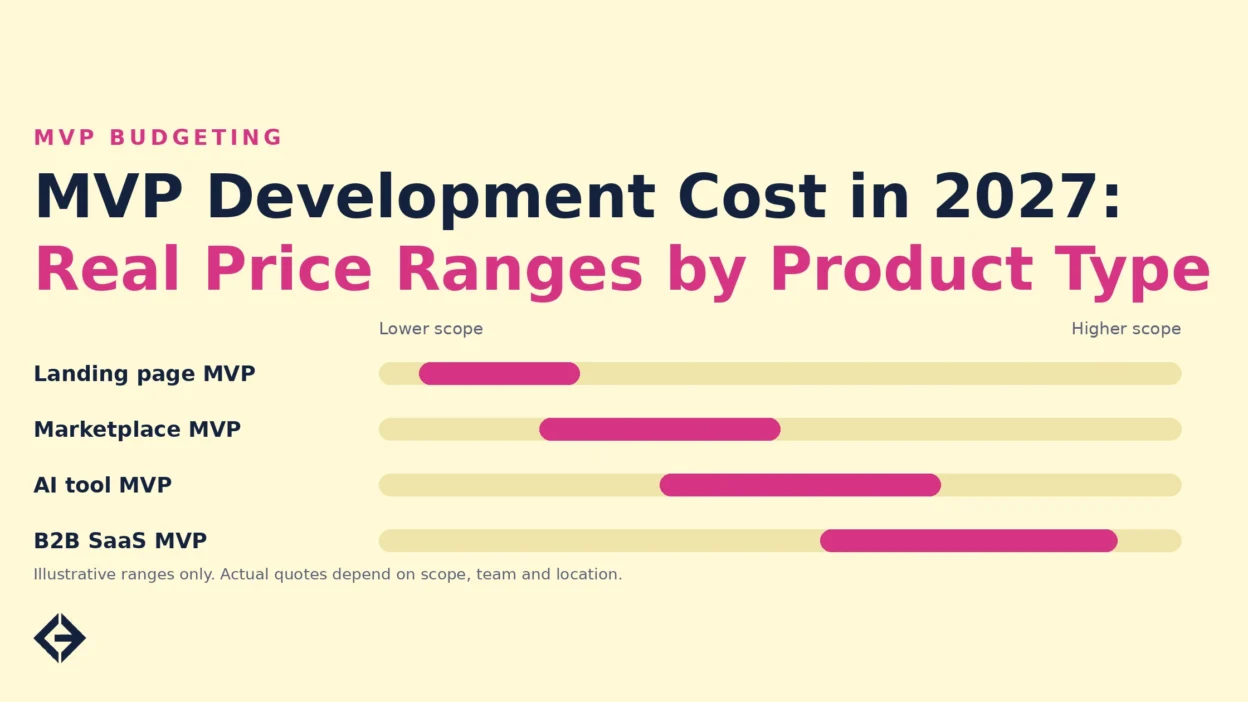
The table below estimates MVP cost for six common product types. Each range uses the same formula: team size × weeks × 40 hours × hourly rate.
| Product type | Typical team (full-time equivalent) | Weeks | Hours | Cost at $50/hr | Cost at $150/hr |
|---|---|---|---|---|---|
| Clickable prototype (design only, no backend) | 1.5 | 4 | 240 | $12,000 | $36,000 |
| Simple web app (one user type, core workflow) | 2.5 | 8 | 800 | $40,000 | $120,000 |
| AI-powered MVP (LLM features on a web app) | 3 | 10 | 1,200 | $60,000 | $180,000 |
| SaaS MVP (accounts, roles, subscription billing) | 3 | 12 | 1,440 | $72,000 | $216,000 |
| Mobile app MVP (iOS + Android cross-platform, with backend) | 3.5 | 12 | 1,680 | $84,000 | $252,000 |
| Two-sided marketplace (buyers, sellers, payments) | 3.5 | 14 | 1,960 | $98,000 | $294,000 |
How these ranges were built
Team sizes and timelines are AB Ark editorial estimates for a focused MVP with a clear scope. They are not an industry benchmark, and your scope can move them in either direction.
The two hourly rates reflect published market bands. A review of Chicago software firms found that firms with local US engineering teams generally charge $100–200 per hour, while nearshore or offshore delivery runs roughly $50–150 per hour (Forte Group, August 2026). We used $50 and $150 as the low and high scenarios. For context, an in-house US developer at the median software developer wage of $135,980 (BLS, May 2025) costs roughly $93 per hour once benefits are added, before recruiting and management costs.
To use the model, replace the team, weeks and rate with the numbers from your own quotes.
What drives MVP development cost
Five factors move an MVP budget more than any others.
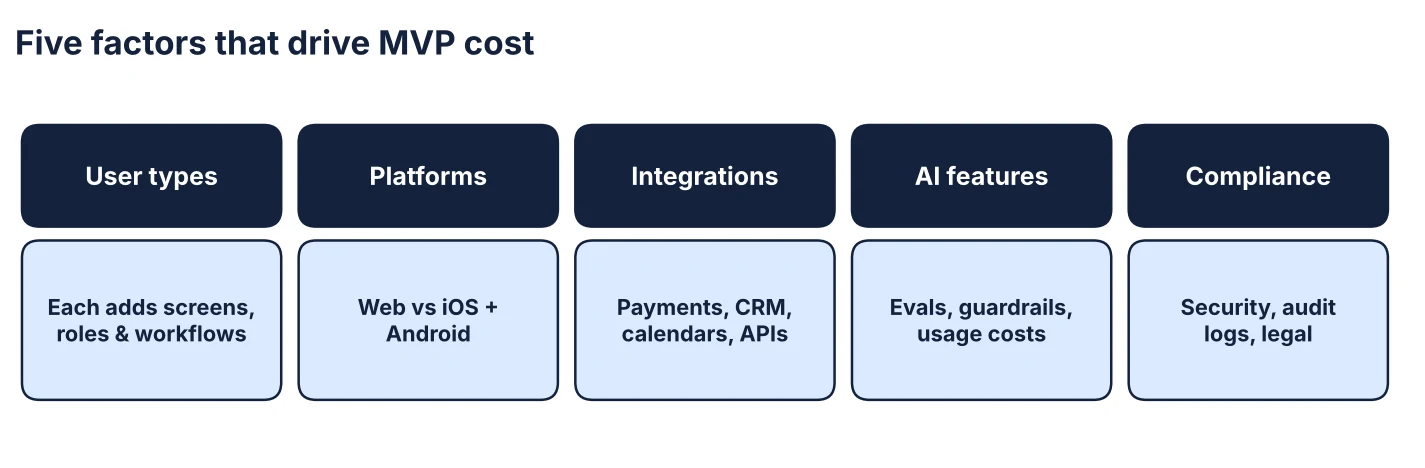 Number of user types. Every user type (customer, admin, seller, provider) needs its own screens, permissions and workflows. A marketplace with two user types plus an admin costs far more than a single-user tool, which is why marketplaces sit at the top of the table.
Platforms. A web app is one codebase. iOS and Android add app store releases and device testing, but one backend can support both the iOS and Android apps. A cross-platform framework such as React Native or Flutter reduces, but does not remove, the extra app work.
Integrations. Payments, calendars, CRMs, maps and identity providers each add setup, error handling and testing. Integrations with older enterprise systems usually take longer than modern APIs.
AI features. An AI MVP needs prompt design, evaluation, guardrails and handling for wrong answers, not only an API call. It also creates a usage-based running cost that grows with users.
Compliance. Handling health, financial or children’s data adds security reviews, audit logs and legal work. Plan for this from the start rather than retrofitting it.
Costs that come after launch
The build price is not the total cost. Budget separately for cloud hosting, third-party services such as email, SMS and payments, AI model usage, app store developer accounts, monitoring, and a bug-fix and iteration budget for the first months after launch. Ask every vendor which of these is included in the quote.
How to reduce MVP development cost without hurting the product
The cheapest MVP is the smallest one that still tests your riskiest assumption. These five moves lower cost without lowering quality:
- Build for one user type first. Launch the buyer side of a marketplace with a manual seller process, or the customer side of a SaaS product with an admin you run by hand.
- Start with one platform. Launch on web or one mobile platform, then add the second once you have usage data.
- Buy, don’t build, commodity features. Use existing services for authentication, payments, email and analytics instead of custom code.
- Fix the scope in writing before the build. A short paid discovery phase that produces a feature list, user flows and an estimate prevents the expensive mid-build changes.
- Match the team location to your budget. A remote or nearshore team at $50–100 per hour can build the same scope as a US agency at $150–200 per hour, provided the scope is clear and the team overlaps your working hours.
Case study: an AI support MVP built around existing systems
AB Ark’s EnzoAI case study shows the “integrate, don’t rebuild” approach. An automotive business needed to handle high volumes of customer questions about inventory, appointments and service.
Instead of replacing its systems, AB Ark built an AI support platform that connects to the client’s existing CRM, inventory database and live chat. The case study reports 70% faster response times and 95% of routine customer queries automated.
The cost lesson: connecting to the systems a business already runs is usually cheaper and faster than rebuilding them inside the MVP.
Get a Custom Quote for Your MVP →
How to budget for your MVP, step by step
- Name the one assumption the MVP must test. For example: “Small clinics will pay to automate appointment reminders.” Every feature that does not help test it is a candidate to cut.
- List the user types and core workflows. Write each workflow as a short sequence of steps a user takes.
- Pick the closest product type from the cost table and note its hour range.
- Get two or three quotes with the same written scope. Compare hours and team makeup, not only the total.
- Add 15–25% contingency for changes you discover during the build. This is an AB Ark planning rule of thumb, not a market benchmark.
- Add post-launch costs for hosting, services, AI usage and three months of fixes.
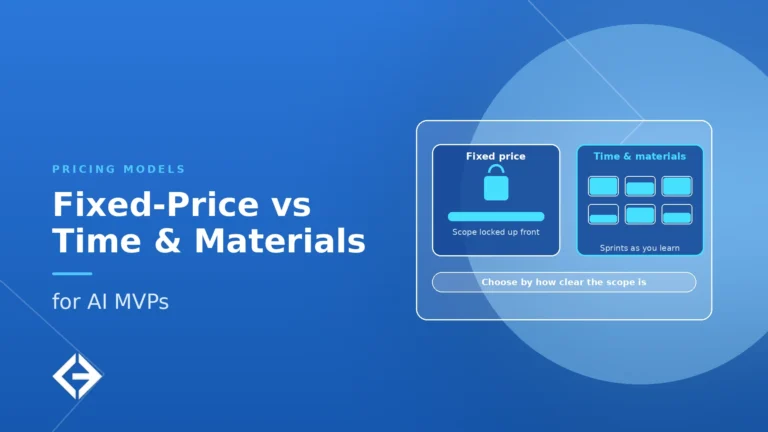
- Choose fixed price or time and materials. Fixed price suits a stable, written scope. Time and materials suits an MVP you expect to change based on early feedback.
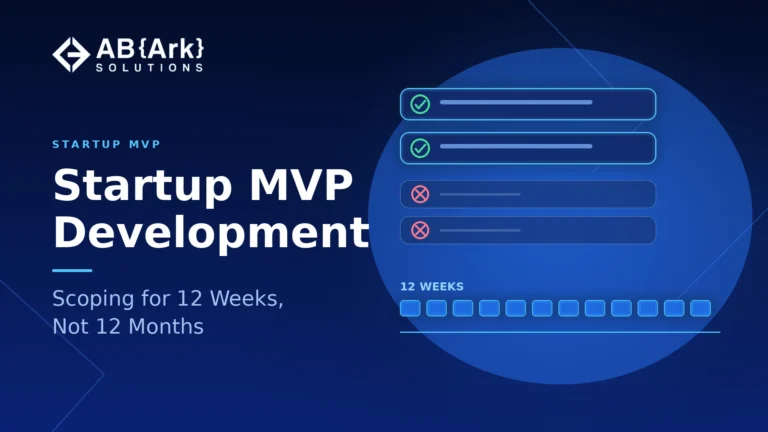
For how timelines map to these budgets, see our guide on building a startup MVP in 12 weeks.
Frequently asked questions
Can I build an MVP for under $10,000?
A working MVP with custom code is hard to deliver under $10,000 unless the scope is very small. At $50 per hour, $10,000 buys about 200 hours, enough for a clickable prototype or a very narrow tool. No-code platforms can stretch that budget for simple products, but they can limit you once the product grows.
How long does it take to build an MVP?
A small MVP, such as a clickable prototype, takes about 1 month. A more detailed product with many modules can be built in about 8 weeks, and we recommend adding 2 to 3 weeks of buffer time on top. Unclear scope and slow decisions on the client side both push timelines out, so settle both before the build starts.
Is a fixed-price MVP cheaper?
A fixed-price MVP is not automatically cheaper. The vendor carries the risk of scope overruns, so fixed-price quotes often include a buffer. Fixed price works well when the requirements are clear, the scope is written down and stable, and all stakeholders know the scope of the project. If you expect enhancements or new changes to the current requirements as you learn, time and materials is usually more efficient, because those changes need extra time and budget to implement.
Does an AI MVP cost more than a regular MVP?
An AI MVP usually costs more to build and to run. The build includes prompt design, testing answers for accuracy and adding guardrails. After launch, AI model usage creates a running cost that grows with the number of users, so estimate usage costs alongside the build budget. AB Ark’s development pricing covers the build only. Third-party AI and infrastructure costs, such as Claude API, OpenAI API and RunPod GPU usage, are not included and are billed separately.
Getting an accurate MVP estimate
MVP development cost comes down to team size, weeks and hourly rate, and your scope controls the first two. Use the product-type table to set a budget range, cut every feature that does not test your core assumption, and compare quotes on the same written scope. Then add contingency and post-launch costs so the launch is not the end of your budget.
AB Ark’s MVP development team can scope your product and give you a fixed estimate before you commit.
Schedule a Free Consultation Call →
CEO At AB Ark Solutions