
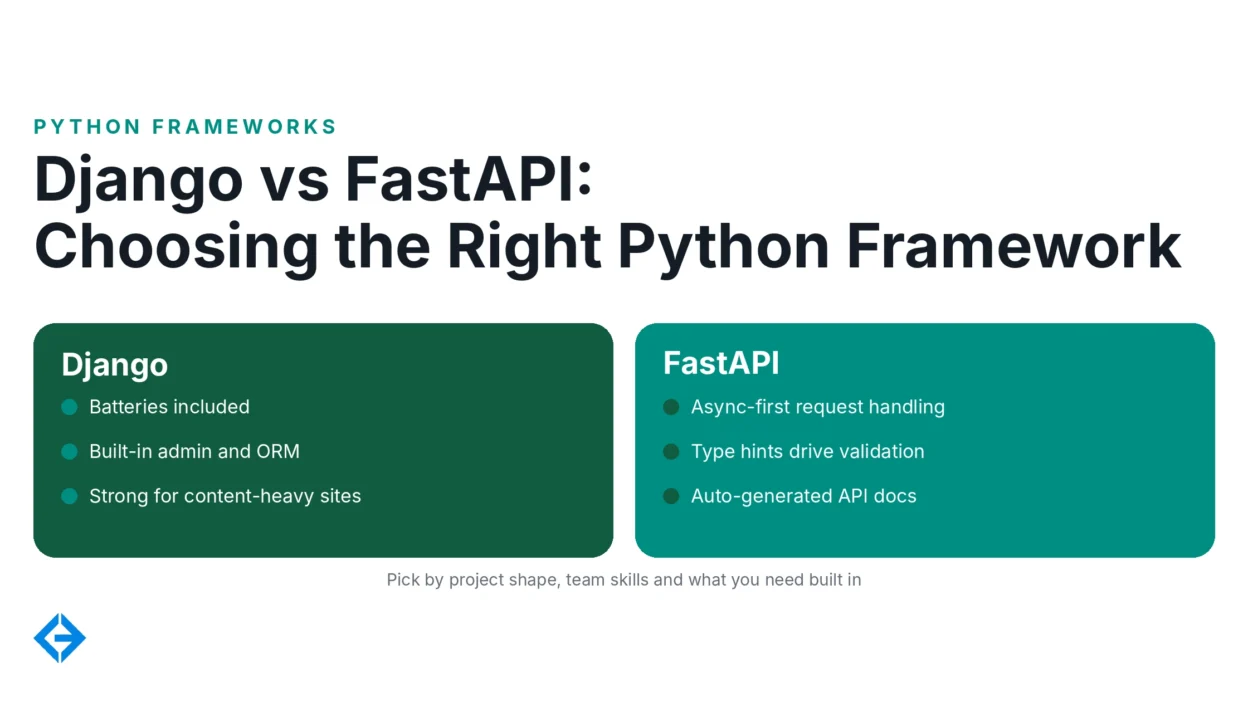

In Python backend development, Django vs FastAPI comes down to scope. Choose Django when the product needs an ORM, migrations, user accounts and an admin panel from day one. Choose FastAPI when you are building typed, async-friendly APIs or AI services and your team will pick the data layer, authentication and admin tooling itself. Both are production-ready, and many teams run Django for the core product and FastAPI for specific services.
Version numbers, release dates and framework behavior in this guide were checked against official documentation and release notes on November 25, 2026. It is written for CTOs, founders and engineering leads who need to choose a backend before they build. It compares the two frameworks on what they include, async behavior, security, upgrade burden and team cost, then gives you a decision framework and a safe way to run both.
Key Takeaways
- Django and FastAPI differ mainly in scope: Django includes an ORM, migrations, authentication and an admin, while FastAPI provides typed request handling and automatic OpenAPI docs and leaves the rest to your team.
- Speed rarely decides the choice. Both frameworks support async, and real response times depend on non-blocking code, middleware, the database and deployment, so benchmark your own workload.
- Upgrade effort differs. FastAPI is still on 0.x releases (0.165.0 on November 18, 2026) with frequent breaking changes, while Django follows a published support and deprecation policy.
- FastAPI passed Django in one major survey (38% vs 35%), but usage counts do not measure fit, because the two cover different scopes.
- Running both is a valid architecture when one service owns the database schema.
Talk to Our Team About Your Python Project →
What Is the Difference Between Django and FastAPI?
Django is a full-stack Python web framework, and FastAPI is an API framework built on Starlette and Pydantic. The practical difference is how much each includes: Django bundles a database layer, migrations, authentication and an admin interface, while FastAPI focuses on request validation, serialization and API documentation and expects you to add the rest.
FastAPI’s documented feature set is built on the OpenAPI and JSON Schema standards, generates interactive API docs automatically, validates data with Pydantic, and includes dependency injection plus OAuth2, JWT, HTTP Basic and API-key security helpers. It does not list an ORM, migrations or an admin panel among its features, so those come from libraries you select.
Django, now at version 6.1 (released August 5, 2026) and supporting Python 3.12 to 3.14, ships the data layer and staff tooling inside the framework. For APIs it is usually paired with Django REST Framework or Django Ninja, which adds Pydantic-based validation and OpenAPI docs on top of Django.
That matters because “Django vs FastAPI” is often really “Django REST Framework vs FastAPI” or “Django with Ninja vs FastAPI”. The API layer can look similar. What you inherit around it does not.
Adoption data points the same way. In the eighth Python Developers Survey, with fieldwork in late 2024, 38% of respondents used FastAPI, ahead of Django at 35% and Flask at 34%, and up from 29% for FastAPI the year before. Usage counts do not measure fit, though: FastAPI is an API framework, so the comparison is not like for like.
Django vs FastAPI at a Glance
The table summarizes how the two compare on the points that most often decide a backend choice. Sources for each row follow the table.
| Dimension | Django | FastAPI |
|---|---|---|
| Primary scope | Full-stack web framework for web apps and APIs | API framework built on Starlette and Pydantic |
| Data layer | Bundled ORM and migrations, with async query methods | Not bundled: you choose an ORM or driver and a migration tool |
| Admin interface | Built-in model admin for authorized staff | Not included in core |
| Validation and API docs | Forms in core; serializers through Django REST Framework; Pydantic and OpenAPI through Django Ninja | Pydantic validation and OpenAPI docs generated from type hints |
| Async model | Async views and ORM calls under ASGI; transactions still need sync code | Async def runs on the event loop; plain def runs in a thread pool |
| Authentication | Users, groups, sessions, permissions and password hashing included | OAuth2, JWT, HTTP Basic and API-key helpers; user storage and rules are yours |
| Background work | Tasks framework (since 6.0) defines and queues jobs; an external worker runs them | BackgroundTasks run in-process; heavy jobs belong in a separate queue |
| Release policy | Published support windows and deprecation rules; 6.2 LTS due April 2027 | 0.x versions; breaking changes appear in minor releases |
| Python versions | Django 6.1 supports Python 3.12 to 3.14 | Dropped Python 3.10 in 0.162.6; added Python 3.15 support in 0.162.3 |
| Typical fit | Data-heavy products, SaaS, portals, internal tools | Microservices, API backends, AI and streaming services |
Sources: Django 6.0 release notes (CSP, Tasks), Django 6.1 release notes, Django async docs, Django annual release cycle, FastAPI features, FastAPI async docs, FastAPI Background Tasks and FastAPI release notes. The “Typical fit” row is AB Ark’s editorial judgment.
What You Inherit and What You Build
Choosing Django means inheriting a data layer, accounts, an admin and security defaults that share one set of conventions. Choosing FastAPI means a smaller core and more selection work: your team picks, wires and upgrades the data layer, authentication, admin tooling and job queue. Neither is free. The cost shows up at different times.
With Django, one model definition feeds migrations, the admin and forms. Django’s admin gives authorized staff a record-editing interface without custom screens, which matters when support or operations teams need to correct data. With FastAPI, the SQL database tutorial shows one way to connect a database, but the framework leaves the ORM, migrations and connection handling to the team. Two FastAPI services in the same company can end up with different data layers unless someone sets a standard.
Background work is a shared gap. Django 6.0 added a Tasks framework for defining and queuing jobs, but it does not provide a worker, and its built-in backends are intended for development and testing. In FastAPI, BackgroundTasks run after the response in the same process, and the docs point to bigger tools such as Celery for heavy background computation. In both frameworks, jobs that must survive a restart need separate infrastructure.
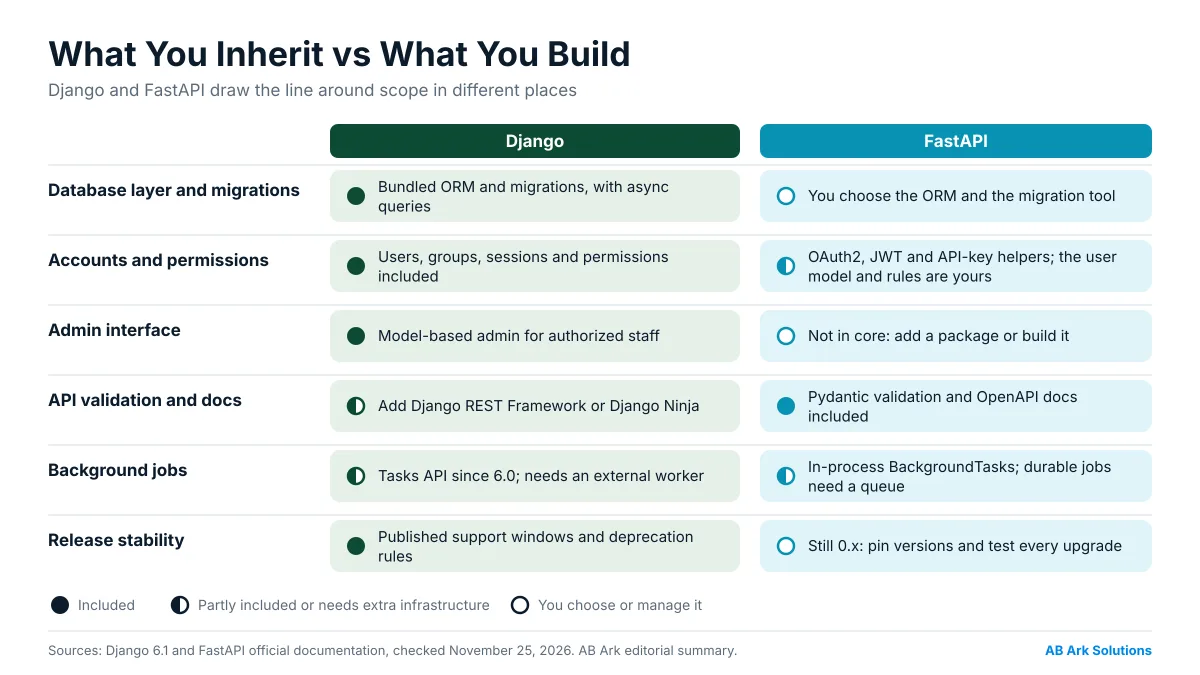 To use this in practice, list the capabilities in Figure 1 that your product needs in its first year and estimate the build and maintenance cost of each one you would supply yourself. Estimate the admin and the permission model first, because both are easy to leave out of the initial scope and expensive to add later.
Is FastAPI Faster Than Django?
FastAPI can handle more concurrent requests than a synchronous Django deployment when endpoints spend most of their time waiting on databases, model APIs or other services, and the code does not block. A framework-only benchmark does not predict your application’s speed, because database access, serialization, middleware and worker settings usually dominate.
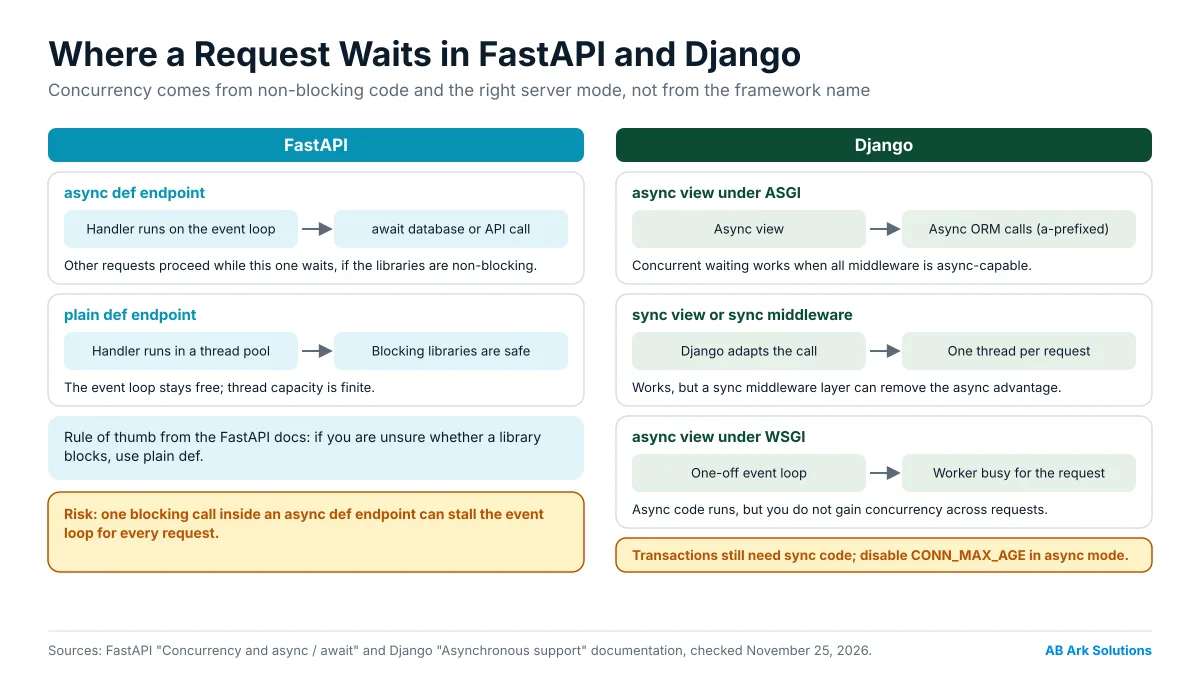
FastAPI’s async documentation states the rule: use async def when your libraries support await, use plain def when they block, and use plain def if you are unsure. Plain def endpoints run in a thread pool, while async def endpoints run on the event loop, so a blocking call inside one can stall other requests.
Django is not synchronous-only. Its async documentation covers async views, a fully async request stack under ASGI, and a-prefixed async variants of QuerySet methods. The limits are specific. Transactions do not yet work in async mode, persistent connections set with CONNMAXAGE should be disabled, and synchronous middleware makes Django keep a thread per request, which can remove the async advantage. An async view under WSGI runs in a one-off event loop and gains no concurrency across requests.
 Published benchmarks add less than they seem to. TechEmpower’s Framework Benchmarks, a widely cited cross-framework test, list FastAPI and Django entries built with different database approaches, including raw queries and a full ORM, in the Round 23 results, and its GitHub repository was archived in March 2026. Comparison articles that quote requests per second often rely on older rounds or the author’s own setup, so treat those figures as a reason to test, not as a result.
How to benchmark Django and FastAPI fairly
A fair test compares equivalent work, not hello-world responses. This six-step plan is an AB Ark editorial method that a team can run in a day:
- Match the data. Use the same database, schema and data volume in both implementations.
- Match the work. Implement the same validation and response shape, including serialization of related records.
- Match the runtime. Use the same ASGI server mode, worker count, container size and connection pool limits.
- Add realistic waiting. Stub an upstream or model API with a fixed delay, because that is where async changes the result.
- Ramp the load. Record p50, p95 and p99 latency, error rate, CPU and memory at each concurrency step.
- Test what you will ship. Repeat with your real middleware and authentication enabled.
Check query counts before blaming the framework. Django 6.1’s fetch modes can reduce many N+1 query patterns to two queries, which can matter more than the framework choice for list endpoints.
Security: What Each Framework Gives You and What You Still Own
Django ships more security controls by default, including CSRF and clickjacking middleware, password hashing and, since Django 6.0, built-in Content Security Policy support. FastAPI provides OAuth2, JWT, HTTP Basic and API-key helpers plus Starlette features, but user storage, permission rules and most hardening choices belong to the team.
Django keeps tightening defaults with each release. Django 6.0 added built-in CSP support with middleware, nonces and settings, and Django 6.1 raised the default PBKDF2 password hasher to 1,500,000 iterations. Django also publishes a deployment checklist covering settings such as DEBUG, allowed hosts and secret keys.
FastAPI’s feature list covers OAuth2 with JWT, HTTP Basic and API-key schemes plus Starlette features such as CORS and session cookies. FastAPI is also still adding protections: its release notes show configurable request body size limits in 0.164.0 and form parsing limits in 0.165.0, both on November 18, 2026. Check what your pinned version enforces, and set limits at the gateway as well.
In either framework you still own:
- Object-level authorization, meaning who may see or change each record.
- Secrets management and dependency updates.
- Rate limiting and abuse controls.
- Which database fields each API endpoint exposes.
Stability and Upgrades: Which Framework Costs More to Keep Current?
Django costs less to keep current in predictable ways, because it publishes support windows and a deprecation policy. FastAPI is still on 0.x versions, and its release notes flag breaking changes in minor releases, so teams need version pinning and an upgrade routine.
Django’s annual release cycle announcement lists Django 6.2 LTS for April 2027, with extended support through April 2030. From January 2028, Django moves to one release a year, each supported for three years, and the commitments for 5.2 LTS and 6.2 LTS stand. Its release process keeps deprecation shims for at least two feature releases, though it notes that a release can still carry a few documented backwards incompatibilities. The ecosystem is steady too: in the 2026 Django Developers Survey of about 3,500 respondents, PostgreSQL has been the database of choice for 76% to 79% of developers for five consecutive years.
FastAPI’s release 0.165.0 shipped on November 18, 2026. Counting the release-note headings, AB Ark found 16 releases labeled “Breaking Changes” between January 1 and November 18, 2026, ten of them in the six days from October 18 to 23. Examples include 0.151.0, which now treats a JSON null differently from an omitted value, and 0.162.6, which dropped Python 3.10 support.
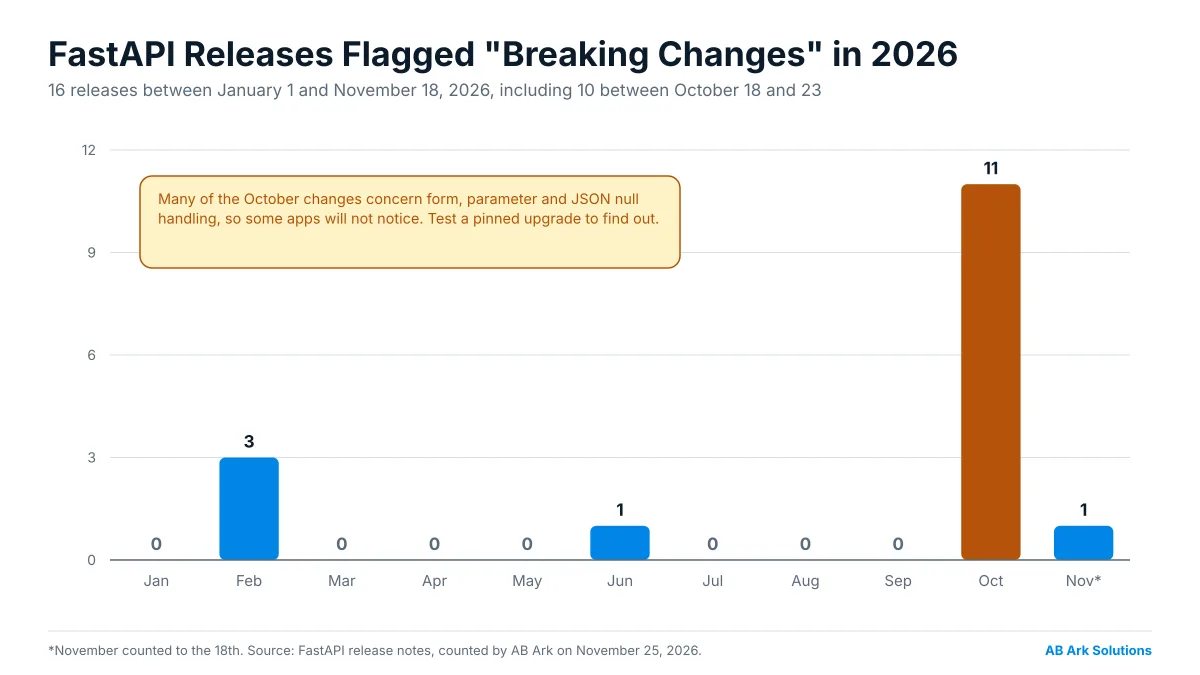 Many of the October changes concern form, parameter and JSON null handling, so some applications will not notice them. You can only know by testing. None of this makes FastAPI unfit for production; it makes upgrades a scheduled task. A workable routine is to pin the exact version, read the release notes before each bump, run contract tests against your OpenAPI schema, and upgrade monthly in small steps instead of once a year in a large one.
Django vs FastAPI for AI and LLM Backends
Both can serve AI features. FastAPI is the more common starting point for model-serving and streaming APIs because it is async-first and documents Server-Sent Events, while Django fits AI features inside a larger product that already needs accounts, an admin and relational data. In either, heavy inference should run outside the request worker.
Most LLM features are I/O-bound: the backend sends a prompt to a model API and waits. Async code helps in either framework. Local inference is different. It is CPU or GPU work, and it belongs in a worker process or model server, not inside a request handler. FastAPI’s Background Tasks docs make the same point for heavy background computation.
FastAPI documents Server-Sent Events, which suits streaming model output to a browser token by token. Django supports async views and streaming responses, and its async documentation covers handling client disconnects in long-lived requests.
A common split is Django for users, billing, prompts and configuration, with a FastAPI gateway for streaming inference. AB Ark’s guide to hiring FastAPI developers explains why many FastAPI roles also involve AI integration. If the AI feature is the core of your product, start with AI engineers rather than backend generalists.
When to Choose Django, FastAPI or Both
Choose Django for data-heavy products with accounts and staff workflows, FastAPI for API-first services with typed contracts and high I/O concurrency, and both when a Django product needs a focused high-concurrency or AI service. The table maps common scenarios to a starting point.
| Scenario | Starting point | Why |
|---|---|---|
| SaaS product with customer accounts, billing and a staff back office | Django | Accounts, ORM, migrations and admin are inherited, so effort goes into product logic. |
| Marketplace or portal with relational data and moderation | Django | Relational models, permissions and a moderation admin share one set of conventions. |
| Internal tool where operations staff correct records | Django | The model-based admin covers record editing without custom screens. |
| Backend for a mobile app or single-page app with no staff UI | FastAPI (or Django with Ninja or DRF) | Typed contracts and OpenAPI docs support client generation and clear errors. |
| Microservice that other services call | FastAPI | A small surface and an OpenAPI contract keep ownership clear. |
| Model-serving or LLM gateway with streaming responses | FastAPI | Async handling and documented Server-Sent Events fit token streaming. |
| Existing Django product that needs a few high-concurrency or AI endpoints | Both | Extract a bounded FastAPI service, or add Django Ninja inside the existing app. |
| Long-lived, regulated system with a small team | Django | Published support windows and fewer libraries to choose and upgrade. |
Get a Custom Quote for Your Python Backend Team →
Can You Use Django and FastAPI Together?
Yes. Three patterns work in practice: run a FastAPI service beside a Django core, add Django Ninja inside Django for Pydantic-style APIs, or mount a Django app inside FastAPI. The first is the easiest to reason about.
- Django core with a separate FastAPI service. Each deploys on its own. They talk over HTTP or a queue, and the OpenAPI schema is the contract.
- Django Ninja inside Django. You keep the ORM, admin and authentication and gain type-hint validation and OpenAPI docs. For an existing Django team that wants a FastAPI-style developer experience, this is usually the lowest-risk option.
- Django mounted inside FastAPI. FastAPI’s docs include a guide to including WSGI apps such as Django. It can help during a gradual migration, but it puts two frameworks, two sets of middleware and one deployment in the same process, so treat it as a bridge rather than an end state.
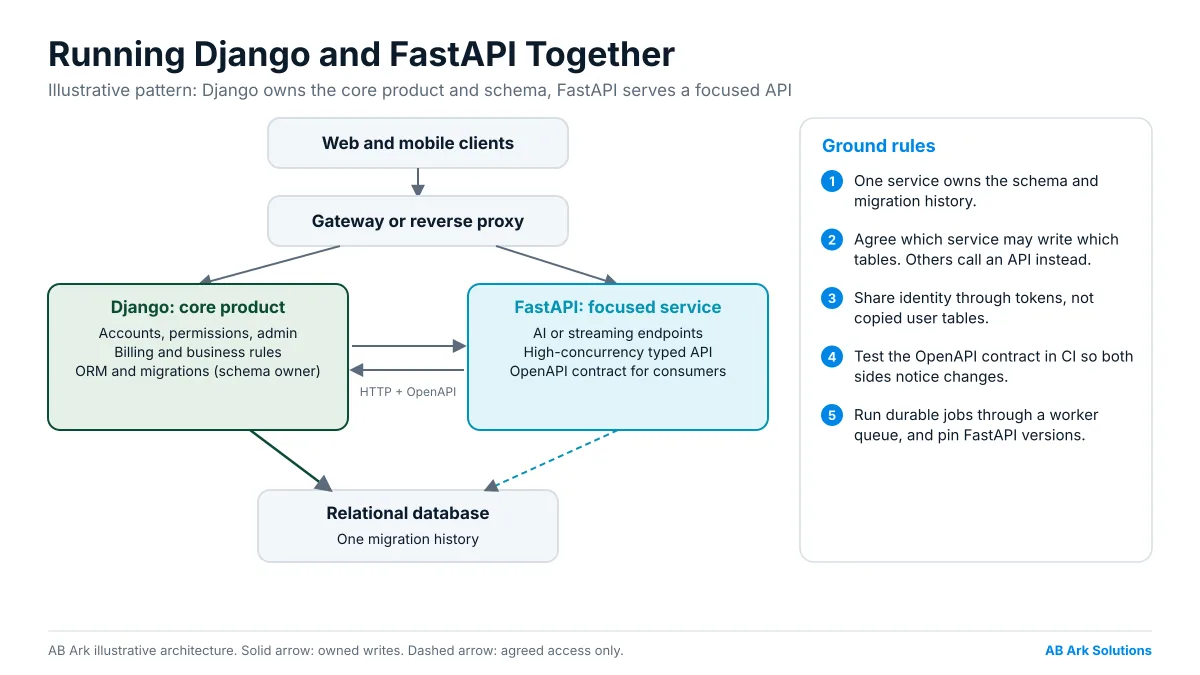
The failure mode is shared database writes without ownership. Two services changing the same tables lead to migration conflicts and to business rules that one service silently bypasses. Decide which service owns each table before the second service ships.
A Seven-Question Fit Check for Django vs FastAPI
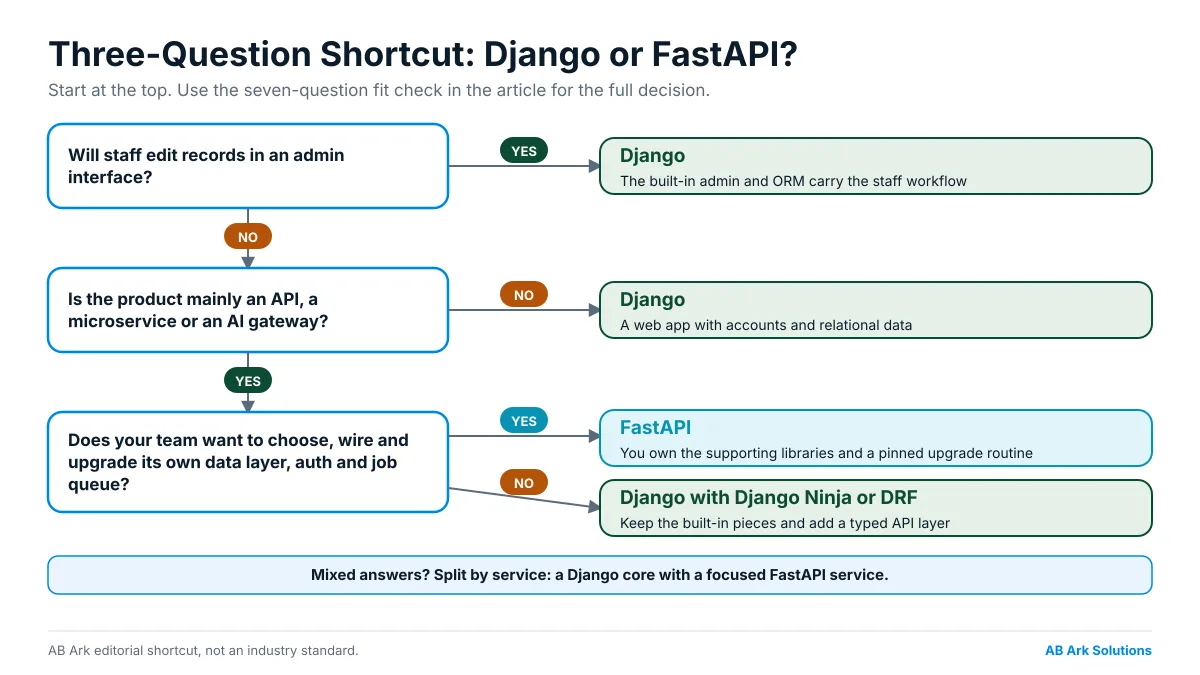
Answer seven questions about the product, the team and the lifespan of the system. Five or more answers on one side point to that framework. A split of three to four points to separate services or to your team’s strongest skills. This is an AB Ark editorial framework, not an industry standard.
| # | Question | Leans Django if | Leans FastAPI if |
|---|---|---|---|
| 1 | Do non-developers edit data? | Yes: staff need an admin interface | No staff interface is needed |
| 2 | What is the product? | A web app with accounts, billing and relational data | An API, microservice or AI gateway |
| 3 | Who calls it? | Browsers and staff, with an API on the side | Other software: apps and services |
| 4 | Where does request time go? | Database work and business logic | Waiting on upstream APIs or model calls |
| 5 | Who maintains the stack? | A small team that wants fewer choices | A team that can own library choices and upgrades |
| 6 | How long will it live? | Long-lived and upgrade-averse, for example regulated | A fast-moving or replaceable service |
| 7 | What does the team already know? | Django conventions | Async Python and type hints |
What Changes for Hiring and Team Cost
Django and FastAPI hires share Python, but the skills that matter differ. Django roles lean on ORM performance, migrations, security settings and upgrades, while FastAPI roles lean on async correctness, Pydantic validation, database access and deployment.
AB Ark’s hiring guides cover how to test and price each profile: see how to hire Django developers and how to hire FastAPI developers. Framework choice also changes team shape. A Django product often needs one or two strong full-stack Python engineers who own models, migrations and the admin. A platform with several FastAPI services usually needs stronger platform skills: API contracts, observability, deployment and a shared standard for data access.
AB Ark states on its Python developer page that developers are available on hourly, part-time, monthly and project-based terms and can be onboarded within 48 to 72 hours after requirements are finalized. For a new product without an in-house backend lead, a dedicated development team usually fits better than adding single developers. If you already have a tech lead, staff augmentation can add Django or FastAPI engineers to that team.
How to Migrate Between Django and FastAPI Without a Rewrite
Migrate only when a measured requirement justifies it. A full rewrite from Django to FastAPI discards the ORM, migrations, admin and permission model Django already provides, so extracting one bounded API into a FastAPI service usually carries less risk.
- Measure first. Profile the endpoints that miss latency or concurrency targets. Do not migrate on a hunch.
- Try cheaper fixes. Move to ASGI, use async views for I/O-bound endpoints, and fix N+1 queries before changing frameworks.
- Define the contract. Write the OpenAPI schema for the endpoints you plan to move.
- Extract one bounded service. Leave authentication, the admin and the schema in Django, and give the FastAPI service an API or agreed tables.
- Run both in parallel. Mirror traffic and compare responses and latency before you cut over.
- Move traffic gradually. Keep a rollback path until the new service has run through a full release cycle.
The reverse move is rarer but real. A FastAPI team that finds itself hand-building an admin, user management and migration tooling should consider adding Django for the back office instead of extending the custom code.
A Note on Proof
AB Ark’s Python developer page lists Django, Flask and FastAPI among the frameworks its engineers work with, and the case studies page documents delivered web, AI and software products. None of the case-study summaries we reviewed names Django or FastAPI as the framework behind a result, so this guide does not attribute any project outcome to either framework.
FAQs
Is FastAPI better than Django?
Neither is better in general. FastAPI suits API-first services, AI endpoints and high I/O concurrency, while Django suits products that need an ORM, accounts and an admin out of the box. Choose by scope and team capacity. The seven-question fit check above turns that into a repeatable decision.
Is FastAPI faster than Django?
It can be for I/O-bound endpoints written with non-blocking code, but Django also supports async views and an async ORM interface under ASGI. Database access, middleware and worker settings often decide the result, so benchmark equivalent work in your own environment before treating speed as a deciding factor.
Can you use Django and FastAPI together?
Yes. Common patterns are a FastAPI service beside a Django core, Django Ninja inside Django, or Django mounted inside FastAPI during a migration. Keep one service as the owner of the database schema and migrations, and agree which service may write each table.
Which is better for AI and machine learning projects?
FastAPI is a frequent choice for model-serving and streaming APIs because it is async-first and documents Server-Sent Events. Django fits when AI features sit inside a product that also needs accounts, an admin and relational data. In both, run heavy inference in a worker or model server, not in the request handler.
Should I migrate my Django app to FastAPI?
Only if you have measured a problem that FastAPI would solve. Try ASGI, async views and query fixes first. If a rewrite is still justified, extract one bounded API into a FastAPI service and keep Django’s authentication, admin and schema until the new service proves itself.
Choosing Between Django and FastAPI
Choose Django when your product needs a relational data model, accounts and a staff admin, and you want published support windows. Choose FastAPI when you are building API-first or AI services and can own the data layer, authentication and a pinned upgrade routine. Choose both when a Django core needs a focused service, and give one service ownership of the schema.
AB Ark provides vetted Python developers and AI engineers for Django products, FastAPI services and the migrations between them, on hourly, part-time, monthly or project-based terms.
The right framework is the one whose missing pieces your team is ready to own: choose Django if you would rather inherit them, and FastAPI if you would rather select them.
Schedule a Free Consultation Call →
Head Of Engineering Department